Thank You for Your Inquiry_Price List Enclosed Template

Free Word download β€’ Edit online β€’ Save & share with Drive β€’ Export to PDF

1 pageβ€’20–30 min to fillβ€’Difficulty: Standardβ€’Signature requiredβ€’Legal review recommended
Learn more ↓
FreeThank You for Your Inquiry_Price List Enclosed Template

At a glance

What it is
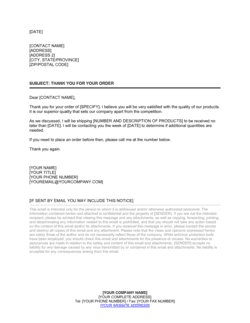
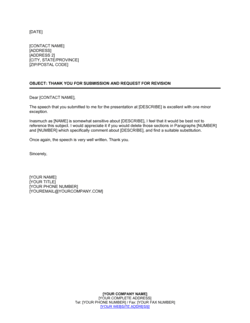
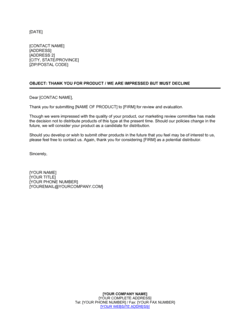
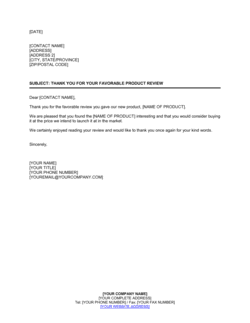
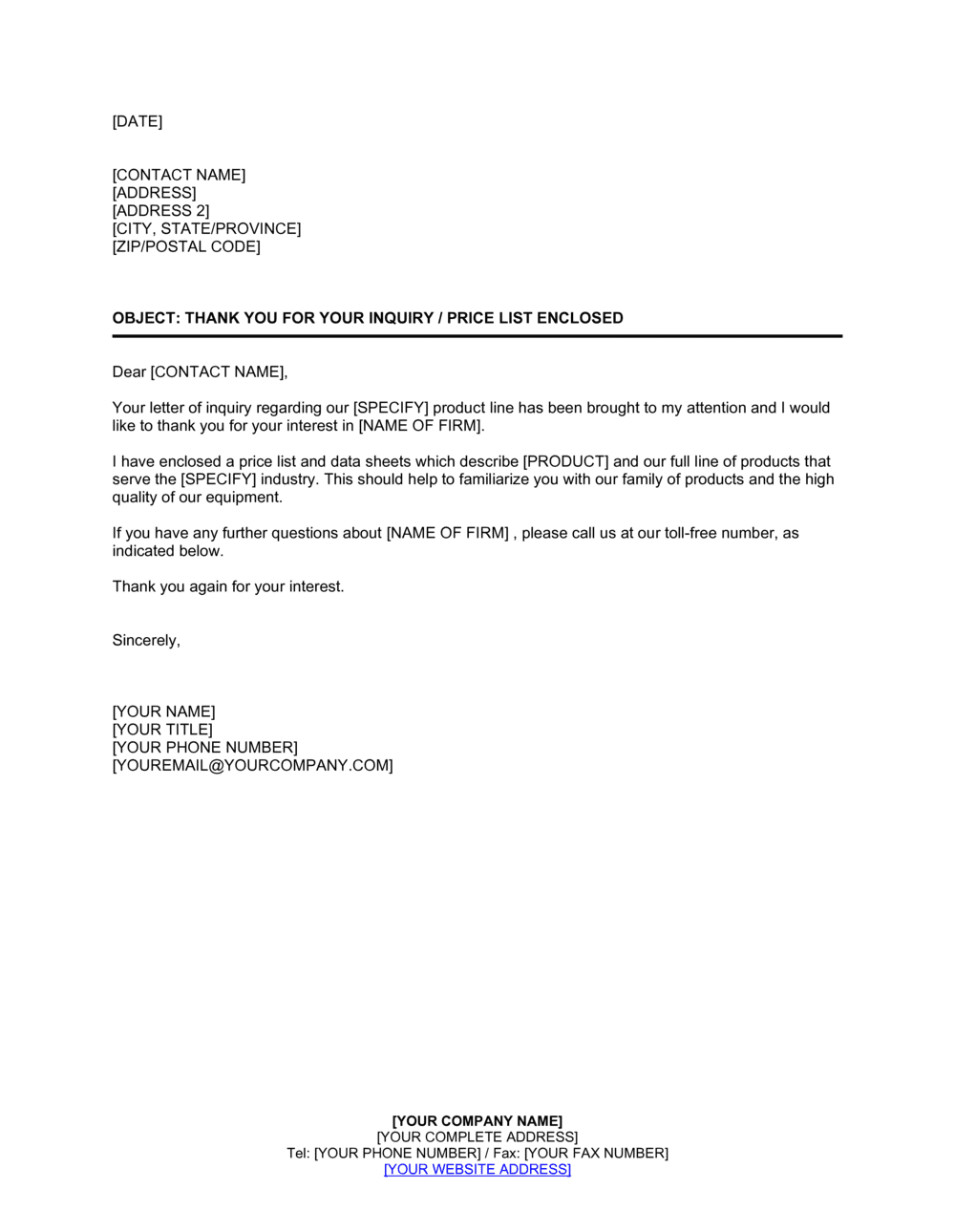
A Thank You For Your Inquiry Price List Enclosed letter is a formal business communication sent to a prospective customer or client who has requested pricing information. It acknowledges the inquiry, expresses appreciation, and presents an attached price list along with any relevant terms, conditions, or next steps. This free Word download is fully editable online and can be exported as PDF for immediate dispatch by mail or email.
When you need it
Use it whenever a prospect, buyer, or business contact submits a request for pricing β€” whether by phone, email, web form, or in person at a trade event. It is especially important when the price list carries terms that govern any subsequent order or contract, making a signed or acknowledged cover letter part of the commercial record.
What's inside
Opening acknowledgment of the inquiry, expression of thanks, summary of the enclosed price list and its effective date, reference to applicable terms and conditions, an invitation to follow up, and a professional closing with signature block. Together, these elements create a documented, professional exchange that supports downstream order processing and dispute resolution.

What is a Thank You For Your Inquiry Price List Enclosed Letter?

A Thank You For Your Inquiry Price List Enclosed letter is a formal business communication sent to a prospective customer, buyer, or trade contact who has requested pricing information about a company's products or services. It performs two functions in a single document: it acknowledges the inquiry and expresses appreciation for the recipient's interest, and it transmits an attached price list along with the commercial terms β€” validity period, payment conditions, and any applicable discounts β€” that govern orders placed in response. The letter creates a dated, signed record of the price communication, which is essential when the price list will later be referenced in an order, invoice, or supply contract.

Why You Need This Document

Responding to a pricing inquiry with a raw price list attachment and no cover letter leaves significant commercial and legal gaps. Without a signed, dated cover letter, you have no documented record of when prices were communicated, which version of the price list was sent, or whether your terms and conditions were incorporated into the exchange. If a buyer places an order three months later citing prices that have since changed, the absence of a validity clause in your cover letter can leave you with limited grounds to refuse. A professionally drafted price list letter establishes the terms of the communication β€” effective date, price validity window, governing terms, and confidentiality obligations β€” before any order is placed, reducing the risk of pricing disputes, unauthorized price-list redistribution, and ambiguity about which commercial terms apply. This template gives you a complete, editable letter ready to personalize and dispatch in under 15 minutes.

Which variant fits your situation?

If your situation is…Use this template
Responding to a wholesale or trade buyer requesting bulk pricingWholesale Price List Cover Letter
Following up a sales call where pricing was promisedSales Follow-Up Letter with Price List
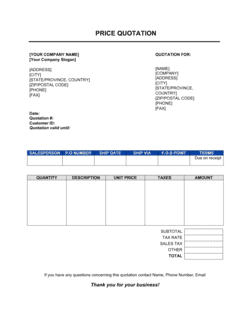
Sending pricing as part of a formal quotationPrice Quotation Letter
Delivering a formal bid in response to an RFQRequest for Quotation Response
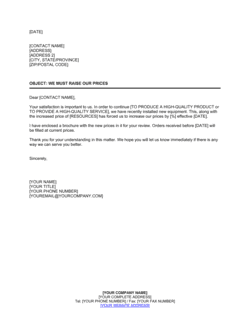
Updating existing customers about revised pricingPrice Increase Notification Letter
Presenting a service fee schedule to a prospective clientService Rate Card Cover Letter
Responding to a retail buyer's product inquiry with catalog and pricingProduct Catalog and Price List Letter

Common mistakes to avoid

❌ No price validity period stated

Why it matters: Without a defined validity period, a buyer who places an order three months later can argue the price list constituted a standing offer still in effect, potentially binding you to obsolete pricing.

Fix: Always include an explicit validity clause stating the number of days the prices are guaranteed and the calendar expiry date β€” 30 to 90 days is standard practice.

❌ Sending a price list without referencing terms and conditions

Why it matters: A price list delivered without a terms reference creates a partial agreement β€” prices are known, but payment terms, delivery conditions, and return policies are not incorporated, leaving major commercial gaps.

Fix: Include a clause in the letter body that names your standard terms document and states that all orders are subject to those terms, with a location (URL or enclosure) where they can be reviewed.

❌ Using a generic or unsigned cover letter

Why it matters: An unsigned or templated letter with no named sender signals a mass mailing rather than a considered commercial response, reducing the perceived credibility of the price list and the company behind it.

Fix: Personalize the letter to the specific inquiry, name the sales representative responsible for the account, and ensure the letter is signed before dispatch.

❌ Omitting confidentiality language on negotiated pricing

Why it matters: Proprietary or negotiated price lists shared without a confidentiality notice can be forwarded to competitors or used by the buyer as leverage with other suppliers, damaging your pricing strategy.

Fix: Add a brief confidentiality notice stating that the enclosed pricing is provided in commercial confidence for the named recipient only and may not be shared with third parties.

❌ Failing to specify currency and tax treatment

Why it matters: An international buyer receiving a price list that does not state the currency or whether prices include VAT, GST, or sales tax will either delay a response for clarification or place an order based on an incorrect assumption, creating billing disputes.

Fix: State the currency code (USD, CAD, GBP, EUR) and whether prices are exclusive or inclusive of applicable taxes immediately after listing the price document reference.

❌ Not retaining a signed copy of the dispatched letter

Why it matters: If an order dispute arises over which price list governed the transaction, you need a retrievable copy of the exact letter and price list you sent, signed and dated, as documentary evidence.

Fix: Store a countersigned or archived copy of every dispatched price list letter in your CRM or document management system, linked to the customer record and the resulting order.

The 9 key clauses, explained

Salutation and inquiry reference

In plain language: Opens the letter by addressing the recipient by name and referencing the specific inquiry β€” date, method of contact, or inquiry number β€” to establish a clear paper trail.

Sample language
Dear [RECIPIENT NAME], Thank you for your inquiry dated [DATE] regarding our [PRODUCT/SERVICE CATEGORY]. We are pleased to respond and have enclosed our current price list for your review.

Common mistake: Using a generic 'Dear Customer' salutation instead of the recipient's name. An impersonal opening signals a mass mailing and reduces the credibility of the accompanying price list.

Expression of thanks and company introduction

In plain language: Briefly thanks the recipient for their interest and, if this is a first contact, introduces the company and its core value proposition in one to two sentences.

Sample language
[COMPANY NAME] has provided [PRODUCT/SERVICE] to businesses in [INDUSTRY/REGION] since [YEAR]. We appreciate the opportunity to present our pricing and look forward to supporting your needs.

Common mistake: Writing a three-paragraph company history instead of a two-sentence positioning statement. Buyers want the price list, not a brand story β€” bury long introductions and the recipient may never reach the terms.

Description of the enclosed price list

In plain language: Identifies the price list by name or document reference number, states its effective date, and summarizes the categories or product lines it covers.

Sample language
Please find enclosed Price List [PL-YYYY-NNN], effective [DATE], covering [PRODUCT CATEGORIES]. All prices are stated in [CURRENCY] and are exclusive of applicable taxes unless otherwise noted.

Common mistake: Failing to state the effective date of the price list. Without one, the seller cannot defend the prices as current if an order arrives weeks later citing prices that have since changed.

Price validity and expiry clause

In plain language: States the period during which the listed prices are guaranteed and will not change, and what happens when the validity period expires.

Sample language
Prices listed are valid for [30/60/90] days from the date of this letter. [COMPANY NAME] reserves the right to revise pricing after [EXPIRY DATE] with [X] days' written notice.

Common mistake: Omitting a validity period entirely, leaving the price list open-ended. This can create a binding offer in some jurisdictions if the recipient places an order months later and argues the letter constituted a standing offer.

Terms and conditions reference

In plain language: Directs the recipient to the company's standard terms and conditions β€” payment terms, delivery, returns, and minimum orders β€” either enclosed or available at a stated URL.

Sample language
All orders are subject to [COMPANY NAME]'s Standard Terms and Conditions of Sale, a copy of which is enclosed / available at [URL]. By placing an order, [BUYER NAME] agrees to be bound by those terms.

Common mistake: Describing terms in the letter body instead of referencing a separate terms document. Summarizing terms in a cover letter invites disputes about which version governs if the full terms say something different.

Discount and pricing tier disclosure

In plain language: If applicable, discloses any volume discounts, tiered pricing, or promotional rates and the conditions that unlock them, so the buyer understands the full pricing structure.

Sample language
Orders of [X] units or more qualify for a [Y]% volume discount. Promotional pricing indicated in the enclosed list is available through [DATE] only and is not combinable with other discounts.

Common mistake: Quoting a discounted price verbally or by email, then sending a price list that shows only list prices. The discrepancy creates a contractual ambiguity about which price governs the order.

Invitation to place an order or schedule a follow-up

In plain language: Provides clear next steps β€” how to place an order, who to contact, and what information the seller needs to process it β€” along with an offer to answer questions.

Sample language
To place an order, please contact [SALES REPRESENTATIVE NAME] at [EMAIL / PHONE], or complete and return the attached order form. We are happy to arrange a call to discuss your specific requirements.

Common mistake: Ending the letter without a call to action. A price list delivered without a clear next step loses its commercial purpose and leaves the prospect to find their own path forward β€” or move to a competitor.

Confidentiality and non-disclosure notice

In plain language: Marks the price list as confidential and commercial-in-confidence, prohibiting the recipient from sharing it with third parties β€” especially important for negotiated or non-public pricing.

Sample language
The pricing information enclosed is provided in confidence for [RECIPIENT NAME / COMPANY] only. It may not be disclosed to third parties or used for any purpose other than evaluating a potential purchase from [COMPANY NAME].

Common mistake: Omitting a confidentiality notice on negotiated price lists. Without one, a buyer may share the pricing with competitors or use it as leverage with other suppliers, undermining your commercial position.

Signature block and date

In plain language: Closes the letter with the sender's printed name, title, company name, date of signature, and contact details, creating the official record of who dispatched the price list and when.

Sample language
Yours sincerely, [SENDER NAME] | [TITLE] | [COMPANY NAME] | [DATE] | [EMAIL] | [PHONE]

Common mistake: Sending the letter unsigned or with only a typed name. An unsigned price list cover letter lacks the authority of a formal business communication and, in some jurisdictions, may not constitute a legally effective dispatch.

How to fill it out

  1. 1

    Enter the date, sender, and recipient details

    Add today's date at the top of the letter, then fill in your full company name, address, and contact details. Enter the recipient's name, title, company, and address in the addressee block.

    πŸ’‘ Use the recipient's full legal name and company name as they appear on the inquiry β€” mismatched names on a commercial letter delay follow-up and can create confusion if the letter is part of a contract chain.

  2. 2

    Reference the original inquiry specifically

    In the opening clause, note the date and method of the inquiry β€” email dated [DATE], phone call on [DATE], or web form submission reference [NUMBER]. This ties the letter to a specific commercial event.

    πŸ’‘ If the inquiry was submitted via a form or CRM with a reference number, include it. That number becomes the thread linking the inquiry, the price list, and any resulting order.

  3. 3

    Identify the enclosed price list by document reference and effective date

    Give the price list a document reference number (e.g., PL-2026-001) and state its effective date clearly in the body of the letter. Confirm the currency and whether prices are inclusive or exclusive of tax.

    πŸ’‘ Assign a new reference number every time you issue a revised price list β€” this prevents disputes about which version of pricing governed an order.

  4. 4

    Set the price validity period

    Insert the number of days the prices are guaranteed β€” 30, 60, or 90 days is standard. Calculate and print the expiry date explicitly so the recipient does not need to do the math.

    πŸ’‘ In commodity or volatile-input industries, use 30-day validity. In stable markets, 60–90 days is acceptable and reduces the friction of repeated re-quoting.

  5. 5

    Reference your standard terms and conditions

    Name the terms document, state where it can be found (enclosed or URL), and include the binding language confirming that orders are governed by those terms.

    πŸ’‘ If your terms are available on your website, add the exact URL and note the date the terms were last updated β€” this protects against a buyer claiming they could not find them.

  6. 6

    Add any applicable discount or tier information

    If the recipient qualifies for volume pricing, promotional rates, or a negotiated discount, state the conditions clearly and reference where they appear on the price list.

    πŸ’‘ Never reference a discount verbally and then send a list without it. If a special price was discussed, annotate the price list directly and reference that annotation in the letter.

  7. 7

    Write a clear call to action with contact details

    Tell the recipient exactly how to proceed β€” place an order, schedule a call, or return a completed order form. Include the name and direct contact of the person handling the account.

    πŸ’‘ Personalize this to the sales representative handling the inquiry β€” routing responses to a generic inbox introduces delay and reduces conversion rates.

  8. 8

    Sign and dispatch with the price list attached

    Sign the letter, scan or export as PDF alongside the price list, and send as a single combined document or clearly linked attachment. Retain a copy of the signed letter and price list in your CRM or document system.

    πŸ’‘ Send the combined package as a single PDF rather than two separate files. A single file is harder to separate, keeps the cover letter with the price list in the recipient's records, and looks more professional.

Frequently asked questions

What is a thank you for your inquiry price list enclosed letter?

It is a formal business letter sent to a prospective customer or buyer in response to their request for pricing information. The letter acknowledges the inquiry, thanks the recipient for their interest, and presents an attached price list along with the applicable terms, validity period, and next steps for placing an order. It serves as both a professional courtesy and a documented commercial communication that supports downstream contracting and order processing.

Is a price list cover letter legally binding?

In most jurisdictions, a price list is an invitation to treat rather than a binding offer β€” meaning the seller is presenting prices for consideration but retaining the right to accept or decline any resulting order. However, if the cover letter uses language that constitutes a firm offer to sell at stated prices with defined validity, it may create binding obligations. Including a clear validity clause and a statement that orders are subject to acceptance by the seller helps preserve the invitation-to-treat status.

Why should I include a validity period on the price list?

A validity period defines the window during which the listed prices are guaranteed and protects you from being held to outdated pricing if a buyer delays placing an order. Without one, a buyer may place an order months later at prices that are no longer commercially viable, and you may have limited grounds to refuse without creating a dispute. A 30-to-90-day window is standard for most industries and gives buyers sufficient time to make a purchasing decision.

Do I need to include terms and conditions with the price list?

Yes. A price list without terms and conditions is commercially incomplete β€” it confirms what things cost but not when payment is due, how delivery works, what the return policy is, or what minimum orders apply. Referencing your standard terms in the cover letter and enclosing or linking to them ensures every element of the commercial relationship is covered. Courts in most jurisdictions will look to the terms referenced at the time of the price list dispatch when interpreting subsequent orders.

Can I send this letter by email instead of post?

Yes, email delivery is standard practice and accepted in all major jurisdictions for commercial correspondence of this type. Attach the signed cover letter as a PDF together with the price list, rather than pasting the letter text into the email body. This ensures the signed, dated letter remains part of the document record and travels with the price list even if the email is forwarded or printed by the recipient.

What is the difference between a price list letter and a quotation?

A price list letter transmits a general schedule of prices applicable to any order within the validity period β€” it is not tailored to a specific quantity or specification. A quotation is a specific offer for a defined scope: a set quantity, delivery date, and configuration, priced individually. Use a price list letter to respond to general pricing inquiries and a formal quotation when a buyer has provided enough detail to price a specific requirement.

Should the price list letter be signed?

Yes. A signed cover letter establishes who dispatched the price list, on what date, and with what authority. This matters if a dispute arises later about which price list governed an order or whether the terms were properly communicated. In some jurisdictions and industries, an unsigned commercial letter may be given less weight as documentary evidence than a signed one. At minimum, include a typed signature block with the sender's name and title.

How do I handle confidential or negotiated pricing in the letter?

Include a confidentiality notice in the letter body stating that the pricing is provided in commercial confidence for the named recipient only. Mark the price list itself as confidential in the document header. If the pricing reflects a negotiated arrangement rather than standard list prices, note this in the letter and specify that the prices are not transferable to third parties or combinable with other offers. This protects your pricing strategy and provides grounds to challenge any unauthorized use.

What details should the signature block include?

The signature block should include the sender's handwritten or electronic signature, printed full name, job title, company name, date of signing, direct email address, and phone number. For letters dispatched on behalf of a company, the signatory should have authority to issue commercial pricing β€” typically a sales manager, account executive, or director. Including contact details directly in the signature block reduces the friction for the recipient to follow up and place an order.

How this compares to alternatives

vs Price Quotation Letter

A price quotation is a specific offer for a defined scope β€” a named quantity, configuration, and delivery date β€” priced for that request only. A price list letter transmits a general schedule applicable to all orders within a validity period. Use a quotation when the buyer has provided full specifications; use a price list letter for general inquiries where the scope is not yet defined.

vs Price Increase Letter

A price increase letter notifies existing customers of an upward revision to prices they are already paying under an existing arrangement. A price list enclosed letter responds to a new inquiry with current pricing. One manages an existing relationship; the other initiates a prospective one.

vs Sales Proposal

A sales proposal presents a tailored solution to a specific customer need, including pricing, implementation scope, timelines, and ROI arguments. A price list letter simply transmits pricing for general review. Use a proposal when the buyer has a complex or high-value requirement; use a price list letter for commodity or catalog inquiries.

vs Product Catalog Cover Letter

A product catalog cover letter accompanies a full product catalog and focuses on product range, features, and availability. A price list enclosed letter focuses on pricing terms, validity, and conditions of sale. Both may be sent together, but they serve distinct purposes β€” the catalog informs; the price list letter commits to commercial terms.

Industry-specific considerations

Manufacturing and Wholesale

Tiered pricing by unit volume, FOB shipping terms, and minimum order quantities are central to the letter and must be clearly linked to the enclosed price schedule.

Professional Services

Rate cards for consulting, legal, or accounting services require a validity clause and a note that rates are subject to revision based on scope changes or annual reviews.

Retail and E-commerce

Wholesale buyers expect pricing net of suggested retail prices, with margin guidance and promotional pricing windows noted alongside standard list prices.

Technology and SaaS

Software and subscription pricing letters often reference a separate pricing page URL and must address currency, billing frequency, and whether enterprise discounts require a separate negotiation.

Jurisdictional notes

United States

Under the UCC (Uniform Commercial Code), a price list is generally treated as an invitation to deal rather than a binding offer, meaning the seller can decline an order even after sending the list. However, if the letter uses language that constitutes a firm offer β€” specifying quantity and a definite time period β€” it may be irrevocable under UCC Article 2. State consumer protection laws in California, New York, and Texas may impose additional disclosure obligations on price lists for consumer-facing businesses.

Canada

Canadian contract law treats a price list as an invitation to treat in most provinces, consistent with common-law principles. In Quebec, the Civil Code provides a distinct framework where a public offer to sell may be binding if it specifies the essential elements of the sale. Consumer protection legislation in provinces such as Ontario and British Columbia requires that advertised prices be accurate and that any limitations on pricing be clearly disclosed. French-language requirements apply in Quebec for commercial documents distributed to Quebec-based recipients.

United Kingdom

English and Scots law firmly categorizes a price list as an invitation to treat following the principle established in Pharmaceutical Society of GB v Boots. The seller is under no obligation to accept an order placed at listed prices unless and until they do so explicitly. The Consumer Rights Act 2015 and Consumer Contracts Regulations 2013 impose obligations on businesses selling to consumers, including the right to withdraw from a contract if prices are misstated. VAT treatment must be clearly indicated on price lists β€” whether prices are exclusive or inclusive of 20% VAT.

European Union

EU member states generally treat price lists as invitations to treat under their national contract law frameworks, though the specific rules vary by country. The EU's Omnibus Directive and Price Indications Directive require traders to display the lowest price applied in the 30 days before any discount claim and to present prices clearly inclusive of taxes for consumer transactions. GDPR considerations arise where a price list letter includes personalized pricing based on customer data β€” such profiling must comply with applicable lawful basis and transparency requirements. Cross-border B2B price lists in the EU should state whether prices are subject to applicable national VAT or reverse-charge mechanisms.

Template vs lawyer β€” what fits your deal?

PathBest forCostTime
Use the templateSmall businesses and sales teams responding to routine pricing inquiries for standard products or servicesFree10–15 minutes per letter
Template + legal reviewBusinesses sending negotiated or confidential pricing, or operating in industries with regulated pricing disclosure requirements$150–$400 for a one-time legal or commercial review of the template1–2 business days
Custom draftedHigh-value wholesale agreements, international distributors, or situations where the price list will be incorporated into a formal supply contract$500–$2,000+3–7 business days

Glossary

Price List
A formal document itemizing the prices a seller charges for specific products or services, often including unit prices, minimum order quantities, and effective dates.
Inquiry
A formal or informal request from a prospective buyer asking for product, service, or pricing information before committing to a purchase.
Effective Date
The date from which prices on the enclosed list are valid and applicable to orders placed by the recipient.
Terms and Conditions
The contractual rules governing a sale β€” payment terms, delivery lead times, return policies, and minimum order requirements β€” referenced in or attached to the cover letter.
Acknowledgment
Written confirmation that a communication, request, or document has been received and is being acted upon.
Price Validity Period
The defined window β€” e.g., 30 or 60 days β€” during which the quoted or listed prices are guaranteed and will not be subject to unilateral change.
Net Price
The final price after all applicable discounts, rebates, or allowances have been deducted, before tax is added.
FOB (Free On Board)
A shipping term specifying the point at which ownership and risk of goods transfers from seller to buyer, which affects whether freight costs are included in the listed price.
Minimum Order Quantity (MOQ)
The smallest number of units or minimum dollar value a supplier will accept in a single order, often stated in the price list terms.
Offer vs. Invitation to Treat
A legally significant distinction: a price list is typically an invitation to treat β€” not a binding offer β€” meaning the seller can refuse an order even after sending the list, unless the letter creates a firm offer.

Part of your Business Operating System

This document is one of 3,000+ business & legal templates included in Business in a Box.

  • Fill-in-the-blanks β€” ready in minutes
  • 100% customizable Word document
  • Compatible with all office suites
  • Export to PDF and share electronically

Create your document in 3 simple steps.

From template to signed document β€” all inside one Business Operating System.
1
Download or open template

Access over 3,000+ business and legal templates for any business task, project or initiative.

2
Edit and fill in the blanks with AI

Customize your ready-made business document template and save it in the cloud.

3
Save, Share, Send, Sign

Share your files and folders with your team. Create a space of seamless collaboration.

Save time, save money, and create top-quality documents.

β˜…β˜…β˜…β˜…β˜…

"Fantastic value! I'm not sure how I'd do without it. It's worth its weight in gold and paid back for itself many times."

Managing Director Β· Mall Farm
Robert Whalley
Managing Director, Mall Farm Proprietary Limited
β˜…β˜…β˜…β˜…β˜…

"I have been using Business in a Box for years. It has been the most useful source of templates I have encountered. I recommend it to anyone."

Business Owner Β· 4+ years
Dr Michael John Freestone
Business Owner
β˜…β˜…β˜…β˜…β˜…

"It has been a life saver so many times I have lost count. Business in a Box has saved me so much time and as you know, time is money."

Owner Β· Upstate Web
David G. Moore Jr.
Owner, Upstate Web

Run your business with a system β€” not scattered tools

Stop downloading documents. Start operating with clarity. Business in a Box gives you the Business Operating System used by over 250,000 companies worldwide to structure, run, and grow their business.

Start freeΒ Β·Β No credit card required