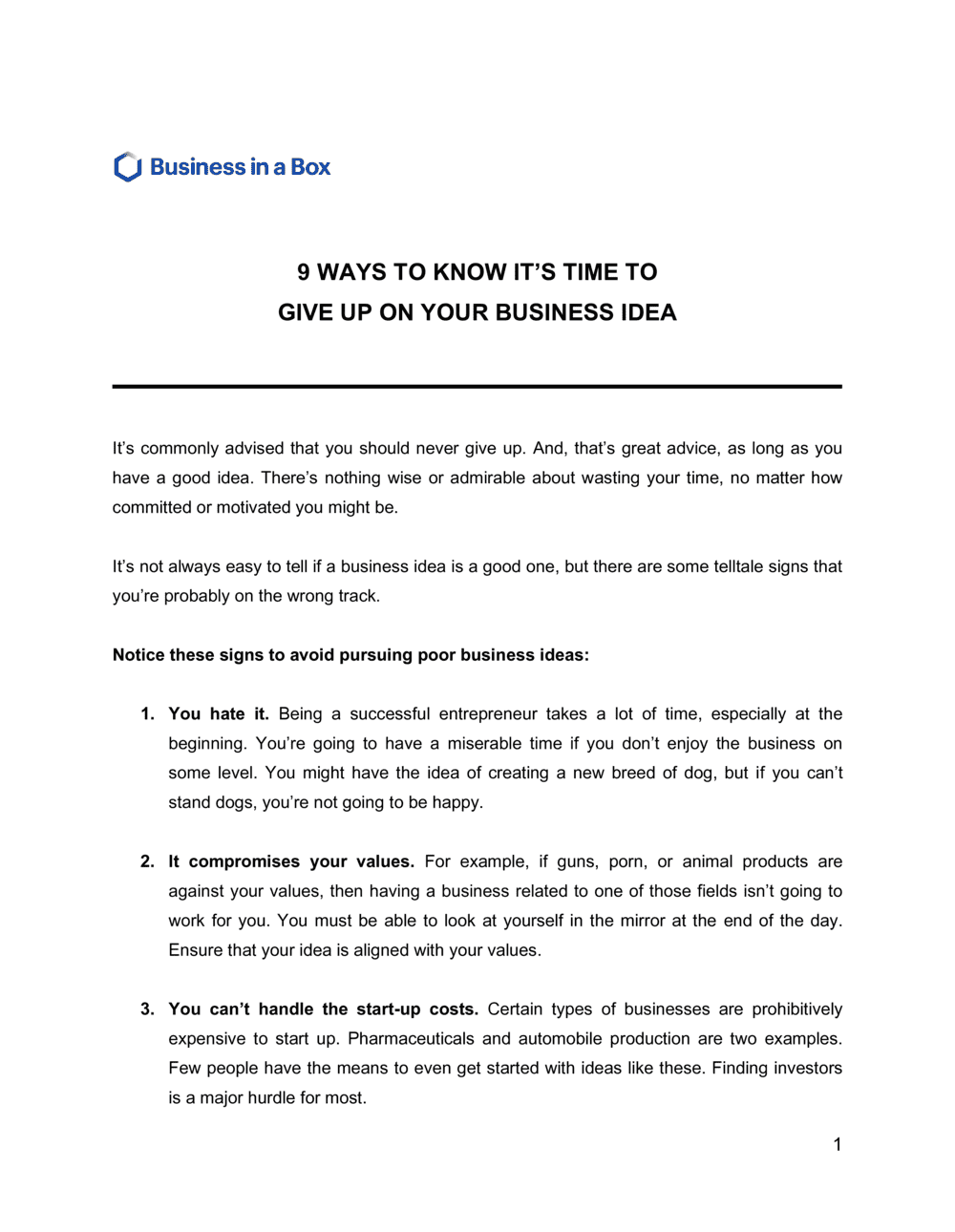
9 Ways To Know It_s Time To Give Up On Your Business Idea

Free to read β€’ Save or share with one click

Free9 Ways To Know It_s Time To Give Up On Your Business Idea Template

At a glance

What it is
"9 Ways To Know It's Time To Give Up On Your Business Idea" is a structured self-assessment guide that walks founders and entrepreneurs through nine evidence-based signals β€” market, financial, operational, and personal β€” that indicate a business idea is unlikely to succeed. This free Word download gives you a repeatable framework to evaluate viability objectively rather than emotionally, and to document your reasoning before making a pivotal decision.
When you need it
Use it when growth has stalled for three or more consecutive months despite genuine effort, when you are considering a major pivot, or when mounting losses are forcing a honest reassessment of whether to continue. It is also useful as a pre-launch screen before committing significant capital to a new idea.
What's inside
Nine diagnostic sections covering market demand, competitive positioning, unit economics, personal motivation, resource availability, customer feedback patterns, team alignment, regulatory or structural barriers, and opportunity cost. Each section includes evaluation criteria, honest self-assessment prompts, and a scoring framework to guide the final decision.

What is "9 Ways To Know It's Time To Give Up On Your Business Idea"?

"9 Ways To Know It's Time To Give Up On Your Business Idea" is a structured self-assessment guide that walks founders and entrepreneurs through nine evidence-based signals β€” spanning market demand, unit economics, competitive positioning, customer feedback, personal motivation, resource availability, team alignment, regulatory barriers, and opportunity cost β€” to determine objectively whether a business idea is worth continuing. Unlike a general strategy review, it is purpose-built to answer a single binary question: should you keep going, pivot, or stop? This free Word download gives you a repeatable diagnostic framework you can complete in a single focused session and share with advisors, co-founders, or investors when a high-stakes decision can no longer be deferred.

Why You Need This Document

Most founders do not quit too early β€” they quit too late, after consuming months of runway, personal savings, and career capital on an idea the evidence turned against long before the decision was made. Without a structured framework, the decision to continue is driven by sunk-cost thinking, emotional attachment, and optimism bias rather than by the signals the market is actually sending. The cost of this delay is concrete: capital that could fund a better idea is gone, team members disengage and leave, and the founder's credibility with investors and advisors erodes with each avoidable missed milestone. This template replaces that emotional loop with a scored, documented assessment that surfaces the real signals, forces the opportunity cost calculation, and produces a written rationale you can stand behind β€” whether the conclusion is to continue with conviction, pivot with a plan, or stop with clarity and move on.

Which variant fits your situation?

If your situation is…Use this template
Assessing a pre-launch idea before spending any moneyBusiness Idea Evaluation Template
Deciding whether to pivot the product rather than shut down entirelyBusiness Pivot Plan
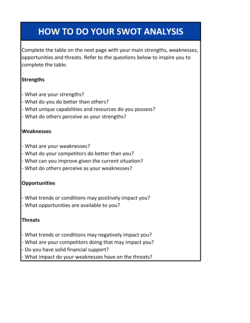
Completing a full strategic review of an existing businessSWOT Analysis
Documenting the wind-down process after deciding to closeBusiness Closure Plan
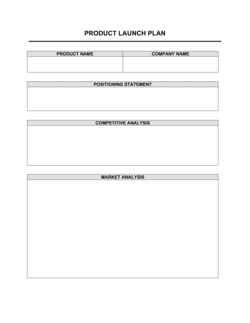
Evaluating a new product line within an existing businessNew Product Launch Plan
Presenting a go/no-go recommendation to a board or investorsExecutive Summary Report
Stress-testing assumptions before a funding roundBusiness Plan

Common mistakes to avoid

❌ Treating sunk costs as a reason to continue

Why it matters: Money, time, and effort already spent are gone regardless of what you decide next. Letting them drive the decision means compounding a loss rather than cutting it.

Fix: Evaluate each signal section based entirely on future expected value. Document past investment separately and explicitly exclude it from the scoring logic.

❌ Conflating customer enthusiasm with validated demand

Why it matters: Enthusiastic prospects who do not pay are not customers β€” they are a leading indicator of a product that sounds good but does not solve a problem urgently enough to justify spending money.

Fix: Accept only paid transactions, signed letters of intent, or deposits as evidence of demand. Strike all other proxies from the assessment.

❌ Skipping the opportunity cost calculation

Why it matters: Without a dollar value on your time and alternatives, the decision defaults to emotional attachment rather than rational comparison β€” systematically biasing the outcome toward continuing.

Fix: Use your last annual salary or the median market rate for your role and skills as the floor for your time's value. Assign it a number and include it in the scoring.

❌ Completing the assessment alone without external input

Why it matters: Founders are subject to strong optimism bias and loss aversion. A solo assessment almost always produces a 'continue' result regardless of the evidence, because the evaluator controls the framing.

Fix: Share the completed assessment with at least one person who has no financial or emotional stake in the outcome and ask them to argue the case for stopping.

❌ Setting no decision deadline before starting the assessment

Why it matters: Without a deadline, the assessment becomes a comfort ritual β€” revisited monthly, never acted on β€” while the business continues to consume resources and the founder's best years.

Fix: Write the decision deadline on the first page of the document before completing any section. Share it with a mentor or advisor to create external accountability.

❌ Applying the assessment to a temporary setback rather than a structural problem

Why it matters: Using a 'give up' framework during a rough quarter rather than a sustained pattern produces false negatives β€” founders abandon viable businesses during normal difficulty cycles.

Fix: Only initiate the assessment after at least three consecutive months of stalled or declining progress, or when a specific structural question (regulatory barrier, competitive threat) demands resolution.

The 9 key sections, explained

Signal 1 β€” No evidence of genuine market demand

Signal 2 β€” Unit economics are structurally negative

Signal 3 β€” Competitive moat does not exist

Signal 4 β€” Customer feedback reveals a fundamental flaw

Signal 5 β€” The founder's motivation has collapsed

Signal 6 β€” Resources required to reach viability are unavailable

Signal 7 β€” Team alignment has broken down irreparably

Signal 8 β€” Regulatory or structural barriers make the market inaccessible

Signal 9 β€” Opportunity cost has become undeniable

How to fill it out

  1. 1

    Set the evaluation date and define the decision deadline

    Record today's date and commit to a specific date by which you will act on the assessment β€” typically 2 to 4 weeks out. A deadline prevents the evaluation from becoming an indefinite loop of reassessment.

    πŸ’‘ Tell a trusted advisor or mentor your decision deadline before you start. External accountability reduces the risk of indefinitely postponing a painful conclusion.

  2. 2

    Complete the market demand section with hard data only

    Pull your actual paid-customer count, conversion rate from prospect to paying customer, and any evidence of repeat purchase or referral. Do not count surveys, waitlist signups, or verbal interest.

    πŸ’‘ If you have fewer than 10 paying customers after 6 months of active selling, treat this section as a red flag regardless of how strong your pipeline looks.

  3. 3

    Calculate unit economics from your actual numbers

    Divide total sales and marketing spend by new customers acquired to get CAC. Multiply average revenue per customer by average relationship length and gross margin to get LTV. Compare the two.

    πŸ’‘ A LTV:CAC ratio below 1.5:1 in a capital-constrained business is typically non-viable without a clear, specific path to improvement β€” not a vague assumption about scale.

  4. 4

    Audit competitive defensibility honestly

    List every way a well-funded competitor could replicate your product in 6 to 12 months. Then list any barriers that would prevent or delay that replication. Be specific β€” 'great team' is not a barrier.

    πŸ’‘ Ask a devil's advocate β€” someone who has not worked on your product β€” to make the case that a large incumbent could copy you. Their answer is usually more accurate than your own.

  5. 5

    Synthesize customer feedback into signal categories

    Categorize every piece of negative feedback from churned customers and declined prospects into: fixable product issues, pricing objections, or fundamental demand problems. Count items in each category.

    πŸ’‘ If more than 40% of negative feedback falls into the 'fundamental demand' category rather than product or pricing, the core premise likely needs to change, not just the execution.

  6. 6

    Score motivation, team alignment, and resource availability

    Use the 1–10 scoring prompts for personal motivation, co-founder alignment, and resource probability. Calculate a composite score and note which signals are in the red zone β€” below 5.

    πŸ’‘ Weight team alignment and founder motivation at 1.5Γ— the other factors β€” execution problems are usually people problems, and no strategy survives a disengaged team.

  7. 7

    Calculate and document the opportunity cost

    Assign an annual dollar value to your time (use your most recent market salary as a floor), list the specific alternatives you are forgoing, and multiply by the remaining commitment period you are considering.

    πŸ’‘ Founders consistently underestimate opportunity cost by 40–60% because they use current income β€” which is zero β€” rather than market value of their skills.

  8. 8

    Make and document the final decision with rationale

    Sum your signal scores, review the red-zone items, and write a 2 to 3 sentence rationale for your decision: continue, pivot, or stop. Store the completed assessment for future reference.

    πŸ’‘ Write the rationale as if explaining your decision to a future version of yourself in 3 years. Clarity now prevents revisiting the same decision repeatedly.

Frequently asked questions

How do you know when to give up on a business idea?

The clearest signal is a sustained pattern β€” not a single bad month β€” where multiple evidence-based indicators point to a structural problem rather than a temporary setback. Specifically: no paying customers after sustained selling effort, unit economics that are negative with no credible path to improvement, a competitive landscape that eliminates your differentiation, and a founder whose motivation has genuinely shifted rather than temporarily dipped. A structured assessment that scores each signal independently and combines them into a composite picture is more reliable than any single data point.

Is giving up on a business idea the same as failing?

No. Deciding to stop pursuing an idea that the evidence shows is unlikely to succeed is a rational, disciplined decision β€” not a failure. The failure mode is continuing to invest time and capital into a structurally broken idea because stopping feels like admitting defeat. Many successful serial entrepreneurs describe their pivots and shutdowns as the decisions that freed them to find the opportunities that actually worked.

What is the difference between pivoting and giving up?

A pivot retains the core insight or technology and changes the application β€” customer segment, channel, pricing model, or product scope β€” based on evidence gathered from the current attempt. Giving up means concluding that neither the current approach nor any reasonable variation of it is likely to produce a viable business. The test is specific: can you articulate a concrete, evidence-based version of the idea that addresses the current failure modes? If yes, pivot. If no, stop.

How long should you try before evaluating whether to quit?

There is no universal timeline, but a useful heuristic for most consumer and B2B products is six months of active, focused selling effort. If you cannot identify 10 paying customers who found measurable value in that window, the signal is worth taking seriously. For capital-intensive or enterprise-sales models with long cycles, 12 to 18 months is a more appropriate evaluation horizon. The key is defining the evaluation criteria before the clock starts β€” not after the result is already clear.

What role does opportunity cost play in the decision to stop?

Opportunity cost is one of the most systematically underweighted factors in a founder's decision to continue. Every month spent on a non-viable idea is a month not spent on the next idea, a career opportunity forgone, or income not earned. Assigning a specific dollar value to your time β€” using your market salary as a floor β€” and multiplying it by the remaining months you are considering committing forces the comparison to be concrete rather than abstract.

Can this assessment be used for an existing business, not just a new idea?

Yes. The nine signals apply equally to an existing business that has stopped growing as to a pre-revenue idea. The market demand, unit economics, competitive moat, and team alignment sections are directly applicable to any business at any stage. For existing businesses, the signal thresholds may differ β€” a business with 100 customers and declining retention requires a different calibration than a business with zero customers β€” but the framework is the same.

Should I complete this assessment by myself?

Not entirely. Founders are subject to strong optimism bias and loss aversion, which consistently skew solo assessments toward continuing. Complete the factual sections β€” unit economics, customer feedback, resource availability β€” on your own, then share the completed document with at least one advisor, mentor, or investor who has no financial stake in the outcome. Ask them specifically to argue the case for stopping and evaluate their arguments on their merits.

What should I do immediately after deciding to stop?

Document the decision and its rationale in writing before taking any action β€” this prevents second-guessing and creates a record for future reflection. Then notify co-founders, advisors, and investors in that order before any public announcement. Review your obligations: customer contracts, employee agreements, investor commitments, and any IP assignments. Consider whether a structured wind-down plan is needed to close cleanly rather than simply stopping activity.

How is this template different from a SWOT analysis?

A SWOT analysis is a broad strategic audit designed to identify strengths, weaknesses, opportunities, and threats across a business β€” useful for ongoing strategy but not designed to answer a binary go/no-go question. This assessment is specifically structured to evaluate whether a business idea should continue, with nine targeted signals and a scoring mechanism oriented toward that single decision. Use a SWOT for ongoing strategic review; use this template when facing a genuine pivot-or-quit moment.

How this compares to alternatives

vs SWOT Analysis

A SWOT analysis is a general-purpose strategic audit covering strengths, weaknesses, opportunities, and threats. It is designed for ongoing strategic planning, not for a binary go/no-go decision. This assessment is purpose-built to answer one specific question β€” should you continue β€” with nine scored signals and a decision framework. Use SWOT for quarterly strategy reviews; use this template when a pivot-or-quit decision is actually on the table.

vs Business Plan

A business plan is a forward-looking document that assumes continuation and maps a path to success. This assessment is a diagnostic tool that questions whether continuation is warranted in the first place. They address opposite sides of the same decision: complete this assessment first, and write or revise the business plan only if the assessment supports continuing.

vs Business Pivot Plan

A pivot plan documents a specific, evidence-based change to a business model β€” it assumes the decision to change direction has already been made. This assessment is the step before that decision: it determines whether the situation calls for a pivot or a full stop. Complete this assessment first; if the conclusion is pivot rather than stop, the pivot plan is the natural next document.

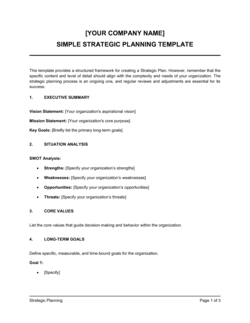
vs Strategic Planning Template

A strategic plan sets 3-to-5-year goals, initiatives, and resource allocations for a business that is already operating and continuing. This assessment is a decision-point document for situations where continuation itself is in question. Strategic planning is appropriate after this assessment confirms the business is worth the continued investment of time and resources.

Industry-specific considerations

Technology / SaaS

Unit economics evaluation focuses on MRR, churn rate, and CAC payback period; competitive moat assessment centers on network effects and switching costs rather than physical assets.

Retail / E-commerce

Demand validation focuses on repeat purchase rate and return rate as proxies for product-market fit; opportunity cost analysis weighs inventory capital tied up in a non-selling SKU.

Food & Beverage

Regulatory and structural barriers β€” food safety licensing, distribution agreements, shelf-space competition β€” feature prominently; founder motivation assessment must account for the physical and operational intensity of the category.

Professional Services

Opportunity cost is especially high because founders typically have strong market salaries to forgo; competitive moat assessment focuses on reputation, referral network, and proprietary methodology rather than technology.

Consumer Hardware / Deep Tech

Resource availability section is critical given high capital requirements; regulatory pathway assessment for FCC, CE, or FDA approval timelines can alone determine viability.

Healthcare / MedTech

Regulatory barrier analysis dominates the assessment β€” FDA 510(k) or PMA timelines, reimbursement code availability, and clinical validation requirements each independently determine whether the idea is commercially viable.

Template vs pro β€” what fits your needs?

PathBest forCostTime
Use the templateSolo founders and small teams conducting a structured self-assessment before a pivot or shutdown decisionFree2–4 hours to complete all nine sections with real data
Template + professional reviewFounders with investor obligations, co-founder disputes, or significant capital at stake who need an experienced outside perspective$300–$1,500 for a business advisor or startup mentor session1–3 days including advisor review and discussion
Custom draftedBusinesses with investor or lender reporting obligations, significant employee headcount, or complex wind-down requirements$2,000–$8,000 for a consultant or turnaround advisor engagement2–4 weeks

Glossary

Pivot
A deliberate, structured change to a core element of a business model β€” product, customer segment, channel, or revenue model β€” in response to evidence that the current approach is not working.
Product-Market Fit
The point at which a product satisfies a strong market demand β€” evidenced by organic growth, low churn, and customers who would be very disappointed if the product disappeared.
Burn Rate
The monthly net cash outflow a business incurs while operating at a loss β€” used to calculate how many months of runway remain before funds are exhausted.
Opportunity Cost
The value of the next-best alternative forgone when resources β€” time, money, or attention β€” are committed to a given course of action.
Unit Economics
Revenue and cost metrics calculated at the level of a single customer or transaction, used to determine whether the business model is fundamentally profitable at scale.
Churn Rate
The percentage of customers who stop using a product or service within a given period β€” high churn is a leading indicator that the product is not delivering enough value to retain users.
Sunk Cost Fallacy
The tendency to continue investing in a failing course of action because of resources already spent, rather than evaluating future prospects on their own merits.
Runway
The number of months a business can continue operating at its current burn rate before running out of cash, assuming no new revenue or funding.
Validated Learning
Insights about customer behavior gained through systematic experimentation β€” the foundation of the Lean Startup methodology for testing assumptions before scaling.
Go/No-Go Decision
A binary checkpoint at which a founder, team, or investor decides whether to continue pursuing a course of action based on defined criteria and evidence gathered to date.

Part of your Business Operating System

This document is one of 3,000+ business & legal templates included in Business in a Box.

  • Fill-in-the-blanks β€” ready in minutes
  • Compatible with all office suites
  • Export to PDF and share electronically

Create your document in 3 simple steps.

From template to signed document β€” all inside one Business Operating System.
1
Download or open template

Access over 3,000+ business and legal templates for any business task, project or initiative.

2
Edit and fill in the blanks with AI

Customize your ready-made business document template and save it in the cloud.

3
Save, Share, Send, Sign

Share your files and folders with your team. Create a space of seamless collaboration.

Save time, save money, and create top-quality documents.

β˜…β˜…β˜…β˜…β˜…

"Fantastic value! I'm not sure how I'd do without it. It's worth its weight in gold and paid back for itself many times."

Managing Director Β· Mall Farm
Robert Whalley
Managing Director, Mall Farm Proprietary Limited
β˜…β˜…β˜…β˜…β˜…

"I have been using Business in a Box for years. It has been the most useful source of templates I have encountered. I recommend it to anyone."

Business Owner Β· 4+ years
Dr Michael John Freestone
Business Owner
β˜…β˜…β˜…β˜…β˜…

"It has been a life saver so many times I have lost count. Business in a Box has saved me so much time and as you know, time is money."

Owner Β· Upstate Web
David G. Moore Jr.
Owner, Upstate Web

Run your business with a system β€” not scattered tools

Stop downloading documents. Start operating with clarity. Business in a Box gives you the Business Operating System used by over 250,000 companies worldwide to structure, run, and grow their business.

Start freeΒ Β·Β No credit card required