Stakeholder Correspondence Templates
★★★★★4.7from 280+ reviews· Trusted by 20M+ businesses
Identify, engage, and communicate with stakeholders using documents built for real business situations.
WordEditable onlinePDF37+ stakeholder correspondence templates
Other Administration categories
Correspondence and acknowledgment
More stakeholder correspondence templates
250K+Clients
20M+Free users
20+Years
190+Countries
10,000+Law firms
50M+Downloads
Trusted across review platforms
- Capterra★★★★☆4.649 reviews
- G2★★★★☆4.713 reviews
- GetApp★★★★☆4.649 reviews
- Google Play★★★★☆4.6179 ratings
- Google Reviews★★★★☆4.567 reviews
Frequently asked questions
What is a stakeholder analysis?
A stakeholder analysis is a structured process for identifying all parties who have an interest in or influence over a project, and then assessing their level of power and interest. The output is typically a matrix or table that helps you prioritise where to invest engagement effort. It is usually completed at the start of a project and updated as circumstances change.
What is the difference between a stakeholder analysis and a stakeholder engagement plan?
A stakeholder analysis tells you who your stakeholders are and how much attention each requires. A stakeholder engagement plan tells you what you will do about it — the specific communication actions, timelines, channels, and owners for each group. The analysis comes first and feeds directly into the plan.
Who counts as a stakeholder?
Any individual, group, or organisation that can affect your project or that will be affected by its outcomes qualifies as a stakeholder. This typically includes internal stakeholders (employees, managers, board members) and external stakeholders (customers, suppliers, regulators, community groups, investors). The boundaries depend on the scope and nature of the project.
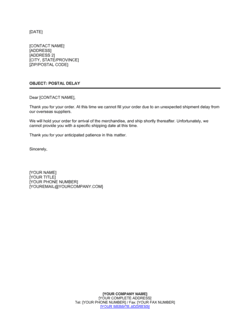
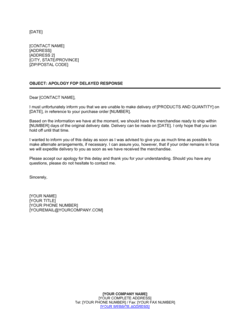
When should I send an acknowledgment of postal delay?
Send an acknowledgment as soon as you become aware that a mailed document or parcel expected by a stakeholder has been delayed. Proactive communication prevents the stakeholder from assuming the correspondence was lost or ignored, and it demonstrates professional courtesy. Include the original send date, the expected new arrival window, and a contact for follow-up questions.
How often should a stakeholder engagement plan be updated?
At a minimum, review and update the plan at each major project milestone or phase gate. In fast-moving projects or during periods of significant change, monthly reviews are appropriate. Stakeholder priorities, influence levels, and concerns shift over time, and an outdated plan can create communication gaps.
Does a small business need a stakeholder engagement plan?
Yes, though the format can be simpler. Even a small business launching a new product, entering a new market, or going through a significant operational change benefits from a clear record of who needs to be communicated with, what they need to know, and who is responsible for reaching out. A single-page plan is enough for most small-business contexts.
Can these templates be used for non-profit or public sector organisations?
Yes. Stakeholder analysis and engagement planning are widely used in non-profit, government, and public-sector contexts — often with a broader definition of stakeholders that includes community members, donors, and regulators. The core structure of the templates applies across sectors; you may wish to adapt the language to suit your organisation's terminology.
Stakeholder Correspondence vs. related documents
A stakeholder register is a simple list of stakeholders and their contact details, typically maintained as a project artifact. A stakeholder analysis goes further by assessing each stakeholder's influence, interest, and potential impact. The analysis is the strategic tool; the register is the operational record.
A communication plan covers all project communications — internal team updates, status reports, and external messaging. A stakeholder engagement plan focuses specifically on the two-way relationship with stakeholders: how to inform, consult, involve, or partner with them. Use the engagement plan to supplement a broader communication plan.
Key clauses every Stakeholder Correspondence contains
Stakeholder correspondence documents share a common set of structural elements regardless of which specific template you use.
- Stakeholder identification. Names and defines each stakeholder or stakeholder group relevant to the project or correspondence.
- Influence and interest assessment. Rates each stakeholder by their level of influence over decisions and their level of interest in outcomes.
- Engagement objectives. States what you want to achieve with each stakeholder — inform, consult, involve, collaborate, or empower.
- Communication channels and frequency. Specifies how each stakeholder will be reached (email, meetings, reports) and how often.
- Responsible owner. Assigns a named person or role accountable for managing each stakeholder relationship.
- Key messages. Summarises the core information each stakeholder needs to receive, tailored to their role and interests.
- Issues and escalation log. Records emerging concerns, open questions, or risks related to a stakeholder, with an escalation path.
- Acknowledgment and response details. In correspondence documents, confirms receipt, explains any delays, and sets expectations for follow-up timing.
How to write a stakeholder correspondence document
Effective stakeholder documents start with a clear picture of who your stakeholders are and what they need from you — before you write a single line.
1
List every stakeholder
Identify all individuals, groups, and organisations that affect or are affected by your project or decision.
2
Assess influence and interest
Rate each stakeholder on a simple high/medium/low scale for both their influence over the project and their level of interest in outcomes.
3
Prioritise your engagement
Focus detailed engagement efforts on high-influence, high-interest stakeholders; use lighter-touch communication for lower-priority groups.
4
Define engagement objectives per stakeholder
Decide whether each stakeholder needs to be informed, consulted, involved in decisions, or treated as a collaborative partner.
5
Select communication channels and frequency
Match the channel — email updates, formal reports, one-on-one meetings, group briefings — to the stakeholder's preference and the nature of the information.
6
Assign ownership
Name the person responsible for managing each stakeholder relationship so nothing falls through the gaps.
7
Plan for issues and delays
Build in a process for logging concerns and responding promptly — including a formal acknowledgment letter when correspondence is delayed.
8
Review and update regularly
Stakeholder maps and engagement plans become outdated quickly; schedule a review at each major project milestone.
At a glance
- What it is
- Stakeholder correspondence documents are structured business tools used to identify key stakeholders, plan engagement activities, and manage written communications with them throughout a project or ongoing operations.
- When you need one
- Any time you are launching a project, managing a change initiative, or responding to stakeholders about delays or issues, these templates help you communicate clearly and professionally.
Which Stakeholder Correspondence do I need?
The right template depends on where you are in the stakeholder management process — mapping who matters, planning how to engage them, or responding to a specific communication issue.
Your situation
Recommended template
Starting a project and need to map who has a stake in it
Provides a structured framework for identifying, classifying, and prioritising stakeholders.Planning how and when to communicate with stakeholders over a project lifecycle
Outlines communication strategies, frequency, and responsibilities for each stakeholder group.A mailed document or parcel has been delayed and a stakeholder needs acknowledgment
Provides a professional written acknowledgment that manages expectations around delivery timing.Glossary
- Stakeholder
- Any individual, group, or organisation that affects or is affected by a project, decision, or initiative.
- Stakeholder analysis
- A structured assessment of who your stakeholders are, how much influence they hold, and how interested they are in your project.
- Stakeholder engagement plan
- A document that sets out how, when, and by whom each stakeholder group will be communicated with throughout a project.
- Influence-interest matrix
- A four-quadrant grid used to plot stakeholders by their level of influence over a project against their level of interest in its outcomes.
- Engagement level
- A classification of how deeply a stakeholder is involved — ranging from 'inform' at one end to 'empower' or 'co-create' at the other.
- Key messages
- The core information tailored for a specific stakeholder or stakeholder group, designed to address their particular concerns or interests.
- Postal acknowledgment
- A written confirmation sent to a recipient when a mailed item is known to be delayed, setting revised expectations for delivery.
- Escalation path
- A defined process for raising unresolved stakeholder concerns to a higher level of authority within the project or organisation.
- Stakeholder register
- An operational record listing stakeholder names, roles, and contact details, distinct from the more analytical stakeholder analysis.
What is stakeholder correspondence?
Stakeholder correspondence refers to the structured documents and communications a business uses to identify, analyse, and engage the people and organisations that have a stake in its activities. At the core of this category are three functions: mapping who your stakeholders are, planning how you will engage them, and managing specific written communications — such as acknowledgments of delays — that arise in the course of that relationship.
Unlike general business correspondence, stakeholder correspondence is strategic. It connects individual communications back to a broader picture of who has influence or interest in a project, and ensures that each message sent or received is handled in a way that supports the overall relationship. In practice, this means combining analytical documents (like a stakeholder analysis) with planning tools (like an engagement plan) and transactional letters (like a postal delay acknowledgment) into a coherent communication approach.
These documents are used across industries and organisation sizes — from a sole trader managing supplier relationships to a large corporation navigating a major change programme. The common thread is the need to communicate with intention, consistency, and accountability.
When you need a stakeholder correspondence document
The need for stakeholder correspondence documents typically arises at the start of a project, during a significant organisational change, or whenever a communication breakdown creates a risk to a relationship. If you are about to share information, request input, or respond to a concern from anyone outside your immediate team, having the right document in place makes the difference between a managed relationship and an avoidable problem.
Common triggers:
- Launching a new project and needing to identify everyone with a stake in its outcome
- Planning a product rollout or market entry that will affect customers, suppliers, or regulators
- Navigating an internal restructure that requires careful communication with employees and board members
- Managing a change programme where community or government stakeholders need regular updates
- Responding to a supplier or partner whose mailed documents or parcels have been delayed
- Preparing for an investor presentation and needing to understand each investor's concerns in advance
- Building a repeatable communication process for ongoing stakeholder relationships across the business
Without structured stakeholder documents, communication tends to be reactive, inconsistent, and difficult to audit. A missed update to a high-influence stakeholder or an unanswered acknowledgment of delay can damage trust that takes far longer to rebuild than it took to lose. Starting with the right template ensures that your engagement is deliberate, traceable, and professional from the outset.
Award-winning platform
- Great Place to Work 2025
- BIG Award — Product of the Year 2025
- Smartest Companies 2025
- Global 100 Excellence 2026
- Best of the Best 2025