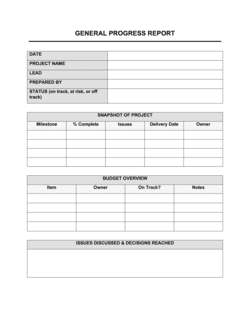
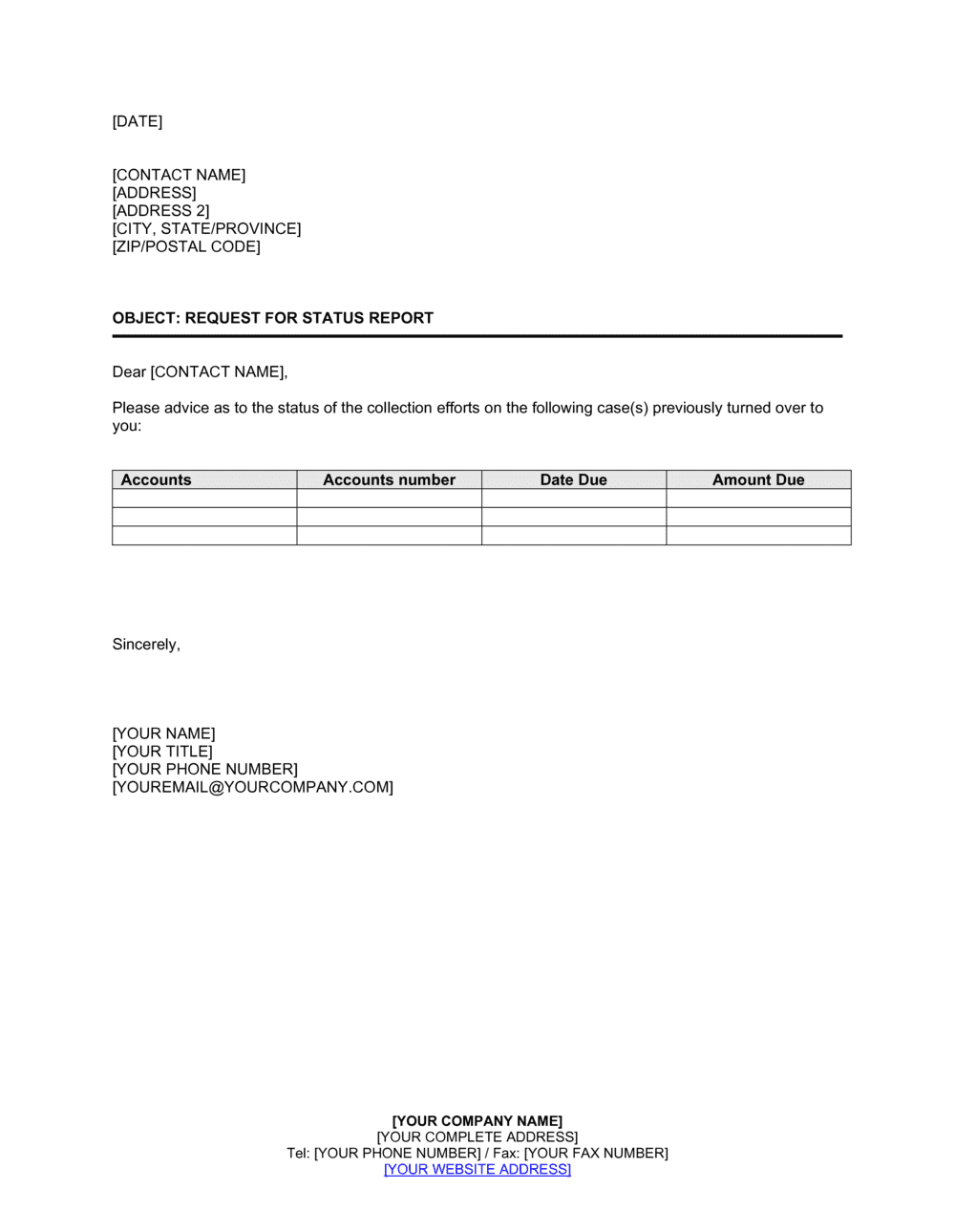
Request for Status Report Template

Free Word download β€’ Edit online β€’ Save & share with Drive β€’ Export to PDF

1 pageβ€’20–25 min to fillβ€’Difficulty: Standard
Learn more ↓
FreeRequest for Status Report Template

At a glance

What it is
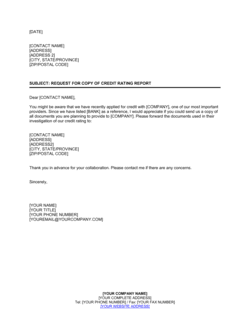
A Request For Status Report is a formal business letter sent by a manager, client, or stakeholder to ask for a written update on the progress of a project, task, or outstanding deliverable. This free Word download gives you a ready-to-edit letter you can customize with your own project details and send in minutes, either as a printed letter or exported PDF.
When you need it
Use it when a project, assignment, or action item has gone without a response or update for longer than expected, or whenever a formal written record of your request is needed. It is equally useful for routine check-ins on long-running projects where regular reporting has not been established.
What's inside
Sender and recipient details, a clear statement of the project or task in question, the specific information being requested, a response deadline, and a professional closing with contact details. Every component is formatted for immediate use with simple placeholder fields to fill in.

What is a Request For Status Report?

A Request For Status Report is a formal business letter sent by a manager, client, or project stakeholder to ask a contractor, vendor, employee, or service provider for a written update on the progress of a specific project, task, or deliverable. It identifies the work in question by name and reference number, lists the precise information being requested, sets a clear response deadline, and creates a documented paper trail that can be referenced if the matter escalates. Unlike a casual email follow-up, a formal status request signals that the update is overdue or important enough to warrant a written record.

Why You Need This Document

When a project update is overdue and informal reminders have gone unanswered, a formal written request changes the dynamic. It puts the request on record, establishes a specific response deadline, and creates documentation you can reference in any subsequent dispute, audit, or escalation. Contractors and vendors who ignore informal follow-ups consistently respond to formal letters β€” the written format signals accountability in a way that phone calls and casual emails do not. For projects governed by a contract, a documented request for status is also often the required first step before triggering late-delivery clauses or placing work on hold. This template gives you a professionally formatted letter you can complete in under ten minutes, send immediately, and file as part of your project records.

Which variant fits your situation?

If your situation is…Use this template
Requesting an update on an active project from a contractor or vendorRequest For Status Report
Following up on an overdue deliverable after no response to earlier requestsFollow-Up Letter
Asking a team member or employee for a written weekly progress updateWeekly Status Report
Formally documenting and escalating an unresolved issue to senior managementEscalation Letter
Requesting a comprehensive end-of-project summary from a service providerProject Completion Report
Asking for a financial update on a budget or expenditureBudget Status Report
Checking on the status of a submitted proposal or bidProposal Follow-Up Letter

Common mistakes to avoid

❌ Requesting an update verbally before sending the letter

Why it matters: A verbal request creates no record. If the recipient disputes whether they were asked, or the matter escalates, you have no documented evidence of the request.

Fix: Send the formal letter as the primary request, or follow up a verbal conversation with a written request the same day, referencing the prior discussion.

❌ Using vague language with no specific deadline

Why it matters: Requests without a deadline are consistently deprioritized. Without a date, the recipient has no obligation to respond by any particular time, and delays compound.

Fix: Always include a specific calendar date for the response and note what will happen if the deadline is not met.

❌ Omitting the project reference number or name

Why it matters: Recipients managing multiple projects cannot quickly identify which work is being asked about, slowing their response and sometimes resulting in a reply about the wrong project.

Fix: Include the exact project name, contract number, or purchase order number in both the reference line and the body of the letter.

❌ Asking for too much information in one request

Why it matters: A letter that asks for a full written report, a revised timeline, a budget reconciliation, and a risk assessment will likely receive a partial response or no response at all.

Fix: Limit the request to four to six specific, answerable questions. Follow up with a second request if additional detail is needed after reviewing the initial response.

The 9 key clauses, explained

Sender and recipient information

In plain language: Identifies who is sending the letter and who it is addressed to, including full names, titles, organizations, and contact details.

Sample language
[SENDER NAME] | [TITLE] | [ORGANIZATION] | [ADDRESS] | [EMAIL] | [PHONE] To: [RECIPIENT NAME] | [TITLE] | [ORGANIZATION] | [ADDRESS]

Common mistake: Using a first name or nickname instead of the recipient's full name and title. A formal letter sent to an informal salutation can be overlooked or misrouted in large organizations.

Date and reference line

In plain language: States the date the letter is written and includes a reference number or project name to help both parties file and locate it.

Sample language
Date: [DATE] Re: Status Report Request β€” [PROJECT NAME / CONTRACT NUMBER / REFERENCE NUMBER]

Common mistake: Omitting a reference number when the recipient manages multiple projects. Without it, they must search their records to understand which work the letter concerns, adding unnecessary delay.

Opening and purpose statement

In plain language: States clearly and immediately why the letter is being sent β€” to request a status update on a named project or task.

Sample language
I am writing on behalf of [ORGANIZATION] to request a current status report on [PROJECT NAME / TASK DESCRIPTION], which was assigned to your team on [DATE].

Common mistake: Opening with pleasantries or background that buries the request. The recipient should know the letter's purpose within the first two sentences.

Description of the project or task

In plain language: Briefly identifies the work in question β€” the project name, scope summary, and relevant contract or assignment details β€” so there is no ambiguity about what is being asked about.

Sample language
The scope of work, as outlined in [CONTRACT / AGREEMENT / PURCHASE ORDER NUMBER] dated [DATE], covers [BRIEF DESCRIPTION OF DELIVERABLES OR TASKS].

Common mistake: Assuming the recipient knows exactly what is being referred to without any identifying detail. Especially on long-running engagements, a brief description prevents confusion and speeds up the response.

Specific information requested

In plain language: Lists the precise questions or updates being asked for β€” completed milestones, current blockers, percentage complete, or expected finish date.

Sample language
Please provide an update covering: (1) tasks completed to date; (2) tasks currently in progress; (3) any issues or obstacles affecting the timeline; and (4) your projected completion date.

Common mistake: Asking for a generic 'update' with no specifics. Vague requests produce vague responses. Listing exactly what you need reduces back-and-forth and gets you actionable information faster.

Response deadline

In plain language: States the date by which you need the status report, giving the recipient a clear expectation.

Sample language
Please submit the requested status report no later than [DATE β€” e.g., Friday, May 16, 2026].

Common mistake: Not including any deadline, or writing 'as soon as possible.' Recipients without a specific date tend to deprioritize the response, especially when managing competing workloads.

Consequences or next steps if no response

In plain language: Optionally states what will happen if no response is received by the deadline β€” escalation, contract review, or project hold β€” without being threatening in tone.

Sample language
If we do not receive a response by [DATE], we will need to escalate this request to [SUPERVISOR / CLIENT / MANAGEMENT] and may place the related work on hold pending clarification.

Common mistake: Either omitting this clause entirely (leaving no accountability) or phrasing it as a threat rather than a factual consequence. A neutral, factual tone is more effective and preserves the working relationship.

Preferred format and submission instructions

In plain language: Tells the recipient how and where to submit the status report β€” by email, via a project management tool, or as an attached form.

Sample language
Please send your response by email to [EMAIL ADDRESS] with the subject line '[PROJECT NAME] β€” Status Report [DATE].' A response directly in the email body is acceptable for brief updates.

Common mistake: Leaving the submission method unspecified. Recipients may respond by phone, in a meeting, or via a channel you don't monitor β€” all of which fail to create the written record the letter was meant to generate.

Professional closing and signature block

In plain language: Closes the letter courteously, provides the sender's direct contact details, and includes a signature.

Sample language
Thank you for your prompt attention to this matter. Please do not hesitate to contact me directly at [PHONE] or [EMAIL] if you have any questions. Sincerely, [SENDER NAME] [TITLE] | [ORGANIZATION]

Common mistake: Closing with no contact details other than a signature. If the recipient has a question or needs clarification before responding, they should be able to reach you without searching for your information.

How to fill it out

  1. 1

    Fill in sender and recipient details

    Enter your full name, title, organization, and contact information at the top. Then address the letter to the specific individual responsible for the work β€” not a team or department name if you can avoid it.

    πŸ’‘ If you are unsure who the correct point of contact is, send a brief email first to confirm before issuing the formal letter.

  2. 2

    Add the date and reference line

    Enter today's date and a reference line that identifies the project by name and any relevant contract or purchase order number. This links the letter to your formal records.

    πŸ’‘ Use the exact project name or contract reference that appears in your signed agreement β€” not an internal nickname β€” so the recipient can locate it immediately.

  3. 3

    Write the purpose statement

    State clearly in the first sentence that you are requesting a status report and name the project. Keep this sentence factual and direct β€” one sentence is enough.

    πŸ’‘ Avoid starting with 'I hope this letter finds you well' or similar fillers. Formal business letters are more effective when they get to the point immediately.

  4. 4

    Describe the project or task

    Add a brief one-to-two sentence description of the work in question, referencing the original assignment date and any relevant agreement number. This removes any ambiguity about what is being asked.

    πŸ’‘ Copy the scope summary directly from the contract or statement of work to ensure precise, consistent language.

  5. 5

    List the specific information you need

    Break your request into numbered points β€” completed work, work in progress, blockers, and expected completion date. This structure makes it easy for the recipient to respond systematically.

    πŸ’‘ Limit yourself to four to six specific questions. Longer lists feel overwhelming and often result in partial answers.

  6. 6

    Set a firm response deadline

    Enter a specific calendar date, not a relative term like 'within the week.' Give at least three to five business days unless the situation is urgent.

    πŸ’‘ For contractors and vendors, check your contract for any agreed reporting timelines before setting a deadline β€” your deadline should be consistent with the contract terms.

  7. 7

    Specify how and where to submit the response

    Provide a direct email address and a suggested subject line format. If you are using a project management platform, name it and provide the relevant link or channel.

    πŸ’‘ A specific subject line format (e.g., '[PROJECT NAME] β€” Status Report [DATE]') keeps your inbox organized and makes it easier to find responses later.

Frequently asked questions

What is a request for status report?

A request for status report is a formal written communication sent to a contractor, employee, vendor, or project team asking for a written update on the current state of a project, task, or deliverable. It identifies the work in question, lists the specific information needed, sets a response deadline, and creates a documented paper trail of the communication. It is used when informal follow-ups have not produced results or when a formal record of the request is needed.

When should I send a request for status report instead of just an email?

Send a formal letter when you need a documented record β€” for example, when a contractor has missed a milestone, when a project is running significantly behind schedule, or when the status update may be needed as evidence in a contract dispute. For routine day-to-day check-ins, a brief email is sufficient. The formal letter signals that the matter is being tracked and escalation is possible if no response is received.

How long should a request for status report letter be?

One page is the standard length. The letter should be long enough to clearly identify the project, list the specific questions being asked, and state a deadline β€” but short enough to be read and acted on quickly. Lengthy letters with extensive background detail often result in slower responses than concise, direct ones.

What should I do if I receive no response after sending the letter?

If the response deadline passes without a reply, send a brief follow-up letter or email referencing the original request and stating that you have not yet received a response. If the matter is urgent or the work is under a formal contract, consider escalating to your counterpart's supervisor or flagging the non-response in your project records. Keeping a written record of every request and non-response is important if the situation eventually leads to a contract dispute.

Can this letter be sent by email?

Yes. While the template is formatted as a formal letter, the content is equally appropriate when sent as an email β€” paste the letter body into the email or attach the PDF. Sending it as a formal PDF attachment rather than an inline email can signal greater urgency and creates a cleaner record for filing. Whichever format you use, request a read receipt or delivery confirmation so you have evidence it was received.

Do I need to state consequences in the letter?

It is not required, but it is often effective. A brief, factual statement of what will happen if no response is received β€” escalation, project hold, or contract review β€” gives the recipient a reason to prioritize the response without threatening the relationship. Keep the language neutral and factual rather than confrontational.

Is a request for status report the same as a progress report?

No. A request for status report is the letter you send asking for an update. A progress report is the document the recipient prepares in response, summarizing what has been completed, what is underway, and what remains. The two documents are complementary β€” the request triggers the report.

Can I use this template for internal team requests as well as external ones?

Yes, with minor adjustments. For internal use, the tone can be slightly less formal and the reference to contracts or agreements may not apply. The core structure β€” project name, specific questions, and a response deadline β€” remains valuable regardless of whether the recipient is an outside vendor or a colleague on the same team.

How this compares to alternatives

vs Follow-Up Letter

A follow-up letter is sent after a prior communication β€” meeting, proposal, or application β€” to re-engage or check on a decision. A request for status report is specifically focused on obtaining a written update on ongoing work or a project in progress. Use the follow-up letter when you need a response to a previous message; use the status request when you need a progress update on active work.

vs Weekly Status Report

A weekly status report is a structured document that a team member or contractor fills in and submits on a regular schedule. A request for status report is the letter that asks for such an update when it is overdue or has not been established as a routine. The request triggers the report β€” the two documents work together.

vs Project Completion Report

A project completion report is a final summary submitted once all work is finished, covering outcomes, lessons learned, and final budget. A request for status report is used mid-project to check on progress while work is still underway. Use the completion report at the end; use the status request at any point during the project lifecycle.

vs Demand Letter

A demand letter formally requires a party to take a specific action β€” pay an amount owed, cure a contract breach, or cease a particular behavior β€” and implies legal consequences if they do not comply. A request for status report simply asks for information and does not make legal demands. If a contractor's non-response has become a breach of contract, escalate from a status request to a demand letter.

Industry-specific considerations

Construction

Used by project owners and general contractors to request written milestone updates from subcontractors when site visits are not possible or a formal record is required.

Professional Services

Law firms, consultancies, and accounting practices use status request letters to formally follow up on client deliverables, court filings, or advisory work in progress.

Government and Public Sector

Government agencies routinely issue formal status requests to contractors and grantees, where written documentation of compliance and progress is required by procurement regulations.

Technology / SaaS

Product managers and vendor managers use formal status requests when an integration, development milestone, or support ticket has exceeded its expected resolution date.

Template vs pro β€” what fits your needs?

PathBest forCostTime
Use the templateAny manager, business owner, or professional who needs a clear, documented request for a project updateFree5–10 minutes
Template + professional reviewRequests related to formal contracts where the letter may later be referenced in a dispute$50–$150 (brief review by a business advisor or contract manager)1 business day
Custom draftedHigh-value contracts where non-response may trigger legal remedies or formal dispute resolution$200–$600 (lawyer-drafted letter with legal citations)2–5 business days

Glossary

Status Report
A written summary of the current state of a project, task, or activity, including work completed, work remaining, and any issues blocking progress.
Deliverable
A specific, tangible output β€” document, product, milestone, or service β€” that a party is expected to produce by a defined date.
Response Deadline
The specific date by which the recipient is asked to submit the requested status update.
Action Item
A discrete task assigned to a person or team, with an owner and an expected completion date.
Escalation
The process of referring an unresolved issue or non-response to a higher level of authority when normal communication channels have not produced results.
Paper Trail
A series of written records β€” letters, emails, and reports β€” that document communication and decisions over time, useful for resolving disputes or audits.
Stakeholder
Any person or organization with a direct interest in the outcome of a project, including clients, managers, contractors, and funders.
Reference Number
A unique identifier β€” such as a contract number, project code, or purchase order number β€” used to link the letter to a specific file or agreement.
Point of Contact
The named individual responsible for responding to the request or coordinating the status update from the recipient's side.
Work in Progress (WIP)
Tasks or deliverables that have been started but not yet completed at the time of the status request.

Part of your Business Operating System

This document is one of 3,000+ business & legal templates included in Business in a Box.

  • Fill-in-the-blanks β€” ready in minutes
  • 100% customizable Word document
  • Compatible with all office suites
  • Export to PDF and share electronically

Create your document in 3 simple steps.

From template to signed document β€” all inside one Business Operating System.
1
Download or open template

Access over 3,000+ business and legal templates for any business task, project or initiative.

2
Edit and fill in the blanks with AI

Customize your ready-made business document template and save it in the cloud.

3
Save, Share, Send, Sign

Share your files and folders with your team. Create a space of seamless collaboration.

Save time, save money, and create top-quality documents.

β˜…β˜…β˜…β˜…β˜…

"Fantastic value! I'm not sure how I'd do without it. It's worth its weight in gold and paid back for itself many times."

Managing Director Β· Mall Farm
Robert Whalley
Managing Director, Mall Farm Proprietary Limited
β˜…β˜…β˜…β˜…β˜…

"I have been using Business in a Box for years. It has been the most useful source of templates I have encountered. I recommend it to anyone."

Business Owner Β· 4+ years
Dr Michael John Freestone
Business Owner
β˜…β˜…β˜…β˜…β˜…

"It has been a life saver so many times I have lost count. Business in a Box has saved me so much time and as you know, time is money."

Owner Β· Upstate Web
David G. Moore Jr.
Owner, Upstate Web

Run your business with a system β€” not scattered tools

Stop downloading documents. Start operating with clarity. Business in a Box gives you the Business Operating System used by over 250,000 companies worldwide to structure, run, and grow their business.

Free Forever PlanΒ Β·Β No credit card required