Sponsorship Form Template

Free Word download β€’ Edit online β€’ Save & share with Drive β€’ Export to PDF

1 pageβ€’15–20 min to fillβ€’Difficulty: Standard
Learn more ↓
FreeSponsorship Form Template

At a glance

What it is
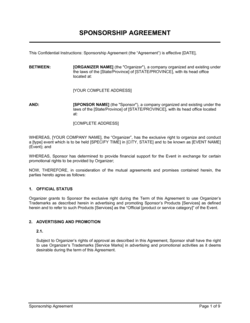
A Sponsorship Form is a structured document used to formalize a sponsorship arrangement at the application or commitment stage. This free Word download captures sponsor contact details, chosen sponsorship level, expected deliverables, payment terms, and event or program information in a single organized form you can edit online and export as PDF.
When you need it
Use it when a potential sponsor confirms interest and you need a written record of their commitment before the event, campaign, or program begins. It bridges the gap between an informal conversation and a full sponsorship agreement.
What's inside
Sponsor and organization details, event or program information, sponsorship tier selection, deliverables checklist, payment amount and schedule, and an acknowledgment block for both parties to confirm the arrangement.

What is a Sponsorship Form?

A Sponsorship Form is a structured document used to formalize a sponsorship arrangement at the application or commitment stage. It captures all the information needed to process and fulfill a sponsor's contribution β€” organization and contact details, chosen sponsorship tier, contribution amount and type, deliverables the sponsor is entitled to, and payment terms. Unlike a full sponsorship agreement, the form is designed for speed and simplicity: it gives both the organizer and the sponsor a shared, written record of exactly what has been committed and what will be delivered in return.

Why You Need This Document

Running a sponsorship program without a formal intake form creates four predictable problems: sponsors forget which tier they agreed to, deliverables become subject to memory and interpretation, payment deadlines go unmissed because they were never stated, and missing logo files delay print production. A completed sponsorship form eliminates all four by putting the commitment, the deliverables, and the payment date in writing before any work begins. For nonprofits, it also generates the documentation trail needed for accurate tax receipts. This template gives you a ready-to-use form you can customize with your event details and tiered package pricing, then distribute to sponsors in minutes β€” so you spend your time fulfilling commitments rather than chasing them.

Which variant fits your situation?

If your situation is…Use this template
Collecting initial expressions of interest before committingSponsorship Proposal
Formalizing legally binding sponsorship obligations and IP rightsSponsorship Agreement
Requesting a cash or in-kind donation from a corporate donorDonation Request Letter
Tracking multiple sponsors and their deliverable statusSponsorship Tracking Spreadsheet
Soliciting event-specific booth or exhibit sponsorshipsEvent Sponsorship Proposal
Acknowledging a completed sponsorship with a formal thank-youSponsorship Thank You Letter
Presenting tiered sponsorship packages to prospectsSponsorship Package Template

Common mistakes to avoid

❌ No payment due date on the form

Why it matters: Sponsors treat an undated commitment as a pledge rather than an obligation. Payment routinely arrives after the event when no deadline is stated, leaving organizers to cover costs out of pocket.

Fix: Enter a specific calendar date β€” not 'before the event' β€” in the payment terms field. For multi-tier sponsors, use an installment schedule with two dated milestones.

❌ Vague deliverable descriptions

Why it matters: Descriptions like 'online visibility' or 'brand exposure' are unenforceable and lead to post-event disputes about whether the sponsor received what they paid for.

Fix: Specify every deliverable with a quantity and format: '3 Instagram posts to [X] followers,' 'logo at 120px wide on homepage for 30 days,' or '6 ft Γ— 8 ft banner at main entrance.'

❌ Missing legal entity name for the sponsor

Why it matters: An invoice or tax receipt issued to the wrong name cannot be processed by corporate accounts payable and may be returned, delaying payment until corrected.

Fix: Add a dedicated 'Legal Organization Name' field separate from the contact name field, and confirm it matches the name on the sponsor's purchase order or payment method.

❌ Asset deadline set too close to production

Why it matters: Receiving a sponsor's logo two days before the printer's deadline leaves no time for revisions. A low-resolution file or incorrect format discovered at this stage causes either a delay or a missing logo on all printed materials.

Fix: Set the asset submission deadline at least 14 days before any print production run, and state this date explicitly on the form next to the logo specifications.

The 8 key fields, explained

Sponsor organization details

Event or program details

Sponsorship level selection

Contribution amount and type

Deliverables checklist

Payment terms and schedule

Logo and asset submission details

Acknowledgment and authorization

How to fill it out

  1. 1

    Enter your event or program details

    Fill in the event name, date(s), venue, and a one- to two-sentence description at the top of the form. This context helps sponsors confirm they are committing to the right initiative.

    πŸ’‘ If you run recurring events, include the edition year or number β€” 'Annual Gala 2026' is clearer than 'Annual Gala' when sponsors reference the form later.

  2. 2

    Define and list your sponsorship tiers with prices

    Enter each tier name and its corresponding contribution amount before sending the form to any prospect. Tiers without prices create negotiation ambiguity and slow commitment.

    πŸ’‘ Limit tiers to four or fewer. More than four options causes decision paralysis and reduces the conversion rate from form submission to payment.

  3. 3

    Collect the sponsor's full organization details

    Ask for the legal entity name, primary contact, email, phone, and billing address. The legal name is required for invoices, tax receipts, and any formal acknowledgment.

    πŸ’‘ Request a dedicated accounts-payable email at this stage β€” routing invoices to the right contact upfront cuts the average payment cycle by 5–10 days.

  4. 4

    Complete the deliverables checklist for the selected tier

    Tick each deliverable the sponsor is entitled to at their chosen level, and fill in any specifics β€” logo size specification, number of social posts, ticket count, or booth dimensions.

    πŸ’‘ Pre-populate the checklist for each tier before distributing. A blank checklist filled in by the sponsor creates mismatched expectations.

  5. 5

    Set the payment due date and accepted methods

    Enter the total amount, the specific calendar date payment is due, and the accepted payment methods. For sponsorships over $2,500, consider adding a 50/50 installment schedule.

    πŸ’‘ Align the final payment due date with at least two weeks before your print and production deadlines β€” not the event date.

  6. 6

    Specify the logo and asset submission deadline

    Enter the required file formats, minimum resolution, and the email address for submissions. Set the asset deadline at least two weeks before any print production run.

    πŸ’‘ Send a calendar reminder to the sponsor on the day they submit the form, scheduled for three days before the asset deadline.

  7. 7

    Route the form to an authorized signatory for acknowledgment

    Confirm the person completing the acknowledgment block has authority to commit the stated dollar amount. Collect their full name, title, and the date of completion.

    πŸ’‘ If the form is returned unsigned or completed by a coordinator, follow up with a brief note requesting authorization from a budget holder before processing.

Frequently asked questions

What is a sponsorship form?

A sponsorship form is a structured document that captures a sponsor's commitment to support an event, program, or campaign. It records the sponsor's organization details, chosen sponsorship level, contribution amount, expected deliverables, and payment terms in one place. It functions as the official record of the arrangement before a full sponsorship agreement is signed.

What is the difference between a sponsorship form and a sponsorship agreement?

A sponsorship form captures the commitment and basic terms at the application or onboarding stage β€” it is a data-collection and acknowledgment document. A sponsorship agreement is a legally binding contract that covers IP rights, exclusivity, cancellation, indemnification, and dispute resolution in full legal detail. For low-value or informal sponsorships, the form alone may suffice. For sponsorships above $2,500 or those involving naming rights or exclusivity, a full agreement is recommended.

Does a sponsorship form need to be signed?

A formal signature is not required for the form to serve as a useful commitment record, but including an acknowledgment block with the authorized signatory's name and date significantly strengthens the organizer's position if a sponsor disputes their commitment or delays payment. For any sponsorship above $1,000, request a dated authorization from someone with budget authority.

What sponsorship tiers should I offer?

Three to four tiers is the standard range β€” typically Presenting, Gold, Silver, and Bronze, or a variation with custom names that reflect your event's brand. Fewer than three tiers limits your ability to attract sponsors at different budget levels. More than four creates decision paralysis. Each tier should have a clearly defined contribution amount and a distinct, non-overlapping set of deliverables.

What deliverables should be listed on a sponsorship form?

Common deliverables include logo placement on the event website and printed materials, social media mentions with specified post counts and platforms, on-site signage, complimentary tickets, booth or exhibition space, speaking or presentation slots, and verbal acknowledgment during the event. Every deliverable should be specific β€” platform, dimensions, quantity, and timing β€” rather than described in general terms.

How do I handle in-kind sponsorships on the form?

Add a 'Contribution Type' field with checkboxes for cash, in-kind, or a combination. For in-kind contributions, include a description field where the sponsor specifies the goods or services being provided and their agreed monetary value. This is important for your accounting records and for issuing accurate tax receipts where applicable.

Can I use this form for recurring annual sponsorships?

Yes β€” update the event name, dates, and deliverables each year and reissue the form to returning sponsors. For sponsors who renew at the same level annually, note the prior year's level on the form to make renewal frictionless. If deliverables or pricing have changed from the prior year, highlight the changes clearly so there is no ambiguity about what the renewed commitment covers.

What happens if a sponsor fills out the form but does not pay?

A completed and acknowledged sponsorship form with a stated payment due date provides a documented basis for following up on the unpaid commitment. Send a formal payment reminder referencing the form's due date and contribution amount. If payment does not arrive, withhold deliverables β€” logo placement, tickets, and booth space β€” until the commitment is fulfilled. For larger sponsorships, a binding sponsorship agreement with a deposit clause prevents this situation.

How this compares to alternatives

vs Sponsorship Agreement

A sponsorship agreement is a legally binding contract covering IP rights, exclusivity, cancellation terms, and indemnification. A sponsorship form is a lighter commitment and data-collection document used at the application or onboarding stage. Use the form to capture initial commitments efficiently; use the agreement for any sponsorship above $2,500 or one that involves naming rights or category exclusivity.

vs Sponsorship Proposal

A sponsorship proposal is an outbound sales document sent to prospects to pitch your event and available packages. A sponsorship form is an inbound document completed by a sponsor who has already decided to commit. The proposal generates interest; the form formalizes the arrangement.

vs Donation Form

A donation form collects charitable contributions with no expectation of a commercial return for the donor. A sponsorship form captures a commercial arrangement where the sponsor receives defined deliverables β€” logo placement, tickets, or naming rights β€” in exchange for their contribution. The distinction matters for tax treatment and how the arrangement is reported by both parties.

vs Event Registration Form

An event registration form collects attendee information and ticket purchases. A sponsorship form is directed at companies or individuals providing financial or in-kind support in exchange for promotional benefits. They capture different relationships with the same event and should never be combined into a single form.

Industry-specific considerations

Events and Entertainment

Conferences, festivals, and award ceremonies use tiered sponsorship forms to manage dozens of sponsors with different levels of signage, booth space, and speaking access.

Nonprofit and Charity

Nonprofits use sponsorship forms to collect corporate pledges for galas and fundraising campaigns, and to generate the documentation needed for charitable tax receipts.

Sports and Recreation

Sports clubs collect kit, venue, and naming-rights sponsorships with forms that specify logo placement on uniforms, scoreboards, and team websites.

Education and Academia

Universities and student associations use sponsorship forms to secure funding and in-kind support for career fairs, hackathons, and campus events from corporate partners.

Template vs pro β€” what fits your needs?

PathBest forCostTime
Use the templateEvent organizers, nonprofits, and clubs managing sponsorships up to $5,000 per sponsorFree10–20 minutes per sponsor
Template + professional reviewOrganizations collecting multiple large sponsorships or adding custom exclusivity and cancellation language$100–$300 (legal or admin review)1–2 hours
Custom draftedEnterprise events with naming-rights deals, multi-year commitments, or category exclusivity clauses requiring a full sponsorship agreement$500–$2,000+3–7 days

Glossary

Sponsorship Level
A named tier β€” such as Gold, Silver, or Bronze β€” that defines the contribution amount and the corresponding set of benefits a sponsor receives.
Deliverable
A specific, promised benefit provided to the sponsor in exchange for their contribution, such as logo placement, social media mentions, or speaking time.
In-Kind Sponsorship
A non-cash contribution where a sponsor provides goods or services β€” such as catering, printing, or equipment β€” instead of money.
Activation
A sponsor's on-site or campaign-based marketing activity that brings their brand to life for the audience, beyond passive logo placement.
Naming Rights
An arrangement granting a sponsor the right to have their brand name attached to an event, venue, stage, or program element.
Exclusivity
A clause or arrangement preventing the organizer from accepting competing sponsors in the same product or service category.
Acknowledgment Block
The section of a sponsorship form where the sponsor confirms they have read the terms and agree to fulfill their payment and participation obligations.
Sponsorship Package
A pre-defined bundle of sponsorship benefits and pricing offered at a specific tier, used to standardize what sponsors receive at each level.
Contra Arrangement
A sponsorship where value is exchanged entirely in goods or services on both sides, with no cash changing hands.
Prospect
A business or individual being actively solicited for a sponsorship commitment but who has not yet signed or paid.

Part of your Business Operating System

This document is one of 3,000+ business & legal templates included in Business in a Box.

  • Fill-in-the-blanks β€” ready in minutes
  • 100% customizable Word document
  • Compatible with all office suites
  • Export to PDF and share electronically

Create your document in 3 simple steps.

From template to signed document β€” all inside one Business Operating System.
1
Download or open template

Access over 3,000+ business and legal templates for any business task, project or initiative.

2
Edit and fill in the blanks with AI

Customize your ready-made business document template and save it in the cloud.

3
Save, Share, Send, Sign

Share your files and folders with your team. Create a space of seamless collaboration.

Save time, save money, and create top-quality documents.

β˜…β˜…β˜…β˜…β˜…

"Fantastic value! I'm not sure how I'd do without it. It's worth its weight in gold and paid back for itself many times."

Managing Director Β· Mall Farm
Robert Whalley
Managing Director, Mall Farm Proprietary Limited
β˜…β˜…β˜…β˜…β˜…

"I have been using Business in a Box for years. It has been the most useful source of templates I have encountered. I recommend it to anyone."

Business Owner Β· 4+ years
Dr Michael John Freestone
Business Owner
β˜…β˜…β˜…β˜…β˜…

"It has been a life saver so many times I have lost count. Business in a Box has saved me so much time and as you know, time is money."

Owner Β· Upstate Web
David G. Moore Jr.
Owner, Upstate Web

Run your business with a system β€” not scattered tools

Stop downloading documents. Start operating with clarity. Business in a Box gives you the Business Operating System used by over 250,000 companies worldwide to structure, run, and grow their business.

Start freeΒ Β·Β No credit card required