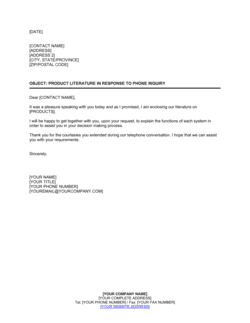
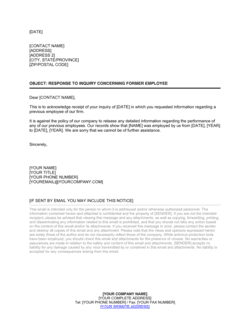
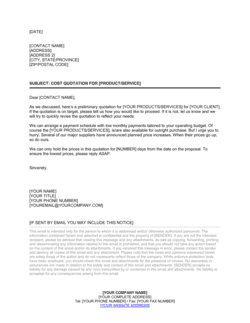
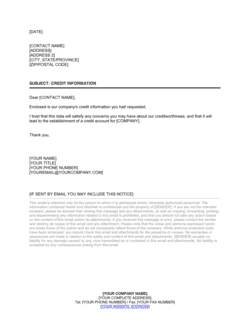
Standard Cover Letter in Response to Inquiry Template

Free Word download β€’ Edit online β€’ Save & share with Drive β€’ Export to PDF

1 pageβ€’15–25 min to fillβ€’Difficulty: Standard
Learn more ↓
FreeStandard Cover Letter in Response to Inquiry Template

At a glance

What it is
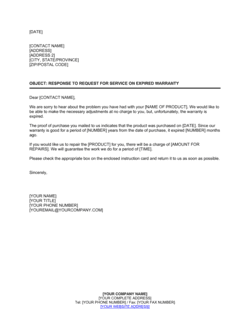
A Standard Cover Letter In Response To Inquiry is a formal business letter sent to acknowledge and answer a request for information received from a prospective client, partner, or stakeholder. This free Word download gives you a ready-to-edit structure you can complete in minutes and export as PDF before sending by email or post.
When you need it
Use it whenever someone has contacted your business requesting product details, pricing, service information, or general company information and you need to respond in a professional, organized format that represents your brand credibly.
What's inside
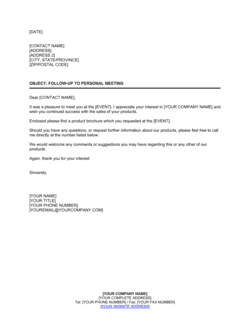
Sender and recipient details, a reference line tying the letter to the original inquiry, an acknowledgment opening, a body that delivers the requested information clearly, a call-to-action closing, and a professional sign-off with contact details.

What is a Standard Cover Letter In Response To Inquiry?

A Standard Cover Letter In Response To Inquiry is a formal business letter sent to a prospective client, partner, or stakeholder who has previously requested information about your products, services, or organization. It acknowledges the original inquiry by name and date, delivers the requested details clearly and professionally, and closes with a specific next step to move the relationship forward. Unlike a cold outreach letter, this document responds to expressed interest β€” making it one of the highest-conversion pieces of written communication in a standard sales or business development process.

Why You Need This Document

Failing to respond to an inquiry promptly and professionally is one of the most common ways businesses lose warm leads. A disorganized or delayed reply signals poor operations; no reply at all signals indifference. A well-structured response letter confirms that your organization takes the prospect's time seriously, delivers the information they need to make a decision, and tells them exactly how to take the next step. Without a consistent template, response quality varies by sender β€” one team member writes three paragraphs of company history before answering the question, another forgets to include pricing, a third sends a one-liner with no contact details. This template standardizes every response to ensure your brand's first written impression is always clear, complete, and professional.

Which variant fits your situation?

If your situation is…Use this template
Responding to a job applicant who submitted a general applicationCover Letter Acknowledgment
Following up after sending a quote or proposalFollow-Up Letter After Proposal
Acknowledging receipt of a complaint and promising a responseAcknowledgment of Complaint Letter
Sending information proactively to a new prospectSales Introduction Letter
Responding to a request for proposal (RFP)Business Proposal
Replying to a media or press inquiryPress Release
Responding to a legal or compliance inquiryFormal Response Letter (Legal)

Common mistakes to avoid

❌ Omitting a specific reference to the original inquiry

Why it matters: Recipients often send multiple inquiries to multiple vendors. A letter with no reference line or acknowledgment of what was asked creates confusion and delays follow-up.

Fix: Always include a 'Re:' line and restate the subject of the inquiry in the opening paragraph so the recipient immediately knows the letter is a direct reply to their message.

❌ Burying the answer in the second or third paragraph

Why it matters: Busy decision-makers skim letters. If the key information β€” pricing, availability, or product details β€” appears late, they may miss it entirely and follow up again.

Fix: Lead the body with the most important piece of information the recipient asked for. Supporting context and company background come after.

❌ No call to action at the close

Why it matters: A response letter that ends with 'We hope this helps' leaves the sales conversation stalled. The recipient has no clear prompt to move forward.

Fix: Close with a specific, low-friction next step β€” a named contact, a direct phone number, and a suggested action like scheduling a call or requesting a sample.

❌ Using a generic greeting when the sender's name is known

Why it matters: 'To Whom It May Concern' signals that the letter is a form response, which reduces the perceived quality of your reply and can damage first impressions.

Fix: Always use the inquirer's name in the salutation. If only a first name is available, use it rather than defaulting to a generic opening.

The 9 key clauses, explained

Sender information and letterhead

In plain language: Your company name, address, phone, email, and website displayed at the top of the letter, typically using your official letterhead.

Sample language
[COMPANY NAME] | [STREET ADDRESS] | [CITY, STATE, ZIP] | [PHONE] | [EMAIL] | [WEBSITE]

Common mistake: Sending the letter from a generic email address or without company branding β€” this undermines credibility and makes it hard for the recipient to follow up.

Date and recipient address block

In plain language: The date the letter is written and the recipient's full name, title, company, and mailing address.

Sample language
[DATE] [RECIPIENT NAME] [RECIPIENT TITLE] [COMPANY NAME] [STREET ADDRESS] [CITY, STATE, ZIP]

Common mistake: Using only the recipient's first name in the address block. Always include full name and title for formal correspondence.

Reference line

In plain language: A short subject line that identifies the inquiry the letter is responding to β€” usually including the date of the original inquiry or a reference number.

Sample language
Re: Your Inquiry of [DATE] Regarding [SUBJECT / PRODUCT / SERVICE NAME]

Common mistake: Omitting the reference line entirely. Without it, the recipient must read the entire letter to understand its purpose, and filing or routing is harder.

Salutation

In plain language: The opening greeting addressed to the specific person who made the inquiry.

Sample language
Dear [MR. / MS. / DR.] [LAST NAME]:

Common mistake: Using 'To Whom It May Concern' when the inquirer's name is known. A named salutation is always more professional and signals that you read the original message.

Opening acknowledgment

In plain language: The first paragraph that thanks the recipient for their inquiry, references what they asked about, and signals that the letter is providing the requested information.

Sample language
Thank you for your inquiry of [DATE] regarding [PRODUCT / SERVICE / TOPIC]. We are pleased to provide the information you requested.

Common mistake: Opening with a lengthy company history instead of directly acknowledging the inquiry. Readers want confirmation that their request was received and understood before anything else.

Information delivery body

In plain language: The main section of the letter that directly answers the inquiry β€” describing the product, service, pricing, terms, or other details the recipient asked for.

Sample language
[COMPANY NAME] offers [PRODUCT / SERVICE DESCRIPTION]. Our standard pricing begins at [PRICE / RATE], and [KEY FEATURE OR BENEFIT]. Enclosed please find our current [BROCHURE / CATALOG / PRICE LIST] for your review.

Common mistake: Burying the key information in the third or fourth paragraph. Lead with the most relevant answer to the inquiry; supporting detail follows.

Call-to-action closing

In plain language: A sentence that tells the recipient what to do next β€” schedule a call, visit the website, request a demo, or contact a specific person.

Sample language
We would welcome the opportunity to discuss your needs further. Please contact [NAME] at [PHONE / EMAIL] to schedule a call at your convenience, or visit [WEBSITE] for additional information.

Common mistake: Ending with a passive statement like 'We hope this information is helpful' with no next step. This leaves the conversation stalled and reduces response rates.

Complimentary close and signature block

In plain language: The sign-off phrase, the sender's handwritten or digital signature, and their printed name, title, and direct contact information.

Sample language
Sincerely, [SENDER NAME] [SENDER TITLE] [COMPANY NAME] [DIRECT PHONE] | [EMAIL]

Common mistake: Using an informal close like 'Thanks!' or 'Cheers' in a formal business response letter. 'Sincerely,' 'Best regards,' or 'Yours truly,' are appropriate for this context.

Enclosure and CC notation

In plain language: A line at the bottom noting any documents attached and any additional recipients copied on the correspondence.

Sample language
Enclosures: [BROCHURE / PRICE LIST / PRODUCT SHEET] CC: [NAME, TITLE]

Common mistake: Referencing enclosed materials in the body of the letter but forgetting to add the enclosure notation β€” or forgetting to actually attach the documents.

How to fill it out

  1. 1

    Add your letterhead and sender details

    Replace the placeholder letterhead with your company name, logo, address, phone, email, and website. Confirm these details match your current contact information.

    πŸ’‘ Save a pre-filled version of the template with your letterhead as a master file so you only need to update the recipient and content for each new response.

  2. 2

    Enter the date and recipient's address block

    Enter today's date in full (e.g., May 2, 2026) and the recipient's complete name, title, company, and mailing address. Use their full legal name, not a nickname.

    πŸ’‘ If you are sending by email rather than post, include the recipient's address block anyway β€” it maintains the formal letter format and is expected in professional correspondence.

  3. 3

    Write the reference line

    Add a 'Re:' line that identifies the date and subject of the original inquiry. If the sender assigned a reference or ticket number, include it here.

    πŸ’‘ Keep the reference line to one line. 'Re: Your Inquiry of April 28, 2026 Regarding Widget Pricing' is sufficient.

  4. 4

    Personalize the salutation

    Address the letter to the specific individual who made the inquiry using their last name and appropriate title (Mr., Ms., Dr.). If you only have a first name, use it rather than defaulting to a generic greeting.

    πŸ’‘ If you are unsure of a person's preferred title or gender, use their full name: 'Dear Jordan Smith:'

  5. 5

    Draft the opening acknowledgment

    In one to two sentences, thank the recipient for reaching out, reference the subject of their inquiry, and confirm you are providing the requested information.

    πŸ’‘ Avoid hollow phrases like 'It is our pleasure to inform you.' Instead, be direct: 'Thank you for your April 28 inquiry about our consulting rates.'

  6. 6

    Deliver the requested information clearly

    Write one to three paragraphs answering the inquiry directly β€” product details, service descriptions, pricing, availability, or whatever was asked. Attach supporting documents and reference them in the body.

    πŸ’‘ Use short paragraphs of three to five sentences. Long unbroken text slows reading and buries key details.

  7. 7

    Add a specific call to action and close

    Tell the recipient the exact next step β€” a phone call, demo, meeting, or follow-up email β€” with a named contact, phone number, and email address. Then add the complimentary close and your full signature block.

    πŸ’‘ Including a specific deadline or availability window ('I'm available for a 20-minute call any morning this week') increases reply rates significantly.

  8. 8

    Add enclosure and CC notations, then review

    List any documents you are attaching or enclosing. Add CC recipients if applicable. Read the full letter once for tone, spelling, and accuracy before sending.

    πŸ’‘ Read the letter from the recipient's perspective: does it answer their question quickly and make the next step obvious? If not, revise the body or CTA.

Frequently asked questions

What is a cover letter in response to an inquiry?

A cover letter in response to an inquiry is a formal business letter sent to acknowledge and answer a request for information from a prospective client, partner, or stakeholder. It confirms receipt of the original inquiry, delivers the requested information clearly, and typically includes a call to action prompting the next step in the business relationship.

When should I send a response letter instead of a reply email?

A formal letter is appropriate when the inquiry came via post, when the recipient is a corporate procurement department or government body that expects formal correspondence, or when you want to attach branded collateral such as a price list or product catalog. For most day-to-day inquiries, a professional email using the same letter structure achieves the same result. The key is matching the formality level the inquirer used.

How quickly should I respond to a business inquiry?

Responding within one business day is the standard expectation for most B2B and B2C inquiries. Studies consistently show that lead response rates drop sharply after 24 hours. If you cannot provide a full response within one business day, send a brief acknowledgment confirming receipt and a specific date by which you will follow up with complete information.

What should a cover letter in response to an inquiry include?

At minimum: your letterhead and contact details, the date, the recipient's full name and address, a reference line identifying the original inquiry, a personalized salutation, an opening acknowledgment, the substantive response to what was asked, a clear call to action, and a professional sign-off with your name and title. Enclosure notations should appear if you are attaching supporting documents.

Should I attach documents to my response letter?

Yes, if the inquiry requested specific materials such as a product catalog, price list, company brochure, or case studies. Reference the attachments in the body of the letter ('Please find our current price list enclosed') and list them in an enclosure notation at the bottom. Do not attach documents that were not requested β€” it adds noise and may appear presumptuous.

Can I use this letter template for email responses?

Yes. The block-format letter structure works well as an email body for formal business correspondence. Paste the text directly into the email, omit the mailing address block if corresponding electronically, and keep the reference line as the email subject. Attaching a PDF version of the signed letter is common practice when corresponding with larger organizations.

How formal should the tone of a response letter be?

Match the tone to your industry and the relationship. A law firm or financial institution should use fully formal language throughout. A creative agency or tech startup can adopt a professional but conversational tone while maintaining correct structure. In all cases, avoid slang, contractions in formal sentences, and humor β€” the letter represents your brand to someone who has not yet become a client.

What is the difference between a response letter and a proposal?

A response letter answers an inquiry by delivering information that was requested β€” pricing, product details, availability. A proposal is a formal offer document that outlines a specific scope of work, pricing, timeline, and terms for the recipient to accept or negotiate. A response letter often precedes a proposal: you answer the inquiry, then follow up with a proposal if the prospect shows continued interest.

How this compares to alternatives

vs Sales Introduction Letter

A sales introduction letter is sent proactively to a prospect with no prior contact β€” it initiates the conversation. A cover letter in response to an inquiry is reactive β€” it answers a question the prospect already asked. The response letter has a warmer starting point because the recipient already expressed interest, making it more likely to convert.

vs Business Proposal

A business proposal is a formal offer document that specifies scope, pricing, timeline, and contractual terms for the prospect to accept or negotiate. A response letter is shorter, less structured, and focuses on delivering requested information rather than making a binding offer. The response letter typically precedes the proposal in the sales process.

vs Letter of Interest

A letter of interest is sent by a prospective buyer, job applicant, or partner to express interest in an opportunity β€” it initiates contact. A cover letter in response to an inquiry is sent by the receiving party to answer that expression of interest. They are mirror documents: one opens the conversation, the other continues it.

vs Acknowledgment Letter

An acknowledgment letter simply confirms receipt of a document, application, or message without delivering substantive information in return. A cover letter in response to an inquiry goes further β€” it acknowledges and then answers. Use an acknowledgment letter when you need more time to gather information; use the response letter when you are ready to deliver it.

Industry-specific considerations

Professional Services

Consultants and agencies use response letters to answer service scope and rate inquiries before moving to a formal proposal.

Manufacturing and Wholesale

Manufacturers respond to product specification, MOQ, and pricing inquiries with letters that attach technical data sheets and current price lists.

Real Estate

Brokers and property managers use formal response letters to answer lease or purchase inquiries and attach available listings or property information packages.

Retail and E-commerce

Retailers reply to bulk order, wholesale account, or vendor partnership inquiries with structured letters that include terms and product catalog enclosures.

Template vs pro β€” what fits your needs?

PathBest forCostTime
Use the templateSmall businesses, freelancers, and sales teams responding to standard product or service inquiriesFree10–15 minutes per letter
Template + professional reviewBusinesses responding to high-value or complex inquiries where wording and tone are critical to the outcome$50–$150 (copywriter or senior colleague review)1–2 hours
Custom draftedEnterprise sales teams needing a library of tailored response letters for multiple product lines or market segments$300–$800 (professional copywriter)1–3 days

Glossary

Reference Line
A line near the top of a business letter that identifies the subject or original inquiry the letter is responding to, making it easy to file and track.
Salutation
The opening greeting of a letter, typically 'Dear [Name]:' β€” using a named individual is more professional than a generic greeting.
Body Paragraph
The main text section of a letter where the substantive information, response, or message is communicated.
Call to Action (CTA)
A sentence or instruction near the close of a letter that tells the reader exactly what to do next β€” schedule a call, visit a link, or reply by a certain date.
Complimentary Close
The sign-off phrase before the signature, such as 'Sincerely,' or 'Best regards,' that marks the formal end of the letter.
Enclosure Notation
A line at the bottom of a letter indicating that additional documents β€” such as a brochure, price list, or spec sheet β€” are included with the letter.
Block Format
The standard business letter layout in which all elements are left-aligned with no indentation, separated by blank lines between paragraphs.
Letterhead
A preprinted or formatted header at the top of a business letter containing the company name, logo, address, phone number, and website.
Carbon Copy (CC)
A notation at the bottom of a letter indicating additional recipients who received a copy, keeping relevant parties informed.

Part of your Business Operating System

This document is one of 3,000+ business & legal templates included in Business in a Box.

  • Fill-in-the-blanks β€” ready in minutes
  • 100% customizable Word document
  • Compatible with all office suites
  • Export to PDF and share electronically

Create your document in 3 simple steps.

From template to signed document β€” all inside one Business Operating System.
1
Download or open template

Access over 3,000+ business and legal templates for any business task, project or initiative.

2
Edit and fill in the blanks with AI

Customize your ready-made business document template and save it in the cloud.

3
Save, Share, Send, Sign

Share your files and folders with your team. Create a space of seamless collaboration.

Save time, save money, and create top-quality documents.

β˜…β˜…β˜…β˜…β˜…

"Fantastic value! I'm not sure how I'd do without it. It's worth its weight in gold and paid back for itself many times."

Managing Director Β· Mall Farm
Robert Whalley
Managing Director, Mall Farm Proprietary Limited
β˜…β˜…β˜…β˜…β˜…

"I have been using Business in a Box for years. It has been the most useful source of templates I have encountered. I recommend it to anyone."

Business Owner Β· 4+ years
Dr Michael John Freestone
Business Owner
β˜…β˜…β˜…β˜…β˜…

"It has been a life saver so many times I have lost count. Business in a Box has saved me so much time and as you know, time is money."

Owner Β· Upstate Web
David G. Moore Jr.
Owner, Upstate Web

Run your business with a system β€” not scattered tools

Stop downloading documents. Start operating with clarity. Business in a Box gives you the Business Operating System used by over 250,000 companies worldwide to structure, run, and grow their business.

Start freeΒ Β·Β No credit card required