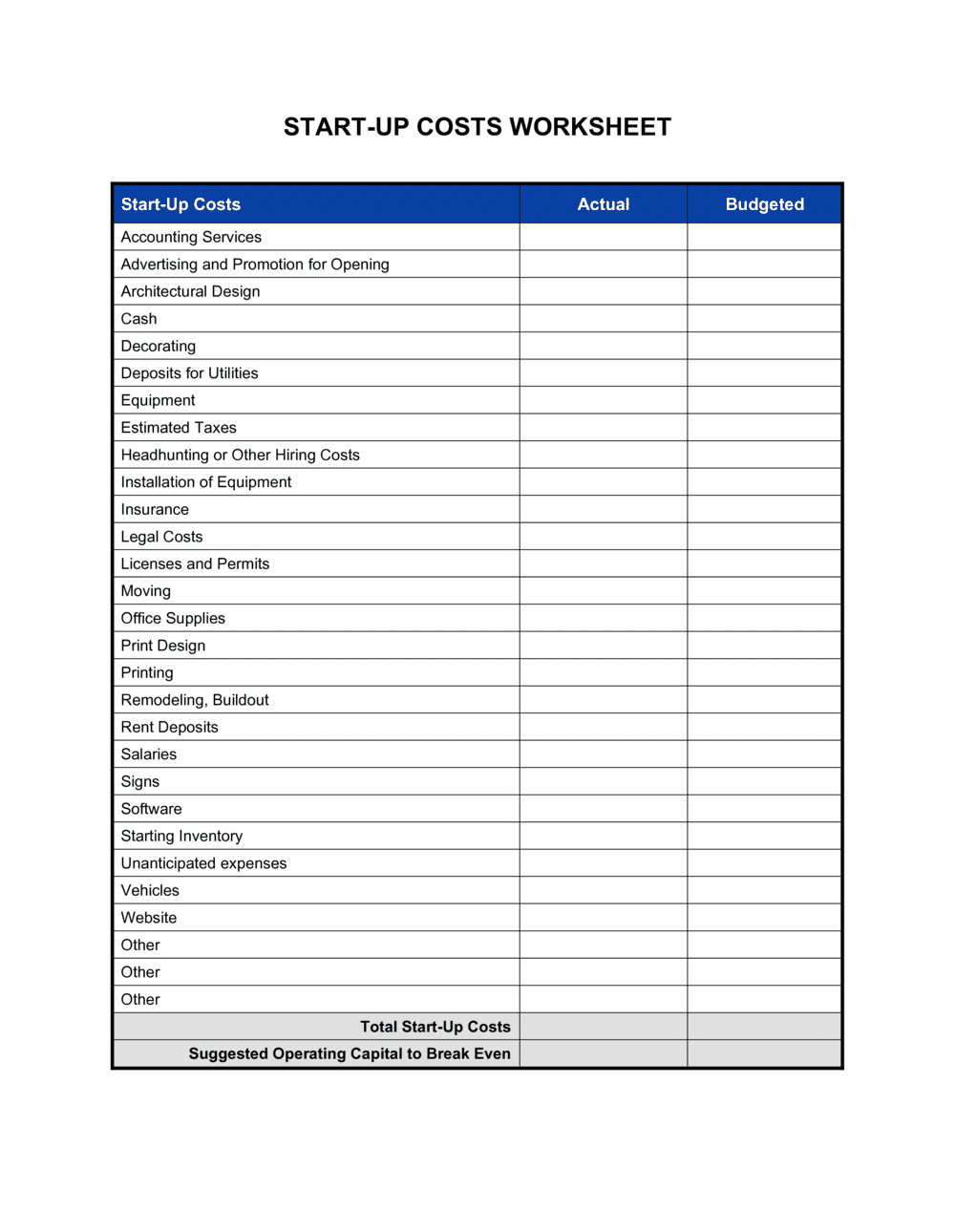
Worksheet_Start-Up Costs

Free download β€’ Use as a template β€’ Print or share

1 pageβ€’20–30 min to useβ€’Difficulty: Standardβ€’Signature requiredβ€’Legal review recommended
Learn more ↓
FreeWorksheet_Start-Up Costs Template

At a glance

What it is
A Startup Costs Worksheet is a structured financial document that itemizes every one-time and recurring expense a business must fund before it can open its doors and reach its first month of operations. This free Word download gives founders, lenders, and investors a single auditable record of estimated capital requirements β€” organized by expense category, funding source, and timing β€” that you can edit online and export as PDF.
When you need it
Use it before you commit capital, apply for a loan, pitch investors, or register your business entity. It is the financial foundation that every other planning document β€” your business plan, cash flow forecast, and funding ask β€” should be built on top of.
What's inside
One-time setup costs, recurring pre-launch expenses, equipment and inventory requirements, working capital reserve, funding source allocations, and a signed certification that the estimates are accurate to the best of the preparer's knowledge β€” making it suitable for submission to banks, the SBA, and angel investors.

What is a Startup Costs Worksheet?

A Startup Costs Worksheet is a structured financial planning document that itemizes every expense a new business must fund before it can begin generating revenue β€” from entity formation fees and leasehold improvements to opening inventory, pre-launch marketing, and working capital reserves. Unlike a cash flow forecast, which begins at the point of first revenue, the startup costs worksheet captures the full capital requirement of the pre-launch phase and maps each cost to a specific funding source: owner equity, bank loan, SBA financing, investor capital, or grants. Signed by the preparer, it functions as both an internal planning tool and a formal financial disclosure submitted to lenders, the SBA, franchisors, and investors.

Why You Need This Document

Without a complete, signed startup costs worksheet, lenders cannot approve a loan, the SBA cannot process a 7(a) or 504 application, and investors have no basis for evaluating whether a founder's capital plan is realistic. Founders who skip this step consistently encounter the same crisis: a funding gap that surfaces 60 to 90 days after launch when actual costs exceed informal estimates by 20 to 40%. The consequences are concrete β€” payroll shortfalls, unpaid suppliers, and emergency borrowing at unfavorable rates that compress already-thin startup margins. A properly completed worksheet eliminates that gap before launch by forcing every cost category into the open, sizing the working capital reserve against a worst-case revenue scenario, and adding a contingency buffer that converts cost overruns from crises into planned events. This template gives you the structure to do all of that in a single afternoon β€” and the signed certification block that transforms your estimates into a document lenders and investors will actually accept.

Which variant fits your situation?

If your situation is…Use this template
Opening a physical retail or food-service locationRetail Startup Costs Worksheet
Launching a SaaS or software productTech Startup Budget Template
Applying for an SBA 7(a) or 504 loanSBA Loan Business Plan with Startup Costs
Planning ongoing monthly operating expenses post-launchOperating Budget Template
Projecting revenue alongside startup costs12-Month Financial Projections Template
Presenting capital needs to angel or venture investorsInvestor Business Plan
Tracking actual spend against initial estimates post-launchExpense Report Template

Common mistakes to avoid

❌ Leaving the certification block unsigned

Why it matters: An unsigned worksheet cannot be submitted to a bank or the SBA as supporting documentation; it will be returned, delaying the loan timeline by days or weeks.

Fix: Sign and date the certification block before finalizing the document, and ensure any co-founders or guarantors listed also sign where required.

❌ Omitting the working capital reserve entirely

Why it matters: Without a cash buffer, a single delayed revenue payment or unexpected expense in the first 90 days can make payroll or rent payments impossible β€” forcing an emergency loan or closure.

Fix: Add a dedicated working capital line equal to at least three months of projected operating expenses, and treat it as a non-negotiable cost category, not an optional buffer.

❌ Using a single lump sum for equipment

Why it matters: Lenders and the SBA require an itemized equipment list β€” a single line reading 'equipment: $45,000' triggers a documentation request and stalls the application.

Fix: List every equipment item individually with vendor name, model, and quoted price; attach vendor quotes for any item over $500.

❌ Excluding pre-opening soft costs like legal fees and branding

Why it matters: Founders who omit soft costs routinely face a 15–25% cost overrun in the first month when invoices arrive from lawyers, accountants, and designers.

Fix: Build a dedicated soft-costs section covering legal, accounting, branding, website, and professional services β€” budget $3,000–$15,000 minimum even for simple businesses.

❌ Calculating working capital from optimistic revenue projections

Why it matters: If revenue takes twice as long to reach breakeven as projected, an optimistically sized working capital reserve is exhausted before the business can self-fund.

Fix: Always size working capital from the zero-revenue scenario: monthly fixed costs multiplied by the number of months to breakeven under your conservative case.

❌ No contingency reserve line

Why it matters: Startup costs in real projects consistently run 20–40% over initial estimates; a worksheet with no contingency presents a false picture of capital adequacy to lenders and investors.

Fix: Add a contingency line of at least 10% of total costs β€” 15 to 20% if any major element (build-out, equipment import) has high variance β€” and explain the basis to reviewers.

The 10 key clauses, explained

Preparer identification and certification

In plain language: Identifies who prepared the worksheet, their role, the business entity, and includes a signed statement that all estimates are made in good faith and to the best of the preparer's knowledge.

Sample language
Prepared by: [PREPARER NAME], [TITLE], on behalf of [BUSINESS LEGAL NAME], a [ENTITY TYPE] organized in [STATE/PROVINCE]. I certify that the cost estimates contained herein are accurate and complete to the best of my knowledge as of [DATE].

Common mistake: Leaving the certification unsigned or undated before submitting to a lender. An unsigned worksheet is treated as informal and can stall or invalidate a loan application.

Business description and launch date

In plain language: States the nature of the business, the planned launch date, and the geographic location or market served β€” providing context for the cost estimates that follow.

Sample language
[BUSINESS NAME] will operate as a [DESCRIPTION OF BUSINESS] serving [TARGET MARKET] in [CITY/REGION], with a planned launch date of [DATE].

Common mistake: Omitting the planned launch date, which prevents lenders from assessing the disbursement timeline and leaves working capital calculations without an anchor.

One-time setup and formation costs

In plain language: Lists all non-recurring costs to legally establish the business: entity registration, permits, licenses, legal fees, and initial professional services.

Sample language
Entity formation (LLC/Corp): $[AMOUNT] | Business licenses and permits: $[AMOUNT] | Legal and professional fees: $[AMOUNT] | Trademark registration: $[AMOUNT] | Total: $[SUBTOTAL]

Common mistake: Underestimating permit and licensing costs by relying on a single government website. Municipal, state/provincial, and federal requirements stack β€” total permit costs commonly run 2 to 3 times the initial estimate.

Facility and leasehold costs

In plain language: Covers security deposits, first and last month's rent, build-out costs, signage, and any leasehold improvements required before opening.

Sample language
Security deposit: $[AMOUNT] | First/last month rent: $[AMOUNT] | Leasehold improvements: $[AMOUNT] | Signage: $[AMOUNT] | Total: $[SUBTOTAL]

Common mistake: Budgeting only for the security deposit and ignoring build-out costs. Leasehold improvements on commercial space typically cost $30–$150 per square foot and represent the single largest startup cost category for retail and food-service businesses.

Equipment and technology costs

In plain language: Itemizes all hardware, machinery, software, and technology infrastructure purchases required before the business can operate.

Sample language
Equipment (itemized): $[AMOUNT] | Point-of-sale system: $[AMOUNT] | Computers and peripherals: $[AMOUNT] | Software licenses (annual): $[AMOUNT] | Total: $[SUBTOTAL]

Common mistake: Listing equipment as a single lump sum rather than itemizing. Lenders and the SBA require itemized equipment lists; a lump sum triggers a request for documentation and delays approval.

Inventory and supplies

In plain language: Estimates the initial product inventory or raw materials needed to open and operate through the first 30 to 60 days of business.

Sample language
Opening inventory (itemized by category): $[AMOUNT] | Packaging and supplies: $[AMOUNT] | Safety and compliance consumables: $[AMOUNT] | Total: $[SUBTOTAL]

Common mistake: Estimating opening inventory without modeling sell-through rate. Overstocking ties up cash; understocking creates stockouts in the first weeks β€” both damage the business before it gains traction.

Marketing and pre-launch promotion

In plain language: Budgets for branding, website development, pre-opening advertising, grand-opening events, and initial digital marketing spend.

Sample language
Logo and brand identity: $[AMOUNT] | Website design and development: $[AMOUNT] | Pre-launch advertising: $[AMOUNT] | Grand opening event: $[AMOUNT] | Total: $[SUBTOTAL]

Common mistake: Treating marketing as a discretionary line item that can be cut if other costs run over. Pre-launch marketing spend directly drives opening-day revenue β€” cutting it reduces the revenue that offsets all other startup costs.

Working capital reserve

In plain language: Sets aside 3 to 6 months of projected operating expenses as a cash buffer to cover payroll, rent, and fixed costs before revenue reaches breakeven.

Sample language
Monthly operating expenses (from Operating Budget): $[AMOUNT] | Reserve months: [NUMBER] | Working capital reserve: $[TOTAL] (= Monthly Expenses Γ— Reserve Months)

Common mistake: Calculating working capital based on optimistic revenue projections rather than the no-revenue scenario. If the business takes longer to reach breakeven β€” which it almost always does β€” an underfunded reserve creates a cash crisis within 90 days of opening.

Funding sources and gap analysis

In plain language: Maps each category of startup costs to a specific funding source β€” owner equity, bank loan, SBA loan, investor capital, or grants β€” and identifies the remaining funding gap.

Sample language
Owner equity contribution: $[AMOUNT] | SBA / bank loan: $[AMOUNT] | Investor capital: $[AMOUNT] | Grants / other: $[AMOUNT] | Total funding committed: $[TOTAL] | Funding gap (costs minus committed funding): $[GAP]

Common mistake: Showing total costs and total funding as equal without reconciling them line by line. Lenders cross-check every category β€” an unexplained matching total without line-level sourcing is a red flag.

Contingency reserve

In plain language: Adds a defined percentage buffer β€” typically 10 to 20% of total estimated costs β€” to cover cost overruns, delayed timelines, or unplanned expenses.

Sample language
Total estimated startup costs: $[SUBTOTAL] | Contingency reserve ([10–20]%): $[AMOUNT] | Grand total capital required: $[GRAND TOTAL]

Common mistake: Omitting the contingency line entirely to make the funding ask appear smaller. First-time founders routinely underestimate startup costs by 20 to 40%; no contingency buffer converts minor overruns into funding crises.

How to fill it out

  1. 1

    Complete the preparer identification block

    Enter your full legal name, title, the registered business name and entity type, and today's date. Do not leave this section blank β€” a signed, dated worksheet is required by most lenders.

    πŸ’‘ Use the exact legal entity name as it appears on your articles of incorporation or organization, not a trade name.

  2. 2

    Set the planned launch date and business description

    Write one to two sentences describing what the business does and who it serves. Enter the projected first day of revenue-generating operations as a specific calendar date.

    πŸ’‘ Build your launch date with a 30-day buffer beyond your most optimistic timeline β€” permitting and build-out almost always run long.

  3. 3

    Itemize one-time formation and setup costs

    List every legal, registration, and professional-service cost to establish the entity. Research actual fee schedules from your state/provincial registry and local licensing authority rather than estimating.

    πŸ’‘ Call your county or municipality directly for permit fees β€” online fee schedules are frequently out of date and exclude local surcharges.

  4. 4

    Estimate facility and leasehold improvement costs

    Get at least two contractor quotes for any build-out work before entering a number. Include the full security deposit, first and last month's rent, and any fit-out contribution the landlord will not cover.

    πŸ’‘ Ask the landlord for a tenant improvement (TI) allowance before finalizing your cost estimate β€” TI allowances of $20–$50 per square foot are negotiable in most commercial leases.

  5. 5

    List equipment, technology, and software line by line

    Enter each piece of equipment, hardware, and software with its individual cost. Attach or reference vendor quotes for any item over $500.

    πŸ’‘ Check whether leasing equipment rather than purchasing it reduces your upfront capital requirement while preserving cash for working capital.

  6. 6

    Calculate the working capital reserve

    Take your total monthly operating expenses from your operating budget and multiply by the number of months you expect to operate before revenue covers costs β€” use a minimum of three months even if you expect to break even sooner.

    πŸ’‘ Model both a base case and a 6-month reserve scenario. Presenting both to a lender demonstrates capital discipline and reduces perceived risk.

  7. 7

    Map costs to funding sources and calculate the gap

    Assign each cost category to its funding source β€” equity, loan, investor, grant. Sum all committed funding and subtract from total costs to identify the funding gap you still need to close.

    πŸ’‘ If the funding gap is more than 30% of total costs, resolve it before submitting the worksheet to any lender β€” applications with large uncommitted gaps are routinely declined.

  8. 8

    Add the contingency reserve and sign

    Calculate 10 to 20% of your total estimated costs, add it as the final line, and compute the grand total capital required. Sign and date the certification block before sharing or submitting.

    πŸ’‘ Use 15% for a first-time business in a new market; 10% is defensible only if you have prior experience in the same industry and location type.

Frequently asked questions

What is a startup costs worksheet?

A startup costs worksheet is a structured financial document that lists every one-time and pre-launch recurring expense a new business must fund before it can begin operations. It organizes costs by category β€” formation, facility, equipment, inventory, marketing, and working capital β€” maps each to a funding source, and calculates the total capital required. Lenders, the SBA, and investors use it to evaluate whether a founder's capital plan is complete and realistic.

What costs should be included in a startup costs worksheet?

A complete worksheet includes entity formation and legal fees, permits and licenses, facility security deposit and leasehold improvements, equipment and technology purchases, opening inventory, pre-launch marketing and branding, professional services (accounting, consulting), working capital reserve for 3 to 6 months of operating expenses, and a contingency buffer of 10 to 20%. Omitting any major category creates a funding gap that surfaces as a cash crisis after launch.

Do I need to sign a startup costs worksheet?

Yes, when the worksheet is submitted to a lender, the SBA, a franchisor, or an investor, the preparer must sign and date the certification block attesting that all estimates are made in good faith. An unsigned worksheet is treated as informal supporting material rather than a binding financial disclosure and will typically be returned for signature before processing.

How much working capital reserve should I include?

A minimum of three months of projected operating expenses is the standard starting point; six months is recommended for businesses with uncertain early revenue, seasonal demand, or long sales cycles. Calculate working capital from your fixed monthly costs in a zero-revenue scenario β€” not from projected revenue β€” so the reserve is sized for the worst case, not the best case.

Can startup costs be deducted for tax purposes?

In the United States, the IRS allows a deduction of up to $5,000 of qualifying startup costs in the first year of business, with the remainder amortized over 180 months under IRC Section 195. The deduction phases out when total startup costs exceed $50,000. In Canada, eligible startup costs may be treated as pre-production expenses and amortized. Always consult a tax professional for your specific situation, as classification rules vary.

How is a startup costs worksheet different from a business plan?

A startup costs worksheet focuses exclusively on the capital required to launch β€” it is one financial component of a broader business plan. A full business plan adds market analysis, competitive positioning, operating strategy, management team profiles, and multi-year financial projections. Lenders typically require both: the worksheet to verify the funding ask, and the business plan to assess viability and repayment capacity.

What is a contingency reserve and how much should it be?

A contingency reserve is a budget buffer added to total startup costs to absorb overruns, delayed timelines, and unplanned expenses. Use 10% for straightforward businesses in familiar markets where most costs are vendor-quoted; use 15 to 20% when any major cost category β€” build-out, imported equipment, or custom software β€” carries meaningful variance. Omitting it entirely is one of the most common causes of first-year cash crises.

Do investors or lenders require a startup costs worksheet?

Yes. The SBA requires a sources-and-uses-of-funds statement as part of every 7(a) and 504 loan application β€” the startup costs worksheet is the most common format used to satisfy this requirement. Commercial banks and credit unions request the same documentation. Angel investors and accelerators use it to evaluate a founder's financial literacy and capital discipline before committing funds.

How often should a startup costs worksheet be updated?

Update it every time a material cost changes β€” when you receive an actual contractor quote to replace an estimate, when a permit fee differs from the published schedule, or when the launch date shifts. Submit the most current signed and dated version with every financing application. A worksheet based on estimates made more than six months before the projected launch date will typically be questioned by underwriters.

How this compares to alternatives

vs Business Plan

A business plan provides the full strategic and financial context β€” market analysis, competitive positioning, operations, management team, and multi-year projections. A startup costs worksheet is a single financial component of that plan, focused exclusively on the capital needed to launch. Lenders require both: the worksheet to validate the funding ask, and the plan to assess repayment capacity.

vs Operating Budget

A startup costs worksheet captures the one-time and pre-launch expenses needed to open the business. An operating budget projects the ongoing monthly revenues and expenses once operations begin. They are complementary: the working capital reserve on the startup worksheet is sized using the monthly expense total from the operating budget.

vs 12-Month Financial Projections

Financial projections model expected revenue and expenses month by month after launch. A startup costs worksheet documents the capital required before the first dollar of revenue arrives. The two documents work in sequence: use the worksheet to plan and fund the launch, then use projections to manage the first year of operations.

vs Expense Report

An expense report records actual spending that has already occurred β€” typically for employee reimbursement or bookkeeping purposes. A startup costs worksheet is a forward-looking planning document built from estimates before launch. Once the business opens, actual startup expenditures should be reconciled against the worksheet to identify overruns and adjust working capital accordingly.

Industry-specific considerations

Retail and food service

Leasehold improvements and equipment dominate the worksheet, often representing 60 to 70% of total startup costs; TI allowance negotiations directly reduce the capital requirement.

Professional services

Startup costs are relatively low and weighted toward soft costs β€” licensing, professional liability insurance, and office setup β€” making the working capital reserve the largest single line item.

SaaS and technology

Development costs, cloud infrastructure setup, and software tooling are the primary hard costs; the worksheet must distinguish between capitalizable development costs and operating expenses for tax and investor purposes.

Manufacturing

Equipment purchases, facility build-out to code, and raw material inventory create the largest startup cost exposure; equipment financing and SBA 504 loans are frequently used to reduce equity requirements.

Healthcare and medical

Licensing, credentialing, HIPAA compliance infrastructure, and malpractice insurance represent significant soft costs that first-time practice owners routinely underestimate.

Food and beverage

Health department permits, commercial kitchen equipment, and initial food inventory must all be itemized; many jurisdictions require a completed cost worksheet before issuing a food-service operating permit.

Jurisdictional notes

United States

The SBA requires a sources-and-uses statement β€” typically satisfied by a signed startup costs worksheet β€” for all 7(a) and 504 loan applications. IRC Section 195 governs the tax treatment of startup costs, allowing a $5,000 first-year deduction with 180-month amortization of the remainder. State and local permit fees vary widely; California, New York, and Illinois impose multi-layer licensing costs that significantly exceed national averages.

Canada

The Canada Small Business Financing Program (CSBFP) requires a detailed cost breakdown for asset-backed loans covering equipment and leasehold improvements. Pre-production and startup expenditures may be eligible for capital cost allowance (CCA) deductions under the Income Tax Act. Quebec requires all business registration documents and financial submissions to be available in French for provincially regulated entities.

United Kingdom

The British Business Bank's Start Up Loans programme requires applicants to submit a detailed startup cost forecast alongside a business plan and cash flow projection. HMRC allows pre-trading expenses incurred in the seven years before the business begins trading to be treated as if incurred on the first day of trading for tax purposes. VAT registration thresholds and sector-specific licensing costs should be included in the worksheet for relevant businesses.

European Union

EU member state business support programs β€” including those funded through ERDF regional development grants β€” typically require a certified startup cost statement as a condition of application. GDPR compliance infrastructure, including data processing agreements and privacy tooling, represents a mandatory soft cost for any EU-based business handling personal data. VAT treatment of startup costs varies by member state and whether the business will be a registered VAT trader from inception.

Template vs lawyer β€” what fits your deal?

PathBest forCostTime
Use the templateFirst-time founders and small business owners planning a single-location launch with straightforward cost categoriesFree2–4 hours
Template + legal reviewSBA or bank loan applicants, franchise buyers, or anyone submitting the worksheet as a formal financial disclosure$150–$400 (accountant or SCORE advisor review)1–3 days
Custom draftedMulti-location launches, complex build-outs with multiple contractors, or businesses in regulated industries requiring certified cost documentation$500–$2,000 (CPA or financial consultant preparation)1–2 weeks

Glossary

One-Time Startup Cost
An expense incurred once to establish the business β€” such as incorporation fees, equipment purchases, or leasehold improvements β€” that is not expected to recur monthly.
Working Capital Reserve
Cash set aside to cover operating expenses (payroll, rent, utilities) during the period between launch and the point when revenue covers costs β€” typically 3 to 6 months of expenses.
Capital Expenditure (CapEx)
Spending on physical assets with a useful life exceeding one year, such as machinery, vehicles, or computers, which are depreciated over time rather than expensed immediately.
Amortization of Startup Costs
The IRS-permitted process of deducting up to $5,000 of startup costs in Year 1 and spreading the remainder over 180 months for US tax purposes.
Leasehold Improvement
Modifications made to a rented commercial space β€” such as partitions, flooring, or electrical upgrades β€” that are typically capitalized and amortized over the lease term.
Soft Costs
Intangible or professional-service startup expenses such as legal fees, permits, branding, and website development, as opposed to hard physical asset costs.
Hard Costs
Tangible physical asset purchases β€” equipment, furniture, signage, and inventory β€” included in the startup cost estimate.
Funding Gap
The difference between total estimated startup costs and the capital the founder has already committed or secured; the amount that must be raised or financed.
Pre-Opening Expenses
Costs incurred before the business generates its first dollar of revenue, including rent during build-out, employee training wages, and pre-launch marketing.
Contingency Reserve
An additional budget buffer β€” typically 10 to 20% of total estimated costs β€” set aside for unplanned expenses that routinely arise during the startup phase.
Debt Service
The scheduled principal and interest payments on any loans used to fund startup costs, which must be factored into working capital requirements from day one.
Equity Contribution
The founder's or investor's own capital invested into the business, recorded as a funding source on the worksheet to offset the total startup cost requirement.

Part of your Business Operating System

This document is one of 3,000+ business & legal templates included in Business in a Box.

  • Fill-in-the-blanks β€” ready in minutes
  • 100% customizable Word document
  • Compatible with all office suites
  • Export to PDF and share electronically

Create your document in 3 simple steps.

From template to signed document β€” all inside one Business Operating System.
1
Download or open template

Access over 3,000+ business and legal templates for any business task, project or initiative.

2
Edit and fill in the blanks with AI

Customize your ready-made business document template and save it in the cloud.

3
Save, Share, Send, Sign

Share your files and folders with your team. Create a space of seamless collaboration.

Save time, save money, and create top-quality documents.

β˜…β˜…β˜…β˜…β˜…

"Fantastic value! I'm not sure how I'd do without it. It's worth its weight in gold and paid back for itself many times."

Managing Director Β· Mall Farm
Robert Whalley
Managing Director, Mall Farm Proprietary Limited
β˜…β˜…β˜…β˜…β˜…

"I have been using Business in a Box for years. It has been the most useful source of templates I have encountered. I recommend it to anyone."

Business Owner Β· 4+ years
Dr Michael John Freestone
Business Owner
β˜…β˜…β˜…β˜…β˜…

"It has been a life saver so many times I have lost count. Business in a Box has saved me so much time and as you know, time is money."

Owner Β· Upstate Web
David G. Moore Jr.
Owner, Upstate Web

Run your business with a system β€” not scattered tools

Stop downloading documents. Start operating with clarity. Business in a Box gives you the Business Operating System used by over 250,000 companies worldwide to structure, run, and grow their business.

Free Forever PlanΒ Β·Β No credit card required