Checklist Start-Up

Free download β€’ Use as a template β€’ Print or share

2 pagesβ€’20–25 min to useβ€’Difficulty: Standard
Learn more ↓
FreeChecklist Start-Up Template

At a glance

What it is
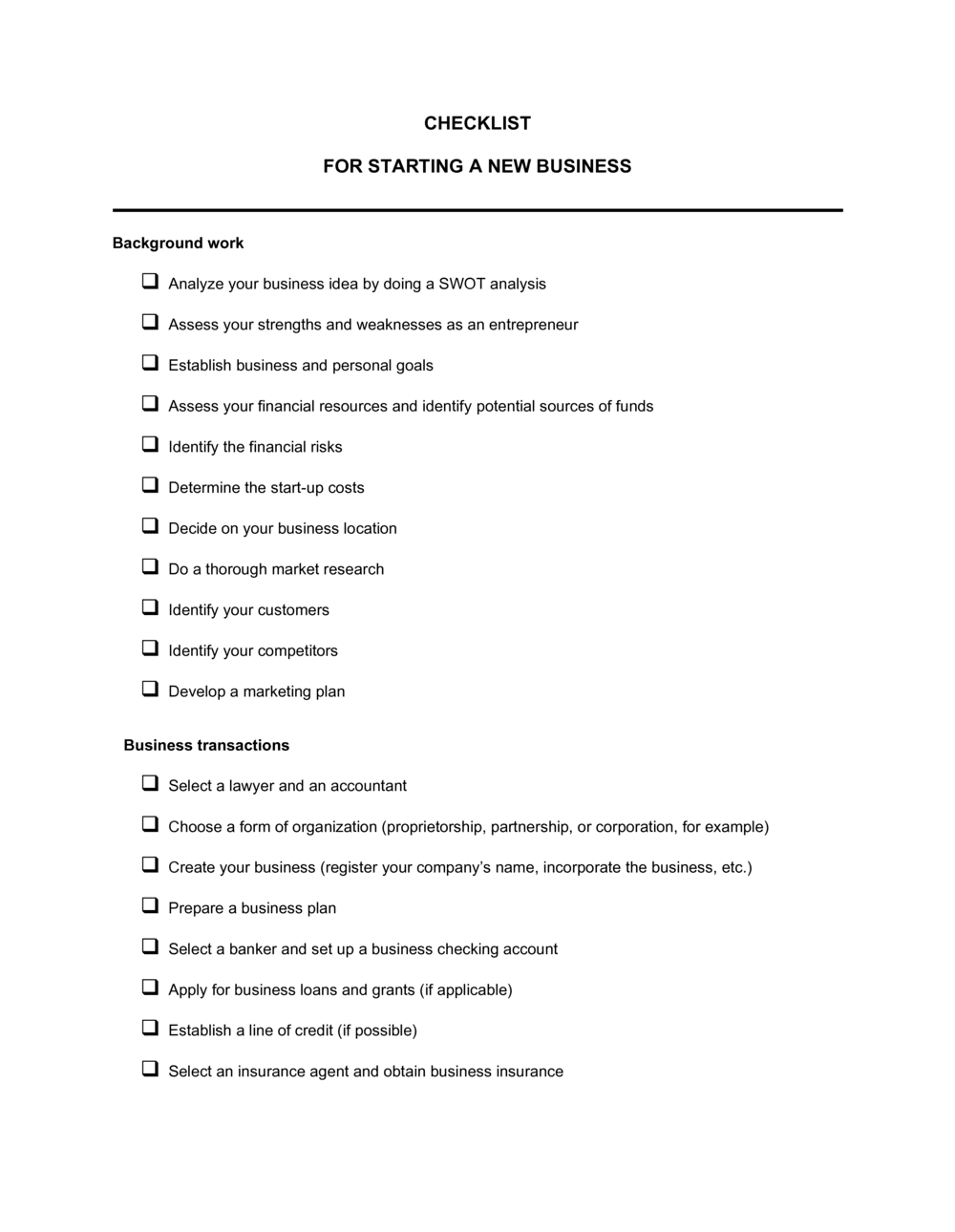
A Startup Checklist is a structured form that organizes every foundational task a new business owner must complete before and immediately after launch. This free Word download gives you a printable, editable checklist covering legal registration, financial setup, branding, operations, and marketing β€” all in a single document you can customize to your industry and edit online or export as PDF.
When you need it
Use it the moment you decide to start a business β€” before you register your entity, open a bank account, or spend a dollar on branding. It keeps pre-launch tasks visible and prevents critical steps from falling through the cracks during the chaos of a new venture launch.
What's inside
Business formation tasks, tax registration items, financial setup steps, branding and domain actions, operational prerequisites, insurance requirements, technology and tools setup, and marketing launch tasks β€” each as a discrete checkable line item with a status column.

What is a Startup Checklist?

A Startup Checklist is a structured form that organizes every legal, financial, and operational task a new business owner must complete before and immediately after launching a business. It covers entity registration, tax IDs, banking setup, licenses, insurance, branding, and foundational contracts β€” each as a discrete, checkable line item with a status field and target date. Rather than relying on memory or scattered notes during the high-pressure pre-launch period, this template gives founders a single, trackable document that makes launch progress visible and verifiable.

Why You Need This Document

Launching a business without a structured checklist means critical steps get deferred or forgotten entirely β€” and the consequences range from avoidable penalties to complete loss of liability protection. Operating without a sales tax permit triggers back taxes from the date of first sale. Commingling personal and business funds before a dedicated account is open can void the personal liability protection an LLC provides. Skipping a local business license because a state filing felt sufficient exposes the business to fines and forced closure. This template ensures every required action is captured in one place, in the right sequence, so founders can move fast without missing the steps that matter most.

Which variant fits your situation?

If your situation is…Use this template
Launching a product-based retail or e-commerce businessE-commerce Startup Checklist
Opening a food service or restaurant locationRestaurant Startup Checklist
Starting a solo consulting or freelance practiceFreelance Business Checklist
Tracking ongoing monthly operational tasks post-launchBusiness Operations Checklist
Planning a full business launch campaignProduct Launch Plan
Mapping out business strategy alongside the launch tasksBusiness Plan

Common mistakes to avoid

❌ Mixing personal and business finances from day one

Why it matters: Commingling funds eliminates the liability protection an LLC or corporation provides and creates a bookkeeping nightmare at tax time.

Fix: Open a business bank account immediately after entity formation and run every business transaction β€” income and expenses β€” through it exclusively.

❌ Skipping local business license research

Why it matters: State entity registration does not authorize you to operate at the city or county level β€” many jurisdictions issue separate local licenses with their own fees and renewal cycles.

Fix: Check your city and county government websites for local business license requirements before you open and add any required items to the checklist.

❌ Reserving a business name without checking domain availability

Why it matters: A name that is available for entity registration may already have its .com domain taken, forcing a rebrand or an expensive domain acquisition later.

Fix: Check domain availability and major social media handles before finalizing any business name, and register them on the same day the entity is formed.

❌ Treating the checklist as a one-time document

Why it matters: Licenses expire, insurance policies lapse, and registered agent information becomes outdated β€” a checklist that isn't revisited becomes a false sense of security.

Fix: Schedule a quarterly 15-minute review of the checklist to verify renewal dates, update any changed information, and add new compliance requirements.

The 9 key fields, explained

Business structure and entity registration

Federal and state tax registration

Business name registration and DBA

Business bank account and merchant account

Business licenses and permits

Registered agent designation

Insurance coverage

Branding and online presence

Key contracts and agreements in place

How to fill it out

  1. 1

    Customize the checklist to your business type

    Download the template and remove any sections that don't apply to your business model β€” a solo freelancer won't need workers' compensation insurance; a retail shop won't need a professional liability policy.

    πŸ’‘ Add a 'Target date' column next to the status column so each task has a concrete deadline, not just a checkbox.

  2. 2

    Complete entity formation tasks first

    Register your business structure with the state before tackling any other section β€” your EIN application, bank account, and most licenses require a confirmed entity registration number.

    πŸ’‘ File for your EIN online at IRS.gov immediately after your state confirms entity formation β€” it takes under 10 minutes and is free.

  3. 3

    Work through tax and permit registrations

    Apply for your EIN, state income tax registration, and sales tax permit in sequence. Check your city or county website for any local business license requirement specific to your industry or location.

    πŸ’‘ Some states require a separate state income tax registration distinct from the sales tax permit β€” confirm both are on your list before moving on.

  4. 4

    Set up dedicated business banking

    Open a business checking account and set up a merchant account or payment processor before making any business transactions. Use the account number fields to record details for your records.

    πŸ’‘ Bring your EIN confirmation letter and entity registration to the bank β€” most institutions require both to open a business account.

  5. 5

    Secure insurance coverage

    Identify which policies apply to your business (general liability, professional liability, workers' comp) and obtain quotes from at least two carriers before selecting coverage.

    πŸ’‘ Record the renewal date for each policy in the checklist β€” a lapsed policy on the day of a claim provides no coverage.

  6. 6

    Confirm branding and online presence

    Register your domain, secure matching social media handles, and set up a business email address on your own domain before any public-facing launch activity.

    πŸ’‘ Reserve social handles on every major platform even if you don't plan to use them immediately β€” handle squatting is common and recovery is difficult.

  7. 7

    Execute foundational contracts

    Finalize your operating agreement (if applicable), client services contract, and NDA template so they are ready to send before your first client engagement or vendor relationship.

    πŸ’‘ Date and sign the operating agreement on the same day the entity is formed β€” backdating later is both risky and unnecessary.

Frequently asked questions

What is a startup checklist?

A startup checklist is a structured document that lists every task a new business owner must complete to legally and operationally launch a business. It typically covers entity formation, tax registration, banking, insurance, branding, and foundational contracts β€” organized as checkable line items so nothing is missed during the high-pressure pre-launch period.

What are the most important steps when starting a business?

The foundational steps are: choose and register your legal entity structure, obtain a federal EIN, register for state and local taxes, open a dedicated business bank account, secure required licenses and permits, and put basic insurance in place. Branding and marketing can follow, but legal and financial foundations must come first.

Do I need a business license to start a business?

Most businesses require at least one license or permit β€” and often several. A general business license is required by most cities and counties, and additional industry-specific permits (health, building, professional) may apply depending on what you sell and where you operate. Check federal, state, and local requirements separately, as they are issued by different authorities.

What is an EIN and does every business need one?

An EIN (Employer Identification Number) is a federal tax ID issued by the IRS. Any business that operates as a corporation, partnership, or LLC, hires employees, or opens a business bank account will need one. Sole proprietors with no employees technically can use their SSN, but using an EIN keeps personal and business tax identities separate and is strongly recommended.

When should I register a DBA?

Register a DBA (Doing Business As) any time you operate under a name different from your legal entity name. For example, if your LLC is registered as "Smith Holdings LLC" but you want to operate as "Bright Cleaning Co.," you need a DBA filed in the appropriate county or state before using that name on invoices, signage, or bank accounts.

How long does it take to complete a business startup checklist?

The timeline depends on how quickly government agencies process filings. Entity formation takes 1–5 business days online in most states. EIN issuance is immediate online. Local licenses can take 2–6 weeks. Insurance setup typically takes 2–5 business days. Realistically, plan for 3–6 weeks from first filing to fully operational status, though some items can be completed in parallel.

Can I use this checklist for any type of business?

The core checklist covers tasks common to virtually all business types. However, certain industries require additional items β€” food service businesses need health permits, contractors need surety bonds, healthcare providers need professional licenses. Use the template as your foundation and add industry-specific rows for your particular sector.

What contracts should a new business have in place at launch?

At minimum: an operating agreement (for multi-member LLCs), a client services or sales agreement, a non-disclosure agreement template, and any vendor or supplier agreements required before operations begin. Having these drafted before your first transaction prevents disputes over terms that were never formally agreed to.

How this compares to alternatives

vs Business Plan

A business plan maps strategy, market opportunity, and financial projections for investors and lenders. A startup checklist is an operational task tracker that ensures legal and administrative foundations are in place before launch. Both are used at startup stage but serve entirely different purposes β€” the plan makes the case for the business; the checklist makes sure it is legally operational.

vs Product Launch Plan

A product launch plan coordinates marketing, distribution, and go-to-market activities for a specific product release. A startup checklist covers the legal, financial, and operational prerequisites for an entire new business. Use the checklist first to establish the business, then the launch plan to bring the first product to market.

vs Business Operations Checklist

A business operations checklist tracks recurring day-to-day or monthly operational tasks for an already-running business. A startup checklist is a one-time document covering the formation and launch tasks that only happen at the start of a business. Once the startup checklist is complete, an operations checklist takes over for ongoing management.

vs Project Plan

A project plan organizes tasks, owners, timelines, and dependencies for a defined project with a set deliverable. A startup checklist is less structured and more broadly scoped β€” it is a milestone tracker for the business launch as a whole, not a project with a single output. Use a project plan if you need assigned owners and dependencies across a team; use the checklist for solo or small-team launches.

Industry-specific considerations

Professional Services

Professional liability (E&O) insurance and state professional licensing requirements are additional checklist items beyond the standard business formation steps.

Retail and E-commerce

Sales tax permit registration across multiple states, merchant account setup, and product liability insurance are priority items unique to product-based businesses.

Food and Beverage

Health department permits, food handler certifications, and fire inspection approvals add several jurisdiction-specific steps before a food business can legally operate.

Construction and Trades

Contractor licensing, surety bond requirements, and workers' compensation insurance are mandatory checklist items in most states before any project work can begin.

Template vs pro β€” what fits your needs?

PathBest forCostTime
Use the templateFirst-time founders and small business owners launching a straightforward domestic businessFree30 minutes to customize; 3–6 weeks to complete all tasks
Template + professional reviewBusinesses in regulated industries or those launching in multiple states simultaneously$200–$500 for a one-hour session with a business attorney or accountant1–2 days to review and add jurisdiction-specific items
Custom draftedFranchise systems or accelerators building a standardized launch checklist for many operators$500–$2,000 for a consultant or attorney to build a bespoke version1–2 weeks

Glossary

Entity Formation
The legal process of registering a business structure β€” such as an LLC, corporation, or sole proprietorship β€” with the appropriate government authority.
EIN (Employer Identification Number)
A nine-digit tax ID issued by the IRS to identify a business entity for federal tax purposes β€” required to open a business bank account and hire employees.
DBA (Doing Business As)
A registered trade name used when operating a business under a name different from its legal entity name.
Operating Agreement
A document that defines ownership percentages, management roles, and decision-making rules for an LLC β€” required by law in some states.
Registered Agent
A designated individual or service that receives official legal and government correspondence on behalf of a business entity.
Business License
A permit issued by a local, state, or federal authority authorizing a business to operate legally within a specific jurisdiction or industry.
Sales Tax Permit
A state-issued registration allowing a business to collect sales tax from customers and remit it to the relevant tax authority.
NAICS Code
A six-digit industry classification code used by the US government to categorize businesses by type for statistical, tax, and regulatory purposes.
General Liability Insurance
A business insurance policy covering third-party claims for bodily injury, property damage, and advertising injury arising from business operations.
Merchant Account
A type of business bank account that allows a company to accept and process credit and debit card payments from customers.

Part of your Business Operating System

This document is one of 3,000+ business & legal templates included in Business in a Box.

  • Fill-in-the-blanks β€” ready in minutes
  • 100% customizable Word document
  • Compatible with all office suites
  • Export to PDF and share electronically

Create your document in 3 simple steps.

From template to signed document β€” all inside one Business Operating System.
1
Download or open template

Access over 3,000+ business and legal templates for any business task, project or initiative.

2
Edit and fill in the blanks with AI

Customize your ready-made business document template and save it in the cloud.

3
Save, Share, Send, Sign

Share your files and folders with your team. Create a space of seamless collaboration.

Save time, save money, and create top-quality documents.

β˜…β˜…β˜…β˜…β˜…

"Fantastic value! I'm not sure how I'd do without it. It's worth its weight in gold and paid back for itself many times."

Managing Director Β· Mall Farm
Robert Whalley
Managing Director, Mall Farm Proprietary Limited
β˜…β˜…β˜…β˜…β˜…

"I have been using Business in a Box for years. It has been the most useful source of templates I have encountered. I recommend it to anyone."

Business Owner Β· 4+ years
Dr Michael John Freestone
Business Owner
β˜…β˜…β˜…β˜…β˜…

"It has been a life saver so many times I have lost count. Business in a Box has saved me so much time and as you know, time is money."

Owner Β· Upstate Web
David G. Moore Jr.
Owner, Upstate Web

Run your business with a system β€” not scattered tools

Stop downloading documents. Start operating with clarity. Business in a Box gives you the Business Operating System used by over 250,000 companies worldwide to structure, run, and grow their business.

Free Forever PlanΒ Β·Β No credit card required