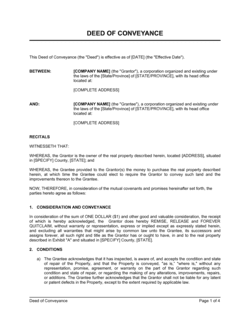
- Conveyance
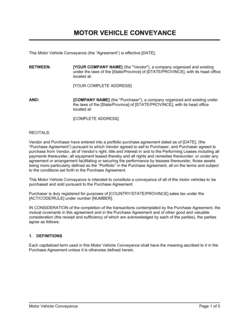
- The legal act of transferring title or ownership of property from one party to another through a written instrument.
- Wind Up
- The formal process of ceasing a business entity's operations, settling its obligations, and distributing remaining assets before dissolution.
- Transferor
- The entity or person conveying ownership of assets — typically the dissolving business or its appointed liquidator.
- Transferee
- The entity or person receiving ownership of the assets — a shareholder, creditor, partner, or successor entity.
- Consideration
- The value exchanged for the transferred assets, which in a wind-up may be nominal ($1), a release of claims, or a pro-rata shareholder distribution.
- Schedule of Assets
- An attached exhibit listing every asset being transferred, with descriptions, valuations, and any encumbrances or conditions attached.
- Representations and Warranties
- Factual statements made by the transferor confirming ownership, the absence of undisclosed liens, and the accuracy of the asset schedule.
- Indemnification
- A clause requiring one party to compensate the other for losses arising from breaches of the agreement's representations or from undisclosed liabilities.
- Conditions Precedent
- Requirements that must be satisfied before the conveyance becomes effective — such as regulatory approval, creditor consent, or shareholder resolution.
- Dissolution
- The legal termination of a business entity's existence, typically filed with the relevant government authority after the wind-up process is complete.
- Encumbrance
- Any lien, mortgage, security interest, or claim attached to an asset that may affect the transferee's clean title upon conveyance.
- Pro Rata Distribution
- Allocation of assets among shareholders or partners in proportion to their respective ownership percentages.