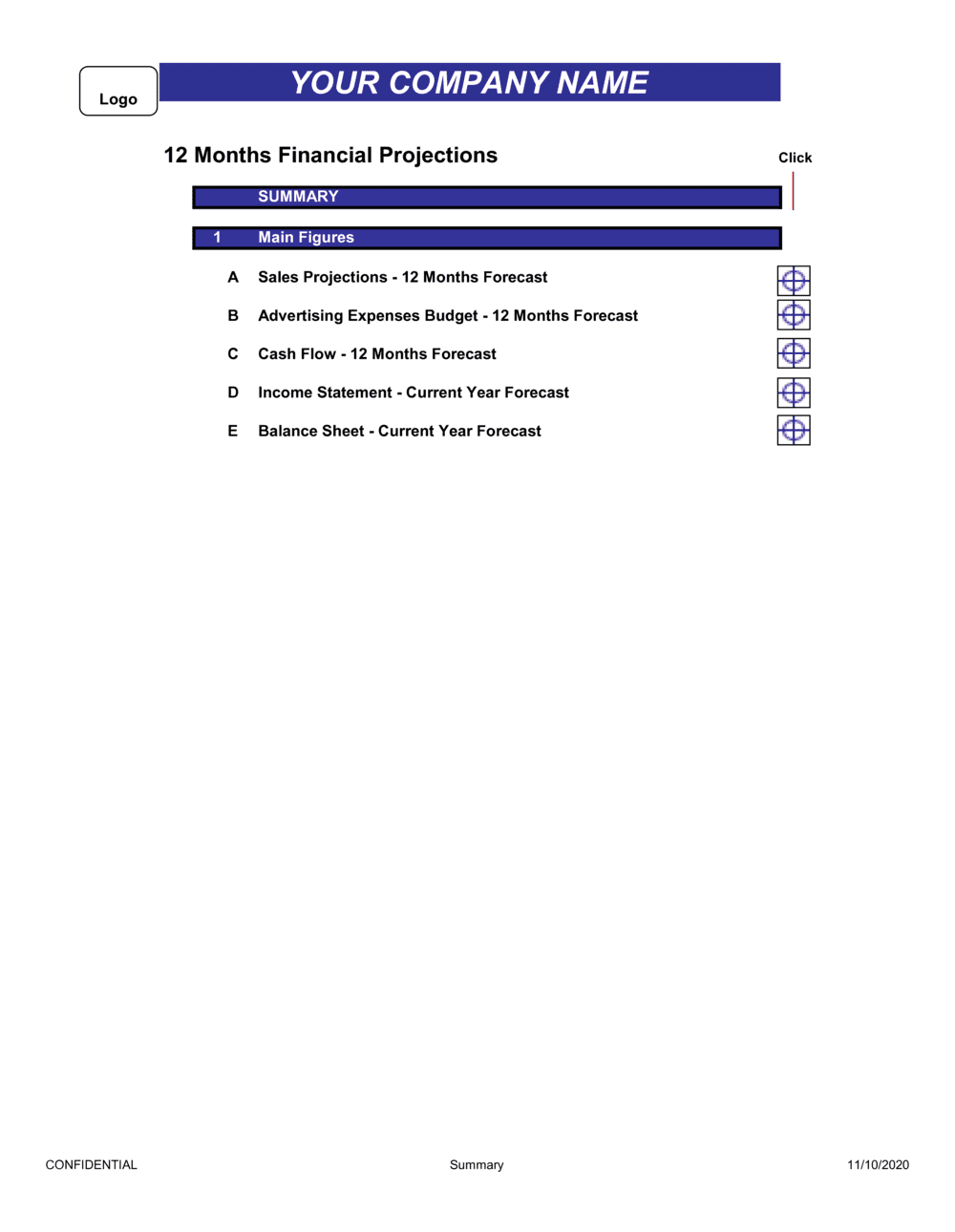
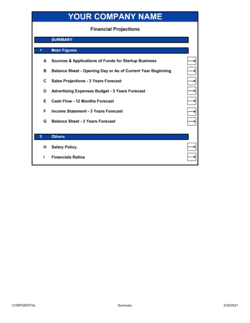
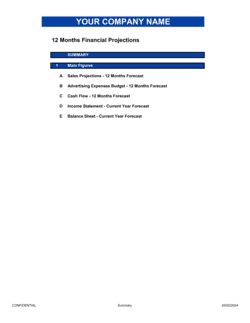
Financial Projections_12 Months Template

Free Excel download β€’ Use online β€’ Print or share

1 pageβ€’20–30 min to useβ€’Difficulty: Standardβ€’Signature requiredβ€’Legal review recommended
Learn more ↓
FreeXLSFinancial Projections_12 Months Template

At a glance

What it is
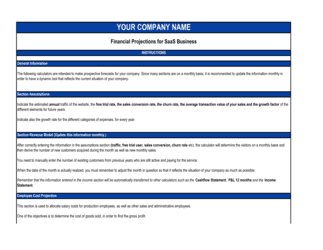
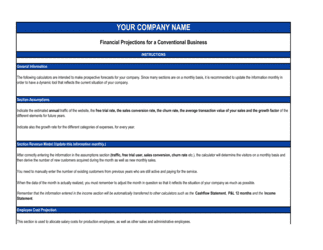
A Financial Projections 12 Months document is a forward-looking financial statement that estimates a business's revenue, expenses, gross profit, operating income, and net cash position on a month-by-month basis for a full fiscal year. This free Word download gives you a structured, investor-ready template you can edit online and export as PDF to present to lenders, investors, or your board.
When you need it
Use it when raising capital, applying for a bank loan or SBA financing, preparing an annual operating budget, or satisfying a reporting obligation to investors or a board of directors. It is also required as a supporting schedule in most formal business plans.
What's inside
Monthly revenue breakdown by stream, cost of goods sold, gross margin, operating expenses by category, EBITDA, net income, a 12-month cash flow statement, and a funding requirements summary β€” all tied together with clearly stated assumptions.

What is a Financial Projections 12 Months Document?

A Financial Projections 12 Months document is a forward-looking financial model that estimates a business's revenue, cost of goods sold, gross profit, operating expenses, EBITDA, net income, and month-end cash position for each of the next 12 calendar months. Unlike a backward-looking financial statement, it is built entirely from documented assumptions about pricing, sales volume, headcount, and payment timing β€” making the quality of those assumptions as important as the calculations themselves. Banks require it for commercial loan applications, investors expect it as part of any funding package, and boards use it as the benchmark against which actual monthly performance is measured.

Why You Need This Document

Without a 12-month financial projection, capital conversations stall immediately: lenders have no basis to assess repayment capacity, and investors have no evidence that the business model is financially viable. An SBA loan application submitted without projected financial statements is returned before review. Internally, operating without a monthly projection means that cost overruns, cash shortfalls, and break-even delays go undetected until they become emergencies rather than decisions. A properly built 12-month projection forces you to confront every assumption about pricing, volume, and cost structure before you spend real money β€” and gives you a monthly benchmark so you can spot variance in Month 2 rather than Month 10. This template gives you a structured, investor-ready starting point that covers every required schedule, so the work is organizing your assumptions rather than building a model from scratch.

Which variant fits your situation?

If your situation is…Use this template
Projecting performance over 3–5 years for a full business planBusiness Plan Financial Projections (Multi-Year)
Tracking actual vs. projected performance month by monthBudget vs. Actual Report
Focused on cash inflows and outflows only, not full P&LCash Flow Statement
Planning revenue targets and quota allocation by sales repSales Forecast Template
Estimating startup costs before operations beginStartup Cost Estimate
Presenting financial projections as part of an investor pitchInvestor Business Plan
Producing a one-page financial summary for internal leadershipFinancial Summary Report

Common mistakes to avoid

❌ No assumptions schedule

Why it matters: Without a documented list of inputs, reviewers cannot evaluate whether the projections are realistic or reverse-engineer what would need to be true for the numbers to hold. Unsupported projections are routinely dismissed.

Fix: Create a dedicated assumptions tab or section listing every growth rate, price point, cost percentage, and timing assumption, with a source or rationale for each.

❌ Treating revenue as cash in the month it is earned

Why it matters: On Net 30 terms, billing $150K in Month 1 produces $0 in cash that month. Projections that conflate revenue with cash will overstate the ending cash balance and produce a misleading picture of liquidity.

Fix: Build a separate cash flow statement that offsets collections by your actual payment terms. The P&L and cash flow must tell different β€” and both accurate β€” stories.

❌ Understating payroll costs by excluding employer taxes and benefits

Why it matters: Employer payroll taxes (FICA, FUTA, state SUI) plus health benefits typically add 18–25% on top of gross wages. A $500K salary line becomes $590K–$625K in total employer cost β€” a gap that can push a marginally funded business into a cash deficit.

Fix: Use a fully loaded cost per head that includes gross salary, employer taxes, benefits, and any equity-related charges. Apply this rate to all headcount in the OpEx schedule.

❌ Hockey-stick revenue with no unit-level support

Why it matters: A projection showing flat revenue for three months followed by 40% month-over-month growth with no explanation of what changes in Month 4 is immediately dismissed by lenders and investors as wishful thinking.

Fix: Build every revenue line from unit economics up β€” customer count times ACV, or units times price. The growth rate should follow logically from a specific event: a hire, a campaign launch, or a new channel going live.

The 10 key clauses, explained

Assumptions and Basis of Preparation

In plain language: Documents the key inputs β€” growth rates, pricing, headcount additions, payment terms, and macro factors β€” that drive every number in the projection.

Sample language
Revenue is projected to grow at [X]% month-over-month based on [ASSUMPTION]. Average selling price is $[X]. COGS as a percentage of revenue is assumed at [X]% for the period. Headcount increases from [X] to [X] FTEs by Month [X].

Common mistake: Embedding assumptions inside the model without a separate schedule. Reviewers cannot evaluate the projection's credibility without seeing the inputs explicitly stated and sourced.

Revenue Schedule by Stream

In plain language: Breaks projected income into distinct revenue lines β€” product sales, service revenue, subscription fees, licensing β€” with a monthly figure for each.

Sample language
Product Revenue: Month 1 $[X] | Month 2 $[X] ... Month 12 $[X]. Service Revenue: Month 1 $[X] ... Month 12 $[X]. Total Revenue: $[ANNUAL TOTAL].

Common mistake: Lumping all revenue into a single line. Investors and lenders require stream-level visibility to assess which sources are recurring, scalable, or at risk.

Cost of Goods Sold (COGS) Schedule

In plain language: Lists the direct costs of producing goods or delivering services each month, broken down by materials, direct labor, and any variable production costs.

Sample language
Direct Materials: $[X]/month. Direct Labor: $[X]/month. Production Overhead: $[X]/month. Total COGS: $[X]/month. Gross Margin: [X]%.

Common mistake: Applying a flat COGS percentage across all 12 months without adjusting for volume-related cost changes, supplier price increases, or seasonal production shifts.

Gross Profit Summary

In plain language: Calculates monthly gross profit (Revenue minus COGS) and the gross margin percentage, which serves as the benchmark for pricing and production efficiency.

Sample language
Month [X]: Revenue $[X] | COGS $[X] | Gross Profit $[X] | Gross Margin [X]%.

Common mistake: Reporting gross profit without the margin percentage. A $200K gross profit means very different things at a 20% margin versus a 60% margin, and lenders always benchmark to industry norms.

Operating Expenses Schedule

In plain language: Lists all recurring overhead costs β€” salaries, rent, marketing, software, insurance, and professional fees β€” by category and month.

Sample language
Salaries and Benefits: $[X]/month. Rent and Utilities: $[X]/month. Marketing and Advertising: $[X]/month. Software and Subscriptions: $[X]/month. Professional Fees: $[X]/month. Total OpEx: $[X]/month.

Common mistake: Understating salaries by excluding employer payroll taxes and benefits. These typically add 15–25% on top of gross wages and materially affect the operating expense total.

EBITDA and Operating Income

In plain language: Derives monthly EBITDA (Gross Profit minus OpEx) and operating income, before interest and tax charges, to show the business's core earnings power.

Sample language
Month [X]: Gross Profit $[X] | Total OpEx $[X] | EBITDA $[X] | Depreciation $[X] | Operating Income (EBIT) $[X].

Common mistake: Conflating EBITDA with cash flow. A positive EBITDA does not mean the business has positive cash β€” accounts receivable timing, debt service, and capex can produce a cash deficit even in profitable months.

Net Income Projection

In plain language: Calculates monthly net income after interest expense on any debt, income tax provision, and any one-time charges β€” the true bottom-line result.

Sample language
Month [X]: Operating Income $[X] | Interest Expense $[X] | Tax Provision ([X]%) $[X] | Net Income $[X] | Cumulative Net Income $[X].

Common mistake: Omitting an income tax provision entirely for pre-profit businesses. Even a zero-tax placeholder signals awareness of the obligation and prevents investor questions about financial literacy.

12-Month Cash Flow Statement

In plain language: Tracks actual cash inflows (collections) and outflows (payments) each month, separately from accrual-basis revenue and expense recognition, to show the true liquidity position.

Sample language
Operating Cash Inflows: $[X]. Operating Cash Outflows: $[X]. Net Operating Cash Flow: $[X]. Investing Activities: $[X]. Financing Activities: $[X]. Ending Cash Balance: $[X].

Common mistake: Treating revenue as cash in the month it is earned when collection terms are Net 30 or longer. A business billing $100K in Month 1 on Net 30 terms collects $0 of that in Month 1 β€” a gap that drains cash reserves faster than the P&L suggests.

Break-Even Analysis

In plain language: Identifies the monthly revenue level at which total costs equal total income, showing when the business stops losing money and begins generating profit.

Sample language
Fixed Monthly Costs: $[X]. Variable Cost as % of Revenue: [X]%. Break-Even Revenue: $[X]/month (= Fixed Costs Γ· (1 – Variable Cost Ratio)). Projected Break-Even Month: [MONTH/YEAR].

Common mistake: Calculating break-even on gross margin alone without including operating expenses. This produces a break-even figure that understates the true revenue required and misleads lenders about viability.

Funding Requirements and Use of Proceeds

In plain language: States the total external capital needed to fund the 12-month plan, broken into specific spending buckets, and ties each bucket to a measurable operational milestone.

Sample language
Total Funding Required: $[X]. Allocation: Product Development [X]% ($[X]) | Sales and Marketing [X]% ($[X]) | Operations [X]% ($[X]) | G&A [X]% ($[X]). Expected Milestone: [OUTCOME] by [DATE].

Common mistake: Requesting a lump-sum amount with no allocation detail. Lenders and investors treat unallocated funding requests as a red flag indicating insufficient planning.

How to fill it out

  1. 1

    Document your assumptions before touching the numbers

    List every key input β€” monthly revenue growth rate, pricing per unit or SKU, COGS percentage, planned headcount changes, and payment terms β€” in a dedicated assumptions schedule before building any line items.

    πŸ’‘ Cite a source for each major assumption: a comparable company benchmark, an industry report, or your own historical data. Unsourced assumptions are the first thing investors challenge.

  2. 2

    Build the revenue schedule by stream

    Enter projected monthly revenue for each distinct revenue line β€” product, service, subscription, licensing β€” separately. Derive each month from your unit-level assumptions rather than applying a blanket growth percentage to a prior period total.

    πŸ’‘ Model Month 1 from first principles (units Γ— price, or customers Γ— ACV), then apply your growth rate forward. This creates a defensible starting point rather than a circular reference.

  3. 3

    Calculate COGS and gross margin month by month

    Apply your COGS percentage or per-unit cost to each month's revenue projection. Adjust for any known cost changes β€” supplier price increases, volume discounts, or seasonal production shifts β€” rather than holding COGS flat.

    πŸ’‘ If your gross margin changes materially between Month 1 and Month 12, flag it explicitly in the assumptions section so reviewers understand the driver.

  4. 4

    Enter operating expenses by category

    List every recurring overhead item β€” salaries (including employer taxes and benefits), rent, software, insurance, marketing, and professional fees β€” by month. Step up headcount-related costs in the month a hire is planned.

    πŸ’‘ Add a 5–10% contingency line for unplanned expenses. Projections that show zero variance from budget over 12 months signal inexperience to experienced reviewers.

  5. 5

    Derive EBITDA and net income

    Subtract total OpEx from gross profit to get EBITDA. Then deduct depreciation, interest, and an income tax provision to arrive at monthly net income. Track cumulative net income to identify when the business becomes cumulatively profitable.

    πŸ’‘ A business can show positive EBITDA by Month 6 but negative cumulative net income through Month 10 due to early-period losses. Show both figures so the full picture is clear.

  6. 6

    Build the cash flow statement separately from the P&L

    Adjust revenue for collection timing (Net 30 means cash arrives 30 days after billing), and adjust expenses for payment timing (Net 45 payables means cash leaves 45 days after the invoice). Ending cash each month must reconcile to beginning cash plus net cash flow.

    πŸ’‘ The cash flow statement will almost always show a worse picture than the P&L in the early months. This is normal and expected β€” do not smooth the numbers to hide it.

  7. 7

    Calculate break-even and state the funding requirement

    Compute the monthly revenue needed to cover all fixed and variable costs. Identify the projected break-even month. Then total the cumulative cash deficit through break-even to determine the minimum capital required.

    πŸ’‘ Add a 20% buffer to the minimum capital requirement to account for timing delays and assumption misses. Asking for the exact minimum signals you have no margin for error.

  8. 8

    Stress-test with a downside scenario

    Run a second version of the model with revenue at 70% of the base case. Check whether the business survives β€” positive ending cash each month β€” under the downside. If it does not, adjust the funding request or cost structure accordingly.

    πŸ’‘ Present both the base case and the downside scenario to investors. Founders who proactively share stress-test results build significantly more credibility than those who present only an upside.

Frequently asked questions

What are financial projections?

Financial projections are forward-looking estimates of a business's revenue, costs, and cash position over a defined future period β€” in this case, 12 months. They are built from documented assumptions about pricing, volume, cost structure, and timing, and typically include a projected income statement, a cash flow statement, and a break-even analysis. Lenders, investors, and boards use them to evaluate viability and risk.

Why do I need 12-month financial projections?

Banks require them for any SBA or commercial loan application. Investors expect them as part of any fundraising conversation. Internally, a 12-month projection gives leadership a concrete monthly benchmark against which to measure actual performance and make operating decisions. Without them, budgeting is guesswork and capital requests lack the evidence needed to secure approval.

What is the difference between a financial projection and a financial forecast?

The terms are often used interchangeably, but technically a financial projection is based on hypothetical assumptions (what-if scenarios), while a financial forecast is based on expected conditions the management team believes are likely to materialize. In practice, most lenders and investors use both terms to mean a forward-looking financial statement built on explicitly documented assumptions.

What should 12-month financial projections include?

A complete 12-month projection includes a monthly revenue schedule broken down by stream, a COGS schedule and gross margin summary, an operating expense schedule by category, EBITDA and net income for each month, a separate cash flow statement adjusted for collection and payment timing, a break-even analysis, and a funding requirements summary with use-of-proceeds detail. An assumptions schedule supporting all inputs is essential.

How accurate do financial projections need to be?

Projections are inherently estimates β€” no reviewer expects perfect accuracy. What they evaluate is whether the assumptions are reasonable, internally consistent, and grounded in evidence. Projections that land within 20% of actual results are generally considered strong. The quality of the assumptions schedule matters more than the precision of any individual number.

Can I use financial projections for an SBA loan application?

Yes. The SBA and most participating lenders require 12-month projected financial statements β€” including a profit and loss projection, a cash flow projection, and often a projected balance sheet β€” as part of the loan application package. The projections must be accompanied by a written explanation of the assumptions. This template is structured to meet those requirements.

How do financial projections differ from a cash flow statement?

A cash flow statement is one component of a full financial projection. The projection also includes a projected income statement (P&L) showing revenue, COGS, and expenses on an accrual basis. The cash flow statement adjusts that accrual picture for the actual timing of money moving in and out of the business β€” collections, payments, debt service, and capex. Both are required; neither alone tells the complete story.

Do I need an accountant to prepare financial projections?

For straightforward businesses with a single revenue stream and simple cost structure, a high-quality template is sufficient for most applications. Engage an accountant or CFO when the business has multiple revenue streams with different margin profiles, complex cost structures, significant capex, or when the projection is supporting a loan above $500K or a Series A raise. A professional review of a self-prepared projection typically costs $300–$800 and is worth it before any material capital raise.

What is a sensitivity analysis and should I include one?

A sensitivity analysis shows how the projection's key outputs β€” net income, ending cash, break-even month β€” change when one or more assumptions shift by a defined amount, such as revenue coming in at 70% or 130% of plan. Including a downside scenario builds credibility with sophisticated investors and lenders by demonstrating that the business remains viable even if things do not go exactly to plan.

How this compares to alternatives

vs Cash Flow Statement

A cash flow statement records actual or projected cash inflows and outflows only β€” it does not show revenue, gross margin, or operating income on an accrual basis. The 12-month financial projections document includes the cash flow statement as one of its schedules alongside a full P&L and break-even analysis. Use the standalone cash flow statement when lenders or investors need a focused liquidity summary without the full projection package.

vs Business Plan

A business plan is a narrative strategic document that contextualizes the financial projections with market analysis, competitive positioning, team bios, and a funding rationale. The 12-month financial projections document is a purely quantitative schedule β€” the financial section that gets embedded in or attached to the business plan. If you need to raise capital, you need both.

vs Financial Projections (Multi-Year)

A multi-year financial projection extends the same model to three or five years, with annual rather than monthly granularity for Years 2 and beyond. The 12-month version provides the monthly detail that banks and early-stage investors require for near-term decision-making. Use the multi-year version alongside the 12-month model for any capital raise or strategic plan that needs to demonstrate a path to scale.

vs Budget vs. Actual Report

A budget vs. actual report compares what was projected against what actually happened each month β€” it is a performance management tool, not a planning document. Build your 12-month projections first; then use the budget vs. actual report each month to track variance and update assumptions. The two documents are sequential, not interchangeable.

Industry-specific considerations

SaaS / Technology

MRR and ARR build by cohort, churn rate impact on recurring revenue, cloud infrastructure cost scaling, and CAC payback period by acquisition channel.

Retail / E-commerce

Seasonal revenue peaks, inventory purchasing cash timing, average order value trends, and fulfillment cost per order as a percentage of revenue.

Professional Services

Billable utilization rate targets (typically 65–75%), average bill rate by service line, revenue per billable employee, and accounts-receivable collection timing.

Food and Beverage / Restaurant

Food cost as a percentage of revenue (target 28–35%), covers per day by daypart, labor cost percentage, and pre-opening cost amortization.

Healthcare / MedTech

Reimbursement lag between service delivery and insurance payment, regulatory compliance cost allocation, and milestone-based revenue recognition for device sales.

Manufacturing

Raw material cost volatility, production capacity utilization rate, capex depreciation schedule, and supplier payment terms impact on working capital.

Jurisdictional notes

United States

The SBA requires projected financial statements β€” including a 12-month P&L, cash flow projection, and balance sheet β€” for most 7(a) and 504 loan applications. The SEC requires audited financial statements and forward-looking projections for registered securities offerings, with safe-harbor protections for projections that include meaningful cautionary language. State-specific franchise disclosure laws (FDD) mandate specific financial projection formats for franchisors.

Canada

BDC and EDC financing applications require 12-month cash flow projections accompanied by a written assumptions narrative. The CRA does not prescribe a format for internal projections, but businesses claiming SR&ED credits must support projected R&D spending with documented cost estimates. In Quebec, projections submitted to Investissement QuΓ©bec must meet specific format requirements and are often reviewed in French.

United Kingdom

UK banks and the British Business Bank require 12-month cash flow forecasts and projected P&Ls for SME loan applications, typically covering at least the term of the loan. Companies raising under EIS or SEIS must submit financial projections to HMRC as part of advance assurance applications. Projections included in FCA-regulated investment materials must comply with the Financial Promotions regime and include prescribed risk disclosures.

European Union

EU structural fund grant applications β€” including those under Horizon Europe β€” require detailed 12-month financial projections with a specified cost breakdown by category. Projections included in a prospectus under the EU Prospectus Regulation must meet ESMA disclosure standards and include cautionary language. Member state development banks (e.g., KfW in Germany, Bpifrance in France) each have their own projection format requirements for subsidized loan programs.

Template vs lawyer β€” what fits your deal?

PathBest forCostTime
Use the templateFounders and small business owners preparing projections for SBA loans under $500K or early-stage investor conversationsFree8–20 hours depending on business complexity
Template + legal reviewBusinesses with multiple revenue streams, significant capex, or projections supporting a loan or raise above $500K$300–$800 for an accountant or CFO review3–5 business days
Custom draftedSeries A raises, regulated industries, complex multi-entity structures, or projections that will be audited or used in a prospectus$2,000–$8,000 for a professional financial modeler or CPA firm engagement2–4 weeks

Glossary

Revenue Projection
A forward-looking estimate of the income a business expects to earn from each revenue stream over a defined period.
Cost of Goods Sold (COGS)
The direct costs attributable to producing goods or delivering services β€” materials, direct labor, and production overhead.
Gross Margin
Revenue minus COGS, expressed as a dollar amount or percentage β€” a primary measure of how efficiently a business generates profit from its core activity.
Operating Expenses (OpEx)
Recurring costs not directly tied to production, including rent, salaries, marketing, insurance, and software subscriptions.
EBITDA
Earnings Before Interest, Taxes, Depreciation, and Amortization β€” a widely used proxy for operating cash generation and business value.
Net Income
The bottom-line profit after all expenses, interest, taxes, depreciation, and amortization have been deducted from revenue.
Cash Flow Projection
A month-by-month estimate of actual cash coming in and going out of the business, independent of accrual-basis revenue recognition.
Burn Rate
The monthly rate at which a business spends its cash reserves β€” typically used for pre-revenue or pre-profit companies to measure runway.
Runway
The number of months a business can operate at its current burn rate before exhausting available cash, assuming no new revenue or funding.
Assumptions Schedule
A documented list of the inputs and growth rates underpinning the projection model β€” critical for reviewers to evaluate the credibility of the numbers.
Sensitivity Analysis
A scenario test showing how the projection changes if one or more key assumptions (price, volume, COGS) shift by a defined percentage.
Break-Even Point
The revenue level at which total income equals total costs, producing neither profit nor loss β€” a key milestone for lenders and investors.

Part of your Business Operating System

This document is one of 3,000+ business & legal templates included in Business in a Box.

  • Fill-in-the-blanks β€” ready in minutes
  • 100% customizable Word document
  • Compatible with all office suites
  • Export to PDF and share electronically

Create your document in 3 simple steps.

From template to signed document β€” all inside one Business Operating System.
1
Download or open template

Access over 3,000+ business and legal templates for any business task, project or initiative.

2
Edit and fill in the blanks with AI

Customize your ready-made business document template and save it in the cloud.

3
Save, Share, Send, Sign

Share your files and folders with your team. Create a space of seamless collaboration.

Save time, save money, and create top-quality documents.

β˜…β˜…β˜…β˜…β˜…

"Fantastic value! I'm not sure how I'd do without it. It's worth its weight in gold and paid back for itself many times."

Managing Director Β· Mall Farm
Robert Whalley
Managing Director, Mall Farm Proprietary Limited
β˜…β˜…β˜…β˜…β˜…

"I have been using Business in a Box for years. It has been the most useful source of templates I have encountered. I recommend it to anyone."

Business Owner Β· 4+ years
Dr Michael John Freestone
Business Owner
β˜…β˜…β˜…β˜…β˜…

"It has been a life saver so many times I have lost count. Business in a Box has saved me so much time and as you know, time is money."

Owner Β· Upstate Web
David G. Moore Jr.
Owner, Upstate Web

Run your business with a system β€” not scattered tools

Stop downloading documents. Start operating with clarity. Business in a Box gives you the Business Operating System used by over 250,000 companies worldwide to structure, run, and grow their business.

Start freeΒ Β·Β No credit card required