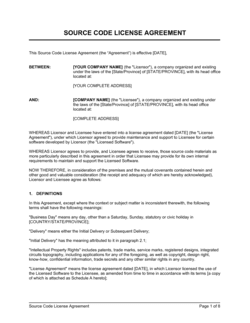
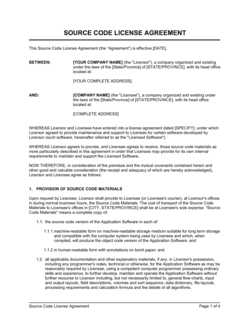
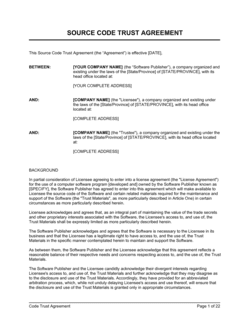
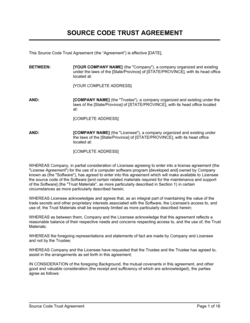
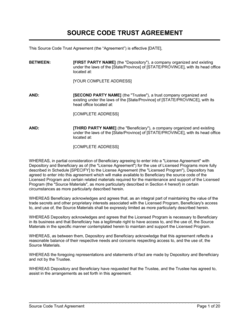
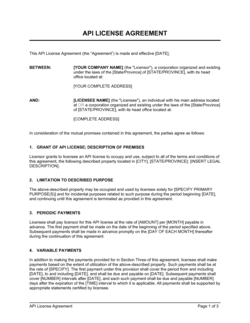
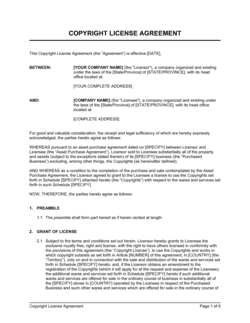
Source Code License Agreement Fully Paid-Up, Royalty Free Template

Free Word download • Edit online • Save & share with Drive • Export to PDF

20 pages40–50 min to fillDifficulty: ExpertSignature requiredLegal review recommended
Learn more ↓
FreeSource Code License Agreement Fully Paid-Up, Royalty Free Template

At a glance

What it is
A Source Code License Agreement (Fully Paid-Up, Royalty-Free) is a legally binding contract in which a licensor grants a licensee the right to use, modify, and deploy identified source code for a one-time upfront payment, with no ongoing royalty obligations. This free Word download gives you a structured, attorney-ready starting point you can edit online and export as PDF to execute with software vendors, acquirers, or development partners.
When you need it
Use it when a software developer or IP owner transfers broad usage rights to a buyer or partner in exchange for a single lump-sum payment, eliminating future per-unit, per-seat, or revenue-based royalty calculations. It is also used in M&A transactions, technology transfers, and strategic partnerships where ongoing royalty tracking would be impractical or undesirable.
What's inside
Grant of license and scope, permitted uses and restrictions, ownership and IP retention, representations and warranties, limitation of liability, indemnification, term and termination, and governing law. The agreement clearly distinguishes the one-time payment structure from ongoing royalty arrangements and defines exactly what source code is covered.

What is a Source Code License Agreement (Fully Paid-Up, Royalty-Free)?

A Source Code License Agreement (Fully Paid-Up, Royalty-Free) is a legally binding contract in which a licensor grants a licensee the right to access, use, modify, and deploy identified source code in exchange for a single one-time payment, with no ongoing royalties, per-seat fees, or revenue-based charges ever owed. Unlike standard software licenses that tie ongoing payments to usage volume or revenue, the fully paid-up structure gives the licensee predictable, perpetual access to the code for a fixed upfront cost. The licensor retains copyright ownership of the original code, while the licensee gains the right to build derivative works, integrate the code into commercial products, and operate without financial exposure to future licensing renegotiations.

Why You Need This Document

Without a written source code license agreement, neither party has enforceable clarity on what rights were actually conveyed. A licensee who paid a significant sum for source code — but received only an email and a zip file — may find that they have no legally cognizable rights to modify, distribute, or sublicense the code when it matters most: during an acquisition, a product audit, or a customer due-diligence review. The licensor, in turn, has no documented restrictions preventing the licensee from sublicensing to competitors, removing attribution notices, or using the code in ways the licensor never intended. Open-source component risk compounds this further — embedded GPL or AGPL code discovered after the fact can void the commercial value of the entire transaction. This template establishes the precise scope of the license grant, documents the fully paid-up payment structure, protects both parties on IP ownership and warranties, and creates the paper trail that investors, acquirers, and regulators expect to see in any serious technology transaction.

Which variant fits your situation?

If your situation is…Use this template
Licensing source code with ongoing royalties based on revenue or unitsSoftware License Agreement (Royalty-Bearing)
Permanently transferring all ownership of the source code to the buyerIntellectual Property Assignment Agreement
Licensing compiled object code only, not source codeSoftware License Agreement
Sharing source code confidentially for evaluation without granting use rightsNon-Disclosure Agreement (NDA)
Engaging a developer to create new source code as a work for hireSoftware Development Agreement
Contributing to or using open-source software under a community licenseOpen Source Software Contribution Agreement
Licensing source code to multiple parties under a single master agreementMaster Software License Agreement

Common mistakes to avoid

❌ Vague source code description in Exhibit A

Why it matters: If the licensed code is described only as 'the software,' disputes arise immediately about which files, modules, or versions are covered — especially after the licensor updates the codebase.

Fix: Attach a file manifest, repository URL with commit hash, or version number to Exhibit A and have both parties initial it at signing.

❌ Omitting 'irrevocable' from the license grant

Why it matters: A fully paid-up license without irrevocability can be withdrawn by the licensor at will, leaving the licensee with no rights despite having paid the full fee — a commercially unacceptable outcome.

Fix: Always include 'perpetual, irrevocable' in the grant clause for a fully paid-up arrangement; these two words are the core commercial consideration the licensee is paying for.

❌ No open-source component warranty or SCA scan

Why it matters: Embedded GPL or AGPL code obligates the licensee to open-source their entire derived product — a consequence that can destroy commercial value and trigger customer contract breaches.

Fix: Require the licensor to warrant the absence of conflicting open-source components and conduct a software composition analysis scan before signing.

❌ Termination clause that voids existing derivative works

Why it matters: If termination immediately kills all licensee rights, products already built on the licensed code become unauthorized — exposing the licensee to infringement liability the moment the agreement ends.

Fix: Include a survival clause allowing the licensee to continue using and distributing derivative works completed before the termination date, even after the agreement terminates.

❌ No sublicensing provision for downstream product sales

Why it matters: When the licensee sells or acquires a product containing the licensed source code, the buyer or acquirer has no rights to the underlying code — creating a legal gap at exactly the moment it matters most.

Fix: Address sublicensing rights explicitly: either grant a right to sublicense to customers and acquirers, or require licensee to obtain separate written consent for each sublicense.

❌ Governing law chosen without connection to the parties' actual locations

Why it matters: Choosing a governing state for convenience (e.g., Delaware for incorporation) when both parties operate elsewhere can mean neither party's counsel is familiar with the applicable case law — and some states' courts will apply local law regardless.

Fix: Choose the governing law of the state or country where the licensor operates or where the IP is primarily developed, and confirm litigation or arbitration venue is practical for both parties.

The 10 key clauses, explained

Recitals and definitions

In plain language: Identifies both parties by legal name, describes the licensed source code, and defines all capitalized terms used throughout the agreement.

Sample language
This Source Code License Agreement ('Agreement') is entered into as of [DATE] between [LICENSOR LEGAL NAME], a [STATE] [ENTITY TYPE] ('Licensor'), and [LICENSEE LEGAL NAME], a [STATE] [ENTITY TYPE] ('Licensee'). 'Source Code' means the software described in Exhibit A, including all files, documentation, and associated materials.

Common mistake: Describing the licensed source code too vaguely — e.g., 'all software created by Licensor.' Without a precise Exhibit A identifying specific repositories, file names, or version numbers, disputes arise over what was actually licensed.

Grant of license

In plain language: States the scope of rights conveyed — typically a perpetual, irrevocable, fully paid-up, royalty-free license to use, copy, modify, and distribute the source code — and whether the license is exclusive or non-exclusive.

Sample language
Licensor hereby grants to Licensee a perpetual, irrevocable, worldwide, fully paid-up, royalty-free, [exclusive / non-exclusive] license to use, reproduce, modify, prepare derivative works of, and distribute the Source Code solely for [PERMITTED PURPOSES].

Common mistake: Omitting 'irrevocable' from the grant. A fully paid-up license that can be revoked at will provides minimal commercial value — the licensee has paid in full but can lose access at any time.

Permitted uses and restrictions

In plain language: Defines exactly what the licensee may and may not do with the source code — including whether it may be sublicensed, embedded in commercial products, distributed to third parties, or reverse-engineered.

Sample language
Licensee may use the Source Code to develop, modify, and deploy internal and commercial products. Licensee shall not: (a) sublicense the Source Code to any third party without Licensor's prior written consent; (b) remove or alter any proprietary notices; or (c) use the Source Code to develop a product that directly competes with Licensor's [PRODUCT NAME].

Common mistake: Failing to address sublicensing rights. If the licensee later sells their product to an acquirer, the acquirer needs rights to the embedded source code — silence on sublicensing creates a legal gap at the worst possible time.

Ownership and IP retention

In plain language: Confirms that the licensor retains all copyright, patent, and trade secret rights in the original source code, and addresses ownership of derivative works created by the licensee.

Sample language
Licensor retains all right, title, and interest in and to the Source Code and all intellectual property rights therein. As between the parties, Licensee shall own all derivative works created by Licensee, provided that such derivative works do not include any portion of the Source Code except as licensed herein.

Common mistake: Leaving derivative work ownership unaddressed. If the licensee builds a product on top of the licensed code and the agreement is silent on who owns the derivative, both parties may have colorable claims — creating serious problems in any future M&A transaction.

Consideration and payment

In plain language: States the one-time license fee, the payment deadline, and confirms that no further royalties, maintenance fees, or usage-based charges are owed under the fully paid-up structure.

Sample language
In consideration for the rights granted herein, Licensee shall pay Licensor a one-time license fee of $[AMOUNT] within [30] days of the Effective Date. The parties acknowledge that this fee constitutes full and final consideration for the license, and no royalties, maintenance fees, or additional payments shall be due under this Agreement.

Common mistake: Not expressly stating 'no further fees are owed.' Without this language, a licensor may later argue that support, updates, or new versions require separate payment — undermining the fully paid-up structure the parties intended.

Representations and warranties

In plain language: The licensor represents that it owns or has authority to license the source code, that it does not infringe third-party IP rights, and that the code does not contain undisclosed malware or open-source components with conflicting license obligations.

Sample language
Licensor represents and warrants that: (a) Licensor has full right and authority to grant the license herein; (b) the Source Code does not infringe any third-party patent, copyright, trade secret, or other IP right; and (c) the Source Code does not contain any open-source software components subject to license terms that would require Licensee to disclose or license any of its proprietary code.

Common mistake: Omitting the open-source component warranty. Embedded GPL or AGPL code can impose copyleft obligations on the licensee's entire codebase — a risk that only a specific warranty and a software composition analysis (SCA) scan can meaningfully address.

Limitation of liability

In plain language: Caps the licensor's total financial exposure — typically at the license fee paid — and excludes indirect, consequential, and punitive damages.

Sample language
In no event shall Licensor's total liability under this Agreement exceed the license fee paid by Licensee. Neither party shall be liable for any indirect, incidental, special, consequential, or punitive damages, even if advised of the possibility of such damages.

Common mistake: Setting no cap at all, or setting the cap at a nominal amount like $100 on a multi-million-dollar technology deal. Courts may enforce these clauses literally — leaving the injured party with no meaningful remedy for a material breach.

Term and termination

In plain language: For a fully paid-up license the term is typically perpetual, but the agreement should specify grounds for termination — e.g., material breach, insolvency — and what happens to the licensee's rights and existing derivative works if termination occurs.

Sample language
This Agreement is effective as of the Effective Date and shall continue in perpetuity unless terminated. Either party may terminate this Agreement upon [30] days' written notice if the other party materially breaches this Agreement and fails to cure such breach within such period. Upon termination, all licenses granted herein shall terminate, except that Licensee may continue to use derivative works completed prior to the effective date of termination.

Common mistake: Termination language that immediately voids derivative works already deployed in the licensee's products. A perpetual, fully paid-up structure should survive termination for existing derivative works — otherwise the licensee loses the benefit they paid for.

Confidentiality

In plain language: Requires both parties to protect non-public information — including the source code itself — from disclosure to third parties, and specifies the standard of care and permitted disclosures.

Sample language
Each party agrees to maintain the other party's Confidential Information in strict confidence using at least the same degree of care it uses for its own confidential information, but no less than reasonable care. Licensee shall not disclose the Source Code to any third party except to employees and contractors with a need to know who are bound by confidentiality obligations at least as protective as those herein.

Common mistake: No time limit on confidentiality for source code. Unlike general business information, source code may retain trade secret status indefinitely — but a five-year sunset clause in a boilerplate NDA can inadvertently allow disclosure of code still in active commercial use.

Governing law and dispute resolution

In plain language: Specifies the jurisdiction whose law governs the agreement and the mechanism for resolving disputes — arbitration, litigation, or a tiered negotiation-then-arbitration process.

Sample language
This Agreement shall be governed by the laws of the State of [STATE], without regard to its conflict-of-law principles. Any dispute arising out of or relating to this Agreement shall be resolved by binding arbitration administered by [AAA / JAMS] in [CITY, STATE], except that either party may seek injunctive relief in any court of competent jurisdiction to prevent irreparable harm.

Common mistake: No carve-out for injunctive relief. IP disputes involving ongoing use of misappropriated source code are exactly the scenario where a party needs emergency court relief — a mandatory arbitration clause without this carve-out can delay critical action for months.

How to fill it out

  1. 1

    Identify both parties with full legal names and entity types

    Enter the licensor's and licensee's full registered legal names, entity types (LLC, corporation, etc.), states of formation, and principal addresses. Confirm these match the parties' corporate registry filings.

    💡 If a parent company owns the IP but a subsidiary is signing, clarify whether the subsidiary has authority to license on the parent's behalf — or have the parent countersign.

  2. 2

    Draft Exhibit A: precise description of the licensed source code

    List the specific repositories, module names, version numbers, programming languages, and any associated documentation included in the license. Attach a file manifest or GitHub commit hash if the code is being transferred digitally.

    💡 A vague description like 'all software developed by Licensor' is the single most common source of post-signing disputes — be specific to the file or repository level.

  3. 3

    Confirm the license scope: exclusive vs. non-exclusive

    Decide whether the licensee will be the only party allowed to use this source code (exclusive) or whether the licensor can also license it to others (non-exclusive). Exclusive licenses typically command a significantly higher one-time fee.

    💡 If the license is exclusive to a specific industry vertical or geography but not globally, state that explicitly — partial exclusivity can be structured but must be precisely worded.

  4. 4

    Define permitted uses and restriction carve-outs

    List every use the licensee is authorized to make: internal development, product embedding, commercial distribution, SaaS delivery, etc. Then list explicit restrictions — no sublicensing without consent, no competitive use, no removal of copyright notices.

    💡 Think through the licensee's likely five-year product roadmap before finalizing restrictions — overly narrow permitted-use language often requires a costly amendment within 12–18 months.

  5. 5

    State the one-time fee and confirm no further payments

    Enter the exact dollar amount, the payment deadline (typically 30 days from signing), the payment method, and include explicit language confirming no royalties, maintenance fees, or update fees are owed.

    💡 If source code updates or future versions are intended to be included, address that specifically — silence means they are not covered and will require a separate agreement.

  6. 6

    Complete the representations and run an open-source audit

    Before the licensor executes the warranty of non-infringement and no conflicting open-source components, run a software composition analysis (SCA) scan using a tool like FOSSA, Black Duck, or Snyk to identify any embedded open-source with GPL, LGPL, or AGPL obligations.

    💡 Discovering GPL-licensed code after signing that voids the commercial license is far more expensive than a $500 SCA scan before signing.

  7. 7

    Set the confidentiality period and access controls

    Confirm that confidentiality for source code survives termination indefinitely (or for a defined long period — at minimum 10 years) and specify the access controls the licensee must maintain, including who may view and modify the code.

    💡 Require the licensee to maintain an internal log of employees and contractors with access to the source code — this is standard in enterprise technology transactions and makes enforcement much easier.

  8. 8

    Execute before any code delivery

    Both parties must sign the agreement before the source code is delivered or repository access is granted. Post-delivery signatures create a gap during which the licensee used code without any contractual rights.

    💡 Use a digital signature platform with timestamp verification. For transactions above $500K, consider having both parties initial every page to prevent later disputes about which version was signed.

Frequently asked questions

What is a fully paid-up, royalty-free source code license?

A fully paid-up, royalty-free source code license grants the licensee the right to use, modify, and deploy identified source code in exchange for a single one-time payment, with no ongoing royalties, per-seat fees, or revenue-based charges owed. The licensor retains ownership of the underlying intellectual property, but the licensee's right to use the code is not contingent on any further payment. This structure is common in technology acquisitions, strategic partnerships, and enterprise software procurement where predictable, perpetual access is valued over variable licensing costs.

What is the difference between a source code license and a software assignment?

A software assignment permanently transfers ownership of the source code and all associated IP rights to the buyer — the original creator no longer owns it. A source code license grants usage rights while the licensor retains ownership. For a fully paid-up, royalty-free license, the practical day-to-day difference can be small, but the licensor retains the right to license the same code to others (if non-exclusive) and owns any improvements they make independently. Assignment is typically preferred when complete control over the IP is essential.

Does a fully paid-up license need to be exclusive?

No — fully paid-up and royalty-free describe the payment structure, not the exclusivity scope. A fully paid-up license can be exclusive (only the licensee may use the code) or non-exclusive (the licensor can license the same code to multiple parties). Exclusive fully paid-up licenses command significantly higher one-time fees because the licensor foregoes all future licensing revenue from that code. The agreement must state explicitly which applies.

What open-source risks should I check before signing a source code license?

The primary risk is embedded open-source components with copyleft licenses — particularly GPL, LGPL, or AGPL — that impose obligations on the licensee's entire derived product, including mandatory disclosure of proprietary source code. Before signing, require the licensor to provide a software bill of materials (SBOM) and conduct an independent software composition analysis (SCA) scan using tools like FOSSA, Black Duck, or Snyk. The licensor should also warrant in the agreement that no conflicting open-source components are present.

Can a fully paid-up license be terminated?

It depends on the contract. A well-drafted fully paid-up license should be perpetual and irrevocable in normal circumstances, with termination only available for material breach or insolvency. Even where termination is permitted, the agreement should include a survival clause allowing the licensee to continue using derivative works already completed and deployed before termination. Without these protections, the licensee's significant upfront investment is exposed to forfeiture.

Who needs to sign a source code license agreement?

Both the licensor and the licensee must sign — typically authorized signatories of each legal entity (e.g., CEO, CTO, or a person with a board-delegated signing authority). If the IP is held in a subsidiary or SPV rather than the operating company, the IP-holding entity must be the named licensor and signatory. For transactions above $250K, consider having legal counsel review and confirm each party's signing authority before execution.

Is a source code license agreement enforceable without consideration?

No — like all contracts, a source code license requires consideration to be enforceable. For a fully paid-up structure, the one-time license fee serves as consideration from the licensee; the grant of rights serves as consideration from the licensor. If the fee is nominal (e.g., $1), courts in some jurisdictions may scrutinize whether adequate consideration was exchanged, particularly in disputes involving large-scale commercial use. Set the license fee at a commercially reasonable amount reflecting the actual value of the rights granted.

Do I need a lawyer for a source code license agreement?

For straightforward domestic licensing transactions under $100K with clear permitted uses, a high-quality template reviewed by a technology attorney for one to two hours is typically sufficient. Engage a lawyer for the full drafting or review process when the transaction value is material, the license is exclusive, the code will be embedded in a commercial product sold to third parties, there are international parties involved, or open-source component risk is significant. Technology IP attorneys typically charge $350–$700 per hour for license review.

What happens to the source code license in an M&A transaction?

This depends entirely on whether the license is assignable. Many source code licenses include anti-assignment clauses requiring licensor consent before the license can be transferred to an acquirer. In an asset purchase, the acquirer typically needs the license assigned to them — if consent is required and the licensor refuses or demands additional payment, the transaction can stall. When drafting the license, negotiate an express right to assign to a successor in connection with a merger, acquisition, or sale of substantially all assets, without requiring licensor consent.

What is the difference between a source code license and an object code license?

An object code license grants rights only to the compiled, executable version of the software — the binary that runs on a computer but cannot easily be read, modified, or rebuilt. A source code license grants rights to the human-readable instructions, enabling the licensee to inspect, modify, compile, and build derivative products. Source code licenses are therefore far more valuable commercially and carry significantly greater IP risk for the licensor, which is why they command higher fees and more detailed contractual protections.

How this compares to alternatives

vs Software License Agreement (object code only)

A standard software license agreement typically grants rights to compiled object code — the executable program — without exposing the underlying source code. A source code license grants access to the human-readable code, enabling modification and derivative works. Source code licenses are substantially more powerful and carry greater IP risk for the licensor, requiring more detailed restrictions and warranties.

vs Intellectual Property Assignment Agreement

An IP assignment permanently transfers full ownership of the source code and all associated rights to the buyer — the original creator has no further rights. A fully paid-up source code license grants broad, perpetual use rights while the licensor retains ownership. Assignment is preferred when the buyer requires absolute control and the ability to exclude the creator from future use; a license is preferred when the licensor wants to retain ownership or the right to license the same code to others.

vs Software Development Agreement

A software development agreement governs the creation of new source code — it defines deliverables, timelines, payment milestones, and IP ownership of code yet to be written. A source code license agreement governs the use of existing, already-created code. The two documents often work together: a development agreement creates the code, and a license agreement (or IP assignment) then governs how the client may use the delivered work.

vs Non-Disclosure Agreement (NDA)

An NDA restricts disclosure of confidential information — including source code — but does not grant any right to use, modify, or deploy it. An NDA is appropriate when sharing source code for evaluation purposes only, before a license is agreed. A source code license agreement grants actual usage rights and should contain its own confidentiality clause rather than relying on a standalone NDA to protect the code post-signing.

Industry-specific considerations

Technology / SaaS

Embedding third-party libraries into a commercial SaaS platform under a fully paid-up structure eliminates per-seat royalty calculations as the customer base scales.

Financial Services / Fintech

Banks and payment processors acquiring trading algorithms or compliance software prefer fully paid-up licenses to avoid royalty obligations tied to transaction volumes that can reach billions annually.

Healthcare / MedTech

Medical device manufacturers licensing diagnostic software into FDA-cleared products require perpetual, royalty-free rights so that device economics are not subject to future licensor pricing changes.

Defense and Government

US federal procurement regulations (FAR/DFARS) frequently require contractors to obtain fully paid-up, royalty-free government purpose rights to source code developed under government contracts.

Manufacturing and Industrial IoT

Manufacturers embedding control software into products shipped over 10–20 year lifecycles need royalty-free perpetual source code rights to maintain, patch, and support deployed units without ongoing licensor dependency.

Professional Services / IT Consulting

Systems integrators and consultancies that build custom platforms on licensed components use fully paid-up licenses to deliver clean IP to end clients without royalty obligations passing through the engagement.

Jurisdictional notes

United States

US copyright law (17 U.S.C.) governs source code as a literary work. Patent rights may overlap if the code implements a patented method — the license should address both. California's strong employee invention statutes (Labor Code §2870) limit employer IP assignment for code written on personal time; similar analysis applies to licensor warranties. Non-compete clauses are unenforceable in California and several other states, but IP restrictions and use limitations in a license agreement are generally enforceable. State law variations on implied warranties and limitation-of-liability enforceability mean governing-law choice matters significantly.

Canada

Canadian copyright in software is governed by the Copyright Act (R.S.C. 1985, c. C-42), which protects source code as a literary work. There is no software patent regime as broad as the US — patent claims for pure business-method software face higher scrutiny. Quebec's Civil Code applies to agreements between Quebec-domiciled parties, potentially modifying standard common-law interpretation of limitation-of-liability clauses. Cross-border transactions between Canadian and US parties should specify currency (CAD vs. USD) and confirm tax withholding obligations under the Canada-US Tax Treaty.

United Kingdom

Source code is protected as a literary work under the Copyright, Designs and Patents Act 1988 (CDPA). The UK's Computer Programs Directive (retained post-Brexit) grants licensees a non-waivable right to make back-up copies and study the program — clauses purporting to prohibit these acts are void. Post-Brexit, UK and EU IP regimes have diverged; a license should address whether it covers Great Britain, Northern Ireland, or both. Limitation-of-liability clauses excluding liability for fraud or death/personal injury are void under the Unfair Contract Terms Act 1977.

European Union

EU Software Directive (2009/24/EC) grants licensees non-waivable rights to study and correct errors in licensed software — these cannot be contracted away. GDPR applies if the source code processes personal data or if the agreement involves data transfers between EU and non-EU parties. The EU's proposed Cyber Resilience Act (CRA), expected to take effect from 2027, will impose security-by-design requirements on software placed on the EU market, which may affect warranty and liability representations in source code licenses. Member states vary on the enforceability of indemnification and consequential damage waivers — legal review in the relevant member state is strongly recommended for high-value transactions.

Template vs lawyer — what fits your deal?

PathBest forCostTime
Use the templateStraightforward domestic non-exclusive licenses under $100K with a single identified codebase and clearly defined permitted usesFree1–2 hours
Template + legal reviewLicenses above $100K, exclusive grants, code embedded in commercial products sold to third parties, or cross-border transactions$500–$1,500 for a technology IP attorney review3–5 business days
Custom draftedMaterial M&A-related technology transfers, exclusive global licenses above $500K, regulated industries (healthcare, defense, fintech), or multi-party licensing structures$3,000–$15,000+2–6 weeks

Glossary

Fully Paid-Up License
A license where all financial obligations are satisfied by a single upfront payment, with no further fees owed regardless of how much the licensee uses the software.
Royalty-Free License
A license that grants usage rights without requiring the licensee to pay a percentage of revenue, a per-unit fee, or any other recurring payment tied to exploitation of the licensed material.
Source Code
The human-readable instructions written in a programming language that, when compiled or interpreted, produce executable software.
Object Code
The compiled, machine-readable output of source code — the binary version of a program that a computer can execute but a human cannot easily read or modify.
Licensor
The party that owns the intellectual property rights in the source code and grants permission to use it under the terms of the agreement.
Licensee
The party receiving the right to use the source code, subject to the scope, restrictions, and conditions specified in the agreement.
Permitted Use
The specific activities the licensee is authorized to perform with the source code — such as internal use, modification, integration into products, or sublicensing.
Derivative Work
A new work based on or incorporating the licensed source code, such as a modified version, a compilation, or a product built using the code as a component.
Sublicense
The right granted by a licensee to a third party to use the licensed source code — only permissible if the original license agreement expressly allows it.
Escrow (Source Code Escrow)
An arrangement where source code is deposited with a neutral third party and released to the licensee only if the licensor fails to maintain or support the software.
Warranty of Non-Infringement
A representation by the licensor that the source code does not infringe any third party's intellectual property rights — patents, copyrights, or trade secrets.
Indemnification
A contractual obligation by one party to compensate the other for losses, legal costs, or damages arising from a specified event, such as a third-party IP infringement claim.

Part of your Business Operating System

This document is one of 3,000+ business & legal templates included in Business in a Box.

  • Fill-in-the-blanks — ready in minutes
  • 100% customizable Word document
  • Compatible with all office suites
  • Export to PDF and share electronically

Create your document in 3 simple steps.

From template to signed document — all inside one Business Operating System.
1
Download or open template

Access over 3,000+ business and legal templates for any business task, project or initiative.

2
Edit and fill in the blanks with AI

Customize your ready-made business document template and save it in the cloud.

3
Save, Share, Send, Sign

Share your files and folders with your team. Create a space of seamless collaboration.

Save time, save money, and create top-quality documents.

★★★★★

"Fantastic value! I'm not sure how I'd do without it. It's worth its weight in gold and paid back for itself many times."

Managing Director · Mall Farm
Robert Whalley
Managing Director, Mall Farm Proprietary Limited
★★★★★

"I have been using Business in a Box for years. It has been the most useful source of templates I have encountered. I recommend it to anyone."

Business Owner · 4+ years
Dr Michael John Freestone
Business Owner
★★★★★

"It has been a life saver so many times I have lost count. Business in a Box has saved me so much time and as you know, time is money."

Owner · Upstate Web
David G. Moore Jr.
Owner, Upstate Web

Run your business with a system — not scattered tools

Stop downloading documents. Start operating with clarity. Business in a Box gives you the Business Operating System used by over 250,000 companies worldwide to structure, run, and grow their business.

Start free · No credit card required