How to Manage Cash Flow

Free to read β€’ Save or share with one click

FreeHow to Manage Cash Flow Template

At a glance

What it is
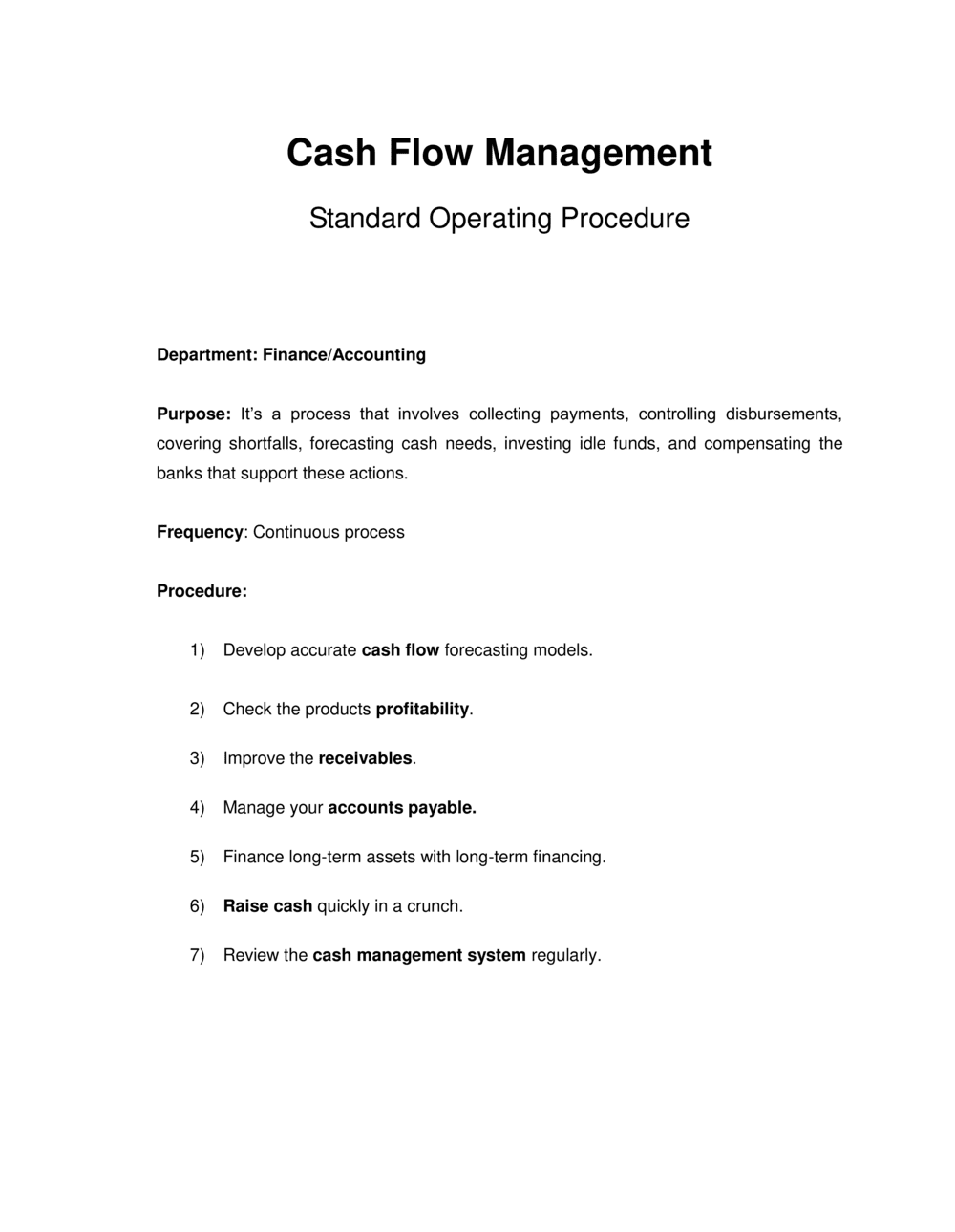
How To Manage Cash Flow is an operational guide and planning template that walks business owners and finance managers through the process of tracking inflows and outflows, forecasting future cash positions, and closing common cash gaps. This free Word download gives you a structured, editable framework you can adapt to your business cycle and share with your bookkeeper, CFO, or board.
When you need it
Use it when launching a business, entering a high-growth phase, experiencing seasonal revenue swings, or preparing for a credit application that requires demonstrated cash management practices.
What's inside
The template covers cash flow fundamentals, a 13-week rolling forecast structure, accounts receivable and payable management tactics, expense timing strategies, financing options for bridging shortfalls, and a monthly review cadence with key metrics to track.

What is a Cash Flow Management Guide?

A Cash Flow Management Guide is an operational document that combines a structured methodology, a rolling forecast framework, and a set of repeatable procedures for monitoring, forecasting, and improving the cash position of a business. Unlike a cash flow statement β€” which records what happened β€” this guide is a forward-looking tool that tells you what is likely to happen over the next 13 weeks and what levers to pull when inflows and outflows are misaligned. It covers everything from how to structure a weekly forecast to when to invoke a line of credit, and it gives finance managers, business owners, and their advisors a shared language and process for staying ahead of cash shortfalls.

Why You Need This Document

Businesses do not fail because they are unprofitable β€” they fail because they run out of cash at the wrong moment. A profitable business running Net 45 receivables against Net 15 payables can be technically insolvent on a Tuesday when payroll is due. Without a structured cash management process, these shortfalls appear without warning, leaving only expensive, last-minute options: emergency credit at punishing rates, delayed supplier payments that damage key relationships, or missed payroll that triggers staff departures. A documented cash flow management framework provides 4–8 weeks of advance visibility β€” enough time to accelerate a collection call, defer a discretionary purchase, or arrange a planned line of credit draw rather than a panic one. This template gives you the forecasting structure, the receivables and payables procedures, and the review cadence to build that visibility into a weekly habit.

Which variant fits your situation?

If your situation is…Use this template
Projecting monthly cash position for the next 12 monthsCash Flow Forecast (12 Months)
Tracking actual cash in and out week by weekWeekly Cash Flow Statement
Presenting cash position to investors or lendersCash Flow Statement
Planning for a seasonal business with predictable slow periodsSeasonal Cash Flow Plan
Managing a startup's burn rate and funding runwayStartup Financial Model
Applying for a bank loan or line of creditBusiness Plan (with financials)
Preparing a full set of management accountsMonthly Financial Report

Common mistakes to avoid

❌ Confusing profit with cash

Why it matters: A business can show healthy net income on its P&L while running out of cash due to receivables lag, inventory buildup, or debt repayments not captured in operating income.

Fix: Run a cash flow statement alongside the P&L every month and treat the closing cash balance β€” not net income β€” as the primary operating health metric.

❌ Using annual projections as the only cash management tool

Why it matters: A 12-month forecast averages out timing gaps that can cause a cash crisis in a specific week. A business that looks fine annually can miss payroll in March.

Fix: Maintain a 13-week rolling forecast updated weekly in parallel with any annual model. The short-term view catches timing shortfalls before they become crises.

❌ Paying supplier invoices immediately instead of on the due date

Why it matters: Paying Net 30 invoices on day 1 is an interest-free loan to your supplier. For a business with $50,000 in monthly payables, this can tie up $50,000 of unnecessary cash at any given time.

Fix: Set up a weekly payment run on a fixed day of the week and pay invoices only when they are within 2–3 days of the due date, unless an early-payment discount exceeds your cost of capital.

❌ Setting a cash reserve with no connection to fixed costs

Why it matters: A $10,000 reserve sounds prudent until payroll is $22,000 every two weeks. The reserve must be anchored to actual obligations, not a round number.

Fix: Calculate your minimum reserve as the sum of one full payroll cycle plus one month's rent and debt service. Review and update this floor every quarter.

The 9 key sections, explained

Cash Flow Fundamentals Overview

Cash Flow Forecast Structure

Accounts Receivable Management

Accounts Payable Management

Expense Timing and Cost Controls

Cash Flow Gap Analysis

Financing Options for Shortfalls

Cash Reserve and Minimum Balance Policy

Monthly Cash Flow Review Cadence

How to fill it out

  1. 1

    Gather your opening cash balance and bank statements

    Pull your current bank balance and the last 3 months of bank and credit card statements. This is your baseline β€” every projection starts from a verified real number.

    πŸ’‘ Reconcile your bank balance to your accounting software before entering any numbers. An unreconciled gap in the opening balance will compound into every forecast week.

  2. 2

    List all expected inflows by source and timing

    Map every expected cash receipt β€” customer payments, loan drawdowns, owner injections β€” to the specific week you realistically expect it to land in your account, not the invoice date.

    πŸ’‘ Use your historical DSO to estimate receipt dates. If your average DSO is 38 days, shift each invoice receipt 38 days from the invoice date, not 30.

  3. 3

    Map all fixed and variable outflows to payment dates

    List every scheduled outflow β€” payroll, rent, supplier payments, loan repayments, tax instalments β€” on the date the cash actually leaves your account, not the invoice or accrual date.

    πŸ’‘ Pull your direct debit schedule from your bank portal to catch subscriptions and automatic payments that often get missed in manual forecasts.

  4. 4

    Calculate the weekly closing balance and flag shortfalls

    Subtract total outflows from total inflows for each week, add the opening balance, and record the closing balance. Highlight any week where the closing balance falls below your minimum threshold.

    πŸ’‘ Color-code the closing balance row: green above threshold, amber within 20% of threshold, red below. This makes shortfall weeks visible without reading every number.

  5. 5

    Classify each shortfall as timing or structural

    For every red or amber week, identify the cause. A timing gap (receivables arriving a week late) requires a different response than a structural gap (outflows permanently exceeding inflows at current revenue).

    πŸ’‘ If more than three consecutive weeks show structural shortfalls, the problem is not a cash flow management issue β€” it is a pricing or cost structure issue that a line of credit will only defer.

  6. 6

    Select and document the response for each gap

    For each identified shortfall, record the specific action β€” accelerate invoice collection, defer a discretionary expense, draw the line of credit, or initiate a supplier payment negotiation β€” with the responsible person and deadline.

    πŸ’‘ Assign one owner per action item. Shared accountability for cash gap responses means no one acts until it is too late.

  7. 7

    Update the forecast weekly and review actuals vs. plan

    Every week, enter actual inflows and outflows, compare them to what was forecast, and roll the 13-week window forward by one week with updated assumptions.

    πŸ’‘ Persistent forecast errors in the same category β€” e.g., customer receipts always arriving 5 days later than projected β€” signal a bad assumption that needs a permanent fix, not just a weekly adjustment.

Frequently asked questions

What does managing cash flow mean?

Managing cash flow means actively tracking, forecasting, and controlling the timing of money moving in and out of your business so you always have enough cash to meet obligations as they come due. It involves building a rolling forecast, accelerating customer collections, timing supplier payments strategically, maintaining a minimum cash reserve, and responding to projected shortfalls before they become crises. It is distinct from managing profit β€” a business can be profitable and still run out of cash.

Why is cash flow management important for small businesses?

Cash flow problems are the most common reason small businesses fail β€” not lack of profit or demand, but running out of cash to cover payroll, rent, or supplier payments at the wrong moment. Small businesses typically have thinner reserves and less access to emergency credit than larger companies, meaning a two-week delay in a major customer payment can trigger a payroll shortfall. Active cash management provides the visibility to see problems 4–8 weeks ahead, when corrective options are still available.

What is a 13-week cash flow forecast?

A 13-week cash flow forecast is a rolling, week-by-week projection of expected cash inflows and outflows for the next quarter. It is updated every week by replacing the completed week with a new week at the end, keeping the horizon constant. The 13-week format is the standard tool for active cash management because it is detailed enough to catch short-term shortfalls while being long enough to allow corrective action. It is also the format most lenders and turnaround advisors request when assessing a business in financial stress.

What is the difference between cash flow and profit?

Profit is the difference between revenue and expenses on an accrual basis β€” it recognizes income when earned and expenses when incurred, regardless of when cash changes hands. Cash flow measures only actual cash received and paid. A business invoicing on Net 60 terms can show strong profit while waiting 60 days for cash. Depreciation reduces profit but requires no cash outflow. Loan repayments consume cash but do not affect operating profit. Both metrics matter, but cash flow determines whether you can make payroll on Friday.

How much cash reserve should a business keep?

The commonly cited target is 3–6 months of operating expenses, but for practical day-to-day management, the minimum floor should equal at least one full payroll cycle plus one month of fixed costs β€” rent, debt service, and essential subscriptions. Seasonal businesses should hold reserves calibrated to their slowest revenue month, not their average. The right number depends on revenue predictability, payment terms with customers, and access to a line of credit as a backup.

What are the most effective ways to improve cash flow?

The highest-impact levers are: invoice immediately upon delivery rather than at month-end, shorten payment terms from Net 30 to Net 15, offer a small early-payment discount (1–2%) for customers who pay within 7 days, pay supplier invoices on their due date rather than early, and defer discretionary spending until after major customer receipts land. Together, these changes can reduce DSO by 10–15 days and extend DPO by a similar margin β€” effectively freeing weeks of working capital without any financing.

When should a business use a line of credit for cash flow?

A line of credit is appropriate for bridging predictable, short-term timing gaps β€” for example, when a large customer payment is due in Week 3 but payroll falls in Week 1. It is not appropriate as a permanent substitute for insufficient operating margin. If you are drawing on a line of credit every month without fully repaying it, the problem is structural β€” your business is not generating enough cash from operations to fund itself, and adding debt makes the underlying problem worse.

How does accounts receivable management affect cash flow?

Accounts receivable directly determines when cash from completed work actually arrives in your bank account. Every day of DSO above your payment terms represents cash tied up in unpaid invoices. A business with $500,000 in annual revenue and 45-day DSO has approximately $61,000 permanently tied up in receivables at any moment β€” money it has earned but cannot spend. Reducing DSO by 10 days on that revenue base frees roughly $13,700 in working capital with no additional sales required.

What metrics should I track to manage cash flow effectively?

The core metrics are: closing cash balance versus minimum threshold (weekly), days sales outstanding (monthly), days payable outstanding (monthly), burn rate (monthly for pre-revenue or early-stage businesses), cash conversion cycle (quarterly), and actual versus forecast variance (weekly). Tracking DSO and DPO together gives you the cash conversion cycle β€” the number of days it takes to turn a sale into collected cash after paying your suppliers β€” which is the single most actionable summary metric for working capital efficiency.

How this compares to alternatives

vs Cash Flow Statement

A cash flow statement is a historical accounting document reporting actual inflows and outflows for a completed period β€” it records what happened. A cash flow management guide is a forward-looking operational tool for forecasting and controlling future cash positions. Use the statement to understand the past; use the management framework to influence the future.

vs Cash Flow Forecast (12 Months)

A 12-month cash flow forecast provides an annual view of projected cash position, useful for strategic planning and investor presentations. A cash flow management guide adds the operational layer β€” the 13-week rolling forecast, collection procedures, payment policies, and shortfall responses β€” that converts a projection into an active management system.

vs Budget Template

A budget allocates planned revenue and spending for the year on an accrual basis and is primarily a cost-control and performance tool. A cash flow management framework focuses specifically on the timing of actual cash movements, which often diverges significantly from budgeted amounts due to payment terms, prepayments, and receivables lag.

vs Monthly Financial Report

A monthly financial report summarizes P&L, balance sheet, and cash position after the fact, for management review. A cash flow management guide is a prospective operational document focused on the next 13 weeks β€” it feeds into the monthly report but operates at a shorter time horizon and higher frequency.

Industry-specific considerations

Retail and E-commerce

Inventory purchase timing creates large, lumpy outflows weeks before the corresponding sales revenue arrives, making rolling cash forecasts essential during buying seasons.

Construction and Trades

Progress billing, retainage holdbacks, and subcontractor payment schedules create complex inflow and outflow patterns that require project-level cash mapping alongside the overall business forecast.

Professional Services

High DSO from corporate clients and end-of-month invoicing cycles create predictable monthly cash troughs that a 13-week forecast helps anticipate and bridge.

Manufacturing

Raw material purchasing, production lead times, and finished-goods inventory all consume cash well before customer invoices are issued, requiring careful alignment of the procurement calendar with the cash forecast.

Template vs pro β€” what fits your needs?

PathBest forCostTime
Use the templateSmall business owners and freelancers managing straightforward monthly cash cyclesFree2–4 hours to set up; 30 minutes per week to maintain
Template + professional reviewGrowing businesses with complex receivables, multiple revenue streams, or a pending credit application$200–$800 for a bookkeeper or accountant review session1–2 days
Custom draftedBusinesses in financial distress, pre-acquisition due diligence, or lender-mandated cash reporting$1,500–$5,000 for a CFO consultant or turnaround advisor1–2 weeks

Glossary

Cash Flow
The net movement of money into and out of a business over a defined period, distinct from profit or revenue.
Operating Cash Flow
Cash generated or consumed by the core business activities β€” collecting from customers, paying suppliers, and covering operating expenses.
Cash Flow Forecast
A forward-looking projection of expected cash inflows and outflows over a defined period, typically 13 weeks or 12 months.
Working Capital
Current assets minus current liabilities β€” the net liquid resources available to fund day-to-day operations.
Accounts Receivable (AR)
Money owed to the business by customers for goods or services already delivered but not yet paid.
Accounts Payable (AP)
Money the business owes to suppliers and vendors for goods or services received but not yet paid.
Burn Rate
The monthly net cash outflow for a business β€” how fast it spends existing cash before new revenue or financing arrives.
Runway
The number of months a business can continue operating at its current burn rate before exhausting available cash.
Days Sales Outstanding (DSO)
The average number of days between issuing an invoice and receiving payment β€” a key indicator of receivables efficiency.
Line of Credit
A pre-approved borrowing facility from a bank that a business can draw on as needed to cover short-term cash shortfalls.
13-Week Cash Flow
A rolling short-term forecast updated weekly, covering the next 13 weeks in detail β€” the standard tool for active cash management.

Part of your Business Operating System

This document is one of 3,000+ business & legal templates included in Business in a Box.

  • Fill-in-the-blanks β€” ready in minutes
  • Compatible with all office suites
  • Export to PDF and share electronically

Create your document in 3 simple steps.

From template to signed document β€” all inside one Business Operating System.
1
Download or open template

Access over 3,000+ business and legal templates for any business task, project or initiative.

2
Edit and fill in the blanks with AI

Customize your ready-made business document template and save it in the cloud.

3
Save, Share, Send, Sign

Share your files and folders with your team. Create a space of seamless collaboration.

Save time, save money, and create top-quality documents.

β˜…β˜…β˜…β˜…β˜…

"Fantastic value! I'm not sure how I'd do without it. It's worth its weight in gold and paid back for itself many times."

Managing Director Β· Mall Farm
Robert Whalley
Managing Director, Mall Farm Proprietary Limited
β˜…β˜…β˜…β˜…β˜…

"I have been using Business in a Box for years. It has been the most useful source of templates I have encountered. I recommend it to anyone."

Business Owner Β· 4+ years
Dr Michael John Freestone
Business Owner
β˜…β˜…β˜…β˜…β˜…

"It has been a life saver so many times I have lost count. Business in a Box has saved me so much time and as you know, time is money."

Owner Β· Upstate Web
David G. Moore Jr.
Owner, Upstate Web

Run your business with a system β€” not scattered tools

Stop downloading documents. Start operating with clarity. Business in a Box gives you the Business Operating System used by over 250,000 companies worldwide to structure, run, and grow their business.

Start freeΒ Β·Β No credit card required