Bonus Plan Template

Free Word download β€’ Edit online β€’ Save & share with Drive β€’ Export to PDF

2 pagesβ€’20–25 min to fillβ€’Difficulty: Standard
Learn more ↓
FreeBonus Plan Template

At a glance

What it is
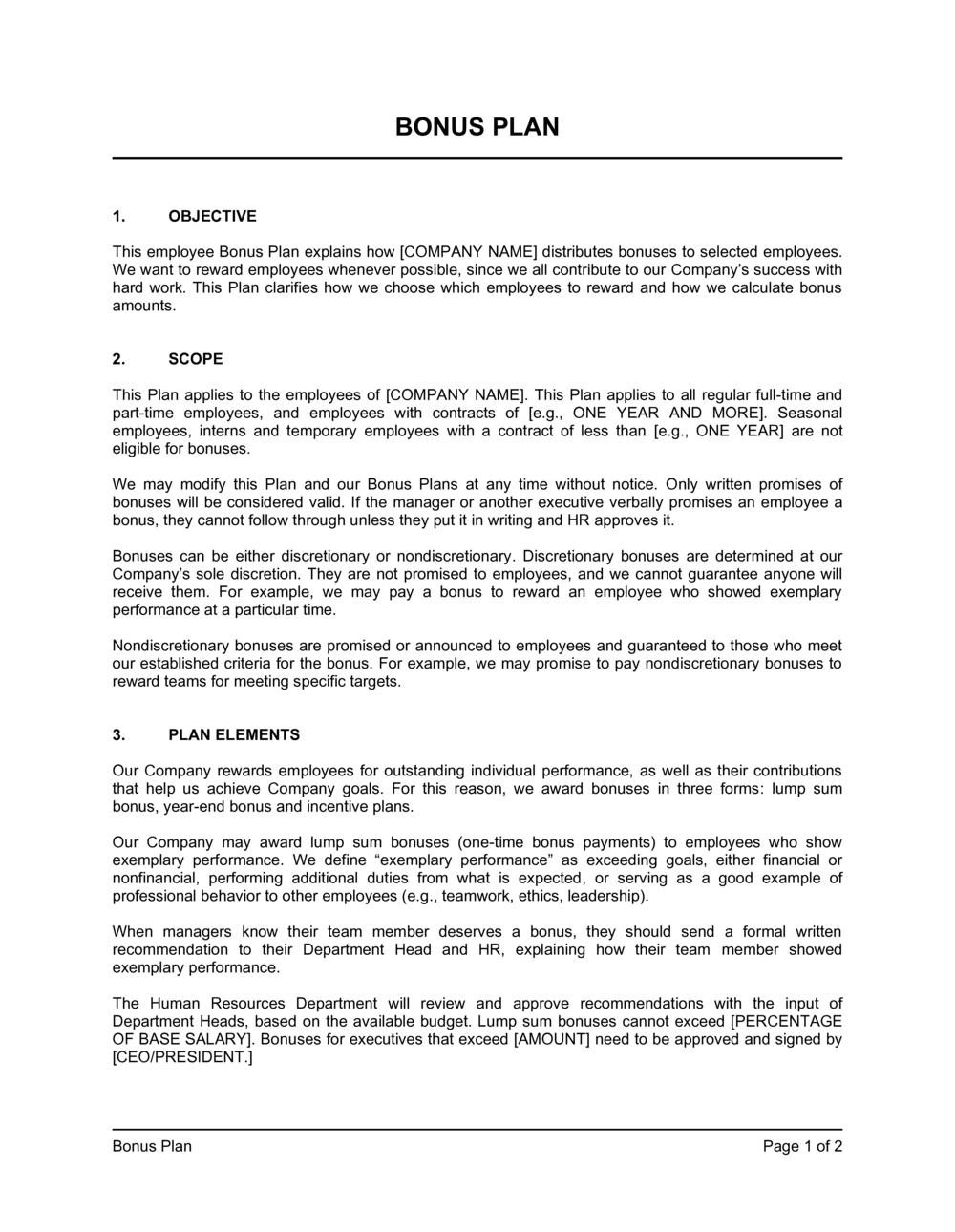
A Bonus Plan is a formal HR policy document that defines a company-wide or team-level bonus program β€” who is eligible, how performance is measured, how payouts are calculated, when bonuses are paid, and who governs exceptions. This free Word download gives you a structured, editable template you can tailor to your organization and export as PDF for distribution to employees and managers.
When you need it
Use it when establishing a new bonus program, replacing ad hoc bonus decisions with a documented policy, or aligning a growing team around consistent, transparent incentive rules before a new performance period begins.
What's inside
Purpose and program objectives, eligibility criteria, performance metrics and targets, individual and company performance weighting, payout calculation methodology with target and maximum amounts, payment timing and conditions, and governance rules covering proration, termination, and discretionary authority.

What is a Bonus Plan?

A Bonus Plan is a formal HR policy document that defines the rules governing a company-wide or team-level incentive program β€” who is eligible, which performance metrics trigger a payout, how the bonus amount is calculated, when it is paid, and who has authority to approve exceptions or amendments. It is the policy backbone that ensures every individual bonus award is calculated on a consistent, documented basis rather than left to managerial discretion after the fact. Without a written plan, bonus decisions are impossible to defend, difficult to accrue accurately, and legally exposed when a departing employee disputes their entitlement.

Why You Need This Document

Running a bonus program without a written plan creates four concrete problems simultaneously. First, employees receive different payouts for equivalent performance because managers apply different mental formulas β€” eroding trust and triggering discrimination concerns. Second, your finance team cannot accrue bonus liability accurately without a defined formula, leading to budget surprises at year-end. Third, employees who resign or are terminated before payment date may have enforceable claims to a pro-rata share if there is no active-employment condition in writing. Fourth, without a funding gate, the company may be contractually obligated to pay bonuses in a year where operating results do not support it. A documented bonus plan closes all four gaps, gives employees a clear line of sight between their effort and their reward, and gives management the governance authority to adjust the program when business conditions change β€” as long as the notice requirements are followed.

Which variant fits your situation?

If your situation is…Use this template
Rewarding individuals based on personal performance metrics onlyIndividual Performance Bonus Plan
Incentivizing a sales team with quota-based commission and bonus componentsSales Commission Plan
Communicating a specific bonus award to a named employeeBonus Letter
Recognizing exceptional one-time contributions outside a formal programSpot Bonus Policy
Incentivizing executives with long-term equity and cash componentsExecutive Compensation Plan
Linking team-level payouts to a shared profit metricProfit Sharing Plan
Retaining key employees through a deferred payout tied to tenureRetention Bonus Agreement

Common mistakes to avoid

❌ No active-employment condition on the payment date

Why it matters: Without this clause, employees who resign before the payment date may still have a legal claim to their pro-rata bonus earned during the period.

Fix: Add explicit language requiring active employment on the payment date, and review jurisdiction-specific rules before applying it to employees in Canada, the UK, or the EU.

❌ Omitting a funding gate

Why it matters: A plan without a funding gate creates an obligation to pay bonuses even in a year where the company posts a loss, straining cash at the worst possible moment.

Fix: Define a minimum company financial result β€” such as achieving 80% of planned EBITDA β€” below which the bonus pool is zero, regardless of individual performance.

❌ Using purely subjective performance metrics

Why it matters: Metrics like 'demonstrates leadership' with no scoring rubric expose the company to discrimination claims and create perceived favoritism that undermines the plan's motivational value.

Fix: Anchor at least 50% of the weighting to objectively measurable financial or operational results; document the scoring rubric for any qualitative component before the period begins.

❌ Publishing the formula without a worked example

Why it matters: Employees who cannot independently verify their expected payout lose trust in the program and escalate to HR unnecessarily, consuming management time.

Fix: Include a numeric example in the plan document using realistic placeholder figures that show exactly how the formula produces a dollar amount at target performance.

The 9 key sections, explained

Purpose and program objectives

Eligibility criteria

Performance measures and targets

Bonus calculation methodology

Target and maximum payout schedule

Funding gate and company performance factor

Payment timing and method

Proration, leaves, and mid-year changes

Governance, exceptions, and amendments

How to fill it out

  1. 1

    Define the performance period and program scope

    Enter the exact start and end date of the performance period and specify whether the plan covers the whole company, a specific department, or a named job-grade band.

    πŸ’‘ Align the performance period to your fiscal year so bonus calculations can use audited financials rather than preliminary estimates.

  2. 2

    Set eligibility rules with a clear active-employment condition

    Specify the employment type, job grades, and hire-date cutoff. Explicitly state that the employee must be actively employed on the payment date to receive a bonus.

    πŸ’‘ List any roles excluded from the plan β€” such as commission-based sales employees covered by a separate plan β€” to avoid double-counting.

  3. 3

    Choose performance metrics and assign weights

    Select two to four metrics (e.g., revenue, EBITDA, customer NPS, individual rating) and assign each a weight totaling 100%. Set threshold, target, and maximum values for each.

    πŸ’‘ Cap the number of metrics at four. More than four dilutes focus and makes the payout calculation too complex to be motivating.

  4. 4

    Build the payout schedule by job level

    Enter the target bonus percentage and the maximum payout cap for each grade or job band in the payout table. Ensure the maximum is at least 150% of target to preserve upside incentive.

    πŸ’‘ Benchmark your target bonus percentages against published compensation surveys for your industry before finalizing β€” underpaying relative to market reduces the plan's retention impact.

  5. 5

    Define the funding gate

    Set the minimum company financial result β€” typically EBITDA or net income as a percentage of plan β€” below which no bonuses are paid. Then build the scaling table from threshold to maximum.

    πŸ’‘ Make the funding gate a simple single number, not a multi-condition formula. Finance teams need to communicate it clearly to all managers at year-end.

  6. 6

    Write the proration and mid-year change rules

    Specify how the bonus is prorated for new hires, role changes, and leaves. Address voluntary resignation and involuntary termination separately, as the treatment is often different.

    πŸ’‘ Consult statutory minimums in the employee's work jurisdiction before deciding whether terminated employees receive any proration β€” some provinces and countries require it.

  7. 7

    State the payment date and governance authority

    Enter the specific payment deadline (e.g., 'no later than March 31 following the performance year'), the approval authority, and the notice period required before any mid-period amendments.

    πŸ’‘ Build in a 30-day buffer between your financial close date and the payment deadline so the audit can complete before bonuses are committed.

  8. 8

    Distribute and document acknowledgment

    Share the final plan with all eligible employees before the performance period begins, and collect a signed or electronic acknowledgment confirming they received and reviewed it.

    πŸ’‘ Store acknowledgments in your HRIS alongside the plan version distributed β€” this is your evidence if a payout dispute arises later.

Frequently asked questions

What is a bonus plan?

A bonus plan is a formal HR policy document that defines the rules of a company's incentive program β€” who qualifies, how performance is measured, how payouts are calculated, and when they are paid. It is the policy backbone behind individual bonus letters, ensuring every award is calculated consistently and can be defended if questioned by employees or auditors.

What is the difference between a bonus plan and a bonus letter?

A bonus plan is the company-wide policy that governs the entire program β€” eligibility rules, performance metrics, payout formulas, and governance. A bonus letter is the individual communication issued to a specific employee stating their personal target, the period covered, and their actual award. The letter references the plan; the plan is the source of truth.

How should bonus targets be set by job level?

Target bonus percentages are typically expressed as a share of base salary and scaled by seniority. Common benchmarks: 5–10% for individual contributors, 10–20% for managers and senior professionals, 20–40% for directors and VPs, and 40–100% or more for C-suite executives. Benchmarking against industry compensation surveys before finalizing targets helps avoid both overpaying and losing candidates to competitors.

What is a funding gate and why does it matter?

A funding gate is a minimum company-level financial result that must be reached before any bonus pool is funded. It protects the business from paying out bonuses during a loss-making year and aligns employee interests with overall company health. A typical gate is achieving 80–85% of the planned EBITDA target; below that level, the payout factor drops to zero.

How are bonuses taxed?

In most jurisdictions, bonus payments are treated as ordinary employment income and subject to income tax withholding and payroll taxes at the time of payment. In the US, the IRS permits employers to withhold a flat 22% supplemental rate on bonus payments under $1 million, or to aggregate the bonus with regular wages and apply the employee's normal withholding rate. Specific rules vary by country and province β€” always confirm with your payroll provider before setting payment terms.

Should bonuses be prorated for new hires?

Most bonus plans prorate awards for employees who join after the start of the performance period, calculated on the number of full or partial months of active service. A common approach is to prorate for employees hired within the first half of the performance period and exclude those hired in the second half. Whatever rule you apply, document it explicitly in the plan and apply it consistently to avoid claims of differential treatment.

How often should a bonus plan be reviewed and updated?

Review the plan annually before the start of each performance period to update metrics, targets, and payout percentages based on current strategy and market conditions. Avoid making changes after the performance period has begun unless business conditions change materially β€” retroactive changes to metrics or targets damage employee trust and may have legal implications in some jurisdictions.

What is a clawback provision and should I include one?

A clawback provision requires an employee to repay a bonus already received if financial results are subsequently restated, or if the employee violates a specific policy condition such as a non-compete. Clawbacks are standard practice for executives in publicly traded companies under Dodd-Frank and are increasingly common in private-company senior plans. For rank-and-file employees, clawbacks are less common and should be limited to documented misconduct rather than routine business variability.

How this compares to alternatives

vs Bonus Letter

A bonus letter is the individual communication issued to one employee stating their specific award amount and payment date. The bonus plan is the policy document that governs how that award was calculated. You need both β€” the plan to establish the rules, the letter to confirm the individual outcome.

vs Sales Commission Plan

A sales commission plan governs variable compensation tied directly to revenue closed, typically paid monthly or quarterly with no company-level funding gate. A bonus plan covers the broader employee population, ties payouts to a mix of company and individual metrics, and pays annually. Sales roles usually need both documents.

vs Profit Sharing Plan

A profit sharing plan distributes a fixed percentage of company profit to employees, with individual allocations based on salary or tenure rather than individual performance ratings. A bonus plan allows for differentiated payouts based on measurable personal performance. Profit sharing rewards collective results; a bonus plan rewards individual contribution.

vs Retention Bonus Agreement

A retention bonus agreement is a one-time payment tied to an employee remaining with the company through a specific date β€” it is not performance-linked. A bonus plan is a recurring program tied to measurable outcomes. Retention bonuses are used for critical hires or during mergers; a bonus plan is an ongoing incentive framework.

Industry-specific considerations

Technology / SaaS

Bonus metrics commonly include ARR growth, net revenue retention, and product milestone delivery, with separate pools for engineering and go-to-market teams.

Financial Services

Regulatory requirements in many jurisdictions mandate clawback provisions, deferred payout schedules for risk-takers, and documented approval by a compensation committee.

Retail / E-commerce

Bonus pools are typically tied to same-store sales growth, gross margin percentage, and inventory shrinkage targets, with quarterly payout cycles to maintain staff motivation.

Professional Services

Billable utilization rate, client satisfaction scores, and revenue contribution per fee-earner are the dominant metrics, with individual performance modifiers carrying higher weight than in product businesses.

Template vs pro β€” what fits your needs?

PathBest forCostTime
Use the templateSmall and mid-size businesses establishing a first formal bonus program for non-executive employeesFree2–4 hours
Template + professional reviewCompanies with 50+ employees, multi-jurisdiction workforces, or plans that include clawback provisions$300–$800 for an HR consultant or employment lawyer review3–5 business days
Custom draftedPublicly traded companies, regulated financial services firms, or executive plans with deferred compensation components$2,000–$8,000+2–4 weeks

Glossary

Target Bonus
The bonus amount payable when an employee or the company meets 100% of defined performance targets β€” expressed as a percentage of base salary or a fixed dollar amount.
Maximum Bonus
The highest possible bonus payout, typically 125–200% of the target bonus, awarded when performance exceeds targets by a defined threshold.
Performance Period
The defined timeframe β€” most commonly a fiscal year or fiscal quarter β€” over which performance is measured for bonus eligibility.
Threshold
The minimum performance level that must be reached before any bonus is paid; performance below the threshold results in a zero payout.
Modifier
A multiplier applied to a calculated bonus amount based on individual performance ratings, used to differentiate payouts within the same job level.
Proration
The reduction of a bonus to reflect a partial performance period β€” typically applied when an employee joins, changes roles, or takes extended unpaid leave mid-year.
Accrual
The accounting practice of recording bonus expense in the period it is earned rather than when it is paid, required for accurate financial reporting.
Discretionary Bonus
A bonus that management may grant at its sole judgment, without a pre-defined formula or entitlement β€” distinct from a formulaic or contractual bonus.
Clawback
A provision requiring an employee to return previously paid bonus amounts if financial results are later restated or if the employee violates a policy condition.
Funding Gate
A company-level financial condition β€” such as achieving a minimum EBITDA margin β€” that must be met before any individual bonuses are paid out regardless of personal performance.

Part of your Business Operating System

This document is one of 3,000+ business & legal templates included in Business in a Box.

  • Fill-in-the-blanks β€” ready in minutes
  • 100% customizable Word document
  • Compatible with all office suites
  • Export to PDF and share electronically

Create your document in 3 simple steps.

From template to signed document β€” all inside one Business Operating System.
1
Download or open template

Access over 3,000+ business and legal templates for any business task, project or initiative.

2
Edit and fill in the blanks with AI

Customize your ready-made business document template and save it in the cloud.

3
Save, Share, Send, Sign

Share your files and folders with your team. Create a space of seamless collaboration.

Save time, save money, and create top-quality documents.

β˜…β˜…β˜…β˜…β˜…

"Fantastic value! I'm not sure how I'd do without it. It's worth its weight in gold and paid back for itself many times."

Managing Director Β· Mall Farm
Robert Whalley
Managing Director, Mall Farm Proprietary Limited
β˜…β˜…β˜…β˜…β˜…

"I have been using Business in a Box for years. It has been the most useful source of templates I have encountered. I recommend it to anyone."

Business Owner Β· 4+ years
Dr Michael John Freestone
Business Owner
β˜…β˜…β˜…β˜…β˜…

"It has been a life saver so many times I have lost count. Business in a Box has saved me so much time and as you know, time is money."

Owner Β· Upstate Web
David G. Moore Jr.
Owner, Upstate Web

Run your business with a system β€” not scattered tools

Stop downloading documents. Start operating with clarity. Business in a Box gives you the Business Operating System used by over 250,000 companies worldwide to structure, run, and grow their business.

Start freeΒ Β·Β No credit card required