Advertising Plan Template

Free Word download β€’ Edit online β€’ Save & share with Drive β€’ Export to PDF

17 pagesβ€’30–40 min to fillβ€’Difficulty: Complex
Learn more ↓
FreeAdvertising Plan Template

At a glance

What it is
An Advertising Plan is a structured operational document that maps out a company's paid promotional activity across channels β€” defining objectives, target audiences, messaging, media mix, budget allocation, and success metrics for a defined campaign period. This free Word download gives you a ready-to-edit framework you can customize for any industry and export as PDF to share with stakeholders, agencies, or leadership.
When you need it
Use it before launching a new product, entering a new market, or committing significant budget to a paid media campaign. It is also the right tool when onboarding an agency or aligning an internal marketing team around a shared promotional strategy.
What's inside
Executive summary, situation analysis, advertising objectives, target audience profiles, key messages and creative direction, channel and media mix, budget breakdown, campaign timeline, and KPIs with measurement plan.

What is an Advertising Plan?

An Advertising Plan is a structured operational document that defines how a company will deploy paid media to reach a specific audience, communicate a defined message, and achieve measurable business objectives within a set budget and timeframe. It covers every material decision required to run a coordinated campaign: which channels to use and why, how much to spend on each, what the core message is, when each element launches, and how performance will be measured. Unlike a general marketing plan, an advertising plan focuses exclusively on paid promotional activity β€” turning strategy into a concrete, executable schedule that an internal team or external agency can act on immediately.

Why You Need This Document

Without a written advertising plan, campaigns are built on informal agreements, verbal briefings, and spreadsheet fragments that contradict each other by launch day. Budget gets spent on channels chosen by habit rather than audience data, messaging drifts across placements until the brand feels unfamiliar, and performance is measured against no agreed standard β€” making it impossible to defend the spend or improve the next campaign. The cost is concrete: uncoordinated advertising consistently produces higher CPAs, lower ROAS, and budget overruns that erode confidence in the entire marketing function. A completed advertising plan eliminates these failure modes before the first dollar is committed, giving every stakeholder β€” leadership, agency, and media buyer β€” a single source of truth that keeps the campaign on strategy from brief to post-mortem.

Which variant fits your situation?

If your situation is…Use this template
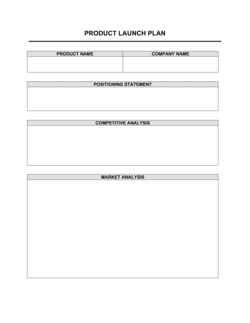
Planning paid media for a single product launchProduct Launch Plan
Coordinating all marketing activity, not just paid advertisingMarketing Plan
Mapping out social media content and paid social campaignsSocial Media Marketing Plan
Planning and tracking digital advertising spend in a spreadsheetAdvertising Budget Template
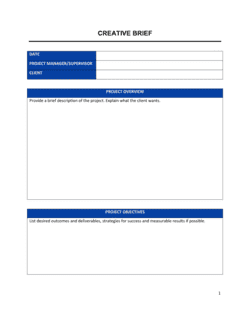
Briefing a creative agency on campaign messaging and directionCreative Brief
Documenting brand positioning before building advertising messagesBrand Strategy Template
Planning a public relations and earned-media campaign alongside paid adsPR Plan

Common mistakes to avoid

❌ Setting activity-based objectives instead of outcome-based ones

Why it matters: Objectives like 'run Google Ads for three months' give the team no target to optimize toward and give leadership no basis for evaluating success or failure.

Fix: Rewrite every objective in the format: achieve [METRIC] of [VALUE] by [DATE]. If you cannot measure it, it is not a valid objective.

❌ Skipping the situation analysis

Why it matters: Without a performance baseline and competitive context, budget decisions are based on assumption rather than evidence, and there is no benchmark to measure improvement against.

Fix: Spend one to two hours pulling historical campaign data and at least one competitor spend estimate before allocating a single dollar to channels.

❌ Allocating the entire budget to media with nothing for creative production

Why it matters: Weak creative running on a well-targeted media plan consistently underperforms strong creative on a modest plan. Underfunding production is one of the most common ways advertising budgets are wasted.

Fix: Allocate 15–20% of the total campaign budget to creative production and testing before distributing the remainder across media channels.

❌ Using a different core message on each channel

Why it matters: Fragmented messaging splits attention and prevents the cumulative brand recall that repeated consistent exposure builds. Audiences rarely see every channel β€” inconsistency makes the brand feel unfamiliar everywhere.

Fix: Write one core message and adapt the format for each channel β€” shorter copy for display, a longer narrative for video β€” while keeping the underlying proposition identical.

❌ Building no contingency into the budget

Why it matters: Media costs fluctuate, top-performing channels often need more investment mid-flight, and unexpected production revisions happen. A plan with zero flexibility runs out of options exactly when optimization matters most.

Fix: Reserve 10% of the total budget as a reallocation pool and define in the plan which metric triggers a reallocation decision.

❌ Setting up measurement and tracking after the campaign launches

Why it matters: Conversion data from the first days of a campaign is lost permanently if tracking is not in place before launch, making ROAS and CPA calculations for the full campaign inaccurate.

Fix: Complete a measurement checklist β€” conversion pixels, UTM parameters, brand lift study enrollment β€” at least 48 hours before any paid media goes live.

The 9 key sections, explained

Executive Summary

Situation Analysis

Advertising Objectives

Target Audience

Key Messages and Creative Direction

Channel and Media Mix

Budget Breakdown

Campaign Timeline and Flighting

KPIs and Measurement Plan

How to fill it out

  1. 1

    Define the campaign objective before touching anything else

    Write one to three specific, measurable objectives with deadlines. Each objective should state what changes, by how much, and by when β€” not what you plan to do.

    πŸ’‘ Tie each objective to a metric you can already measure today so you have a baseline before the campaign launches.

  2. 2

    Complete the situation analysis using real data

    Pull recent campaign performance data, any available brand awareness research, and competitor spend estimates from tools like SEMrush, Pathmatics, or media industry reports.

    πŸ’‘ If you have no historical data, note that in the plan and flag the first campaign as a baseline-building exercise β€” it sets realistic expectations for stakeholders.

  3. 3

    Build detailed audience profiles

    Define your primary and secondary audiences using demographics, psychographics, and behavioral data from your CRM, Google Analytics, or customer surveys. Be specific enough that a media buyer can translate the profile into platform targeting parameters.

    πŸ’‘ Export your top 20% of customers by revenue and build the primary audience profile from their shared characteristics β€” not from internal assumptions.

  4. 4

    Write the key message and creative direction

    State the single most important thing you want the audience to think, feel, or do after seeing the ad. Then list two to three supporting proof points and a specific call to action.

    πŸ’‘ Test your core message with five people outside the marketing team before briefing creative. If they cannot repeat the main idea back in one sentence, simplify it.

  5. 5

    Select channels based on audience behavior, then allocate budget

    List each channel, justify its inclusion with audience data or past performance, and assign a budget percentage. Total all allocations and confirm they equal 100% of the campaign budget.

    πŸ’‘ Reserve 10% as a contingency to reallocate mid-campaign to whichever channel is outperforming β€” rigid budgets miss optimization opportunities.

  6. 6

    Build the campaign timeline with production lead times included

    Work backward from the desired live date. Allow at least two weeks for creative production, one week for trafficking and QA, and two business days for stakeholder approval at each stage.

    πŸ’‘ Mark approval deadlines in the timeline and assign a named owner for each sign-off β€” ambiguous ownership is the leading cause of delayed launches.

  7. 7

    Define your KPIs and reporting cadence before launch

    List the two to three metrics that matter most for each campaign objective, the tool tracking them, and whether reporting is weekly or biweekly. Confirm measurement infrastructure is in place before the campaign goes live.

    πŸ’‘ Set up conversion tracking and UTM parameters before the first ad runs β€” retrofitting attribution after launch produces incomplete data and unreliable ROAS figures.

Frequently asked questions

What is an advertising plan?

An advertising plan is a structured document that defines a company's paid promotional strategy for a specific campaign period. It covers the advertising objectives, target audience, key messages, channel mix, budget allocation, campaign timeline, and KPIs used to measure success. It serves as both an internal decision-making tool and a brief shared with agencies or media partners.

What is the difference between an advertising plan and a marketing plan?

A marketing plan covers the full scope of how a company reaches and retains customers β€” including product, pricing, distribution, content, PR, and paid advertising. An advertising plan focuses specifically on paid media activity: which channels to buy, how much to spend on each, what messages to run, and how to measure campaign performance. Most businesses build an advertising plan as one component within a broader marketing plan.

What should an advertising plan include?

A complete advertising plan includes a situation analysis, specific measurable objectives, target audience profiles, key messages and creative direction, a channel and media mix with budget allocation, a campaign timeline with production milestones, and a KPI measurement plan. Skipping any of these sections typically produces a campaign that is hard to execute, impossible to optimize, and difficult to justify for future budget requests.

How do I choose the right advertising channels for my plan?

Start with where your target audience spends attention, not with what channels your team finds familiar. Use first-party data from your CRM and analytics platform to identify where existing customers came from, then cross-reference with category benchmark data. For awareness objectives, prioritize reach and CPM efficiency. For conversion objectives, prioritize channels with clear intent signals β€” paid search and retargeting consistently outperform awareness channels for direct-response goals.

How much budget should an advertising plan allocate to each channel?

There is no universal formula, but a practical starting point is to allocate the largest share to the channel with the clearest performance history and the lowest CPA, then distribute the remainder across reach-building and test channels. Reserve 10% as a contingency for mid-campaign reallocation. For most small and mid-sized businesses, concentrating 70–80% of budget in two to three channels outperforms spreading thin across six or more.

How long should an advertising campaign run?

Long enough to accumulate statistically meaningful performance data β€” typically a minimum of four weeks for digital campaigns and eight weeks for brand awareness initiatives. Campaigns shorter than four weeks rarely produce enough conversion volume to optimize bidding algorithms or draw reliable conclusions. Campaigns that run indefinitely without a defined review point tend to carry underperforming placements that erode overall ROAS.

What KPIs should I include in an advertising plan?

Select KPIs that map to your specific objectives. For awareness campaigns, track impressions, reach, frequency, and aided brand recall lift. For consideration campaigns, track click-through rate, video completion rate, and site engagement. For conversion campaigns, track CPA, ROAS, and revenue attributed to the campaign. Every advertising plan should include at least one KPI at each stage of the funnel the campaign is designed to influence.

Do I need an advertising agency to use this template?

No. The template is designed to be completed by an in-house marketing team, a solo business owner, or a founder with no agency relationship. If you are working with an agency, the completed plan functions as a strategic brief that aligns both parties before execution begins. An agency should contribute to the channel mix and budget allocation sections using their media buying data, but the objectives, audience, and key messages should be defined by the brand before briefing any external partner.

How often should an advertising plan be updated?

Review the plan at the midpoint of every campaign flight β€” typically at Week 4 or 5 of an eight to ten week campaign β€” to reallocate budget away from underperforming channels and toward those exceeding targets. Write a full plan for each new campaign period rather than recycling the prior plan unchanged. Annual advertising plans should be updated to reflect the prior year's performance data, shifts in competitive spend, and any changes to product positioning or target audience.

How this compares to alternatives

vs Marketing Plan

A marketing plan covers the full spectrum of how a business attracts, converts, and retains customers β€” including product strategy, pricing, distribution, content, and PR alongside paid advertising. An advertising plan focuses exclusively on paid media: channels, budget, messages, and measurement. Build the marketing plan first to establish strategy, then use the advertising plan to execute the paid component.

vs Social Media Marketing Plan

A social media marketing plan covers both organic content and paid social activity on platforms like Meta, LinkedIn, and TikTok. An advertising plan addresses the full paid media mix β€” including search, display, video, print, and out-of-home β€” across all channels, not just social. Use the social media plan when the campaign is social-only; use the advertising plan when the campaign spans multiple channel types.

vs Creative Brief

A creative brief distills campaign strategy into direction for copywriters and designers β€” audience, message, tone, deliverables, and deadlines. An advertising plan is the upstream strategic document from which the creative brief is derived. Complete the advertising plan first to lock objectives, audience, and key messages, then write the creative brief to brief production.

vs Product Launch Plan

A product launch plan coordinates all activities required to bring a new product to market β€” positioning, pricing, sales enablement, PR, and advertising. An advertising plan covers only the paid media component of a launch. When launching a new product, the advertising plan is one section or workstream within the broader launch plan.

Industry-specific considerations

Retail and E-commerce

Seasonal flighting aligned to peak purchase periods, heavy use of retargeting and shopping campaigns, and ROAS as the primary performance metric across all channels.

SaaS and Technology

Paid search dominates for in-market intent capture, with LinkedIn for account-based awareness; CPA and trial-to-paid conversion rate are the critical KPIs.

Healthcare and Wellness

Platform advertising policies restrict certain health claims and targeting parameters, requiring careful compliance review of ad copy and audience definitions before launch.

Food and Beverage

High-frequency creative rotation prevents ad fatigue in a visually saturated category; influencer and connected TV channels play a larger role relative to paid search.

Professional Services

Longer sales cycles shift emphasis toward awareness and consideration channels; LinkedIn and local search advertising typically outperform broad display for lead quality.

Nonprofit and Education

Google Ad Grants provide up to $10,000/month in free search advertising for eligible nonprofits; budget plans must account for grant compliance requirements alongside any paid spend.

Template vs pro β€” what fits your needs?

PathBest forCostTime
Use the templateSmall business owners and in-house marketing teams managing campaigns with budgets under $50,000Free4–8 hours
Template + professional reviewBusinesses spending $50,000–$250,000 on advertising who want a media buyer or marketing consultant to validate channel mix and budget allocation$500–$2,500 for a consultant review session1–2 weeks
Custom draftedEnterprise campaigns over $250,000, multi-market launches, or complex omnichannel strategies requiring full agency planning and media buying$5,000–$25,000+ agency retainer or project fee3–6 weeks

Glossary

Advertising Objective
A specific, measurable goal an advertising campaign is designed to achieve β€” such as generating 500 leads in 90 days or increasing brand recall by 15 percentage points.
Target Audience
The specific group of people an advertiser wants to reach, defined by demographics, psychographics, behaviors, and purchase intent.
Media Mix
The combination of advertising channels β€” such as paid search, display, TV, print, and out-of-home β€” used to reach the target audience across a campaign period.
CPM (Cost Per Mille)
The cost of 1,000 ad impressions on a given channel β€” a standard buying metric for awareness-focused campaigns.
CPA (Cost Per Acquisition)
Total ad spend divided by the number of conversions (purchases, sign-ups, or leads) generated β€” the primary efficiency metric for direct-response campaigns.
ROAS (Return on Ad Spend)
Revenue generated divided by ad spend for the same period β€” a ratio expressing how many dollars of revenue each dollar of advertising produced.
Reach
The total number of unique individuals who see an ad at least once during a campaign period.
Frequency
The average number of times a single individual is exposed to an ad within a defined period β€” higher frequency reinforces recall but risks ad fatigue.
Creative Brief
A document that distills campaign strategy into actionable direction for copywriters and designers, covering audience, message, tone, and call to action.
Flighting
A media scheduling pattern that alternates periods of concentrated advertising activity with periods of no advertising, typically used to stretch a limited budget.
Share of Voice (SOV)
A brand's advertising spend as a percentage of total category spend β€” a measure of how prominently a brand advertises relative to competitors.

Part of your Business Operating System

This document is one of 3,000+ business & legal templates included in Business in a Box.

  • Fill-in-the-blanks β€” ready in minutes
  • 100% customizable Word document
  • Compatible with all office suites
  • Export to PDF and share electronically

Create your document in 3 simple steps.

From template to signed document β€” all inside one Business Operating System.
1
Download or open template

Access over 3,000+ business and legal templates for any business task, project or initiative.

2
Edit and fill in the blanks with AI

Customize your ready-made business document template and save it in the cloud.

3
Save, Share, Send, Sign

Share your files and folders with your team. Create a space of seamless collaboration.

Save time, save money, and create top-quality documents.

β˜…β˜…β˜…β˜…β˜…

"Fantastic value! I'm not sure how I'd do without it. It's worth its weight in gold and paid back for itself many times."

Managing Director Β· Mall Farm
Robert Whalley
Managing Director, Mall Farm Proprietary Limited
β˜…β˜…β˜…β˜…β˜…

"I have been using Business in a Box for years. It has been the most useful source of templates I have encountered. I recommend it to anyone."

Business Owner Β· 4+ years
Dr Michael John Freestone
Business Owner
β˜…β˜…β˜…β˜…β˜…

"It has been a life saver so many times I have lost count. Business in a Box has saved me so much time and as you know, time is money."

Owner Β· Upstate Web
David G. Moore Jr.
Owner, Upstate Web

Run your business with a system β€” not scattered tools

Stop downloading documents. Start operating with clarity. Business in a Box gives you the Business Operating System used by over 250,000 companies worldwide to structure, run, and grow their business.

Free Forever PlanΒ Β·Β No credit card required