E-Commerce Strategy Plan

Free Word download β€’ Edit online β€’ Save & share with Drive β€’ Export to PDF

13 pagesβ€’30–40 min to fillβ€’Difficulty: Complex
Learn more ↓
FreeE-Commerce Strategy Plan Template

At a glance

What it is
An E-Commerce Strategy Plan is a structured operational document that maps every dimension of an online selling operation β€” target market, channel mix, product assortment, pricing, logistics, technology stack, and KPIs β€” into a single actionable plan. This free Word download gives you a complete, editable framework you can customize for your business and export as PDF to share with leadership, investors, or agency partners.
When you need it
Use it when launching a new online store, expanding an existing retail business into digital channels, replatforming to a new commerce solution, or realigning a stagnant e-commerce operation around measurable growth targets.
What's inside
Market and competitive analysis, customer segmentation and buyer personas, channel strategy, product and pricing framework, digital marketing and traffic plan, conversion optimization approach, fulfillment and logistics model, technology stack, and a KPI dashboard with 12-month targets.

What is an E-Commerce Strategy Plan?

An E-Commerce Strategy Plan is a structured operational document that defines how a business will build, operate, and grow its online selling operation over a defined period β€” typically 12 to 36 months. It brings together market analysis, customer segmentation, channel mix decisions, product and pricing strategy, digital marketing budget allocation, conversion optimization priorities, fulfillment model, technology stack, and a KPI dashboard into a single coordinated plan. Unlike a general business plan, it is built specifically around the mechanics of online commerce: traffic acquisition, conversion funnel performance, order economics, and the technology infrastructure that ties them together.

Why You Need This Document

Without a written e-commerce strategy plan, channel and budget decisions are made reactively β€” chasing the most recent trend rather than executing against a coherent model. The cost is concrete: acquisition budgets get spread across too many channels simultaneously, unit economics are never stress-tested against fulfillment and platform fees, and KPIs are tracked without decision rules that trigger reallocation when performance slips. Retailers who launch without a documented strategy spend an average of six to nine months correcting channel mix, pricing, and fulfillment decisions that a structured plan would have resolved before go-live. This template gives you the framework to make those decisions once, deliberately, before they become expensive to undo.

Which variant fits your situation?

If your situation is…Use this template
Launching a brand-new direct-to-consumer online storeE-Commerce Strategy Plan
Planning a seasonal campaign or major sales event (e.g., Black Friday)Marketing Campaign Plan
Expanding an existing e-commerce brand into international marketsBusiness Expansion Plan
Launching a new product line within an existing storeProduct Launch Plan
Mapping digital marketing spend and ROI across channelsDigital Marketing Plan
Building a full standalone business around the e-commerce operationBusiness Plan
Planning an omnichannel retail strategy across online and physical storesMarketing Plan

Common mistakes to avoid

❌ Activating too many channels at launch

Why it matters: Operating five channels simultaneously with limited inventory, content, and support capacity dilutes performance on every channel and makes it impossible to identify what is actually working.

Fix: Launch with two channels where you have the strongest product-market fit, hit the targets, then expand to additional channels once operations are stable.

❌ Setting KPIs without linking them to budget decisions

Why it matters: A dashboard full of metrics with no decision rules attached becomes a reporting exercise rather than a management tool β€” underperforming channels continue to receive budget with no accountability.

Fix: For every KPI, define the threshold that triggers a budget reallocation or tactical change, and document it in the plan before launch.

❌ Building personas from assumptions instead of data

Why it matters: A strategy built on fictional buyer behavior consistently misses acquisition targets, produces low-converting ad creative, and funds channels the real customer does not use.

Fix: Pull customer segmentation from order history and analytics before writing the plan. Supplement with five to ten direct customer interviews to validate the behavioral assumptions.

❌ Ignoring fulfillment cost at scale

Why it matters: A fulfillment model that is profitable at 200 orders per month can become loss-making at 2,000 if cost-per-order does not decrease with volume β€” a common failure point in fast-growing DTC brands.

Fix: Model fulfillment cost per order at current, 3Γ—, and 10Γ— volume scenarios before committing to a model. Include 3PL quotes as a benchmark even if you start in-house.

❌ Treating conversion rate optimization as a one-time project

Why it matters: A site redesign without an ongoing testing program reverts to previous conversion performance within 90 days as customer behavior and traffic mix change.

Fix: Build a quarterly A/B testing calendar into the plan with at least three test priorities per quarter, an owner, and a defined success metric for each.

❌ Pricing to match competitors without checking unit economics

Why it matters: Matching a competitor's price without confirming the resulting margin can absorb CAC, platform fees, and fulfillment costs turns every sale into a loss.

Fix: Calculate the minimum viable price for each SKU as COGS plus fulfillment cost plus blended CAC plus platform fees, then add target gross margin. Only then compare to competitor pricing.

The 10 key sections, explained

Executive Summary

Market and Competitive Analysis

Customer Segmentation and Buyer Personas

Channel Strategy

Product Assortment and Pricing Strategy

Digital Marketing and Traffic Plan

Conversion Optimization and Site Experience

Fulfillment and Logistics Model

Technology Stack and Platform Roadmap

KPIs, Targets, and Review Cadence

How to fill it out

  1. 1

    Gather baseline performance data before writing

    Pull 12 months of e-commerce data β€” revenue by channel, conversion rate by device, CAC by acquisition source, AOV, and top-selling SKUs. This data drives every target-setting decision in the plan.

    πŸ’‘ If you are launching a new store with no historical data, use industry benchmarks from Shopify, Statista, or your category's trade association as starting assumptions and flag them explicitly.

  2. 2

    Define the market opportunity with two independent sources

    Size your TAM using one top-down source (industry report) and one bottom-up estimate (reachable customers Γ— average spend). Document both in the market analysis section.

    πŸ’‘ If the two estimates diverge by more than 40%, revisit your customer segmentation β€” the gap usually reveals a misaligned assumption about who actually buys.

  3. 3

    Build specific buyer personas from real data

    Pull your top three customer segments from order history, then add behavioral data from Google Analytics β€” device, geography, traffic source, and time to purchase.

    πŸ’‘ Interview five to ten actual customers before finalizing personas β€” one hour of calls will surface insights that months of analytics cannot.

  4. 4

    Set your channel mix and revenue targets

    Decide which two or three channels to prioritize for the plan period, set revenue contribution targets for each, and confirm you have the inventory, content, and budget to operate each one properly.

    πŸ’‘ Resist activating every channel. A focused two-channel strategy that hits its targets builds the team confidence and cash flow to expand responsibly.

  5. 5

    Allocate the acquisition budget with ROAS floors

    Distribute the digital marketing budget across channels and set a minimum ROAS threshold for each. Define the trigger β€” e.g., ROAS below 2:1 for 30 days β€” at which budget is reallocated.

    πŸ’‘ Reserve 10–15% of the acquisition budget as a test-and-learn pool for new channels or creative formats. Document what you tested and what you learned each quarter.

  6. 6

    Map the fulfillment model at multiple order volumes

    Model your fulfillment cost per order at current volume, 3Γ— volume, and 10Γ— volume. Confirm the margin holds across all three scenarios before committing to a model.

    πŸ’‘ Request cost-per-order quotes from two or three 3PL providers even if you plan to fulfill in-house β€” the comparison benchmarks your internal cost and gives you a fallback option.

  7. 7

    Write the executive summary last

    Once all sections are complete, compress the most important market insight, strategic priority, and headline targets into a single page. The summary should make a new reader want to read the full plan.

    πŸ’‘ If the executive summary runs longer than one page, cut it β€” decision-makers read the summary and the KPI table; everything else is supporting evidence.

  8. 8

    Set a 90-day review checkpoint

    Schedule a formal plan review at 30, 60, and 90 days after launch to compare actuals against KPI targets and update channel allocations based on real performance data.

    πŸ’‘ Lock the review date into team calendars at the time the plan is approved β€” reviews that are not scheduled in advance rarely happen.

Frequently asked questions

What is an e-commerce strategy plan?

An e-commerce strategy plan is a structured operational document that defines how a business will sell products or services online β€” covering target market, channel mix, product and pricing strategy, digital marketing approach, fulfillment model, technology stack, and measurable KPIs. It functions as both an internal roadmap for execution teams and an external document for investors or agency partners.

What should an e-commerce strategy plan include?

A complete plan covers ten sections: executive summary, market and competitive analysis, customer segmentation and buyer personas, channel strategy, product assortment and pricing, digital marketing and traffic plan, conversion optimization approach, fulfillment and logistics model, technology stack and platform roadmap, and a KPI dashboard with targets and review cadence. Skipping any of these sections creates blind spots that typically surface as missed revenue or margin targets within the first two quarters.

How is an e-commerce strategy plan different from a business plan?

A business plan covers the full scope of a company β€” legal structure, management team, full financial projections, and capital requirements. An e-commerce strategy plan focuses specifically on the online selling operation: channels, conversion funnel, digital marketing, fulfillment, and technology. Most e-commerce businesses need both β€” the business plan for investors and lenders, the strategy plan for the execution team.

How long should an e-commerce strategy plan be?

A thorough e-commerce strategy plan runs 15–25 pages plus a supporting financial model or KPI spreadsheet. A plan shorter than 10 pages typically lacks the channel-level detail and scenario modeling that teams need to make budget and resource decisions. Plans longer than 35 pages are rarely read in full β€” move supporting data to appendices.

How often should an e-commerce strategy plan be updated?

Review the plan formally every 90 days against actual KPI performance and update channel budgets and targets accordingly. A full annual refresh aligned to the fiscal year is standard for established operations. In the first year of a new e-commerce launch, monthly reviews are appropriate because conversion data, CAC actuals, and channel performance often deviate significantly from initial assumptions.

What KPIs should an e-commerce strategy plan track?

The eight core KPIs for an e-commerce operation are monthly revenue, conversion rate (by device), average order value, customer acquisition cost, return on ad spend, cart abandonment rate, returning customer rate, and gross margin per order. Identify which two or three of these are the leading indicators for your specific model and weight the plan's decision rules around them.

Do I need a consultant to write an e-commerce strategy plan?

For most small to mid-size e-commerce operations, a well-structured template combined with your own performance data is sufficient. Engaging a digital commerce consultant ($2,000–$10,000) adds value when you are replatforming a high-volume store, entering international markets, or building a multi-brand omnichannel strategy where the channel interactions are complex and the cost of a misstep is high.

What is the biggest mistake companies make in e-commerce strategy?

The most consistently damaging mistake is activating too many channels at launch before the operation has the inventory, content, and customer support capacity to manage them. The result is mediocre performance on every channel rather than strong performance on two or three. A focused channel strategy that hits its targets in the first 90 days builds the cash flow and team confidence to expand responsibly.

How do I choose the right e-commerce platform for the strategy?

Platform selection should follow requirements definition, not precede it. Document your integration requirements (ERP, CRM, payment gateway), expected order volume at 12 and 36 months, and team technical capacity before evaluating platforms. Shopify suits most DTC brands under $10M GMV; Magento or headless architectures are warranted for complex multi-store or high-customization requirements. Lock platform decisions in the technology section of the strategy plan after the requirements are clear.

How this compares to alternatives

vs Digital Marketing Plan

A digital marketing plan focuses exclusively on acquisition channels β€” paid search, SEO, email, and social β€” and the budget and tactics behind each. An e-commerce strategy plan encompasses the full operation: market analysis, channel mix, product strategy, fulfillment, technology, and KPIs. The marketing plan is one input into the broader strategy plan.

vs Marketing Plan

A marketing plan covers brand positioning, messaging, campaign calendar, and budget allocation across all marketing activities β€” online and offline. An e-commerce strategy plan is operationally focused on the online selling engine: platform, conversion funnel, fulfillment, and commerce-specific KPIs. Businesses with both online and offline channels typically need both documents.

vs Business Plan

A business plan covers the full company β€” legal structure, management team, total financials, and capital requirements β€” and is designed primarily for investors and lenders. An e-commerce strategy plan is a focused execution roadmap for the online selling operation. Most e-commerce businesses need both: the business plan for external capital conversations, the strategy plan for the internal execution team.

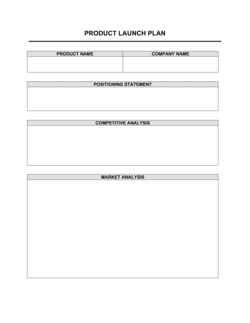
vs Product Launch Plan

A product launch plan covers the go-to-market activities for a single new product β€” positioning, pricing, launch timeline, and launch-day tactics. An e-commerce strategy plan governs the full online business across all products and channels for a 12-month or multi-year period. A product launch plan is a short-horizon tactical document; the strategy plan is the long-horizon operating framework.

Industry-specific considerations

Retail and consumer goods

Omnichannel channel mix, inventory synchronization between physical and online stores, and seasonal promotional planning are the primary strategy drivers.

SaaS and digital products

Subscription billing models, free-trial conversion funnels, and LTV-to-CAC ratio optimization replace physical fulfillment as the core operational focus.

Food and beverage

Perishability constraints drive fulfillment model selection, subscription box mechanics improve LTV, and regulatory labeling requirements affect product page content.

Manufacturing and wholesale

B2B portal strategy, tiered pricing for wholesale vs. retail customers, and minimum order quantity mechanics require distinct treatment from consumer DTC channels.

Fashion and apparel

High SKU count and size/color variant complexity drive inventory planning requirements; returns rates of 25–40% make the returns logistics model a primary margin lever.

Health and wellness

Subscription and auto-ship models improve LTV significantly; FDA and FTC advertising compliance requirements constrain claim language in ad creative and product pages.

Template vs pro β€” what fits your needs?

PathBest forCostTime
Use the templateE-commerce managers, DTC founders, and retail owners building or refreshing a single-market online strategyFree1–2 weeks (20–40 hours)
Template + professional reviewBusinesses entering new markets, replatforming, or preparing an e-commerce section for an investor pitch$500–$2,000 for a digital commerce advisor or agency strategy review2–3 weeks
Custom draftedHigh-GMV retailers, multi-brand operators, or businesses building complex omnichannel or international strategies$3,000–$10,000 for a specialist e-commerce consultancy engagement4–8 weeks

Glossary

Conversion Rate
The percentage of website visitors who complete a target action β€” typically a purchase β€” calculated as orders divided by sessions.
Average Order Value (AOV)
Total revenue divided by total number of orders in a given period, used to measure upsell and bundling effectiveness.
Customer Acquisition Cost (CAC)
Total sales and marketing spend divided by the number of new customers acquired in the same period.
Customer Lifetime Value (LTV)
The total gross profit expected from a single customer across the entire relationship with the brand.
Return on Ad Spend (ROAS)
Revenue generated for every dollar spent on paid advertising, expressed as a ratio (e.g., 4:1 means $4 earned per $1 spent).
Cart Abandonment Rate
The percentage of shoppers who add items to a cart but leave without completing the purchase β€” industry average is approximately 70%.
SKU (Stock Keeping Unit)
A unique identifier assigned to each distinct product variant (size, color, style) for inventory tracking purposes.
Headless Commerce
An architecture that decouples the customer-facing front end from the back-end commerce engine, allowing independent updates to each layer.
Omnichannel Strategy
A unified selling approach that connects the customer experience across online store, marketplace, social commerce, and physical retail touchpoints.
Gross Merchandise Value (GMV)
The total sales value of all merchandise sold through the platform in a given period, before deducting returns, fees, or discounts.
Fulfillment by Third Party (3PL)
Outsourcing warehousing, picking, packing, and shipping to a third-party logistics provider rather than managing it in-house.

Part of your Business Operating System

This document is one of 3,000+ business & legal templates included in Business in a Box.

  • Fill-in-the-blanks β€” ready in minutes
  • 100% customizable Word document
  • Compatible with all office suites
  • Export to PDF and share electronically

Create your document in 3 simple steps.

From template to signed document β€” all inside one Business Operating System.
1
Download or open template

Access over 3,000+ business and legal templates for any business task, project or initiative.

2
Edit and fill in the blanks with AI

Customize your ready-made business document template and save it in the cloud.

3
Save, Share, Send, Sign

Share your files and folders with your team. Create a space of seamless collaboration.

Save time, save money, and create top-quality documents.

β˜…β˜…β˜…β˜…β˜…

"Fantastic value! I'm not sure how I'd do without it. It's worth its weight in gold and paid back for itself many times."

Managing Director Β· Mall Farm
Robert Whalley
Managing Director, Mall Farm Proprietary Limited
β˜…β˜…β˜…β˜…β˜…

"I have been using Business in a Box for years. It has been the most useful source of templates I have encountered. I recommend it to anyone."

Business Owner Β· 4+ years
Dr Michael John Freestone
Business Owner
β˜…β˜…β˜…β˜…β˜…

"It has been a life saver so many times I have lost count. Business in a Box has saved me so much time and as you know, time is money."

Owner Β· Upstate Web
David G. Moore Jr.
Owner, Upstate Web

Run your business with a system β€” not scattered tools

Stop downloading documents. Start operating with clarity. Business in a Box gives you the Business Operating System used by over 250,000 companies worldwide to structure, run, and grow their business.

Start freeΒ Β·Β No credit card required