Digital Marketing Plan Template

Free Word download β€’ Edit online β€’ Save & share with Drive β€’ Export to PDF

15 pagesβ€’1h 35m – 2h 5m to fillβ€’Difficulty: Expert
Learn more ↓
FreeDigital Marketing Plan Template

At a glance

What it is
A Digital Marketing Plan is a structured document that maps your online marketing goals, target audience, channel mix, content approach, budget allocation, and performance metrics into a single actionable plan. This free Word download gives you a ready-to-edit framework you can adapt for any business size or industry and export as PDF for stakeholder review.
When you need it
Use it at the start of a new fiscal year, before launching a product or campaign, or when consolidating scattered channel tactics into a coherent strategy. It is also essential when onboarding a new marketing hire or agency who needs to understand how all digital activity fits together.
What's inside
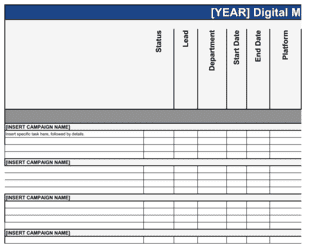
Executive summary, business and marketing objectives, target audience personas, competitive digital landscape, channel strategy (SEO, paid, social, email, and content), editorial calendar, budget breakdown, and KPI tracking framework.

What is a Digital Marketing Plan?

A Digital Marketing Plan is a structured operational document that maps a business's online marketing strategy β€” objectives, target audience, channel mix, content approach, budget allocation, and performance metrics β€” into a single actionable framework covering a defined period, typically a quarter or full year. It bridges the gap between high-level business goals and the day-to-day decisions of which channels to invest in, what content to produce, and how to measure whether any of it is working. Unlike a general marketing plan, it focuses exclusively on digital touchpoints: SEO, paid search, paid social, email, and content marketing.

Why You Need This Document

Without a written digital marketing plan, budget gets distributed by inertia rather than strategy β€” the same channels receive roughly the same spend regardless of whether they are generating pipeline. Teams produce content without knowing which funnel stage it serves, and channel tactics contradict each other because no one mapped how they fit together. The result is wasted spend, missed lead targets, and an inability to explain to leadership why the marketing budget isn't producing revenue. A completed digital marketing plan forces you to connect every channel tactic to a measurable objective, assign a named owner to every initiative, and set a baseline before you spend β€” so you can see what moved, what didn't, and what to change next quarter. This template gives you the structure to produce that plan in one to two weeks rather than starting from a blank document.

Which variant fits your situation?

If your situation is…Use this template
Planning all marketing activity across digital and offline channelsMarketing Plan
Planning a single product or feature launch campaignProduct Launch Plan
Focusing specifically on content production and publishingContent Marketing Plan
Mapping paid search and social media ad strategy in detailAdvertising Plan
Planning email nurture sequences and lifecycle campaignsEmail Marketing Plan
Summarizing strategy at a high level for executive or board reviewOne-Page Marketing Plan
Planning social media content and publishing schedule onlySocial Media Marketing Plan

Common mistakes to avoid

❌ Selecting channels before defining the audience

Why it matters: Choosing TikTok or LinkedIn before knowing where your personas actually spend time wastes budget on reach with no conversion potential.

Fix: Complete the persona section first and document which channels each persona uses at each funnel stage before writing a single channel tactic.

❌ Treating vanity metrics as primary KPIs

Why it matters: Reporting follower growth and impressions as success metrics hides whether marketing is actually generating pipeline β€” and makes it impossible to justify budget increases.

Fix: Tie every primary KPI to a revenue-connected metric: MQLs, cost per lead, lead-to-close rate, or attributed revenue by channel.

❌ Setting an undifferentiated content plan

Why it matters: Publishing blog posts on topics already covered by 50 well-resourced competitors with higher domain authority produces no organic traffic and no leads.

Fix: Run a keyword gap analysis before building the editorial calendar and target topics where your site has a realistic chance of ranking in the top five within 90 days.

❌ No budget contingency line

Why it matters: Allocating 100% of the budget to pre-assigned channels leaves no room to scale a campaign that outperforms mid-quarter or test a new channel that emerges.

Fix: Reserve 10–15% of the total budget as an unallocated test-and-scale fund and document the criteria that trigger its deployment.

❌ Assigning tasks to teams rather than named individuals

Why it matters: Ownership assigned to 'the content team' or 'marketing' means no single person is accountable when a deadline passes.

Fix: Every initiative in the implementation timeline must have a single named owner with a specific due date β€” no shared ownership in the primary owner field.

❌ Writing the plan once and never reviewing it

Why it matters: A digital marketing plan written in January is based on assumptions that may be wrong by March β€” unreviewed plans accelerate spend in the wrong direction.

Fix: Schedule a formal quarterly review to compare actual channel performance against plan targets and reallocate budget from underperforming channels to overperforming ones.

The 9 key sections, explained

Executive Summary

Business and Marketing Objectives

Target Audience and Personas

Competitive Digital Landscape

Channel Strategy

Content Plan and Editorial Calendar

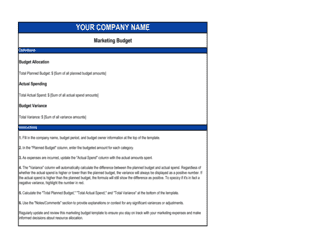
Budget Allocation

KPIs and Measurement Framework

Implementation Timeline and Responsibilities

How to fill it out

  1. 1

    Set business objectives and translate them to marketing targets

    Start with the company's revenue or growth goals for the period. Then define the specific marketing metrics β€” MQLs, organic sessions, conversion rate β€” that must move to hit those goals.

    πŸ’‘ Work backward from the revenue target: if your average deal is $10K and marketing sources 40% of pipeline, you can calculate exactly how many MQLs the plan must deliver.

  2. 2

    Build or refresh your buyer personas

    Interview three to five recent customers and three to five lost deals. Extract shared pain points, job titles, preferred content formats, and channels. Summarize into two to four distinct personas.

    πŸ’‘ The most useful persona insight is usually where they first heard of you β€” it tells you which awareness channel is already working and deserves more investment.

  3. 3

    Audit competitors' digital presence

    Use a tool like Semrush or Ahrefs to pull your top three competitors' organic keyword rankings, estimated traffic, and top-performing content. Note the keyword gaps where they rank and you don't.

    πŸ’‘ Focus on keywords where a competitor ranks 4–10 rather than 1–3 β€” these are positions where a single strong piece of content can realistically displace them within 90 days.

  4. 4

    Select two to three primary channels and define their roles

    Assign each channel a specific role in the funnel: awareness, consideration, or conversion. Specify the tactic, target metric, and monthly spend for each channel before moving to secondary channels.

    πŸ’‘ Resist adding a fourth or fifth channel until the primary channels are hitting their targets consistently β€” channel sprawl is the most common reason digital marketing budgets underperform.

  5. 5

    Build the content plan and editorial calendar

    Map one to two content pieces per month to each funnel stage. Assign a format (blog, video, email, webinar), a topic aligned to a target keyword or persona pain point, and a publication date.

    πŸ’‘ Batch content creation in two-week sprints rather than producing one piece at a time β€” it keeps the calendar full and reduces the context-switching cost of writing.

  6. 6

    Allocate budget by expected return, not channel preference

    Rank channels by their historical or benchmarked CAC. Allocate the largest share of budget to the lowest-CAC channels first, then distribute the remainder across experimental or brand channels.

    πŸ’‘ Reserve 10–15% of the total budget as an unallocated test fund β€” this gives you the flexibility to double down on a tactic that outperforms without waiting for a budget review cycle.

  7. 7

    Define KPIs, baselines, and reporting cadence

    For every objective in the plan, list the metric, its current baseline value, the target, and when and how it will be measured. Connect each metric to a specific dashboard or report.

    πŸ’‘ Set a weekly 15-minute metrics review rhythm rather than monthly β€” you catch underperforming campaigns before they burn through the quarter's budget.

  8. 8

    Assign owners and lock the implementation timeline

    Enter a named owner and target completion date for every initiative. Flag any external dependencies β€” agency onboarding, tool procurement, design resources β€” that could delay a launch.

    πŸ’‘ Color-code the timeline by status (planned, in progress, complete) so the plan doubles as a live project tracker rather than a document that gets filed and forgotten.

Frequently asked questions

What is a digital marketing plan?

A digital marketing plan is a structured document that defines a business's online marketing objectives, target audience, channel strategy, content approach, budget, and performance metrics for a defined period β€” typically a quarter or full year. It translates broad business goals into specific, measurable digital tactics and assigns ownership so the strategy actually gets executed.

What should a digital marketing plan include?

A complete plan covers eight core components: an executive summary, business and marketing objectives with measurable targets, buyer personas, a competitive digital landscape audit, a channel strategy with tactic and spend details, a content plan and editorial calendar, a budget allocation by channel, and a KPI and measurement framework. An implementation timeline with named owners ties everything together.

What is the difference between a digital marketing plan and a marketing plan?

A marketing plan covers all marketing activity β€” digital, print, events, PR, and in-store. A digital marketing plan focuses exclusively on online channels: SEO, paid search, paid social, email, content, and digital advertising. For businesses where digital is the primary acquisition channel, the digital marketing plan may effectively replace the broader marketing plan.

How long should a digital marketing plan be?

For most small to mid-size businesses, 15–25 pages is an effective range β€” detailed enough to guide execution but short enough that the team actually reads it. A full enterprise plan with multiple product lines or geographies may run longer. Appendices like the full editorial calendar and detailed budget model do not need to be embedded in the core document.

How often should a digital marketing plan be updated?

Review the plan formally at the end of each quarter, comparing actual channel performance against targets and updating budget allocations accordingly. The core strategy and persona sections typically hold for a full year; the channel tactics, content calendar, and budget lines should be live documents updated monthly. A plan that is never revisited after January is a strategy in name only.

Which digital marketing channels should I prioritize?

Prioritization depends on where your buyer personas spend time and which channels produce the lowest customer acquisition cost for your business model. SaaS companies typically prioritize SEO and paid search; e-commerce businesses often lead with paid social and email retention; professional services firms often find LinkedIn and content marketing most effective. Start with the one or two channels closest to where your best customers already find you, then expand.

How do I set a digital marketing budget?

A common starting point is allocating 7–12% of projected revenue to marketing for established businesses, or up to 20% for growth-stage companies in competitive markets. Within that envelope, allocate budget to channels in descending order of expected return β€” lowest CAC channels first β€” and reserve 10–15% for testing. Review allocations quarterly against actual CAC and pipeline contribution by channel.

Can I use a template instead of hiring a consultant?

For most small businesses and growth-stage companies, a well-structured template covers 80% of what a consultant would produce. Hire a digital marketing consultant when you need channel-specific expertise you lack in-house β€” advanced SEO audits, paid media optimization, or marketing automation architecture β€” rather than for the planning document itself. The template handles structure; the decisions inside it still require your market knowledge.

How this compares to alternatives

vs Marketing Plan

A marketing plan covers all marketing activity including offline channels β€” events, print, sponsorships, and PR. A digital marketing plan focuses exclusively on online channels. For businesses where digital drives the majority of acquisition, the digital plan can stand alone; otherwise, it serves as a detailed appendix to the broader marketing plan.

vs Social Media Marketing Plan

A social media marketing plan addresses one channel in depth β€” platform selection, posting cadence, content pillars, community management, and paid social tactics. A digital marketing plan covers social as one of several channels alongside SEO, email, and paid search. Use the social plan when social is your primary or most complex channel.

vs Product Launch Plan

A product launch plan is time-bounded β€” it covers the specific campaigns, announcements, and channel tactics needed to bring a single product or feature to market. A digital marketing plan is an ongoing strategic document covering all digital activity for a full year. A launch plan may be built as a campaign module within the larger digital plan.

vs Content Marketing Plan

A content marketing plan focuses on what content to create, in what format, on what cadence, and for which audience segments. A digital marketing plan incorporates content strategy as one section among many, alongside paid media, email, and SEO. Use the standalone content plan when content is the dominant channel and requires its own detailed production calendar.

Industry-specific considerations

SaaS / Technology

MQL-to-SQL funnel metrics, SEO-led content strategy targeting bottom-of-funnel keywords, product-led growth loops, and lifecycle email nurture mapped to trial-to-paid conversion.

E-commerce / Retail

Seasonal campaign calendar, paid social ROAS targets by product category, cart abandonment email sequences, and Google Shopping feed optimization.

Professional Services

Thought-leadership content on LinkedIn and organic search, gated white papers for lead generation, and email nurture sequences targeting long-consideration buying cycles.

Healthcare / MedTech

HIPAA-compliant email marketing, patient or provider persona segmentation, SEO for condition and treatment keywords, and strict ad platform compliance for regulated health claims.

Template vs pro β€” what fits your needs?

PathBest forCostTime
Use the templateMarketing managers, small business owners, and founders building an annual digital strategy without a dedicated strategistFree1–2 weeks to complete with research
Template + professional reviewGrowing businesses that need a channel specialist to validate SEO, paid media, or marketing automation assumptions before committing budget$500–$2,000 for a strategist or agency review session2–3 weeks
Custom draftedEnterprise marketing teams, multi-brand operators, or companies entering a new market who need an agency to build the full plan from a discovery engagement$3,000–$15,000 for a full agency engagement4–8 weeks

Glossary

Buyer Persona
A semi-fictional profile of your ideal customer built from demographic data, behavioral patterns, goals, and pain points β€” used to target messaging and channel selection.
Customer Acquisition Cost (CAC)
Total marketing and sales spend in a period divided by the number of new customers acquired in that same period.
Conversion Rate
The percentage of visitors or leads who complete a desired action β€” signing up, purchasing, or requesting a demo β€” out of the total who entered that stage of the funnel.
SERP (Search Engine Results Page)
The page a search engine returns in response to a query; ranking highly on SERPs is the core objective of SEO.
Cost Per Click (CPC)
The amount paid each time a user clicks on a paid advertisement, used to measure efficiency in paid search and social campaigns.
Return on Ad Spend (ROAS)
Revenue generated divided by the amount spent on advertising in the same period β€” expressed as a multiple, e.g., 4Γ— ROAS means $4 returned per $1 spent.
Marketing Funnel
A model describing the stages a prospect moves through from first awareness of a brand to becoming a paying customer and, ideally, a repeat buyer.
KPI (Key Performance Indicator)
A specific, measurable metric tied to a strategic objective β€” such as monthly organic sessions, email open rate, or cost per lead β€” used to track progress.
Content Calendar
A schedule that maps what content will be published, on which channel, on which date, and by whom β€” keeping production and distribution on track.
Attribution Model
A rule or algorithm that assigns credit for a conversion to one or more marketing touchpoints in the customer's journey β€” e.g., first-touch, last-touch, or linear.
Organic Traffic
Website visitors who arrive through unpaid search results, social shares, or direct referrals rather than paid advertisements.

Part of your Business Operating System

This document is one of 3,000+ business & legal templates included in Business in a Box.

  • Fill-in-the-blanks β€” ready in minutes
  • 100% customizable Word document
  • Compatible with all office suites
  • Export to PDF and share electronically

Create your document in 3 simple steps.

From template to signed document β€” all inside one Business Operating System.
1
Download or open template

Access over 3,000+ business and legal templates for any business task, project or initiative.

2
Edit and fill in the blanks with AI

Customize your ready-made business document template and save it in the cloud.

3
Save, Share, Send, Sign

Share your files and folders with your team. Create a space of seamless collaboration.

Save time, save money, and create top-quality documents.

β˜…β˜…β˜…β˜…β˜…

"Fantastic value! I'm not sure how I'd do without it. It's worth its weight in gold and paid back for itself many times."

Managing Director Β· Mall Farm
Robert Whalley
Managing Director, Mall Farm Proprietary Limited
β˜…β˜…β˜…β˜…β˜…

"I have been using Business in a Box for years. It has been the most useful source of templates I have encountered. I recommend it to anyone."

Business Owner Β· 4+ years
Dr Michael John Freestone
Business Owner
β˜…β˜…β˜…β˜…β˜…

"It has been a life saver so many times I have lost count. Business in a Box has saved me so much time and as you know, time is money."

Owner Β· Upstate Web
David G. Moore Jr.
Owner, Upstate Web

Run your business with a system β€” not scattered tools

Stop downloading documents. Start operating with clarity. Business in a Box gives you the Business Operating System used by over 250,000 companies worldwide to structure, run, and grow their business.

Free Forever PlanΒ Β·Β No credit card required