Instagram Influencer Agreement Template

Free Word download β€’ Edit online β€’ Save & share with Drive β€’ Export to PDF

4 pagesβ€’25–35 min to fillβ€’Difficulty: Complexβ€’Signature requiredβ€’Legal review recommended
Learn more ↓
FreeInstagram Influencer Agreement Template

At a glance

What it is
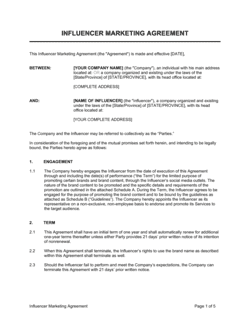
An Instagram Influencer Agreement is a legally binding contract between a brand or advertiser and an Instagram content creator that governs a paid collaboration. This free Word download covers deliverables, posting schedule, compensation, FTC disclosure obligations, intellectual property rights, exclusivity, and termination β€” all in a single editable document you can export as PDF and send for signature in minutes.
When you need it
Use it before any paid Instagram collaboration begins β€” whether it is a one-post product mention, a multi-week campaign, or a long-term brand ambassador arrangement. It protects both parties the moment money or free product changes hands.
What's inside
Scope of services and deliverable specifications, posting schedule and approval workflow, compensation and payment terms, FTC disclosure requirements, intellectual property assignment and usage rights, exclusivity and non-compete restrictions, content removal obligations, confidentiality, representations and warranties, and termination clauses.

What is an Instagram Influencer Agreement?

An Instagram Influencer Agreement is a legally binding contract between a brand and a content creator that governs a paid collaboration on Instagram. It specifies exactly what content the influencer must produce, when it must be posted, how much and when the brand will pay, what FTC disclosures are required, who owns the content after it is published, what competing brands the influencer cannot work with during the campaign, and how either party can exit the arrangement. Unlike a casual DM exchange or email thread, a signed agreement creates enforceable obligations on both sides and defines the recourse available if either party fails to deliver.

Why You Need This Document

Running an Instagram campaign without a signed agreement exposes both parties to predictable and expensive problems. Brands that skip the contract routinely discover that influencers delete posts days after publishing, run competing brand content the following week, or claim ownership of content the brand has already repurposed in paid ads β€” each triggering a legal dispute with no written baseline to resolve it. Influencers who proceed on a handshake agreement frequently find themselves unpaid after delivery, locked into unlimited revision cycles, or unwittingly licensing their likeness for perpetual paid advertising at no extra charge. The FTC adds a compliance dimension that a formal contract addresses directly β€” documenting that both brand and creator understood and accepted their disclosure obligations before a single post went live. This template closes all of those gaps in under 20 minutes, giving both parties a clear, fair record of exactly what was agreed.

Which variant fits your situation?

If your situation is…Use this template
Long-term ambassador relationship spanning several months or seasonsBrand Ambassador Agreement
Multi-platform campaign covering Instagram, TikTok, and YouTubeSocial Media Influencer Agreement
Gifting or product-seeding with no cash paymentProduct Gifting Agreement
Affiliate commission arrangement tied to tracked salesAffiliate Marketing Agreement
Agency representing multiple influencers negotiating on their behalfTalent Representation Agreement
Event appearance or live activation alongside content deliverablesAppearance Agreement
Co-created product line or collection with revenue sharingCo-Branding and Collaboration Agreement

Common mistakes to avoid

❌ Granting a perpetual paid media license in the base fee

Why it matters: A perpetual license to run paid ads using the influencer's likeness is significantly more valuable than a standard organic usage right β€” influencers who sign without realizing this lose ongoing compensation they are entitled to.

Fix: Separate organic usage rights from paid media rights in the contract. Price paid media (whitelisting, dark posts) as a distinct add-on with its own fee and time limit.

❌ No deemed-approval clause in the review process

Why it matters: Without one, a brand can stall indefinitely on content approval, prevent the influencer from posting, and then refuse to pay on the grounds that deliverables were never completed.

Fix: Add language stating that if the brand does not respond with written approval or revision requests within the specified review window, the content is deemed approved and may be posted.

❌ Omitting a kill fee for brand-initiated cancellations

Why it matters: Influencers decline other campaigns and invest time in creative development before a post goes live. A brand that cancels with no kill fee obligation leaves them uncompensated for real work already done.

Fix: Include a kill fee of at least 25–50% of the total contracted fee for cancellations made after the influencer has submitted any draft content.

❌ Vague or overbroad exclusivity clauses

Why it matters: A restriction covering 'all beauty brands' for 180 days can prevent an influencer from accepting work from dozens of non-competing sponsors, effectively making the contract unenforceable as an unreasonable restraint of trade.

Fix: Limit exclusivity to the specific product sub-category (e.g., 'protein powder brands,' not 'all fitness brands'), and restrict the duration to the campaign window plus 30–60 days.

❌ No minimum live period for published content

Why it matters: Without a contractual minimum, influencers can delete posts shortly after going live β€” after which the content no longer generates impressions or drives traffic, and the brand has received nothing of value despite paying in full.

Fix: Require all deliverables to remain live for at least 90 days from the posting date, with brand written consent required for any earlier removal.

❌ Relying on Instagram DMs or emails as the contract

Why it matters: Informal message threads do not constitute a binding written agreement in most jurisdictions and leave IP ownership, exclusivity, and termination terms completely undefined.

Fix: Execute a formal signed agreement before any product is sent, content is created, or payment is made β€” regardless of how casual the relationship feels.

The 10 key clauses, explained

Parties and campaign identification

In plain language: Names the brand and influencer as legal entities or individuals and ties the agreement to a specific campaign, product launch, or time period.

Sample language
This Instagram Influencer Agreement is entered into as of [DATE] between [BRAND LEGAL NAME], a [STATE] [ENTITY TYPE] ('Brand'), and [INFLUENCER FULL LEGAL NAME] ('Influencer') for the [CAMPAIGN NAME] campaign.

Common mistake: Using the influencer's Instagram handle instead of their legal name or business entity. If the influencer operates through an LLC, the contract must name that entity to be enforceable against it.

Scope of services and deliverables

In plain language: Specifies exactly what content the influencer must create β€” format, quantity, platform, caption requirements, hashtags, and any content restrictions.

Sample language
Influencer shall create and publish the following on their Instagram account (@[HANDLE], approximately [X] followers as of [DATE]): (a) [X] in-feed static posts; (b) [X] Instagram Reels of minimum [LENGTH] seconds; (c) [X] Instagram Stories with swipe-up link to [URL]. All content must feature [PRODUCT NAME] and include the caption language in Schedule A.

Common mistake: Omitting the follower count and engagement rate at signing. If the influencer's account is flagged or loses followers significantly before posting, you have no benchmark to trigger a renegotiation.

Posting schedule and content approval

In plain language: Sets submission deadlines for draft content, the number of revision rounds the brand may request, and the go-live posting dates.

Sample language
Influencer shall submit draft content to Brand no later than [X] business days before each scheduled posting date. Brand shall provide written approval or revision requests within [X] business days. Brand may request up to [X] rounds of revisions. If Brand does not respond within the review period, content is deemed approved.

Common mistake: Providing unlimited revision rounds without a deadline. Brands that revise repeatedly for weeks effectively block the influencer from completing the deliverable and then claim non-performance.

Compensation and payment terms

In plain language: States the total fee, payment schedule, applicable expenses or usage bonuses, and conditions that must be met before each payment is released.

Sample language
Brand shall pay Influencer a flat fee of $[AMOUNT] USD per the following schedule: 50% ($[AMOUNT]) upon execution of this Agreement; 50% ($[AMOUNT]) within [X] days of the final deliverable going live and Brand's written acceptance. Affiliate commissions, if any, are paid monthly per Schedule B.

Common mistake: Tying 100% of payment to brand approval without a deemed-approval fallback. An influencer can complete every deliverable correctly and still be withheld payment indefinitely if 'approval' is never formally given.

FTC disclosure and platform compliance

In plain language: Requires the influencer to include mandated paid-partnership disclosures on every piece of sponsored content and to comply with Instagram's branded content tools.

Sample language
Influencer shall clearly and conspicuously disclose the material connection between Influencer and Brand on all Deliverables using Instagram's paid partnership label and the hashtag #ad or #sponsored at the beginning of any caption, in compliance with FTC Endorsement Guidelines 16 C.F.R. Part 255. Failure to disclose constitutes a material breach.

Common mistake: Delegating disclosure compliance entirely to the influencer without making it a breach condition. Brands can face FTC enforcement if they knew or should have known disclosures were inadequate β€” the contract should bind both parties.

Intellectual property and usage rights

In plain language: Defines who owns the content after it is created, what license the brand receives to repurpose it, and for how long.

Sample language
Influencer retains ownership of all Deliverables. Influencer grants Brand a non-exclusive, royalty-free license to use, reproduce, and display the Deliverables on Brand's owned channels for a period of [X] months from the posting date ('Usage Period'). Use in paid media (whitelisting, dark posts) requires a separate written addendum and additional compensation of $[AMOUNT] per [PERIOD].

Common mistake: Granting the brand a perpetual, worldwide, royalty-free license in the base contract without additional payment. Influencers routinely sign this language without realizing it authorizes paid advertising using their likeness indefinitely.

Exclusivity and category restrictions

In plain language: Restricts the influencer from promoting direct competitors within a defined product category and time window around the campaign.

Sample language
During the term of this Agreement and for [X] days following the final posting date, Influencer shall not publish sponsored content for any [PRODUCT CATEGORY] brand that directly competes with Brand, as listed in Schedule C. This restriction does not apply to content published prior to [EFFECTIVE DATE].

Common mistake: Defining the exclusivity category too broadly β€” e.g., 'any consumer goods brand' β€” without additional compensation. Overly broad exclusivity clauses are frequently contested and may be unenforceable as unreasonable restraints of trade.

Morality clause and brand safety

In plain language: Allows the brand to terminate immediately and withhold unpaid fees if the influencer engages in conduct that publicly damages the brand's reputation.

Sample language
Brand may terminate this Agreement with immediate effect if Influencer engages in conduct that, in Brand's reasonable judgment, is likely to materially damage Brand's reputation, including but not limited to public statements, criminal charges, or social media conduct that is discriminatory, fraudulent, or violates applicable law.

Common mistake: Writing a one-sided morality clause that only binds the influencer. Influencers increasingly negotiate reciprocal clauses β€” if the brand becomes embroiled in a scandal, the influencer can also exit without penalty.

Content removal and archive obligations

In plain language: Specifies when and whether the influencer must remove or archive sponsored posts, and under what conditions the brand may request takedown.

Sample language
Influencer shall keep all Deliverables live on their Instagram account for a minimum of [X] months from the posting date. After the minimum live period, Brand may request removal with [X] days' written notice. Influencer shall not voluntarily remove or archive any Deliverable during the minimum live period without Brand's prior written consent.

Common mistake: Not specifying a minimum live period at all. Without one, an influencer can delete a post hours after it goes live, and the brand has no recourse while having paid the full fee.

Termination, kill fees, and post-termination obligations

In plain language: States the notice required to terminate, the kill fee owed if the brand cancels after work begins, and what happens to unpublished content after termination.

Sample language
Either party may terminate this Agreement with [X] days' written notice prior to the first posting date. If Brand cancels after Influencer has submitted at least one draft Deliverable, Brand shall pay a kill fee of [X]% of the total contracted fee. Upon termination, Influencer shall deliver all completed Deliverables to Brand within [X] business days and shall not publish any Deliverable without Brand's prior written consent.

Common mistake: No kill fee provision at all. Influencers who have spent time creating content and cleared their calendar for a campaign have no compensation recourse if the brand simply changes its mind.

How to fill it out

  1. 1

    Identify both parties with legal names and entity types

    Enter the brand's full registered legal entity name and the influencer's legal name or business entity name. Include the influencer's Instagram handle and current follower count as of the signing date.

    πŸ’‘ Ask the influencer for their W-9 (US) or equivalent tax form before signing β€” you will need this for payments over $600 and it confirms their legal name and entity type.

  2. 2

    Define deliverables with format-level specificity

    List every piece of content by format (in-feed post, Reel, Story, Live), quantity, minimum duration for video, required hashtags, and any caption language or mandatory disclosures. Attach detailed creative briefs as Schedule A.

    πŸ’‘ Specify the aspect ratio and resolution requirements for each format β€” a Story delivered in landscape ratio wastes the deliverable.

  3. 3

    Set the posting schedule and approval timeline

    Enter draft submission deadlines, brand review windows (typically 3–5 business days), maximum revision rounds (2 is standard), and firm go-live dates for each deliverable. Include a deemed-approval clause if Brand does not respond in time.

    πŸ’‘ Build at least 5 business days of buffer between the approval deadline and the go-live date to absorb revision cycles without missing campaign timing.

  4. 4

    Complete the compensation block with a payment schedule

    Enter the total flat fee, any usage fee for paid media, affiliate commission rate if applicable, and the payment milestones β€” typically 50% on signing and 50% on final delivery.

    πŸ’‘ State the payment currency explicitly, especially for cross-border agreements. USD and CAD confusion is common and creates disputes at payment time.

  5. 5

    Confirm FTC disclosure requirements and platform tools

    Require use of Instagram's paid partnership label on all posts and at least one of #ad or #sponsored at the beginning of every caption. Reference the current FTC Endorsement Guides and note that this requirement is a material obligation.

    πŸ’‘ Send the influencer a screenshot of a correctly labeled post as a reference β€” many influencers use #sponsored buried at the end of a long caption, which the FTC considers non-compliant.

  6. 6

    Define IP ownership and usage rights with a time limit

    State that the influencer retains content ownership and grant only the specific license the brand needs β€” owned channels, paid media, or both β€” with a defined usage period of 6 to 24 months. List any additional fees for paid media or whitelisting in a separate schedule.

    πŸ’‘ If the brand wants whitelisting rights, add at least 20–30% to the base fee β€” it is standard industry practice and keeps the relationship fair.

  7. 7

    Set exclusivity scope and duration proportionately

    Define the competing category by product type (e.g., 'direct-to-consumer skincare brands' not 'all beauty and wellness'), the duration (30–90 days is typical for campaign exclusivity), and any carve-outs for existing partnerships the influencer already has.

    πŸ’‘ Request a list of the influencer's existing brand deals before negotiating exclusivity β€” conflicts discovered after signing create expensive disputes.

  8. 8

    Sign before any content creation begins

    Both parties must execute the agreement before the influencer begins creating content or receives any product or payment. Unsigned collaboration agreements create ambiguity over IP ownership and compensation obligations.

    πŸ’‘ Use an e-signature tool to timestamp execution and store the fully-signed copy in a shared drive accessible to both parties β€” Instagram DM screenshots are not a substitute for a signed contract.

Frequently asked questions

What is an Instagram influencer agreement?

An Instagram influencer agreement is a legally binding contract between a brand and a content creator that governs a paid Instagram collaboration. It defines the deliverables the influencer must produce, the compensation the brand will pay, FTC disclosure requirements, who owns the content after it is created, any exclusivity restrictions, and how either party can exit the arrangement. Without it, both parties have no enforceable recourse if something goes wrong.

Is an Instagram influencer agreement legally required?

No law mandates a written influencer agreement, but the FTC requires clear disclosure of material connections between brands and creators β€” and a written contract is the clearest way to document that obligation. Beyond FTC compliance, a written agreement is the only reliable way to enforce payment terms, content ownership, and exclusivity if a dispute arises. Most brands and agencies treat a signed agreement as mandatory before any paid collaboration begins.

What FTC rules apply to Instagram influencer content?

The FTC Endorsement Guides (16 C.F.R. Part 255) require influencers to clearly and conspicuously disclose any material connection to a brand β€” including free product, affiliate commissions, or cash payment. On Instagram, this means using the platform's paid partnership label and placing #ad or #sponsored at the beginning of the caption, not buried among other hashtags. The agreement should bind both the brand and the influencer to these requirements, since the FTC can hold both parties accountable.

Who owns the content an influencer creates for a brand?

By default under US copyright law, the influencer owns the content they create. The agreement grants the brand a license to use that content β€” not ownership, unless the contract explicitly includes a work-for-hire clause or full IP assignment. Most industry-standard agreements give the brand a time-limited license for specific channels, with additional fees required for paid media or extended usage. Influencers should review the IP clause carefully before signing.

What is whitelisting and should it be included in the base fee?

Whitelisting allows a brand to run paid Instagram ads directly through the influencer's account, making it appear as though the influencer is sponsoring the ad β€” which typically achieves higher engagement than brand-run ads. It requires the influencer to grant temporary access to their ad account and is significantly more valuable than organic posting rights. Standard industry practice prices whitelisting as a separate add-on, typically 20–50% above the base content fee, with its own defined duration.

What should an exclusivity clause in an influencer agreement cover?

An exclusivity clause should specify the exact product category covered (not a broad industry), the duration of the restriction (typically the campaign period plus 30–90 days), any carve-outs for existing deals the influencer already has, and whether the restriction applies to organic posts, paid posts, or both. Overly broad exclusivity for standard compensation is routinely challenged and sometimes found unenforceable as an unreasonable restraint on the influencer's ability to earn a living.

What happens if an influencer posts non-compliant content or misses a deadline?

The agreement should specify that failure to include required FTC disclosures constitutes a material breach, giving the brand the right to require immediate correction and, in repeated cases, to terminate and withhold payment. Missed posting deadlines should trigger a cure period β€” typically 3–5 business days β€” after which the brand may terminate and pursue damages. Documenting these provisions clearly is far easier than trying to recover costs after the fact.

Do I need a lawyer to draft an Instagram influencer agreement?

For straightforward single-campaign collaborations with micro-influencers, a high-quality template typically covers the necessary provisions. Consider engaging a lawyer when the campaign involves significant fees (over $10,000), complex paid media or whitelisting arrangements, equity or co-branding components, international influencers subject to foreign law, or a long-term ambassador relationship. A 1–2 hour template review with a marketing or IP attorney typically costs $300–$600 and is worthwhile for major campaigns.

Can a brand terminate an influencer agreement if the influencer's reputation changes?

Yes, if the agreement includes a morality clause β€” which is standard in most brand contracts. A properly drafted morality clause allows the brand to terminate immediately if the influencer engages in conduct that, in the brand's reasonable judgment, would materially damage its reputation. Increasingly, influencers negotiate reciprocal clauses that allow them to exit if the brand faces a public scandal. Courts generally enforce morality clauses that are reasonably defined and not used as a pretext for non-payment.

How this compares to alternatives

vs Brand Ambassador Agreement

A brand ambassador agreement governs a long-term, ongoing relationship β€” typically 6 to 12 months β€” in which the influencer represents the brand across multiple campaigns and channels. An Instagram influencer agreement covers a defined, short-term campaign with specific deliverables and a fixed end date. Use the ambassador agreement when the relationship is intended to be recurring and multi-touch; use this template for a single campaign or series of posts.

vs Affiliate Marketing Agreement

An affiliate agreement pays the creator a commission on tracked sales or sign-ups generated through a unique link or promo code, with no guaranteed flat fee. An influencer agreement typically pays a flat content fee regardless of sales performance, with optional affiliate components added. Use an affiliate agreement when the entire compensation model is performance-based; use an influencer agreement when paying for content creation and reach, not just conversion.

vs Social Media Management Agreement

A social media management agreement engages an agency or manager to run a brand's own social media accounts on an ongoing basis. An influencer agreement engages an independent creator to produce sponsored content on their own account for a defined campaign. The management agreement covers account access, content strategy, and scheduling; the influencer agreement covers deliverables, disclosures, and IP rights on third-party creator accounts.

vs Content Creation Agreement

A content creation agreement covers the production of assets β€” photos, videos, copy β€” that the brand owns outright and deploys on its own channels. An influencer agreement is distinct because the content is posted on the creator's own audience-facing account, making the creator's reach and credibility part of the deliverable. IP flows differently, FTC disclosure obligations are unique to the influencer context, and compensation reflects audience access β€” not just production cost.

Industry-specific considerations

Beauty and personal care

Before-and-after content restrictions, dermatologist-claim substantiation requirements, and exclusivity clauses covering both skincare and color cosmetics categories.

Fashion and apparel

Seasonal campaign timing, fit and styling approval requirements, gifting-plus-fee hybrid structures, and reposting rights for lookbook and e-commerce use.

Food and beverage

Health claim compliance under FDA guidelines, recipe exclusivity windows, and mandatory disclosure of any affiliate or promo code tied to the post.

Technology and consumer apps

App download tracking via affiliate links, demo script approval requirements, and restrictions on comparing features to competitor products by name.

Jurisdictional notes

United States

FTC Endorsement Guides (16 C.F.R. Part 255) require clear and conspicuous disclosure of all material connections β€” cash, free product, or affiliate compensation. The FTC updated its guides in 2023 to explicitly address social media. California's right-of-publicity statute (Cal. Civ. Code Β§ 3344) requires consent before using an individual's likeness in advertising, which affects how usage rights and whitelisting clauses must be drafted for California-based influencers.

Canada

The Competition Bureau of Canada requires influencers to disclose paid relationships under the Competition Act. PIPEDA and provincial privacy laws (including Quebec's Law 25) govern how influencer personal data and likeness may be used in advertising. Contracts with Quebec-based influencers should be available in French, and any exclusivity clause should be reviewed for compliance with Quebec's restrictive covenant rules.

United Kingdom

The UK Advertising Standards Authority (ASA) and the Competition and Markets Authority (CMA) require influencers to label paid posts with 'Ad' at the start of the caption or in Instagram's paid partnership tool. The CAP Code governs the content of ads, including health and efficacy claims. Post-Brexit, GDPR-equivalent rules under the UK GDPR apply to any personal data of UK residents used in the campaign.

European Union

The EU Unfair Commercial Practices Directive and national implementations require clear disclosure of commercial intent in influencer content across all member states. GDPR applies to any personal data processed in connection with the campaign, including audience data accessed through Instagram insights. Several member states β€” Germany and France in particular β€” have additional influencer transparency regulations and active enforcement bodies that can fine both brands and creators for non-disclosure.

Template vs lawyer β€” what fits your deal?

PathBest forCostTime
Use the templateBrands running single-campaign collaborations with micro or mid-tier influencers at fees under $5,000Free15–20 minutes
Template + legal reviewCampaigns over $5,000, whitelisting or paid media components, or influencers with dedicated representation$300–$6001–2 days
Custom draftedMacro-influencer or celebrity deals, equity or co-branding arrangements, international creators, or multi-year ambassador programs$1,500–$5,000+1–3 weeks

Glossary

Deliverable
A specific piece of content the influencer is contractually required to produce, such as one in-feed post, two Stories, or one Reel, by a defined date.
FTC Disclosure
A clear and conspicuous label β€” such as #ad or #sponsored β€” required by the US Federal Trade Commission whenever a material connection exists between a brand and a content creator.
Usage Rights
The license a brand receives to repurpose the influencer's content across its own channels β€” paid ads, website, email β€” beyond the original Instagram post.
Exclusivity
A contractual restriction preventing the influencer from promoting competing brands or products within a defined category and time period.
Morality Clause
A provision allowing the brand to terminate the agreement immediately if the influencer engages in conduct that damages the brand's reputation.
Kill Fee
Compensation paid to the influencer when the brand cancels a confirmed campaign after work has begun, to cover time already invested.
Content Approval Workflow
The process by which the brand reviews draft content before it is posted, including submission deadlines and the number of permitted revision rounds.
Whitelisting
A paid media tactic in which the brand runs paid advertising directly through the influencer's Instagram account, requiring the influencer to grant temporary ad account access.
Dark Post
A sponsored Instagram post that runs as a paid ad and is not visible on the influencer's organic feed β€” often used for targeted A/B testing.
Affiliate Link
A trackable URL or promo code unique to the influencer that attributes sales or traffic back to their content for commission calculation.
Content Usage Period
The defined window β€” typically 6 to 24 months β€” during which the brand is licensed to repurpose the influencer's content.

Part of your Business Operating System

This document is one of 3,000+ business & legal templates included in Business in a Box.

  • Fill-in-the-blanks β€” ready in minutes
  • 100% customizable Word document
  • Compatible with all office suites
  • Export to PDF and share electronically

Create your document in 3 simple steps.

From template to signed document β€” all inside one Business Operating System.
1
Download or open template

Access over 3,000+ business and legal templates for any business task, project or initiative.

2
Edit and fill in the blanks with AI

Customize your ready-made business document template and save it in the cloud.

3
Save, Share, Send, Sign

Share your files and folders with your team. Create a space of seamless collaboration.

Save time, save money, and create top-quality documents.

β˜…β˜…β˜…β˜…β˜…

"Fantastic value! I'm not sure how I'd do without it. It's worth its weight in gold and paid back for itself many times."

Managing Director Β· Mall Farm
Robert Whalley
Managing Director, Mall Farm Proprietary Limited
β˜…β˜…β˜…β˜…β˜…

"I have been using Business in a Box for years. It has been the most useful source of templates I have encountered. I recommend it to anyone."

Business Owner Β· 4+ years
Dr Michael John Freestone
Business Owner
β˜…β˜…β˜…β˜…β˜…

"It has been a life saver so many times I have lost count. Business in a Box has saved me so much time and as you know, time is money."

Owner Β· Upstate Web
David G. Moore Jr.
Owner, Upstate Web

Run your business with a system β€” not scattered tools

Stop downloading documents. Start operating with clarity. Business in a Box gives you the Business Operating System used by over 250,000 companies worldwide to structure, run, and grow their business.

Free Forever PlanΒ Β·Β No credit card required