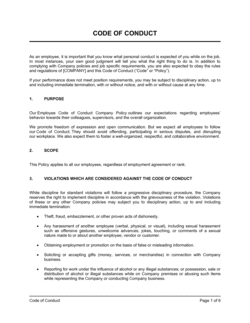
Social Media Policy Template

Free Word download β€’ Edit online β€’ Save & share with Drive β€’ Export to PDF

4 pagesβ€’20–30 min to fillβ€’Difficulty: Standard
Learn more ↓
FreeSocial Media Policy Template

At a glance

What it is
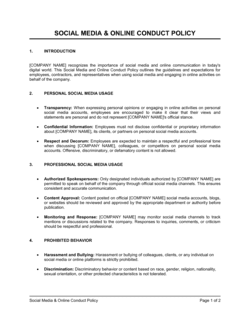
A Social Media Policy is an internal company document that defines how employees and contractors may use social media in connection with their work β€” both on official brand accounts and in personal posts that reference the company. This free Word download gives you a structured, editable starting point you can tailor to your brand, industry, and workforce size, then export as PDF for distribution.
When you need it
Use it when onboarding employees who will manage brand accounts, when a reputational incident prompts a policy review, or when your organization reaches the size where informal guidance is no longer sufficient to protect the brand and maintain compliance.
What's inside
Purpose and scope, definitions of covered platforms and personnel, rules for official brand accounts, personal use guidelines, confidentiality obligations, anti-harassment and conduct standards, crisis and incident response procedures, enforcement and disciplinary consequences, and employee acknowledgment.

What is a Social Media Policy?

A Social Media Policy is an internal governance document that defines how employees, contractors, and agency partners may use social media in connection with their work β€” covering both official brand accounts and personal accounts that reference the company, its products, or its industry. It establishes posting authority, confidentiality obligations, conduct standards, crisis escalation procedures, and the consequences for violations. Unlike informal social media guidelines, a policy is an enforceable document that forms part of the employment relationship and gives managers a documented basis for disciplinary action when something goes wrong.

Why You Need This Document

Without a written social media policy, your first reputational incident becomes your policy-writing exercise β€” under pressure, after the damage is done. Employees post confidential product roadmaps, tag clients in unflattering content, or respond to press inquiries through personal accounts, often with no awareness that any rule has been broken. A clear, distributed policy prevents most of these incidents before they occur and gives you the documentation to act decisively when they do. For companies in regulated industries β€” financial services, healthcare, legal β€” a formal social media policy is not optional: FINRA, HIPAA, and similar frameworks impose compliance obligations that require documented procedures and employee acknowledgment. This template gives you a complete, professionally structured starting point you can tailor to your organization in a matter of hours, not days.

Which variant fits your situation?

If your situation is…Use this template
Governing official brand account management and posting approvalSocial Media Policy (Brand-Focused)
Setting conduct rules for all employees on personal social accountsEmployee Social Media Policy
Covering broader digital communication including email and messaging appsDigital Communication Policy
Outlining response protocols when a social media crisis breaksSocial Media Crisis Management Plan
Governing influencer or brand ambassador relationshipsInfluencer Agreement
Regulating employee internet and device use more broadlyAcceptable Use Policy
Setting expectations for remote employees' online professional conductRemote Work Policy

Common mistakes to avoid

❌ Listing platforms by name without a catch-all clause

Why it matters: A policy that names only LinkedIn, X, and Instagram has a documented gap the moment employees begin posting on a new platform β€” enforcement becomes inconsistent.

Fix: Add 'including but not limited to' before the platform list and append 'and any similar publicly accessible digital platforms' to future-proof the definition.

❌ No documented approval workflow for official accounts

Why it matters: When multiple people have publish access and no approval step is required, off-brand or inaccurate posts go live regularly β€” and the company discovers them after the fact.

Fix: Define a named approver for each official account, specify what content requires pre-approval versus follows a pre-cleared content calendar, and audit account access quarterly.

❌ Requiring disclosure on every personal post

Why it matters: Blanket disclosure requirements are broadly unenforceable and may infringe on employees' personal expression rights, creating legal exposure rather than reducing it.

Fix: Narrow the disclosure requirement to posts that specifically reference the company, its products, competitors, or industry topics where affiliation is material.

❌ No specific escalation timeline in the crisis section

Why it matters: Vague language like 'notify management promptly' produces inconsistent response times β€” a crisis that needed a 2-hour response gets escalated the next morning.

Fix: State explicit timeframes: 'the discovering employee shall notify [ROLE] within 4 hours of identification, regardless of time of day or day of week.'

❌ Storing signed acknowledgments informally

Why it matters: Without a documented acknowledgment on file, employees can credibly claim they never received the policy β€” undermining enforcement in disciplinary proceedings.

Fix: Integrate acknowledgment collection into your HR system or onboarding workflow so signed copies are stored automatically alongside employment records.

❌ Omitting language protecting legally protected activity

Why it matters: A policy that could be read to prohibit employees from discussing wages, hours, or working conditions on social media may violate labor relations law in multiple jurisdictions, exposing the company to regulatory complaints.

Fix: Add a carve-out: 'Nothing in this Policy is intended to restrict employees' rights to engage in protected concerted activity under applicable labor law.'

The 9 key sections, explained

Purpose and scope

Definitions

Official account management

Personal account guidelines

Confidentiality and information security

Conduct and anti-harassment standards

Crisis and incident response

Enforcement and disciplinary consequences

Employee acknowledgment

How to fill it out

  1. 1

    Define the scope and covered personnel

    Start by identifying every group the policy covers β€” full-time employees, part-time staff, contractors, agency partners, and interns. Add a catch-all phrase so future roles are automatically included.

    πŸ’‘ List your active social platforms in the definitions section now, but include 'and any similar platforms' so the policy doesn't need updating every time a new channel emerges.

  2. 2

    Document posting authority for official accounts

    Create Appendix A listing every individual authorized to post on each official account, their access level (publish, draft-only, admin), and the approval required before posting.

    πŸ’‘ Audit your actual account access at the same time β€” most companies discover former employees or agency accounts with active login credentials during this step.

  3. 3

    Write the confidentiality prohibition list

    Work with your legal or compliance team to produce a specific list of content categories employees must not share β€” financial data, unannounced products, client names, internal screenshots. Generic language is harder to enforce.

    πŸ’‘ Cross-reference your NDA or employment contract's confidentiality clause to ensure the social media policy uses the same defined terms.

  4. 4

    Adapt conduct rules to the social context

    Take your existing harassment and equal-opportunity policy provisions and add specific social media behaviors that trigger them β€” tagging colleagues in hostile posts, sharing private conversations, creating fake accounts.

    πŸ’‘ Include a note that conduct rules apply 24/7 for content that references the company or colleagues, not only during working hours.

  5. 5

    Build the crisis escalation chain

    Name specific roles (not individuals, who change) in the escalation sequence β€” social media manager notifies marketing director, who notifies CMO and legal within 4 hours. Assign a decision-maker for account suspension.

    πŸ’‘ Test the chain with a tabletop scenario before publishing the policy. Gaps surface quickly when you walk through a realistic incident.

  6. 6

    Set the enforcement and consequences framework

    Write a graduated consequence range: first infraction (written warning), repeat or serious infraction (suspension or termination), legal violation (immediate termination and referral). Confirm HR and legal have reviewed the language.

    πŸ’‘ Add a line confirming the policy does not restrict legally protected activity, such as employees discussing wages or working conditions β€” this protects you from unfair labor practice claims in many jurisdictions.

  7. 7

    Distribute and collect signed acknowledgments

    Send the policy to all covered personnel with a deadline for signed acknowledgment. Store signed copies in your HR system alongside employment records.

    πŸ’‘ Issue the policy as part of onboarding for new hires and re-issue it whenever material changes are made, collecting a fresh acknowledgment each time.

Frequently asked questions

What is a social media policy?

A social media policy is an internal company document that defines how employees and contractors may use social media β€” both on official brand accounts and in personal posts that reference the company, its products, or its industry. It covers posting authority, confidentiality obligations, conduct standards, crisis response procedures, and disciplinary consequences for violations. Most organizations distribute it as part of the employee handbook and require a signed acknowledgment at onboarding.

Why do businesses need a social media policy?

Without a written policy, companies have no documented standard to enforce when an employee post creates a reputational, legal, or HR incident. A policy establishes clear expectations before problems occur, gives managers a documented basis for disciplinary action, and reduces the risk of accidental disclosure of confidential information. Regulated industries β€” financial services, healthcare, law β€” often need one to satisfy compliance requirements.

Can a company control what employees post on personal social accounts?

A company can set reasonable conduct standards for personal posts that identify the employer, reference the company's products or clients, or could reasonably be attributed to the company. However, policies that broadly prohibit personal expression or discussions of wages and working conditions may conflict with labor relations law in the US, UK, and EU. A well-drafted policy targets company-related content specifically and includes a carve-out for legally protected activity.

What should a social media policy include?

A complete social media policy covers scope and covered personnel, definitions of key terms and platforms, rules for official account management, personal account guidelines, confidentiality prohibitions, anti-harassment and conduct standards, crisis escalation procedures, enforcement and graduated consequences, and an employee acknowledgment block. Regulated industries add sector-specific compliance provisions β€” FINRA requirements for financial services, HIPAA considerations for healthcare.

How often should a social media policy be updated?

Review it at least annually and after any significant reputational incident, platform change, or shift in employment law that affects employee expression rights. If your organization adds new official channels, acquires a company with a different social presence, or changes its brand guidelines, those events should also trigger a policy review. Each material update should be redistributed with a fresh employee acknowledgment.

Does a social media policy need to be signed by employees?

A signed acknowledgment is not legally required in most jurisdictions, but it is strongly recommended. Without it, employees can claim they were unaware of the policy, which significantly weakens any disciplinary action. Collecting a dated signature β€” or a digital equivalent β€” at onboarding and at each material policy update creates a clear record that the employee received and agreed to comply with the rules.

What is the difference between a social media policy and social media guidelines?

A social media policy is a formal governance document with enforceable conduct rules, confidentiality obligations, and disciplinary consequences. Social media guidelines are typically a lighter, guidance-oriented resource β€” tips on brand voice, hashtag usage, and content best practices β€” aimed at helping employees represent the brand well rather than setting hard rules. Most organizations need both: the policy for HR and compliance purposes, and the guidelines as a practical day-to-day reference for the social team.

How do FTC disclosure rules affect our social media policy?

In the US, the FTC requires that individuals disclose material connections to a brand β€” including employment β€” when endorsing products or services on social media. Your policy should require employees to include a disclosure such as 'I work at [Company]' when posting about company products in a promotional way on personal accounts. Failure to include these disclosures can expose both the employee and the company to FTC enforcement action.

Can we terminate an employee for violating the social media policy?

Termination is generally permissible for material or repeated policy violations, particularly where the post causes reputational damage, discloses confidential information, or constitutes harassment. However, the enforceability of termination depends on the employment type (at-will versus contract), the jurisdiction, and whether the conduct was legally protected. A graduated consequence framework β€” warning, suspension, termination β€” applied consistently is more defensible than going straight to dismissal for a first infraction.

How this compares to alternatives

vs Acceptable Use Policy

An acceptable use policy governs all company-owned technology and internet access β€” computers, networks, email, and devices. A social media policy focuses specifically on social platform conduct, including employees' personal accounts. Most organizations need both: the AUP covers infrastructure and company devices; the social media policy covers brand and reputational risk.

vs Employee Handbook

An employee handbook is the master governance document covering all workplace policies β€” conduct, benefits, leave, and disciplinary procedures. A social media policy is typically one section within the handbook or a standalone appendix. Organizations with significant social media exposure often break it out as a separate document to allow more frequent updates without reissuing the full handbook.

vs Digital Communication Policy

A digital communication policy covers all electronic communication β€” email, instant messaging, video conferencing, and social media. A social media policy is narrower, focusing exclusively on social platforms and the specific risks they create (public visibility, virality, influencer obligations). Use a digital communication policy when you need a single document for all channels; use a social media policy when social-specific risks warrant dedicated treatment.

vs Crisis Communication Plan

A crisis communication plan is a strategic document covering how the organization responds to any major reputational, operational, or safety event β€” across all channels. A social media policy includes a crisis protocol section specific to social incidents (account suspension, post removal, escalation timelines). The social media policy governs day-to-day conduct; the crisis plan activates when an incident exceeds normal operational management.

Industry-specific considerations

Financial Services

FINRA and SEC rules require broker-dealers and registered investment advisors to pre-approve and archive employee social media communications β€” the policy must document that workflow explicitly.

Healthcare

HIPAA prohibits sharing any patient-identifiable information; the policy must explicitly extend this prohibition to social posts, including seemingly innocuous case anecdotes or photos taken in clinical settings.

Retail / E-commerce

High employee turnover and a large hourly workforce mean the policy must be written at a reading level accessible to frontline staff, with clear examples of what is and is not permitted.

Professional Services

Client confidentiality is paramount; the policy should prohibit naming or implying client identities in case studies, project updates, or thought-leadership posts without explicit written client consent.

Template vs pro β€” what fits your needs?

PathBest forCostTime
Use the templateSmall to mid-size businesses establishing a social media policy for the first time without a dedicated legal teamFree2–4 hours
Template + professional reviewCompanies in regulated industries or those with a large social media presence where enforcement risk is higher$300–$800 for an HR or employment lawyer review3–5 business days
Custom draftedEnterprise organizations, publicly traded companies, or highly regulated industries requiring bespoke compliance provisions$1,500–$5,000+2–4 weeks

Glossary

Official Account
Any social media profile created and operated in the company's name or on its behalf, including brand pages, product accounts, and regional profiles.
Personal Account
A social media profile created and maintained by an individual employee in their own name, separate from any company-owned account.
Confidential Information
Non-public company data β€” including financial results, product roadmaps, personnel matters, and client details β€” that employees must not disclose on social platforms.
Brand Voice
The defined tone, language style, and communication personality a company uses consistently across all public-facing channels.
Posting Authority
The defined list of roles or individuals authorized to publish content on official company accounts without additional approval.
Crisis Protocol
A documented escalation procedure activated when social media activity creates or threatens significant reputational, legal, or operational harm.
Disclosure Obligation
The requirement β€” and in many jurisdictions a legal requirement under FTC guidelines β€” for employees to identify their employer affiliation when posting about company products or competitors.
Hashtag Policy
Rules governing which branded hashtags employees may or may not use, and how they should be applied in personal versus official posts.
Doxing
The act of publicly exposing private or identifying information about a person without consent β€” prohibited under harassment provisions of most social media policies.
Takedown Request
A formal instruction from the company to an employee or third party to remove a post that violates the policy or applicable law.

Part of your Business Operating System

This document is one of 3,000+ business & legal templates included in Business in a Box.

  • Fill-in-the-blanks β€” ready in minutes
  • 100% customizable Word document
  • Compatible with all office suites
  • Export to PDF and share electronically

Create your document in 3 simple steps.

From template to signed document β€” all inside one Business Operating System.
1
Download or open template

Access over 3,000+ business and legal templates for any business task, project or initiative.

2
Edit and fill in the blanks with AI

Customize your ready-made business document template and save it in the cloud.

3
Save, Share, Send, Sign

Share your files and folders with your team. Create a space of seamless collaboration.

Save time, save money, and create top-quality documents.

β˜…β˜…β˜…β˜…β˜…

"Fantastic value! I'm not sure how I'd do without it. It's worth its weight in gold and paid back for itself many times."

Managing Director Β· Mall Farm
Robert Whalley
Managing Director, Mall Farm Proprietary Limited
β˜…β˜…β˜…β˜…β˜…

"I have been using Business in a Box for years. It has been the most useful source of templates I have encountered. I recommend it to anyone."

Business Owner Β· 4+ years
Dr Michael John Freestone
Business Owner
β˜…β˜…β˜…β˜…β˜…

"It has been a life saver so many times I have lost count. Business in a Box has saved me so much time and as you know, time is money."

Owner Β· Upstate Web
David G. Moore Jr.
Owner, Upstate Web

Run your business with a system β€” not scattered tools

Stop downloading documents. Start operating with clarity. Business in a Box gives you the Business Operating System used by over 250,000 companies worldwide to structure, run, and grow their business.

Free Forever PlanΒ Β·Β No credit card required