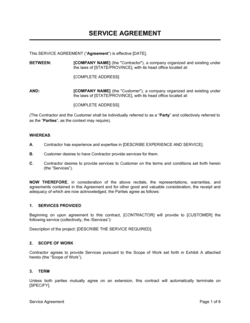
Arbitration Agreement Template

Free Word download β€’ Edit online β€’ Save & share with Drive β€’ Export to PDF

3 pagesβ€’25–30 min to fillβ€’Difficulty: Complexβ€’Signature requiredβ€’Legal review recommended
Learn more ↓
FreeArbitration Agreement Template

At a glance

What it is
An Arbitration Agreement is a legally binding contract in which two or more parties agree to resolve disputes through a private arbitration process rather than through the court system. This free Word download provides a structured, attorney-reviewed starting point covering scope, arbitration rules, seat, governing law, confidentiality, and jury-trial waiver β€” editable online and exportable as PDF.
When you need it
Use it whenever you want to establish in advance how disputes will be resolved β€” before any conflict arises. It is typically signed alongside employment contracts, commercial agreements, service contracts, and consumer terms of service to bind both parties to arbitration as the exclusive dispute-resolution mechanism.
What's inside
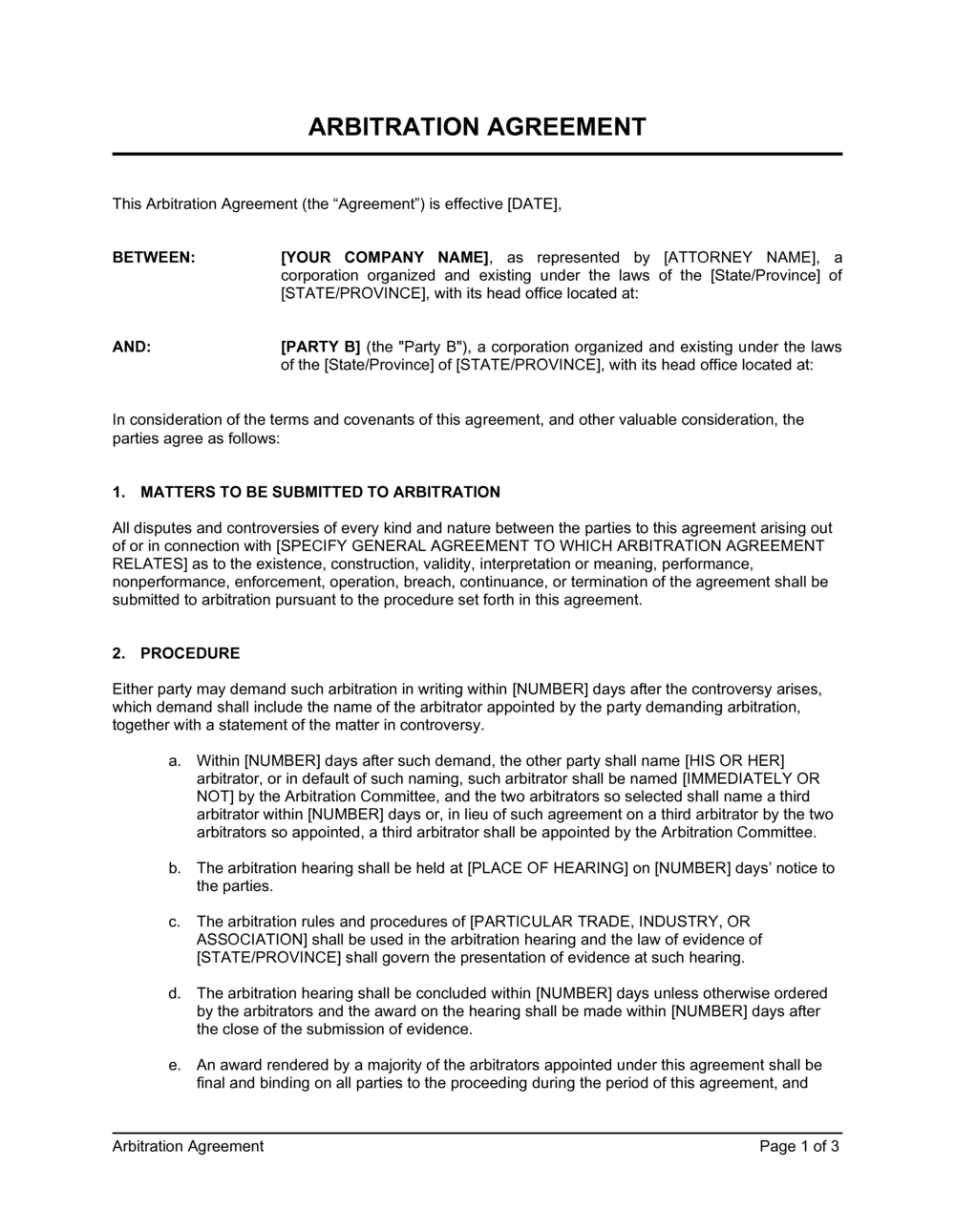
Agreement to arbitrate, scope of covered disputes, arbitration rules and administrator, seat and venue, governing law, number of arbitrators, confidentiality, waiver of class actions and jury trial, and provisions for costs and fees.

What is an Arbitration Agreement?

An Arbitration Agreement is a legally binding contract in which two or more parties agree to resolve any disputes that arise between them through private arbitration rather than through the public court system. Instead of filing a lawsuit, a party initiates proceedings by filing a demand for arbitration with a designated administrator β€” such as the American Arbitration Association, JAMS, or the ICC β€” and a neutral arbitrator (or panel) hears the evidence and issues a final, enforceable award. The agreement is executed before any dispute arises, giving both parties certainty about how future conflicts will be handled and eliminating the unpredictability of litigation.

Arbitration agreements are used as standalone documents or embedded as clauses within employment contracts, commercial service agreements, platform terms of service, and shareholder agreements. They specify the scope of covered disputes, the applicable arbitration rules, the seat and governing law, the number of arbitrators, confidentiality obligations, and β€” critically β€” waivers of class actions and jury trials. In the United States, arbitration agreements are generally enforceable under the Federal Arbitration Act, which reflects a strong federal policy favoring arbitration as an alternative to litigation.

Why You Need This Document

Without a pre-dispute arbitration agreement in place, any conflict with an employee, vendor, customer, or business partner defaults to public court litigation β€” a process that typically takes two to five years, costs tens of thousands of dollars in legal fees and discovery, and plays out on a public docket accessible to competitors, press, and regulators. A properly drafted arbitration agreement replaces that exposure with a faster, private, and final process that both parties have agreed to in advance. It eliminates jury trials, limits discovery costs, and β€” with a class-action waiver β€” prevents individual claims from being aggregated into enterprise-threatening class litigation. For SaaS platforms and consumer-facing businesses in particular, the class-action waiver alone can be the difference between a manageable individual claim and a multi-million-dollar representative action. This template gives you a structured, attorney-reviewed starting point that covers every material term, so you can deploy consistent arbitration language across your contracts without drafting from scratch each time.

Which variant fits your situation?

If your situation is…Use this template
Standalone pre-dispute agreement with an employee before hiringEmployment Arbitration Agreement
Dispute resolution clause embedded in a commercial services contractService Agreement with Arbitration Clause
Consumer-facing arbitration clause within platform terms of serviceTerms of Service Agreement
Arbitration clause included in a partnership or shareholders agreementShareholders Agreement
Post-dispute submission to arbitration after a conflict has already arisenSubmission Agreement (Post-Dispute Arbitration)
International commercial dispute with a foreign counterpartyInternational Arbitration Agreement (ICC Rules)
Mediation as a mandatory first step before proceeding to arbitrationMediation Agreement

Common mistakes to avoid

❌ Using permissive rather than mandatory arbitration language

Why it matters: Clauses that say a party 'may' submit disputes to arbitration allow either side to choose court instead, completely undermining the agreement's purpose.

Fix: Replace permissive language ('may be submitted') with mandatory language ('shall be resolved exclusively by binding arbitration') throughout the agreement.

❌ Omitting a class-action waiver or burying it in fine print

Why it matters: Without a clear class-action waiver, plaintiffs' attorneys can aggregate individual claims into a class action β€” transforming a contained dispute into enterprise-level litigation exposure.

Fix: Include a standalone, all-caps class-action waiver section and have the counterparty initial it separately to demonstrate knowing consent.

❌ Requiring equal cost-sharing in employment or consumer disputes

Why it matters: Courts in the US and EU routinely void arbitration clauses that impose filing or arbitrator fees so high that the weaker party cannot practically access the process β€” a doctrine called 'prohibitive cost.'

Fix: Include a fee-allocation clause stating that the employer or platform will bear all administrative and arbitrator fees exceeding what the claimant would pay to file in court.

❌ Failing to carve out emergency injunctive relief

Why it matters: If the agreement requires all disputes to go to arbitration with no court carve-out, a party seeking emergency injunctive relief β€” such as to stop misappropriation of trade secrets β€” faces procedural delay that can be irreparably harmful.

Fix: Add an explicit carve-out allowing either party to seek emergency injunctive or equitable relief from a court of competent jurisdiction without waiving arbitration rights.

❌ Signing after the employment or commercial relationship has already started

Why it matters: In common-law jurisdictions, an employee or counterparty who is already performing under a contract has given no new consideration for a subsequently introduced arbitration clause, potentially making it unenforceable.

Fix: Execute the arbitration agreement on or before the relationship commences, or provide documented fresh consideration β€” a pay increase, signing bonus, or additional benefit β€” when introducing arbitration terms to an existing relationship.

❌ Designating an arbitration seat with poor enforcement infrastructure

Why it matters: Choosing a seat in a jurisdiction that is not a signatory to the New York Convention or that has hostile arbitration courts can make it impossible to enforce an award against a counterparty with assets elsewhere.

Fix: Choose a seat in a major arbitration-friendly jurisdiction β€” New York, London, Singapore, Paris, or Delaware β€” and confirm the jurisdiction is a New York Convention signatory for any cross-border arrangement.

The 10 key clauses, explained

Parties and recitals

In plain language: Identifies the full legal names of all parties to the agreement and states the underlying commercial or employment relationship that gives rise to potential disputes.

Sample language
This Arbitration Agreement ('Agreement') is entered into as of [DATE] between [PARTY A LEGAL NAME], a [STATE] [ENTITY TYPE] ('Company'), and [PARTY B FULL NAME] ('Counterparty') in connection with [DESCRIPTION OF UNDERLYING RELATIONSHIP].

Common mistake: Identifying parties by trade name or first name only. If the named party doesn't match the entity that signed the underlying contract, the arbitration clause may be unenforceable against the correct legal entity.

Agreement to arbitrate

In plain language: The core operative clause β€” the parties' mutual, binding promise to submit covered disputes to arbitration instead of going to court.

Sample language
The parties agree that any and all disputes, claims, or controversies arising out of or relating to this Agreement, or the breach, termination, enforcement, interpretation, or validity thereof, shall be resolved exclusively by final and binding arbitration.

Common mistake: Using permissive language like 'may be submitted to arbitration' rather than mandatory language like 'shall be resolved exclusively by arbitration.' Permissive clauses allow a party to elect court instead, defeating the purpose.

Scope of covered disputes

In plain language: Defines precisely which types of claims are subject to arbitration β€” and lists any express carve-outs such as injunctive relief or small claims court.

Sample language
Covered disputes include all claims arising under contract, tort, statute, regulation, or otherwise. The following are excluded from arbitration: (a) applications for emergency injunctive or equitable relief; (b) claims filed in small claims court within applicable jurisdictional limits.

Common mistake: Writing a scope clause so broad it captures claims the drafter never intended to arbitrate β€” such as personal injury claims or statutory whistleblower actions β€” which courts may sever and refuse to enforce.

Arbitration rules and administrator

In plain language: Designates the institutional rules that govern the proceedings and the administering body responsible for appointing arbitrators and managing the process.

Sample language
Arbitration shall be conducted in accordance with the [AAA Commercial Arbitration Rules / JAMS Comprehensive Arbitration Rules / ICC Rules of Arbitration] as in effect at the time the demand is filed, administered by [ADMINISTRATOR NAME].

Common mistake: Naming an administrator without confirming it will accept jurisdiction over the type of dispute involved. AAA, JAMS, and ICC each have separate rule sets for employment, consumer, and commercial matters.

Number of arbitrators and selection

In plain language: Specifies whether one arbitrator or a three-member panel will decide the case, and sets out how arbitrators are appointed if the parties cannot agree.

Sample language
Disputes with a claimed value under $[X] shall be decided by a sole arbitrator. Disputes with a claimed value of $[X] or more shall be decided by a panel of three arbitrators. In either case, arbitrators shall be selected pursuant to the applicable administrator's rules.

Common mistake: Requiring a panel of three arbitrators for all disputes regardless of size. Three-arbitrator panels typically cost $50,000–$150,000+ in fees β€” disproportionate for small commercial claims and effectively denying access to arbitration.

Seat, venue, and language

In plain language: Establishes the legal seat of arbitration (which fixes the governing procedural law), the physical hearing location, and the language in which proceedings will be conducted.

Sample language
The seat of arbitration shall be [CITY, STATE/COUNTRY]. Hearings shall take place in [CITY] unless the arbitrator orders otherwise. All proceedings shall be conducted in the [ENGLISH] language.

Common mistake: Confusing the seat of arbitration with the hearing venue. The seat determines which court supervises the arbitration and which procedural law applies β€” choosing a seat in a jurisdiction with poor arbitration infrastructure can make the award hard to enforce.

Governing law

In plain language: Designates the substantive law that applies to the merits of the dispute β€” distinct from the procedural law of the seat.

Sample language
This Agreement and any dispute submitted to arbitration hereunder shall be governed by and construed in accordance with the laws of the State of [STATE], without regard to its conflict-of-laws principles.

Common mistake: Choosing a governing law that has no reasonable connection to the parties or the transaction. Courts and arbitrators may disregard governing-law clauses selected purely to avoid mandatory consumer or employee protections.

Confidentiality

In plain language: Obligates all parties, their counsel, and the arbitrator to keep the existence and outcome of the arbitration β€” including any award β€” strictly confidential.

Sample language
The parties agree that the existence, content, and result of any arbitration proceeding hereunder shall be kept strictly confidential and shall not be disclosed to any third party without the prior written consent of all parties, except as required by law or court order.

Common mistake: Omitting a confidentiality clause entirely. Without it, the opposing party can publicize the proceedings and award β€” eliminating one of the primary advantages of arbitration over litigation.

Class action and jury trial waiver

In plain language: Requires each party to bring claims only in an individual capacity, prohibiting class or representative actions, and waives the right to a jury trial.

Sample language
EACH PARTY WAIVES ITS RIGHT TO A JURY TRIAL AND AGREES THAT CLAIMS SHALL BE BROUGHT ONLY IN AN INDIVIDUAL CAPACITY AND NOT AS A PLAINTIFF OR CLASS MEMBER IN ANY PURPORTED CLASS, COLLECTIVE, OR REPRESENTATIVE PROCEEDING.

Common mistake: Burying the class-action waiver in boilerplate without conspicuous formatting. Courts β€” particularly in California β€” have struck down class-action waivers that were not presented clearly enough for the counterparty to understand what they were waiving.

Costs, fees, and allocation

In plain language: Allocates the costs of arbitration β€” filing fees, arbitrator compensation, and administrative charges β€” between the parties, and addresses whether attorneys' fees may be awarded.

Sample language
The parties shall each bear their own attorneys' fees and costs unless the arbitrator awards fees pursuant to an applicable fee-shifting statute. Administrative and arbitrator fees shall be allocated in accordance with the [ADMINISTRATOR] fee schedule, except that in employment disputes, Company shall bear all fees in excess of those a claimant would pay to file in court.

Common mistake: Requiring the employee or consumer to pay equal administrative and arbitrator fees without a hardship exception. Courts routinely void arbitration clauses that impose cost barriers so high the weaker party cannot practically pursue a claim.

How to fill it out

  1. 1

    Identify the parties with their full legal names

    Enter the complete registered legal name of each party β€” not a trade name or DBA. For individuals, use the name as it appears on a government-issued ID. For entities, confirm the exact name on file with the applicable corporate registry.

    πŸ’‘ Cross-reference the party names against the underlying contract (employment agreement, service agreement, etc.) to ensure they are identical β€” a mismatch creates an enforceability argument.

  2. 2

    Define the scope of covered disputes precisely

    Decide which categories of claims you want to capture β€” contract, tort, statutory, or all β€” and list any explicit carve-outs such as IP injunctive relief or small claims matters. Write the scope in plain English so it survives a plain-meaning challenge.

    πŸ’‘ When in doubt, include injunctive relief as a carve-out. Courts are generally willing to grant emergency injunctions even when an arbitration clause exists, and excluding injunctive relief from the clause avoids a procedural fight when time-sensitive relief is needed.

  3. 3

    Select an arbitration administrator and rule set

    Choose AAA, JAMS, or ICC (or another recognized body) and specify the exact rule set β€” Commercial, Employment, or Consumer. Confirm the administrator will accept the case type before finalizing the clause.

    πŸ’‘ AAA and JAMS publish their fee schedules and rule sets publicly β€” download the current version and attach it as an exhibit so there is no dispute about which rules apply.

  4. 4

    Set the number of arbitrators and selection method

    For disputes under $250,000, a sole arbitrator is standard and significantly cheaper. For disputes above $1M or involving complex commercial matters, a three-member panel is more appropriate. Reference the administrator's default rules for appointment if the parties cannot agree.

    πŸ’‘ Specify that the arbitrator must have at least 10 years of relevant legal or industry experience to avoid being assigned a generalist with no background in the subject matter.

  5. 5

    Designate the seat, hearing location, and language

    Choose the seat of arbitration based on where enforcement of the award is most likely to occur. Set the hearing city for logistical convenience. Confirm the proceedings language β€” for international agreements, specify that written submissions and oral hearings will both be conducted in the named language.

    πŸ’‘ For US domestic agreements, Delaware and New York are the most arbitration-friendly seats β€” courts there have deep familiarity with arbitral procedures and rarely interfere with awards.

  6. 6

    State the governing law clearly

    Choose the substantive law that governs the merits β€” typically the state where the primary business operates or where the contract was formed. Include a conflicts-of-law exclusion to prevent the arbitrator from applying another jurisdiction's rules.

    πŸ’‘ In employment agreements, confirm that the chosen state's law does not restrict the arbitration clause. California, for instance, has robust worker-protection rules that can override contractual governing-law choices.

  7. 7

    Include a conspicuous class-action waiver and jury-trial waiver

    Format both waivers in bold, all-caps text and place them in a visually distinct section. Have the counterparty initial adjacent to each waiver β€” not just sign the last page β€” to confirm they reviewed and understood what they were waiving.

    πŸ’‘ Some employers and platforms add a checkbox or separate acknowledgment page for waivers to create an additional record of knowing consent, which is particularly useful if the clause is challenged as unconscionable.

  8. 8

    Have both parties sign before the underlying relationship begins

    Execute the arbitration agreement on or before the date the employment, service, or commercial relationship commences. Post-commencement signatures in common-law jurisdictions require fresh consideration β€” a bonus, pay increase, or additional benefit β€” to be enforceable.

    πŸ’‘ Use an eSign platform with timestamped audit trails to document when each party signed, which is critical evidence if the clause is later challenged.

Frequently asked questions

What is an arbitration agreement?

An arbitration agreement is a written contract in which two or more parties agree to resolve future disputes through private arbitration rather than through the court system. It designates the arbitration rules, administrator, seat, and governing law in advance β€” before any dispute arises β€” so that if a conflict occurs, both parties are bound to resolve it outside of court. Arbitration agreements are generally enforceable under the Federal Arbitration Act in the US and equivalent legislation in most other major jurisdictions.

Is an arbitration agreement legally binding?

Yes, arbitration agreements are generally enforceable as binding contracts when properly executed, provided they meet basic contract requirements β€” mutual assent, consideration, and legal capacity. Courts in the US, Canada, the UK, and the EU will typically compel arbitration when a valid agreement exists. However, clauses that are unconscionable, lack mutuality, impose prohibitive costs, or waive unwaivable statutory rights may be voided in whole or in part by a court.

What is the difference between arbitration and mediation?

Mediation is a voluntary, non-binding process in which a neutral mediator helps the parties negotiate a settlement β€” the mediator has no power to impose a decision. Arbitration is a binding adjudicative process in which a neutral arbitrator hears evidence and issues a final, enforceable award similar to a court judgment. Many commercial agreements require mediation as a mandatory first step before a party may proceed to arbitration.

Can an arbitration agreement be challenged in court?

Yes. Courts will review arbitration agreements on limited grounds β€” specifically whether the agreement was formed (mutual assent, capacity, and consideration), whether the scope clause covers the dispute at issue, and whether the agreement is unconscionable or violates a non-waivable statutory right. Courts generally do not review the merits of the underlying dispute once a valid arbitration agreement is confirmed.

What is a class-action waiver in an arbitration agreement?

A class-action waiver is a provision requiring each party to bring claims only in an individual capacity, not as part of a class or collective action. The US Supreme Court has upheld class-action waivers in arbitration agreements in a series of decisions. However, some jurisdictions β€” including California in certain consumer and employment contexts β€” apply additional scrutiny to waivers that are not presented conspicuously or that are paired with unconscionably one-sided terms.

Do arbitration agreements apply to employment disputes?

In most US states, yes β€” employers may require employees to sign pre-dispute arbitration agreements covering workplace claims as a condition of employment. However, the Ending Forced Arbitration of Sexual Assault and Sexual Harassment Act (2022) prohibits mandatory arbitration of sexual harassment and sexual assault claims. Several states have additional restrictions on arbitrating certain employment claims. Legal advice is recommended before implementing mandatory employment arbitration.

What happens if one party refuses to arbitrate?

If a party refuses to arbitrate a covered dispute, the other party may file a motion in court to compel arbitration under the Federal Arbitration Act or applicable state or international law. Courts will generally grant the motion if a valid arbitration agreement exists and the dispute falls within its scope. The refusing party may also be liable for the other side's legal fees incurred in compelling arbitration.

Can I appeal an arbitration award?

Arbitration awards are final and binding, with extremely limited grounds for appeal. Under the FAA, a court may vacate an award only if it was procured by fraud, the arbitrator was corrupt, the arbitrator exceeded their authority, or the arbitrator refused to hear material evidence. Courts will not overturn an award simply because the arbitrator made a legal or factual error β€” making thorough preparation before the hearing critical.

Do I need a lawyer to draft an arbitration agreement?

For straightforward commercial or vendor agreements, a quality template is a practical starting point. Legal review is strongly recommended for employment arbitration agreements (given the patchwork of state restrictions), consumer-facing clauses embedded in terms of service, international commercial contracts, and any arrangement where the class-action waiver is a strategic priority. A 1–2 hour attorney review typically costs $300–$600 and can prevent an unenforceability challenge later.

How this compares to alternatives

vs Litigation (no agreement)

Without an arbitration agreement, disputes proceed through the public court system β€” with full discovery, jury trials, public dockets, and appeals that can take 2–5 years. Arbitration is typically faster (6–18 months), private, and final. Litigation is appropriate when a party needs the precedential or public nature of a court ruling, or when injunctive relief is urgently required.

vs Mediation Agreement

A mediation agreement initiates a voluntary, non-binding negotiation facilitated by a neutral mediator β€” no decision is imposed. An arbitration agreement commits both parties to a binding adjudicatory process with a final enforceable award. Many contracts use both in sequence: mandatory mediation first, then arbitration if mediation fails.

vs Dispute Resolution Clause (embedded)

A dispute resolution clause is a single provision embedded within a larger contract (such as a service agreement or employment contract) rather than a standalone document. A standalone arbitration agreement provides greater specificity, is easier for both parties to locate and sign separately, and is generally more defensible if challenged because it demonstrates the party's knowing consent to arbitration as a distinct obligation.

vs Non-Disclosure Agreement

An NDA protects confidential information from disclosure and creates obligations of secrecy. An arbitration agreement governs how disputes are resolved β€” it does not protect information. Many commercial relationships require both: an NDA to protect sensitive data and an arbitration agreement to ensure any breach of the NDA is resolved privately rather than in a public courtroom.

Industry-specific considerations

Technology / SaaS

Embedded in terms of service and SaaS subscription agreements to cover platform disputes, IP ownership conflicts, and data breach liability claims at scale.

Financial Services

FINRA arbitration is mandatory for broker-dealer disputes; commercial lenders use standalone arbitration agreements to resolve loan default and covenant breach disputes outside court.

Healthcare

Used in physician employment agreements and vendor contracts; enforceability against patients for medical malpractice claims is heavily restricted in most US states and should be avoided without specialized counsel.

Construction and Real Estate

AIA contract forms include standard arbitration clauses for construction disputes; lease agreements for commercial properties commonly require arbitration for rent-dispute and breach-of-covenant claims.

Retail / E-commerce

Consumer-facing platforms embed arbitration and class-action waiver clauses in checkout terms to manage product liability and return-policy disputes at scale.

Professional Services

Law firms, consultancies, and accounting practices include arbitration clauses in engagement letters to resolve fee disputes and malpractice claims privately.

Jurisdictional notes

United States

The Federal Arbitration Act governs most commercial and employment arbitration agreements and strongly favors enforcement. However, the 2022 Ending Forced Arbitration of Sexual Assault and Sexual Harassment Act carves out sexual misconduct claims from mandatory arbitration. California imposes some of the strictest requirements β€” including mandatory cost-shifting to employers and restrictions on unconscionable class-action waivers. Several other states have enacted laws limiting employment arbitration; check state-specific rules before deploying a standard form.

Canada

Arbitration in Canada is governed provincially β€” the International Commercial Arbitration Act (modeled on the UNCITRAL Model Law) applies to cross-border disputes, while domestic arbitration is governed by provincial statutes such as Ontario's Arbitration Act, 1991. Employment arbitration agreements are generally enforceable for non-union employees, but courts will scrutinize clauses that waive statutory minimum employment standards. Quebec applies the Civil Code alongside the Code of Civil Procedure for arbitration matters.

United Kingdom

The Arbitration Act 1996 governs arbitration in England, Wales, and Northern Ireland; Scotland has separate legislation. The UK is a strong pro-arbitration jurisdiction β€” London is one of the world's premier arbitration seats. Consumer arbitration agreements are subject to the Consumer Rights Act 2015, which may render mandatory pre-dispute arbitration clauses in consumer contracts unfair and unenforceable. Employment arbitration is significantly restricted β€” most statutory employment claims must be heard by an Employment Tribunal.

European Union

EU member states vary significantly in their approach to arbitration β€” Paris, Amsterdam, and Stockholm are major seats with well-developed arbitration regimes. The Brussels I Recast Regulation excludes arbitration from its scope, meaning enforcement of EU-seated awards relies on the New York Convention and national law. Consumer arbitration is heavily restricted under EU Directive 93/13/EEC on unfair contract terms; mandatory pre-dispute arbitration clauses in B2C contracts are frequently voided by national courts. GDPR considerations apply where arbitration proceedings involve personal data.

Template vs lawyer β€” what fits your deal?

PathBest forCostTime
Use the templateStandard commercial vendor agreements, small business service contracts, and straightforward B2B arrangements in a single domestic jurisdictionFree30–45 minutes
Template + legal reviewEmployment arbitration agreements, consumer-facing terms with class-action waivers, or contracts crossing multiple US states with varying enforceability rules$300–$6001–3 days
Custom draftedInternational commercial arbitration, financial services and regulated-industry disputes, or high-value agreements where the class-action waiver is strategically critical$1,500–$5,000+1–3 weeks

Glossary

Arbitration
A private, binding dispute-resolution process in which a neutral arbitrator (or panel) hears evidence and issues a final award, replacing litigation in court.
Arbitral Award
The final, binding decision issued by an arbitrator at the conclusion of proceedings, enforceable in court under the Federal Arbitration Act or applicable treaty.
Seat of Arbitration
The legal jurisdiction designated as the formal home of the arbitration, which determines the procedural law governing the proceedings.
Class Action Waiver
A provision requiring each party to pursue claims individually rather than as part of a group or class action, preventing aggregation of claims against the other party.
Scope Clause
The section of the agreement that defines which disputes, claims, or controversies are subject to arbitration β€” and which, if any, are excluded.
Arbitration Administrator
The institutional body (such as AAA, JAMS, or ICC) that administers the arbitration, provides procedural rules, and maintains a roster of arbitrators.
Demand for Arbitration
The formal written notice one party files with the arbitration administrator to initiate proceedings when a dispute arises.
Discovery
The pre-hearing process of exchanging evidence and information between parties; arbitration typically allows narrower discovery than court litigation.
Confidentiality Clause
A provision requiring all parties β€” and the arbitrator β€” to keep the existence, proceedings, and outcome of the arbitration private.
Unconscionability
A legal doctrine under which a court may refuse to enforce an arbitration clause that is so one-sided or oppressive that it shocks the conscience.
Federal Arbitration Act (FAA)
US federal law enacted in 1925 that establishes the enforceability of written arbitration agreements and governs the confirmation and vacatur of arbitral awards.
Waiver of Jury Trial
An explicit contractual surrender of each party's constitutional right to have a dispute decided by a jury, in favor of arbitral resolution.

Part of your Business Operating System

This document is one of 3,000+ business & legal templates included in Business in a Box.

  • Fill-in-the-blanks β€” ready in minutes
  • 100% customizable Word document
  • Compatible with all office suites
  • Export to PDF and share electronically

Create your document in 3 simple steps.

From template to signed document β€” all inside one Business Operating System.
1
Download or open template

Access over 3,000+ business and legal templates for any business task, project or initiative.

2
Edit and fill in the blanks with AI

Customize your ready-made business document template and save it in the cloud.

3
Save, Share, Send, Sign

Share your files and folders with your team. Create a space of seamless collaboration.

Save time, save money, and create top-quality documents.

β˜…β˜…β˜…β˜…β˜…

"Fantastic value! I'm not sure how I'd do without it. It's worth its weight in gold and paid back for itself many times."

Managing Director Β· Mall Farm
Robert Whalley
Managing Director, Mall Farm Proprietary Limited
β˜…β˜…β˜…β˜…β˜…

"I have been using Business in a Box for years. It has been the most useful source of templates I have encountered. I recommend it to anyone."

Business Owner Β· 4+ years
Dr Michael John Freestone
Business Owner
β˜…β˜…β˜…β˜…β˜…

"It has been a life saver so many times I have lost count. Business in a Box has saved me so much time and as you know, time is money."

Owner Β· Upstate Web
David G. Moore Jr.
Owner, Upstate Web

Run your business with a system β€” not scattered tools

Stop downloading documents. Start operating with clarity. Business in a Box gives you the Business Operating System used by over 250,000 companies worldwide to structure, run, and grow their business.

Start freeΒ Β·Β No credit card required