Charter Agreement Template

Free Word download β€’ Edit online β€’ Save & share with Drive β€’ Export to PDF

6 pagesβ€’25–35 min to fillβ€’Difficulty: Complexβ€’Signature requiredβ€’Legal review recommended
Learn more ↓
FreeCharter Agreement Template

At a glance

What it is
A Charter Agreement is a legally binding contract under which an owner grants a charterer exclusive use of a vessel, aircraft, vehicle, or venue for a defined period in exchange for a stated fee. This free Word download covers charter fees, deposits, crew and operator responsibilities, fuel, insurance, liability allocation, and damage procedures in a single editable document you can export as PDF and execute before departure or occupancy.
When you need it
Use it any time you are renting out β€” or taking exclusive use of β€” a boat, yacht, private aircraft, charter bus, or event venue for a specific trip or period. It applies equally to commercial operators and private owners who want enforceable written terms rather than a verbal agreement.
What's inside
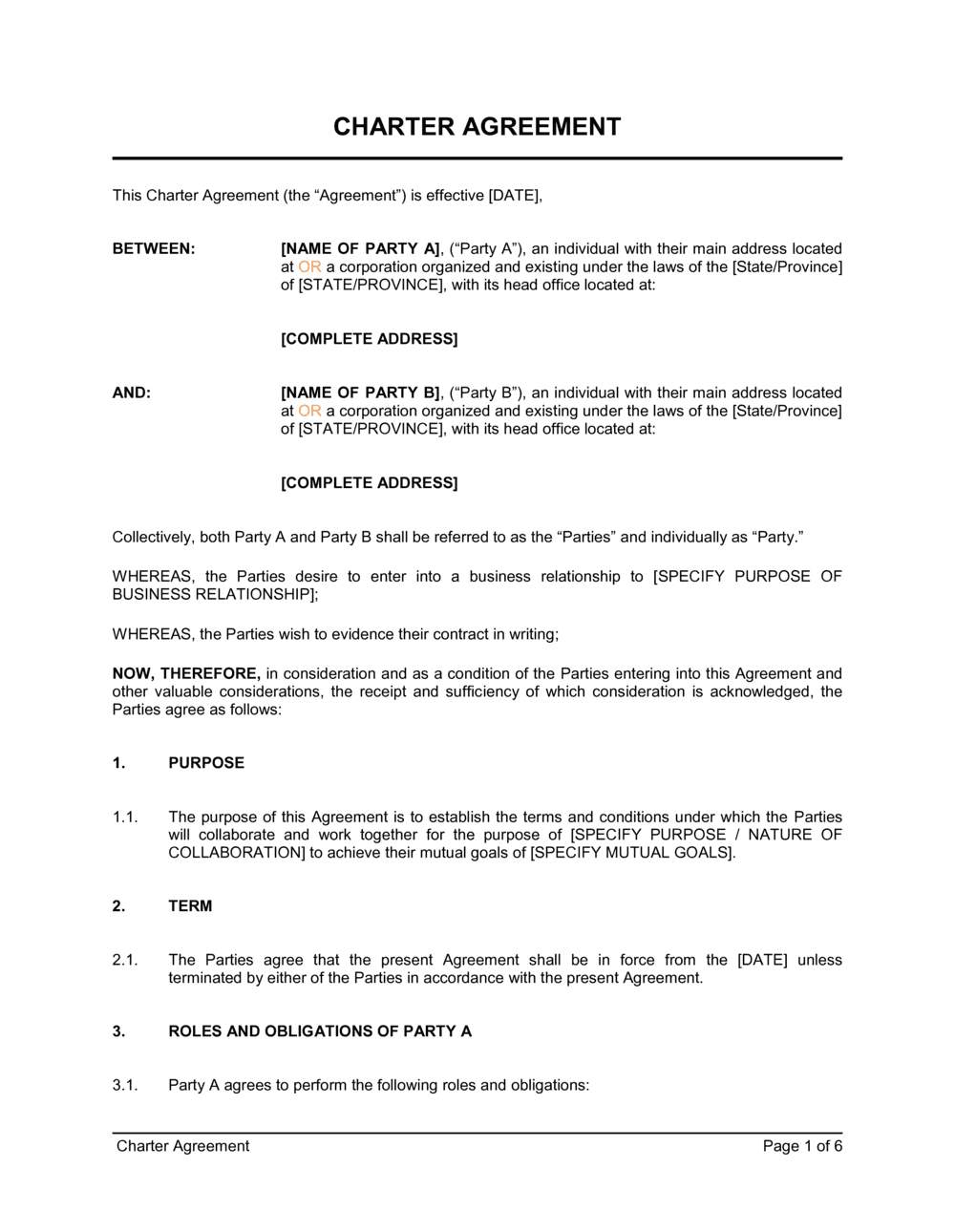
Parties and asset description, charter period and itinerary, fees and deposit schedule, crew and operator duties, fuel and provisioning responsibilities, insurance requirements, liability and indemnification, cancellation and force majeure, damage reporting, and governing law.

What is a Charter Agreement?

A Charter Agreement is a legally binding contract under which an owner grants a charterer exclusive use of a vessel, aircraft, vehicle, or venue for a defined period in exchange for a stated charter fee. Unlike a general rental agreement, a charter typically involves the transfer of an operational asset β€” often including crew, equipment, and supporting services β€” and is governed in part by specialized maritime, aviation, or transport law that operates independently of what the contract says. The agreement defines each party's obligations across the full lifecycle of the engagement: from payment and deposit through the charter period itself, and on to damage reporting and final settlement.

Why You Need This Document

Without a written charter agreement, every ambiguity becomes a dispute. A charterer who paid in full expects their itinerary regardless of weather; an owner who turned away other bookings expects their fee regardless of the charterer's change of plans. Damage found at return triggers a he-said/she-said argument with no baseline, no deposit mechanism, and no agreed assessment process. Insurance claims fail when the policy excludes commercial charter use that was never documented. A properly executed charter agreement β€” signed before the charter period begins, with a condition checklist attached β€” eliminates these failure points by putting every material term in writing before money changes hands or lines are cast off.

Which variant fits your situation?

If your situation is…Use this template
Chartering a sailing or motor yacht for private useYacht Charter Agreement
Hiring a private jet or turboprop for a specific flightAircraft Charter Agreement
Renting a coach or bus for a corporate or event transferCharter Bus Agreement
Exclusive use of a venue for a wedding or private eventVenue Rental Agreement
Commercial fishing vessel hired for a guided charter tripFishing Charter Agreement
Bareboat charter where the charterer operates the vessel themselvesBareboat Charter Agreement
Time-charter where the owner retains crew and operational controlTime Charter Party Agreement

Common mistakes to avoid

❌ No pre-charter condition inspection or handover checklist

Why it matters: Without a documented record of the asset's condition at the start of the charter, neither party can prove who caused damage found at return β€” disputes default to he-said/she-said with no resolution.

Fix: Require a signed, dated condition report with photographs at handover. Attach it to the agreement as Schedule A and have both parties initial each page.

❌ Ambiguous deposit language β€” 'deposit' without 'refundable' or 'non-refundable'

Why it matters: Courts interpret 'deposit' inconsistently β€” in some jurisdictions it is presumed refundable unless stated otherwise, in others it is presumed a forfeiture. Ambiguity leads to disputes and potential clawback claims.

Fix: Label every payment explicitly as 'non-refundable deposit,' 'refundable damage deposit,' or 'advance payment toward total charter fee' and state the exact conditions for retention or return.

❌ Omitting the captain's authority to override charterer itinerary requests

Why it matters: A charterer who paid for a specific route can argue they are entitled to it regardless of weather or safety conditions. Without a clear captain's authority clause, the owner faces liability if they comply with an unsafe request.

Fix: Include an explicit clause granting the captain or operator final authority over all safety decisions, including alteration or abandonment of the itinerary, with no reduction in charter fee for safety-driven changes.

❌ Exceeding certified passenger or payload capacity

Why it matters: Operating beyond the asset's certificated capacity voids hull and liability insurance coverage and breaches maritime, aviation, or transport regulations β€” exposing both parties to fines, criminal liability, and uninsured loss.

Fix: State the maximum passenger number in the agreement as the lower of the physical capacity and the certificated legal limit, and include a clause making the charterer liable for any regulatory penalties resulting from overcapacity.

❌ No force majeure or weather cancellation clause

Why it matters: Extreme weather, government-issued no-sail or no-fly orders, and mechanical failures are foreseeable events. Without a defined procedure, a cancelled charter triggers a full-payment dispute with no agreed resolution path.

Fix: Add a tiered force majeure clause covering weather, mechanical failure, and regulatory orders β€” specify which events trigger a full refund, which trigger a rescheduling right, and which trigger a partial refund.

❌ Choosing a governing law inconsistent with where the charter operates

Why it matters: Maritime, aviation, and transport law in the jurisdiction of operation often applies mandatory safety, liability, and passenger-rights rules that override a contractual choice of law β€” leaving the governing-law clause ineffective for the most critical provisions.

Fix: Choose the law of the jurisdiction where the asset is registered and primarily operates, and add a clause acknowledging that applicable admiralty, aviation, or transport regulations take precedence over the contract where required by law.

The 10 key clauses, explained

Parties, asset description, and charter period

In plain language: Identifies the owner and charterer as legal entities, describes the asset being chartered with sufficient precision (name, registration, make, model, or venue address), and states the exact start and end of the charter period.

Sample language
This Charter Agreement is entered into on [DATE] between [OWNER LEGAL NAME] ('Owner') and [CHARTERER LEGAL NAME] ('Charterer'). Owner agrees to provide exclusive use of [VESSEL/AIRCRAFT/VEHICLE/VENUE NAME AND DESCRIPTION], registration number [REGISTRATION], for the period commencing [START DATE AND TIME] and ending [END DATE AND TIME] ('Charter Period').

Common mistake: Describing the asset by trade name only without a registration or hull number. If a dispute arises about which specific asset was chartered β€” or its condition at handover β€” the lack of a unique identifier makes the agreement ambiguous.

Charter fee, payment schedule, and deposit

In plain language: States the total charter fee, the payment schedule (deposit due at signing, balance due before departure or occupancy), and the amount and refund conditions of the damage deposit.

Sample language
Charterer shall pay a total charter fee of $[AMOUNT] as follows: a non-refundable deposit of $[DEPOSIT AMOUNT] due upon signing, and the remaining balance of $[BALANCE] due no later than [X] days before the start of the Charter Period. A refundable damage deposit of $[DEPOSIT] shall be paid on [DATE] and returned within [X] days of the end of the Charter Period, subject to deductions for damage or fuel shortfall.

Common mistake: Labeling the advance payment as a 'deposit' without specifying whether it is refundable. Courts treat the word ambiguously β€” use 'non-refundable deposit' or 'refundable deposit' explicitly, and state the exact refund conditions.

Crew and operator responsibilities

In plain language: Defines who is responsible for crewing or operating the asset β€” owner or charterer β€” and sets the standards the crew must meet, including licensing, certification, and authority to make safety decisions.

Sample language
Owner shall provide a qualified captain and crew of no fewer than [NUMBER] persons, each holding current [CERTIFICATION TYPE] certifications. The captain shall have final authority over all safety decisions, including decisions to abort or alter the itinerary. Charterer shall not interfere with crew operations.

Common mistake: Omitting the captain's authority to override the charterer's itinerary requests for safety reasons. Without this clause, a charterer can argue their paid itinerary takes precedence, creating liability exposure for the owner in adverse conditions.

Fuel, provisioning, and operating expenses

In plain language: Allocates responsibility for fuel costs, provisioning (food and beverages), docking or landing fees, and other operating expenses during the charter period.

Sample language
Owner shall provide [ASSET] with a full fuel tank at the start of the Charter Period. Charterer is responsible for all fuel consumed during the Charter Period and shall return the [ASSET] with a full tank or reimburse Owner at $[RATE] per gallon/litre. Docking fees, landing fees, and port charges incurred at Charterer's direction are Charterer's sole responsibility.

Common mistake: Not specifying the fuel level at handover. A verbal 'full tank' agreement creates disputes at return β€” photograph the gauge and reference the reading in the agreement or a signed handover checklist.

Insurance requirements

In plain language: Requires the owner to maintain hull and liability insurance at stated minimums and specifies any coverage the charterer must carry, including personal liability or trip cancellation insurance.

Sample language
Owner shall maintain hull and machinery insurance with a minimum insured value of $[AMOUNT] and P&I or liability insurance with limits of no less than $[AMOUNT] per occurrence throughout the Charter Period. Charterer is strongly advised to obtain personal travel or charter cancellation insurance. Proof of Owner's insurance shall be provided to Charterer upon request.

Common mistake: Not requiring the owner to name the charterer as an additional insured where the policy permits. Without this, the charterer has no direct claim under the owner's policy and must pursue the owner directly for indemnification.

Liability and indemnification

In plain language: Allocates liability between owner and charterer β€” typically the owner is liable for structural or mechanical failure and the charterer for damage caused by their acts or negligence β€” and includes mutual indemnification language.

Sample language
Owner shall indemnify Charterer against claims arising from Owner's negligence, unseaworthiness/non-airworthiness of the [ASSET], or crew misconduct. Charterer shall indemnify Owner against claims arising from Charterer's negligence, unauthorized use, or breach of this Agreement. Neither party shall be liable for consequential or indirect damages.

Common mistake: Using a blanket liability waiver that attempts to eliminate all owner liability including gross negligence. Courts in most jurisdictions will void exculpatory clauses that cover gross negligence or intentional misconduct, leaving the rest of the clause β€” and potentially the agreement β€” in an uncertain state.

Itinerary, permitted use, and passenger limits

In plain language: States the agreed itinerary or use parameters, the maximum number of passengers or guests permitted, prohibited activities, and geographic or operational restrictions.

Sample language
The Charter shall operate within the following itinerary: [ITINERARY OR OPERATING AREA]. Maximum passenger capacity is [NUMBER] persons as stated on the [VESSEL/AIRCRAFT] certificate of compliance. Charterer shall not carry cargo for hire, engage in commercial fishing, or operate outside the agreed area without Owner's prior written consent.

Common mistake: Omitting passenger limits or referencing only the vessel's physical capacity rather than the certified legal limit. Exceeding the certificated capacity voids insurance coverage and exposes both parties to regulatory penalties.

Cancellation and refund policy

In plain language: Sets the conditions under which either party may cancel, the notice required, and the financial consequences β€” including refund schedules and the owner's right to reschedule due to mechanical failure or weather.

Sample language
Cancellation by Charterer more than [X] days before the Charter Period: [X]% of total fee refunded. Cancellation within [X] days: no refund. Cancellation by Owner due to mechanical failure or unsafe weather: full refund within [X] days or, at Charterer's option, a rescheduled charter at no additional charge.

Common mistake: No weather cancellation provision at all, or one that gives the owner sole discretion without any refund obligation. Charterers who pay in full and are turned away due to weather will dispute payment β€” a clear, tiered refund schedule prevents this.

Damage reporting and repair

In plain language: Requires the charterer to report any damage immediately, sets the process for assessing repair costs, and states how the damage deposit is applied before any additional claim.

Sample language
Charterer shall immediately notify Owner of any damage to the [ASSET] occurring during the Charter Period. Owner shall obtain at least one written repair estimate within [X] days of the end of the Charter Period. Repair costs shall first be applied against the damage deposit; any excess shall be invoiced to Charterer and due within [X] days of invoice.

Common mistake: No joint pre-charter condition inspection or written handover checklist. Without a documented record of the asset's condition at handover, the owner cannot prove pre-existing damage was caused by the charterer β€” and the charterer cannot prove they didn't cause it.

Governing law, jurisdiction, and dispute resolution

In plain language: Specifies which jurisdiction's law governs the agreement, which courts or arbitral body has jurisdiction, and whether disputes must go through mediation or arbitration before litigation.

Sample language
This Agreement is governed by the laws of [STATE/PROVINCE/COUNTRY]. Any dispute arising hereunder shall be submitted to binding arbitration administered by [BODY] in [CITY], except that either party may seek injunctive relief in any court of competent jurisdiction. For maritime disputes, the parties acknowledge the applicability of applicable admiralty law.

Common mistake: Choosing a governing law with no connection to where the charter operates. Maritime and aviation law in the jurisdiction of operation may override the chosen governing law β€” particularly for safety regulations, passenger rights, and liability caps.

How to fill it out

  1. 1

    Identify both parties with full legal names

    Enter the owner's registered legal entity name (or full legal name for an individual) and the charterer's legal name. Include addresses and contact information for both. If the owner operates through a management company, use that entity's name.

    πŸ’‘ For yacht or aircraft charters, confirm whether the entity named on the registration certificate matches the legal name you are using β€” discrepancies create insurance and liability complications.

  2. 2

    Describe the asset precisely

    Include the asset's name, make, model, year, registration or hull number, flag state for vessels, and tail number for aircraft. For venues, include the full civic address and any permitted-use designation.

    πŸ’‘ Attach a signed condition report or handover checklist as Schedule A. This single step resolves the majority of damage deposit disputes.

  3. 3

    Set the charter period with exact times

    Enter the start date and time, end date and time, and the agreed itinerary or operating area. Vague terms like 'weekend of [DATE]' create ambiguity about when the charter fee starts and stops.

    πŸ’‘ Include a grace period clause β€” for example, 30 minutes β€” and specify the overtime charge rate if the charterer holds the asset beyond the agreed end time.

  4. 4

    Complete the fee, deposit, and payment schedule

    State the total charter fee, the deposit amount and its refundability, the balance due date, and the damage deposit amount and return timeline. Specify the currency for international charters.

    πŸ’‘ For charters booked months in advance, add a price-escalation clause tied to documented fuel cost increases β€” this protects operators against significant fuel price movements between booking and departure.

  5. 5

    Allocate crew, fuel, and operating expenses

    Specify whether the owner or charterer provides crew, set the crew certification requirements, and state who bears fuel, docking, landing, provisioning, and port charges.

    πŸ’‘ Document the fuel level at handover with a photograph and note the reading in the agreement or Schedule A. 'Full tank to full tank' is the clearest standard and the easiest to verify.

  6. 6

    Define insurance minimums and proof requirements

    State the minimum hull/aircraft and liability coverage the owner must maintain, specify any charterer insurance requirements, and require proof of coverage to be exchanged before the charter period begins.

    πŸ’‘ Ask your insurance broker whether the policy covers paying charterers β€” some hull policies exclude commercial charter use, which would leave both parties exposed.

  7. 7

    Complete the cancellation and refund schedule

    Set tiered refund amounts based on days before the charter β€” for example, 100% refund if cancelled more than 60 days out, 50% at 30–60 days, no refund inside 30 days. Add a separate owner-cancellation clause with full-refund or reschedule obligations.

    πŸ’‘ Require the charterer to obtain trip cancellation insurance and include a clause acknowledging you recommended it β€” this reduces requests for discretionary refunds.

  8. 8

    Sign before the charter period begins

    Both parties must sign and date the agreement before the charter period starts. For remote execution, use a timestamped e-signature tool and retain the executed copy with the handover checklist.

    πŸ’‘ Send the fully executed agreement to both parties immediately after signing β€” a charterer who claims they never received it cannot rely on that as a defence if you have a delivery confirmation.

Frequently asked questions

What is a charter agreement?

A charter agreement is a contract under which an asset owner grants a charterer exclusive use of a vessel, aircraft, vehicle, or venue for a defined period in exchange for a charter fee. It sets out each party's obligations regarding payment, crew, fuel, insurance, liability, damage, and cancellation. Unlike a standard rental agreement, a charter typically involves a complete operational unit β€” including crew in a crewed charter β€” and is governed in part by specialized maritime, aviation, or transport law.

What should a charter agreement include?

At minimum: full legal names of owner and charterer, a precise description of the asset with registration or hull number, the exact charter period, total fee and payment schedule, damage deposit terms, crew and operator responsibilities, fuel and expense allocation, insurance requirements, liability and indemnification clauses, passenger or capacity limits, cancellation and refund policy, damage reporting procedures, and governing law. Missing any of these typically causes the dispute you were trying to prevent.

Is a charter agreement legally binding?

Yes β€” a charter agreement is generally enforceable as a binding contract when it is signed by both parties, identifies a specific asset and charter period, and involves genuine consideration (the charter fee). Maritime and aviation charters are also subject to specialized statutory and regulatory regimes that operate independently of the contract. Consider having a lawyer review the agreement if the charter value is significant or if passengers are being carried for hire.

What is the difference between a bareboat charter and a crewed charter?

In a bareboat charter, the charterer takes full possession and operational control of the vessel without the owner's crew β€” the charterer is responsible for crewing, insuring, and operating it. In a crewed charter, the owner provides a captain and crew who remain in operational control throughout the charter period. The liability, insurance, and crew-authority clauses differ significantly between the two, so it is important to use the correct template variant for your arrangement.

Who is responsible for fuel costs in a charter agreement?

Fuel responsibility is allocated by agreement and varies by charter type. In most crewed yacht or aircraft charters, the charterer pays for all fuel consumed during the charter period β€” either by refilling the tank at the end or paying a stated rate per gallon or litre for consumption above the starting level. In some all-inclusive charters, fuel is included in the flat fee. The agreement should state the fuel level at handover, the return standard, and the reimbursement rate to avoid disputes.

What insurance do I need for a charter agreement?

Owners typically need hull and machinery insurance covering the asset's replacement value and liability insurance β€” P&I insurance for maritime charters β€” with limits sufficient to cover passenger injury claims. The policy must cover commercial charter use, as many personal-use policies exclude paying passengers. Charterers are strongly advised to obtain charter cancellation or trip insurance. Both parties should exchange proof of coverage before the charter period begins.

Can a charterer cancel and get a refund?

Refund rights depend entirely on the cancellation policy stated in the agreement. A well-drafted charter agreement uses a tiered schedule β€” for example, full refund if cancelled more than 60 days before the charter, 50% at 30–60 days, and no refund inside 30 days. Owner-initiated cancellations due to mechanical failure or unsafe conditions should provide a full refund or a rescheduling option. Without a written cancellation clause, both parties are left to negotiate or litigate.

Does the captain have authority to change the itinerary?

In a crewed charter, the captain typically has β€” and should be given by contract β€” final authority over all safety decisions, including altering or aborting the agreed itinerary due to weather, mechanical issues, or other safety concerns. The charter agreement should state this explicitly and confirm that no reduction in charter fee applies when the itinerary is changed for safety reasons. Without this clause, a charterer may claim a right to the contracted route regardless of conditions.

Do I need a lawyer to draft a charter agreement?

For straightforward private charters between known parties involving modest fees, a well-structured template is usually sufficient. Engage a maritime, aviation, or transport lawyer when the charter involves commercial carriage of passengers for hire, significant asset values, cross-border or international operations, complex liability or insurance structures, or when one party is a corporate operator with regulatory compliance obligations. A 1–2 hour legal review typically costs $300–$800 and is worthwhile for any charter exceeding $5,000 in value.

How this compares to alternatives

vs Rental Agreement

A rental agreement typically covers the passive use of property β€” a car, equipment, or real estate β€” without an operational crew or specialized regulatory framework. A charter agreement covers the exclusive use of an operational asset (vessel, aircraft, or vehicle) often including crew, and is subject to maritime, aviation, or transport law that a standard rental agreement does not address. Use a charter agreement whenever the asset is operated by or under the supervision of the owner.

vs Transportation Agreement

A transportation agreement covers a carrier's obligation to move people or goods from point A to point B as a common carrier service. A charter agreement covers exclusive, private use of the entire vehicle or vessel for a defined period or itinerary β€” the charterer controls the schedule, not the carrier. The liability regimes and passenger rights that apply differ significantly between the two.

vs Venue Hire Agreement

A venue hire agreement is a specialized form of charter covering exclusive use of a physical space β€” a hall, ballroom, or rooftop β€” for an event. A charter agreement in the maritime or aviation context involves an operational asset with crew, fuel, and regulatory compliance obligations that a venue agreement does not address. For event venue use, a venue-specific template covers catering rights, noise restrictions, and occupancy limits more precisely.

vs Service Agreement

A service agreement covers the delivery of specific services β€” consulting, maintenance, or professional work β€” by one party to another. A charter agreement is not a services contract; it transfers exclusive possession and use of a physical asset for a period. The distinction matters for insurance, liability, and tax treatment β€” mischaracterizing a charter as a services contract can void the owner's hull coverage and create unexpected GST or VAT obligations.

Industry-specific considerations

Marine and yacht charter

Crewed and bareboat yacht charters require P&I insurance, flag-state compliance, and passenger certification β€” the agreement must reference the vessel's safety equipment manifest and maximum souls-on-board certificate.

Private aviation

Aircraft charters are subject to FAA or EASA air operator certificate requirements, and the agreement must address airworthiness certification, pilot currency, and the distinction between Part 91 and Part 135 operations.

Ground transportation and coach hire

Charter bus agreements must address DOT or provincial carrier licensing, driver hour-of-service limits, and the charterer's liability for itinerary delays that force regulatory violations.

Events and venue rental

Venue charter agreements focus on occupancy limits, noise restrictions, alcohol licensing, catering rights, security staffing, and liability for guest injury β€” often requiring the charterer to carry event liability insurance.

Jurisdictional notes

United States

US maritime charters are subject to federal admiralty law, USCG vessel documentation and inspection requirements, and the Limitation of Liability Act. Aircraft charters must comply with FAA regulations distinguishing Part 91 (private) from Part 135 (commercial air carrier) operations. Non-compete and liability waiver clauses in charter agreements are scrutinized under state consumer protection laws in California and Florida β€” the two largest charter markets.

Canada

Canadian vessel charters are regulated under the Canada Shipping Act 2001 and Transport Canada's small vessel compliance program. Commercial passenger vessels require a valid Inspection Certificate and the charterer's maximum capacity is set by Transport Canada, not the owner's preference. Quebec charter agreements must be in French for consumer-facing transactions under the Charter of the French Language. Aviation charters must comply with Transport Canada's Air Operator Certificate requirements.

United Kingdom

UK vessel charters are regulated by the Maritime and Coastguard Agency under the Merchant Shipping Act 1995 and associated Codes of Practice for small commercial vessels. Post-Brexit, UK operators are no longer automatically compliant with EU maritime regulations when chartering in European waters. Aircraft charters must comply with CAA requirements and, for operations in EU airspace, EASA rules. Limitation of liability for passenger injury is governed by the Athens Convention as ratified in the UK.

European Union

EU maritime passenger charters are subject to Regulation (EC) No 392/2009 implementing the Athens Convention, which sets minimum liability limits for passenger death and personal injury. GDPR applies to personal data collected during the booking and charter process. Aviation charters in EU airspace must comply with EASA Air Operations Regulations. Member states β€” particularly Greece, Croatia, and France β€” impose additional national licensing and safety inspection requirements for charter vessels operating in their coastal waters.

Template vs lawyer β€” what fits your deal?

PathBest forCostTime
Use the templatePrivate owners chartering a vessel or venue to known parties for modest fees in a single domestic jurisdictionFree30–45 minutes
Template + legal reviewCommercial operators, charters involving passengers for hire, or cross-border itineraries$300–$8002–5 days
Custom draftedSuperyacht or private aviation charters with high asset values, complex liability structures, or international flag-state issues$1,500–$6,000+1–3 weeks

Glossary

Charterer
The individual or entity that pays to use the vessel, aircraft, vehicle, or venue exclusively for a defined period.
Owner / Operator
The party that owns or controls the asset being chartered and is responsible for its seaworthiness, airworthiness, or operational condition.
Charter Period
The specific start and end dates and times during which the charterer has exclusive use of the asset.
Bareboat Charter
A charter arrangement in which the charterer takes full possession and operational control of a vessel without the owner's crew β€” the charterer is responsible for crewing and operating it.
Time Charter
A charter where the owner retains the crew and operational control of the asset while making it available to the charterer for a defined period.
Damage Deposit
A refundable sum collected before the charter period begins, held by the owner as security against damage, fuel shortfalls, or excess cleaning costs.
Force Majeure
A clause excusing one or both parties from performance obligations when an unforeseeable event beyond their control β€” such as extreme weather, government action, or mechanical failure β€” prevents the charter from proceeding.
Indemnification
A contractual obligation by one party to compensate the other for specified losses, claims, or liabilities arising from the charter.
Seaworthiness / Airworthiness
The condition of a vessel or aircraft being fit for its intended use β€” properly equipped, maintained, certified, and crewed to safely carry out the charter.
Lay Days / Demurrage
In commercial vessel charters, lay days are the agreed time allowed for loading or unloading; demurrage is the penalty charged when that period is exceeded.
Itinerary
The agreed route, ports of call, waypoints, or schedule that defines where and when the chartered asset will operate during the charter period.
P&I Insurance
Protection and Indemnity insurance β€” a form of maritime liability coverage that protects vessel owners against third-party claims for injury, death, or property damage.

Part of your Business Operating System

This document is one of 3,000+ business & legal templates included in Business in a Box.

  • Fill-in-the-blanks β€” ready in minutes
  • 100% customizable Word document
  • Compatible with all office suites
  • Export to PDF and share electronically

Create your document in 3 simple steps.

From template to signed document β€” all inside one Business Operating System.
1
Download or open template

Access over 3,000+ business and legal templates for any business task, project or initiative.

2
Edit and fill in the blanks with AI

Customize your ready-made business document template and save it in the cloud.

3
Save, Share, Send, Sign

Share your files and folders with your team. Create a space of seamless collaboration.

Save time, save money, and create top-quality documents.

β˜…β˜…β˜…β˜…β˜…

"Fantastic value! I'm not sure how I'd do without it. It's worth its weight in gold and paid back for itself many times."

Managing Director Β· Mall Farm
Robert Whalley
Managing Director, Mall Farm Proprietary Limited
β˜…β˜…β˜…β˜…β˜…

"I have been using Business in a Box for years. It has been the most useful source of templates I have encountered. I recommend it to anyone."

Business Owner Β· 4+ years
Dr Michael John Freestone
Business Owner
β˜…β˜…β˜…β˜…β˜…

"It has been a life saver so many times I have lost count. Business in a Box has saved me so much time and as you know, time is money."

Owner Β· Upstate Web
David G. Moore Jr.
Owner, Upstate Web

Run your business with a system β€” not scattered tools

Stop downloading documents. Start operating with clarity. Business in a Box gives you the Business Operating System used by over 250,000 companies worldwide to structure, run, and grow their business.

Start freeΒ Β·Β No credit card required