Amalgamation Agreement Template

Free Word download • Edit online • Save & share with Drive • Export to PDF

7 pages25–35 min to fillDifficulty: ComplexSignature requiredLegal review recommended
Learn more ↓
FreeAmalgamation Agreement Template

At a glance

What it is
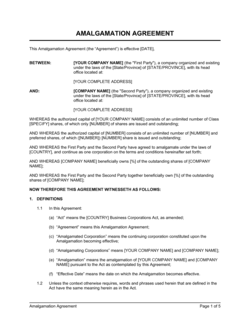
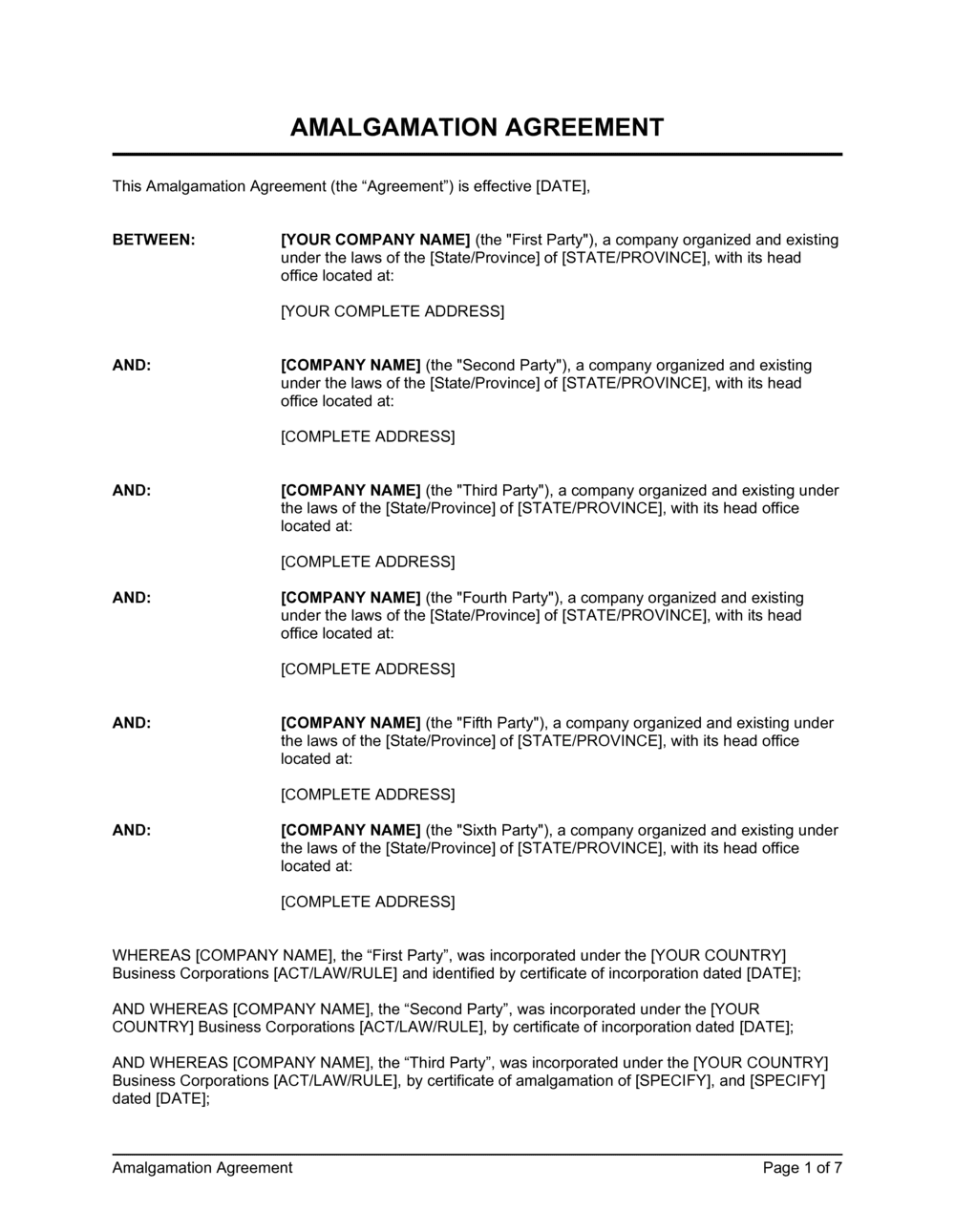
An Amalgamation Agreement is a binding legal contract between two or more corporations that governs how they will combine into a single surviving entity. This free Word download gives you a structured starting point covering share exchange ratios, asset and liability transfer, governance of the amalgamated entity, employee treatment, and closing conditions — ready to edit online and export as PDF for execution.
When you need it
Use it when two or more companies have agreed in principle to merge and need a formal, legally binding document to govern the transaction from signing through the regulatory approval and closing process. It is required before filing amalgamation articles with the relevant corporate registry.
What's inside
Party and entity details, amalgamation structure and effective date, share exchange or cancellation terms, treatment of outstanding options and warrants, transfer of assets and liabilities, governance and officer appointments for the surviving entity, representations and warranties, conditions to closing, regulatory approval obligations, and termination rights.

What is an Amalgamation Agreement?

An Amalgamation Agreement is a binding legal contract between two or more corporations that governs how they will combine into a single surviving legal entity. Upon the effective date, each amalgamating corporation ceases to exist as a separate legal person, and the amalgamated corporation automatically assumes all assets, liabilities, contracts, and legal proceedings of the predecessors by operation of law. The agreement sets out the terms that govern every aspect of this transition — from the share exchange ratio and treatment of outstanding equity instruments to the initial governance structure of the surviving entity and the regulatory approvals required before the transaction can close.

Unlike a share purchase or asset purchase, an amalgamation produces complete structural consolidation: there is no target entity left standing, no separate subsidiary to manage, and no selective carve-out of liabilities. This makes it the preferred mechanism when two related businesses are combining permanently and the parties want a clean, unified corporate structure rather than a holding company with operating subsidiaries underneath.

Why You Need This Document

Without a properly drafted amalgamation agreement, the transaction has no legally enforceable framework — either party can walk away or renegotiate terms at any point before filing, and neither has an obligation to complete. Shareholder approval processes, regulatory filings, and third-party consent requirements all depend on having a signed agreement that specifies exactly what is being approved. Boards cannot pass authorizing resolutions, and registries will not accept articles of amalgamation, without the underlying agreement in place.

The practical consequences of a poorly drafted or missing agreement extend well beyond closing. An amalgamated corporation that inherits undisclosed liabilities, loses key contracts due to overlooked change-of-control clauses, or faces shareholder dissent claims because dissent rights were improperly noticed will spend the first months of its existence in litigation rather than executing its combined business strategy. This template gives both parties a structured, clause-by-clause starting point that surfaces every critical issue — share exchange mechanics, governance deadlocks, longstop dates, and employee obligations — before lawyers are engaged, reducing drafting time and legal cost while ensuring nothing essential is missed.

Which variant fits your situation?

If your situation is…Use this template
Merging two wholly owned subsidiaries into a single entityShort-Form Amalgamation Agreement
Combining two arm's-length private corporations with multiple shareholdersAmalgamation Agreement (Long Form)
Acquiring a target company by absorbing it into the acquirerMerger and Acquisition Agreement
Combining assets without a full corporate mergerAsset Purchase Agreement
Buying shares of a target company rather than merging entitiesShare Purchase Agreement
Restructuring a holding company and its operating subsidiaryCorporate Reorganization Plan
Merging two non-profit corporations into a single registered charityNon-Profit Amalgamation Agreement

Common mistakes to avoid

❌ Using trade names instead of registered legal names

Why it matters: The corporate registry will reject the Articles of Amalgamation if the names in the agreement do not exactly match the registered names, delaying closing by days or weeks.

Fix: Verify the exact registered legal name of each amalgamating corporation from a current corporate profile or certificate of good standing before drafting a single clause.

❌ No longstop date for closing

Why it matters: Without a hard deadline, either party can delay approvals indefinitely — using the uncertainty as leverage to renegotiate terms while both businesses operate in limbo.

Fix: Set a longstop date that reflects the realistic regulatory timeline plus at least 30 days of buffer, and include automatic termination rights if the date passes without closing.

❌ Failing to address dissent rights in the shareholder materials

Why it matters: Shareholders who are not properly informed of their statutory dissent rights can successfully challenge the amalgamation after the fact, exposing the amalgamated corporation to payment of fair value claims plus legal costs.

Fix: Include a dissent rights notice in every shareholder information circular and specify in the agreement how dissenting shareholders will be treated and funded.

❌ Omitting equity-linked instruments from the share exchange clause

Why it matters: Unaddressed stock options, warrants, or convertible notes may have automatic acceleration or anti-dilution rights triggered by the amalgamation, resulting in unplanned cash payments or equity dilution at closing.

Fix: Audit all outstanding equity-linked instruments before drafting and address each one explicitly in the agreement, confirming treatment with both corporations' option plan administrators.

❌ Overlooking change-of-control clauses in material contracts

Why it matters: Key leases, credit facilities, and supplier agreements often require counterparty consent on amalgamation. Closing without those consents puts the amalgamated corporation in immediate breach of material contracts.

Fix: Conduct a contract review at the due diligence stage and list all required consents as closing conditions — then start the consent process at least 6–8 weeks before the target closing date.

❌ Leaving governance of the amalgamated corporation undefined at signing

Why it matters: When the initial board composition and by-laws are left to be negotiated post-closing, parties that were cooperative during the deal frequently deadlock over governance once the transaction is complete.

Fix: Attach fully drafted articles, by-laws, and an initial director and officer schedule to the agreement at signing, and have both boards approve them as part of the closing resolutions.

The 10 key clauses, explained

Parties and recitals

In plain language: Identifies each amalgamating corporation by full legal name, jurisdiction of incorporation, and registered address, and states the commercial purpose of the amalgamation.

Sample language
This Amalgamation Agreement is entered into as of [DATE] between [CORPORATION A LEGAL NAME], a corporation incorporated under the laws of [JURISDICTION] ('Corp A'), and [CORPORATION B LEGAL NAME], a corporation incorporated under the laws of [JURISDICTION] ('Corp B'), collectively the 'Amalgamating Corporations.'

Common mistake: Using a trade name or operating name instead of the full registered legal name. A mismatch between the agreement and the corporate registry record will cause the Articles of Amalgamation filing to be rejected.

Amalgamation structure and effective date

In plain language: Specifies whether the transaction is a long-form or short-form amalgamation, names the amalgamated corporation, and states when the transaction legally takes effect.

Sample language
The Amalgamating Corporations agree to amalgamate pursuant to [APPLICABLE STATUTE] and continue as one corporation under the name '[AMALGAMATED CORPORATION NAME]' effective on the date the Articles of Amalgamation are accepted by [REGISTRY] (the 'Effective Date').

Common mistake: Setting a fixed calendar date as the effective date instead of tying it to registry acceptance. Regulatory delays routinely push filing dates, creating a gap between the contractual effective date and the statutory one.

Share exchange and cancellation

In plain language: States how each class of shares in each amalgamating corporation will be treated — converted at a specified ratio, cancelled for cash, or rolled into the amalgamated corporation on a one-for-one basis.

Sample language
Each issued and outstanding common share of Corp A shall be exchanged for [X] common share(s) of the Amalgamated Corporation. Each issued and outstanding common share of Corp B shall be cancelled without consideration. No fractional shares shall be issued.

Common mistake: Failing to address fractional shares. When the exchange ratio produces fractions, every shareholder affected must receive cash in lieu or the articles will be defective.

Treatment of options, warrants, and convertible instruments

In plain language: Specifies what happens to outstanding stock options, warrants, convertible notes, or other equity-linked instruments of each amalgamating corporation at closing.

Sample language
Each option to acquire a share of Corp A outstanding immediately prior to the Effective Date shall be assumed by the Amalgamated Corporation and converted into an option to acquire [X] common shares of the Amalgamated Corporation on the same terms, with the exercise price adjusted by the exchange ratio.

Common mistake: Leaving options and warrants unaddressed. If the agreement is silent, holders may have contractual anti-dilution rights that entitle them to accelerated vesting or cash settlement, triggering an unplanned cost at closing.

Transfer of assets, liabilities, and contracts

In plain language: Confirms that all assets, debts, obligations, and third-party contracts of each amalgamating corporation transfer to the amalgamated corporation by operation of law on the effective date.

Sample language
On the Effective Date, all property, rights, and assets of each Amalgamating Corporation shall become the property of the Amalgamated Corporation, and all liabilities and obligations of each Amalgamating Corporation shall become liabilities and obligations of the Amalgamated Corporation.

Common mistake: Assuming all contracts transfer automatically without review. Many commercial agreements contain change-of-control or assignment-restriction clauses that technically require counterparty consent on an amalgamation, even though the transfer occurs by statute.

Governance of the amalgamated corporation

In plain language: Sets out the initial board composition, officer appointments, and the form of by-laws and articles that will govern the amalgamated corporation immediately after the effective date.

Sample language
The board of directors of the Amalgamated Corporation shall initially consist of [X] directors, as set out in Schedule [X]. The initial officers shall be [NAME], [TITLE], and [NAME], [TITLE]. The Amalgamated Corporation shall be governed by the by-laws attached hereto as Schedule [X].

Common mistake: Not attaching draft articles and by-laws as schedules at the time of signing. Leaving governance to be agreed post-closing creates deadlock risk, particularly when the predecessor entities had different governance structures.

Representations and warranties

In plain language: Each amalgamating corporation represents that it is duly incorporated, in good standing, has the authority to enter the agreement, and that its financial statements and disclosed liabilities are accurate.

Sample language
Each Amalgamating Corporation represents and warrants to the other that: (a) it is duly incorporated and in good standing under the laws of its jurisdiction; (b) it has full corporate authority to enter into and perform this Agreement; (c) its most recent financial statements fairly present its financial position as at [DATE]; and (d) there is no litigation pending or threatened against it that would materially affect the amalgamation.

Common mistake: Using generic boilerplate representations without tailoring them to disclosed exceptions. Undisclosed liabilities discovered after closing cannot be claimed as breaches if the warranty schedule was not properly prepared.

Conditions to closing

In plain language: Lists the specific events that must occur before either party is obligated to complete the amalgamation — shareholder approval, regulatory clearances, third-party consents, and no material adverse change.

Sample language
The obligations of the parties to complete the amalgamation are conditional upon: (a) approval of the shareholders of each Amalgamating Corporation as required by [STATUTE]; (b) receipt of all required regulatory approvals; (c) no Material Adverse Change having occurred in the business of either Amalgamating Corporation; and (d) receipt of any required third-party consents listed in Schedule [X].

Common mistake: Defining 'Material Adverse Change' too broadly or not defining it at all. Without a precise definition, one party may attempt to walk away on a minor business fluctuation, generating costly litigation.

Employee and benefit plan treatment

In plain language: Confirms that all employment relationships, collective agreements, and benefit plan obligations of the amalgamating corporations are assumed by the amalgamated corporation without interruption.

Sample language
The Amalgamated Corporation shall, on and after the Effective Date, employ all employees of the Amalgamating Corporations on terms and conditions no less favorable than those in effect immediately prior to the Effective Date and shall assume all obligations under each employee benefit plan listed in Schedule [X].

Common mistake: Failing to list all benefit plans and collective agreements in a schedule. If a plan is not explicitly named, its assumption by the amalgamated corporation may be disputed, creating employment law liability.

Termination and abandonment

In plain language: States the conditions under which either party may terminate the agreement before closing — including a longstop date, failure to obtain approvals, or a material breach — and the consequences of termination.

Sample language
Either party may terminate this Agreement by written notice if: (a) the Effective Date has not occurred on or before [LONGSTOP DATE]; (b) any condition precedent becomes impossible to satisfy; or (c) the other party has materially breached this Agreement and has not cured such breach within [30] days of written notice. Termination shall not affect any accrued rights or obligations.

Common mistake: No longstop date. Without a hard deadline, either party can delay indefinitely — creating leverage to renegotiate terms and leaving both businesses in a state of strategic uncertainty for months.

How to fill it out

  1. 1

    Confirm the legal names and jurisdictions of all amalgamating corporations

    Pull the exact registered legal name and jurisdiction of incorporation for each corporation from the relevant corporate registry. These must match the names used in the Articles of Amalgamation filing precisely.

    💡 Order a current certificate of good standing or corporate profile for each entity before drafting — it confirms the registered name and flags any outstanding filing deficiencies that could block the amalgamation.

  2. 2

    Choose the amalgamation structure and name the surviving entity

    Determine whether this is a long-form amalgamation (requiring shareholder votes) or a short-form (parent-subsidiary) amalgamation. Confirm the name of the amalgamated corporation, checking name availability with the registry if a new name is being adopted.

    💡 Name searches can take 1–5 business days in many jurisdictions — run the search before finalizing the agreement, not after signing.

  3. 3

    Calculate and document the share exchange ratio

    Work with a valuator or the parties' accountants to determine the relative fair value of each corporation. Express the exchange ratio as a simple fraction or multiplier per share class and document the valuation basis in a schedule.

    💡 If both corporations are wholly owned by the same parent, the share exchange is typically one-for-one or the subsidiary's shares are cancelled — confirm the tax-neutral treatment with your accountant before committing to the ratio.

  4. 4

    Address all outstanding options, warrants, and convertible instruments

    List every equity-linked instrument outstanding for each amalgamating corporation in a schedule. For each, specify whether it is assumed and converted, accelerated and cashed out, or terminated at closing.

    💡 Review each option plan's change-of-control provisions before drafting this clause — many plans have automatic acceleration on amalgamation that changes the economics of the transaction.

  5. 5

    Identify contracts requiring third-party consent

    Review all material commercial agreements — leases, key supplier contracts, credit facilities, and software licenses — for change-of-control or anti-assignment clauses. List consents required in the conditions-to-closing schedule.

    💡 Lenders almost always require consent or refinancing on amalgamation. Contact your bank early — credit facility consent processes can take 4–8 weeks.

  6. 6

    Set initial governance, board composition, and officer appointments

    Draft the initial articles and by-laws for the amalgamated corporation and attach them as a schedule. Specify the number of directors, initial appointees, and officers by name and title.

    💡 If the two predecessor entities had different fiscal year ends, confirm which fiscal year the amalgamated corporation will adopt — this affects the first tax return filing and financial reporting deadlines.

  7. 7

    Define conditions to closing and the longstop date

    List every approval and consent required before closing, including shareholder resolutions, regulatory clearances, and third-party consents. Set a longstop date that gives 30–60 days of buffer beyond the expected regulatory approval timeline.

    💡 Competition Act pre-merger notification thresholds — $500M transaction size in Canada, Hart-Scott-Rodino thresholds in the US — trigger mandatory waiting periods that must be built into the longstop date.

  8. 8

    Execute before filing articles and obtain board and shareholder approvals

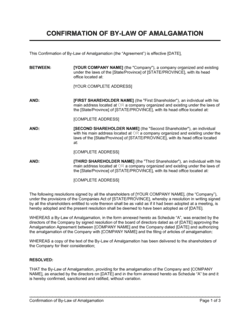
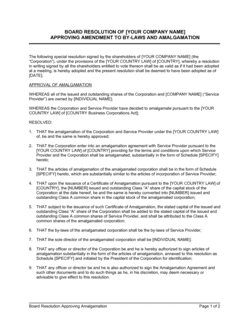
    Both corporations must pass board resolutions authorizing execution before signing. Shareholder approval resolutions (typically special resolutions at two-thirds majority under most statutes) must be obtained before the Articles of Amalgamation are filed.

    💡 Send the agreement to each corporation's shareholders with a notice of meeting and an information circular summarizing the key terms — directors have a fiduciary duty to give shareholders sufficient information to vote on the transaction.

Frequently asked questions

What is an amalgamation agreement?

An amalgamation agreement is a binding legal contract between two or more corporations that governs how they will combine into a single surviving entity. It sets out the share exchange ratio, transfer of assets and liabilities, governance of the resulting corporation, and the conditions that must be met before the transaction can close. It is typically required by corporate statute before articles of amalgamation can be filed with the relevant registry.

What is the difference between an amalgamation and a merger?

In most Canadian and Commonwealth jurisdictions, 'amalgamation' is the specific statutory term for the combination of two corporations into one under corporate law — both predecessors cease to exist and a new entity continues. In the United States, 'merger' is the more common statutory term, and the mechanics vary by state. Both achieve a similar commercial outcome — a single surviving entity — but the documentation and filing requirements differ by jurisdiction.

What is the difference between an amalgamation agreement and a share purchase agreement?

A share purchase agreement transfers ownership of a corporation by selling its shares to a buyer — the target company continues to exist as a separate legal entity after closing. An amalgamation agreement merges two corporations into a single entity, eliminating the predecessor corporations entirely. Share purchases are faster and simpler for straightforward acquisitions; amalgamations are used when the parties want a unified corporate structure and a clean consolidation of assets and liabilities.

Is an amalgamation agreement required by law?

In most jurisdictions with a formal corporate statute — including the Canada Business Corporations Act, Ontario's Business Corporations Act, and equivalent provincial and state statutes — a written amalgamation agreement is a statutory requirement for a long-form amalgamation. Short-form amalgamations between a parent and its wholly owned subsidiaries typically require board resolutions rather than a full agreement, but the specific requirements vary by jurisdiction.

What approvals are required before an amalgamation can close?

Typically: a special resolution approved by at least two-thirds of the shareholders of each amalgamating corporation, board resolutions from each entity, and any required regulatory approvals — including competition authority pre-merger notification if the transaction meets the relevant size thresholds. Depending on the industry, sector-specific approvals from financial regulators, securities commissions, or licensing bodies may also be required.

What happens to employees when two companies amalgamate?

In most jurisdictions, the amalgamated corporation assumes all employment relationships of the predecessor corporations by operation of law. Employees generally continue on the same terms and conditions. The amalgamation itself does not constitute a termination of employment. However, if the business restructures after closing and eliminates roles, standard statutory and common-law notice requirements apply to any resulting terminations.

Do I need a lawyer to complete an amalgamation agreement?

Yes, for virtually any amalgamation. The document triggers statutory processes, shareholder rights, regulatory filings, and successor liability — all of which have jurisdiction-specific requirements that a generic template cannot fully address. A template is a useful starting point for understanding the structure and prompting the right questions, but legal counsel should review and tailor the agreement before execution and manage the articles filing.

What is a short-form amalgamation?

A short-form amalgamation is a simplified statutory process available when a parent corporation amalgamates with one or more of its wholly owned subsidiaries. Because there are no minority shareholders to protect, most statutes permit the transaction to be approved by the board of directors alone — no shareholder vote or amalgamation agreement is required. A directors' resolution and the filing of articles of amalgamation are typically sufficient.

What are dissent rights and how do they affect an amalgamation?

Dissent rights are a statutory protection giving minority shareholders who object to an amalgamation the right to demand payment of fair value for their shares instead of accepting the share exchange ratio. The corporation must fund any dissent payouts from its own resources, which can affect the amalgamated corporation's opening cash position. Proper notice of dissent rights must be given to shareholders in the information circular — failure to do so can invalidate the shareholder vote.

How this compares to alternatives

vs Share Purchase Agreement

A share purchase agreement transfers ownership of a corporation by buying its shares — the target entity survives as a distinct legal person. An amalgamation eliminates both predecessor entities and creates a single new or continuing corporation. Share purchases are simpler for straightforward acquisitions; amalgamations are used when the parties want a fully unified corporate and balance-sheet structure.

vs Asset Purchase Agreement

An asset purchase agreement transfers specified assets and liabilities from a seller to a buyer — unwanted liabilities can be excluded. An amalgamation transfers everything by operation of law, including all known and unknown liabilities. Asset purchases give buyers more control over what they assume; amalgamations are cleaner for combining related entities with no legacy liability concerns.

vs Merger and Acquisition Agreement

A merger and acquisition agreement is a broad commercial term covering share deals, asset deals, and statutory mergers. An amalgamation agreement is the specific statutory instrument used when two corporations combine under corporate law. The M&A agreement sets the commercial terms; the amalgamation agreement implements the statutory process required to effect the combination.

vs Joint Venture Agreement

A joint venture agreement creates a new co-owned entity or contractual arrangement for a specific project while both founding corporations remain independent. An amalgamation permanently combines the founding corporations into a single entity with no exit path short of dissolution. Use a joint venture when the parties want to collaborate but maintain separate legal identities; use an amalgamation when the goal is full and permanent consolidation.

Industry-specific considerations

Technology / SaaS

IP ownership consolidation across entities, assumption of SaaS subscription contracts with change-of-control review, and treatment of employee stock option plans across predecessor entities.

Professional Services

Partner or shareholder governance post-amalgamation, assumption of client engagement letters with professional liability carryover, and regulatory registration transfers for licensed professionals.

Financial Services

OSFI, FCA, or SEC regulatory approval requirements, assumption of client account agreements, and capital adequacy obligations of the amalgamated entity under applicable financial institution statutes.

Manufacturing

Transfer of environmental permits and operating licenses, assumption of collective agreements and defined benefit pension obligations, and consolidation of supplier and distribution contracts.

Jurisdictional notes

United States

In the US, the equivalent process is called a 'statutory merger' and is governed by each state's business corporation act — Delaware, New York, and California each have distinct requirements. Hart-Scott-Rodino pre-merger notification is required when transaction size exceeds approximately $119M (threshold adjusted annually). Some states require an appraisal remedy (equivalent to dissent rights) for objecting shareholders. Federal tax treatment depends on whether the transaction qualifies as a tax-free reorganization under IRC Section 368.

Canada

Amalgamation is explicitly governed by the Canada Business Corporations Act (CBCA) at the federal level and by provincial statutes such as Ontario's Business Corporations Act and the Business Corporations Act (British Columbia). A special resolution passed by at least two-thirds of shareholders in each class is required. Competition Act pre-merger notification thresholds apply when combined assets or revenue exceed $400M (2024 threshold). Quebec-incorporated entities must comply with the Business Corporations Act (Quebec) and French-language disclosure requirements.

United Kingdom

The UK equivalent is a 'merger' under the Companies Act 2006, implemented through a court-approved scheme of arrangement or a statutory merger procedure under Part 27 of the Act. The Competition and Markets Authority (CMA) reviews mergers where the combined UK turnover exceeds £70M or the merger creates or enhances a 25% share of supply. Post-Brexit, EU merger regulation no longer applies to UK transactions. Cross-border mergers with EU entities require separate filings in each relevant EU member state.

European Union

EU-level merger control applies under the EU Merger Regulation when combined worldwide turnover exceeds €5B and EU-wide turnover of each of at least two parties exceeds €250M (or lower alternative thresholds apply). Member state corporate law governs the domestic amalgamation mechanics — Germany's Umwandlungsgesetz, France's Code de commerce, and similar statutes each have distinct procedural requirements. The EU Cross-Border Mergers Directive provides a harmonized framework for mergers between companies incorporated in different EU member states.

Template vs lawyer — what fits your deal?

PathBest forCostTime
Use the templateUnderstanding the structure of an amalgamation agreement and preparing initial drafts for lawyer reviewFree2–4 hours to complete initial draft
Template + legal reviewShort-form parent-subsidiary amalgamations or simple two-party private company amalgamations with aligned shareholders$1,500–$5,000 for legal review and articles preparation2–4 weeks
Custom draftedArm's-length amalgamations with minority shareholders, regulated industries, cross-border entities, or competition review thresholds$5,000–$25,000+ depending on complexity and jurisdiction6–16 weeks including regulatory approvals

Glossary

Amalgamation
A statutory process by which two or more corporations combine to form a single new or surviving corporation, with the predecessor entities ceasing to exist as separate legal persons.
Amalgamating Corporations
The two or more existing legal entities that are parties to the amalgamation and will cease to exist as separate corporations upon the effective date.
Amalgamated Corporation
The single surviving entity that results from the amalgamation, holding all assets, liabilities, rights, and obligations of the predecessor corporations.
Share Exchange Ratio
The formula specifying how many shares of the amalgamated corporation each shareholder receives in exchange for each share held in an amalgamating corporation.
Effective Date
The date on which the amalgamation legally takes effect, typically the date the amalgamation articles are filed with and accepted by the relevant corporate registry.
Articles of Amalgamation
The statutory filing submitted to the relevant corporate registry after the agreement is executed and approvals are obtained, which formally creates the amalgamated corporation.
Dissent Rights
A shareholder's statutory right to object to the amalgamation and demand payment of fair value for their shares rather than accepting the share exchange ratio.
Successor Liability
The principle that the amalgamated corporation automatically assumes all obligations, debts, and legal proceedings of each amalgamating corporation by operation of law.
Condition Precedent
A contractual requirement that must be satisfied or waived before either party is obligated to complete the closing of the amalgamation.
Representation and Warranty
A factual statement made by each amalgamating corporation about its legal status, financial condition, and operations, the breach of which gives the other party a right to terminate or claim damages.
Regulatory Approval
Clearance from a government authority — such as a competition bureau or securities regulator — required before the amalgamation may legally proceed.
Vertical Amalgamation
A short-form amalgamation between a parent corporation and one or more of its wholly owned subsidiaries, typically requiring less documentation and no independent shareholder vote.

Part of your Business Operating System

This document is one of 3,000+ business & legal templates included in Business in a Box.

  • Fill-in-the-blanks — ready in minutes
  • 100% customizable Word document
  • Compatible with all office suites
  • Export to PDF and share electronically

Create your document in 3 simple steps.

From template to signed document — all inside one Business Operating System.
1
Download or open template

Access over 3,000+ business and legal templates for any business task, project or initiative.

2
Edit and fill in the blanks with AI

Customize your ready-made business document template and save it in the cloud.

3
Save, Share, Send, Sign

Share your files and folders with your team. Create a space of seamless collaboration.

Save time, save money, and create top-quality documents.

★★★★★

"Fantastic value! I'm not sure how I'd do without it. It's worth its weight in gold and paid back for itself many times."

Managing Director · Mall Farm
Robert Whalley
Managing Director, Mall Farm Proprietary Limited
★★★★★

"I have been using Business in a Box for years. It has been the most useful source of templates I have encountered. I recommend it to anyone."

Business Owner · 4+ years
Dr Michael John Freestone
Business Owner
★★★★★

"It has been a life saver so many times I have lost count. Business in a Box has saved me so much time and as you know, time is money."

Owner · Upstate Web
David G. Moore Jr.
Owner, Upstate Web

Run your business with a system — not scattered tools

Stop downloading documents. Start operating with clarity. Business in a Box gives you the Business Operating System used by over 250,000 companies worldwide to structure, run, and grow their business.

Start free · No credit card required