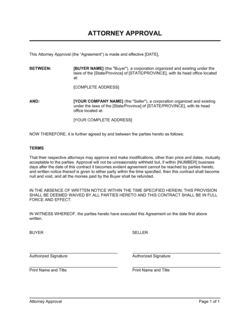
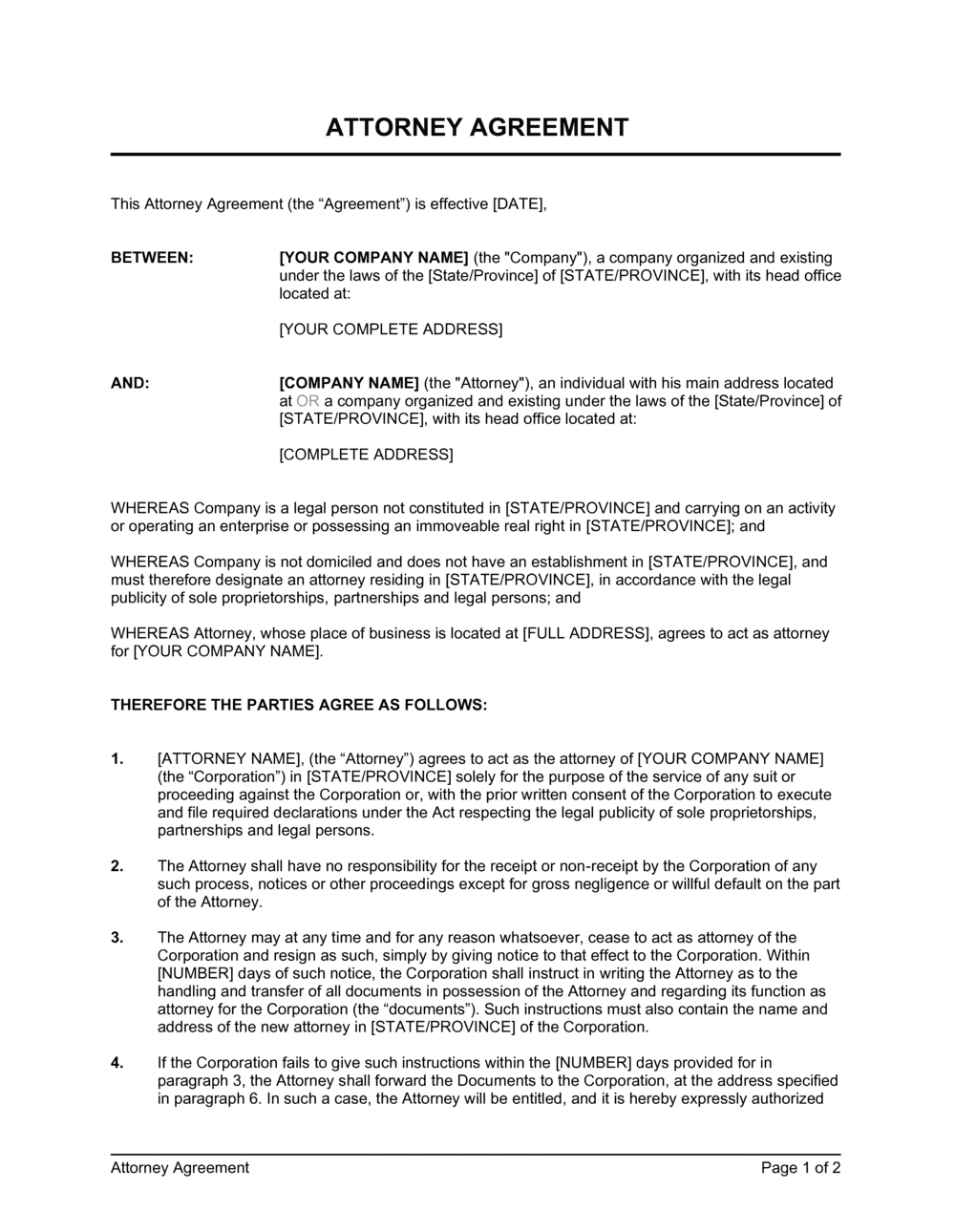
Attorney Agreement Template

Free Word download • Edit online • Save & share with Drive • Export to PDF

2 pages25–30 min to fillDifficulty: StandardSignature requiredLegal review recommended
Learn more ↓
FreeAttorney Agreement Template

At a glance

What it is
An Attorney Agreement is a binding contract between a client and a licensed attorney or law firm that defines the scope of legal representation, fee structure, billing practices, and the obligations of both parties. This template is a free Word download you can edit online and export as PDF — covering retainer terms, hourly or flat-fee arrangements, confidentiality, conflict-of-interest disclosures, and termination rights in a single document.
When you need it
Use it whenever you engage outside legal counsel for business matters — including litigation, contract review, regulatory filings, M&A transactions, or ongoing general counsel services — before the attorney begins any billable work.
What's inside
Identification of the parties and matter, scope of legal services, fee structure and retainer amount, billing and payment terms, file and records handling, confidentiality obligations, conflict-of-interest disclosures, termination rights, and governing bar rules reference.

What is an Attorney Agreement?

An Attorney Agreement is a binding contract between a client and a licensed attorney or law firm that formally establishes the terms of legal representation before any substantive work begins. It defines the specific matter or matters covered, the fee structure and retainer terms, billing and payment obligations, confidentiality and privilege protections, conflict-of-interest disclosure procedures, and the rights of both parties to terminate the relationship. Unlike an informal handshake or a verbal understanding, a written attorney agreement creates enforceable obligations on both sides and ensures that the engagement is governed by clearly agreed terms rather than contested recollections or jurisdiction-specific defaults.

Why You Need This Document

Without a signed attorney agreement, fee disputes are resolved by what each party remembers saying rather than what was written down — and courts frequently find in favor of the client when terms are ambiguous. A client without a written agreement has no documented basis to challenge billing rates, dispute block-billed invoices, or enforce a file-return obligation when switching counsel mid-matter. For the attorney, an unsigned engagement exposes the firm to fee collection problems, scope disputes, and potential bar discipline for failing to document the basis for fees. Executing a clear attorney agreement before work begins protects both sides: the client knows exactly what they are paying for and retains the right to detailed invoices, while the attorney has a documented fee arrangement to enforce if payment is withheld. This template gives both parties a professionally structured starting point that is consistent with bar rules requirements across major jurisdictions.

Which variant fits your situation?

If your situation is…Use this template
Engaging a lawyer for a single defined matter at a flat feeAttorney Flat Fee Agreement
Retaining ongoing general counsel on a monthly basisGeneral Counsel Retainer Agreement
Hiring a lawyer on contingency for a personal injury or commercial claimContingency Fee Agreement
Engaging outside counsel for M&A due diligence or transaction workAttorney Agreement (Transactional)
Retaining a law firm for ongoing employment law adviceEmployment Legal Services Agreement
Engaging a solo practitioner for a short-term litigation matterAttorney Engagement Letter
Contracting with a consultant who is also a licensed attorneyIndependent Contractor Agreement

Common mistakes to avoid

❌ Open-ended scope of representation

Why it matters: Without defined scope boundaries, billing disputes are almost inevitable — and the attorney may claim entitlement to fees for work the client believed was outside the engagement.

Fix: Define the matter with specifics: case name, transaction name, or discrete project. List adjacent services that are explicitly excluded and require a written amendment to add.

❌ Confusing a retainer with a flat fee

Why it matters: A retainer is a deposit held in trust and applied against earned fees — unused amounts must be returned. Treating it as a non-refundable flat fee violates bar rules in most US states, Canadian provinces, and the UK.

Fix: State explicitly whether the retainer is refundable and confirm it will be held in an IOLTA or client trust account until fees are earned.

❌ Accepting block billing without an itemization requirement

Why it matters: Block billing — where multiple tasks are bundled into a single time entry — makes it impossible to verify whether individual charges are reasonable or to dispute specific entries.

Fix: Require that each invoice entry identify the date, timekeeper, a specific task description, and time recorded in tenths of an hour. Include a right to request supporting records.

❌ No termination notice period or withdrawal-for-cause definition

Why it matters: Without a defined notice period and cause standard, an attorney can withdraw mid-litigation with minimal notice, leaving the client scrambling to find replacement counsel before a deadline.

Fix: Set a minimum notice period — 10 business days is common — and enumerate specific grounds for attorney withdrawal, consistent with the applicable rules of professional conduct.

❌ Omitting a post-termination confidentiality clause

Why it matters: A confidentiality obligation that expires with the engagement leaves sensitive business information unprotected the moment the attorney-client relationship ends.

Fix: Include explicit language that the duty of confidentiality survives termination of the agreement indefinitely and is governed by the applicable rules of professional conduct.

❌ Governing law jurisdiction differs from the attorney's licensed jurisdiction

Why it matters: A contract governed by New York law signed by a California-licensed attorney creates a conflict between contractual rights and the California bar rules that actually bind the attorney's professional conduct.

Fix: Set governing law to match the jurisdiction where the attorney is licensed and where the representation will primarily occur. Add a bar rules supremacy clause for conflicts.

The 10 key clauses, explained

Parties and matter identification

In plain language: Names the client and the attorney or law firm, and defines the specific legal matter or project for which the attorney is being engaged.

Sample language
This Attorney Agreement ('Agreement') is entered into as of [DATE] between [CLIENT FULL LEGAL NAME] ('Client') and [ATTORNEY / FIRM NAME], a licensed attorney / law firm in [STATE / JURISDICTION] ('Attorney'). Attorney is engaged to represent Client in connection with [DESCRIPTION OF MATTER].

Common mistake: Identifying only the individual attorney when the engagement is with the firm as a whole — if that attorney leaves, the firm's obligation to continue representation becomes ambiguous.

Scope of legal services

In plain language: Defines precisely what legal work the attorney will and will not perform, preventing scope creep and billing disputes.

Sample language
Attorney shall provide legal services limited to: [SPECIFIC SERVICES, e.g., drafting and negotiating the Asset Purchase Agreement, conducting due diligence on Schedules A–D, and advising on closing conditions]. Attorney is not engaged to provide advice on tax, regulatory, or employment matters unless separately agreed in writing.

Common mistake: Leaving the scope open-ended with language like 'general legal advice.' An undefined scope exposes the client to unlimited billing and the attorney to unlimited liability.

Fee structure and billing rate

In plain language: States whether fees are hourly, flat, contingency, or blended, and specifies the applicable rates for each attorney and staff level.

Sample language
Client shall pay Attorney at the following hourly rates: Partner — $[X]/hr; Associate — $[X]/hr; Paralegal — $[X]/hr. Rates are subject to adjustment upon [30] days' written notice. Alternatively, the flat fee for [DEFINED MATTER] is $[X], payable as set out in Section [X].

Common mistake: Listing only the lead attorney's rate while omitting associate and paralegal rates — clients routinely receive invoices at rates they never agreed to.

Retainer and trust account terms

In plain language: Sets the upfront retainer amount, explains how it is held in a client trust account, and describes the replenishment obligation when the retainer falls below a threshold.

Sample language
Client shall pay an initial retainer of $[AMOUNT] upon execution, to be held in Attorney's IOLTA trust account. Retainer funds will be applied against earned fees and disbursements. When the retainer balance falls below $[MINIMUM], Client shall replenish it to $[AMOUNT] within [10] business days of written notice.

Common mistake: Treating the retainer as a flat fee rather than a deposit. Confusing the two leads to disputes over unused funds and violates bar rules in most jurisdictions.

Billing, invoices, and payment terms

In plain language: Describes how often the attorney invoices, the payment deadline, the detail required on statements, and the consequence of late payment.

Sample language
Attorney shall invoice Client monthly. Invoices are due within [30] days of the invoice date. Invoices shall itemize services by date, timekeeper, task description, and time increment. Balances unpaid after [30] days accrue interest at [1.5]% per month. Attorney may suspend services on [10] days' notice if any invoice remains unpaid.

Common mistake: No itemization requirement on invoices. Block billing — 'Legal services rendered: 12 hrs @ $400' — makes it impossible to verify work performed or challenge specific entries.

Confidentiality and attorney-client privilege

In plain language: Affirms the attorney's duty to maintain client confidences and the existence of attorney-client privilege over communications related to the representation.

Sample language
All communications between Client and Attorney relating to this representation are protected by attorney-client privilege and the duty of confidentiality under [APPLICABLE RULES OF PROFESSIONAL CONDUCT]. Attorney shall not disclose Client's confidential information to any third party without Client's prior written consent, except as required by law or court order.

Common mistake: Omitting a clause that survives termination. Confidentiality obligations must expressly extend beyond the end of the engagement — otherwise enforceability is uncertain.

Conflict-of-interest disclosure

In plain language: Requires the attorney to disclose any known conflicts of interest before or during representation, and states the procedure for obtaining informed written consent if a waivable conflict exists.

Sample language
Attorney represents that, as of the date of this Agreement, Attorney has no known conflict of interest that would preclude representation. Should a conflict arise during the engagement, Attorney shall promptly notify Client in writing. Any conflict requiring waiver must be consented to in writing by Client before representation continues.

Common mistake: Including a blanket advance conflict waiver without adequately explaining the nature of potential future conflicts — courts and bar authorities scrutinize overbroad advance waivers.

File retention and ownership

In plain language: Clarifies who owns the client file, how long the attorney will retain records, and the procedure for returning files upon request or disengagement.

Sample language
The Client's file, including all documents Client provided to Attorney, is the property of Client. Attorney shall retain a copy of the file for [7] years following the conclusion of the matter. Upon written request or upon termination of this Agreement, Attorney shall promptly return Client's original documents and, if requested, a copy of Attorney's work product.

Common mistake: No file return provision. Without one, clients face delays recovering critical documents — especially during disputes with former counsel.

Termination and disengagement

In plain language: States the conditions under which either party may end the representation, the required notice period, and the attorney's obligations upon termination — including file transfer and cooperation with successor counsel.

Sample language
Either party may terminate this Agreement upon [10] days' written notice. Client may terminate at any time for any reason. Attorney may withdraw for cause — including non-payment, misrepresentation, or Client's insistence on a course of action Attorney reasonably believes is unlawful — subject to applicable bar rules. Upon termination, Client remains responsible for fees and disbursements incurred through the termination date.

Common mistake: No withdrawal-for-cause definition. Without it, mid-matter withdrawal by the attorney leaves the client with no notice standard and no basis to challenge it.

Governing law and bar rules compliance

In plain language: Specifies the jurisdiction whose law governs the agreement and affirms that the attorney's obligations are subject to the applicable rules of professional conduct.

Sample language
This Agreement is governed by the laws of [STATE / PROVINCE / COUNTRY]. All professional obligations of Attorney are subject to the [STATE BAR / LAW SOCIETY] Rules of Professional Conduct. In the event of any conflict between this Agreement and those rules, the rules of professional conduct shall govern.

Common mistake: Choosing a governing law that differs from the jurisdiction where the attorney is licensed — creating a conflict between the contractual terms and the bar rules the attorney is actually bound by.

How to fill it out

  1. 1

    Identify both parties with precision

    Enter the client's full legal name — using the registered entity name if the client is a business — and the attorney's or law firm's full legal name and bar jurisdiction. Do not use trade names or abbreviations.

    💡 Confirm the attorney's bar number and verify active standing in the relevant jurisdiction before signing — most state and provincial bar websites offer a public lookup.

  2. 2

    Define the scope of representation narrowly

    Write a specific description of the legal matter: the transaction, dispute, or project the attorney is handling. Explicitly list exclusions — such as tax advice or regulatory filings — if those are out of scope.

    💡 If the engagement will expand over time, add a mechanism for written scope amendments rather than leaving the scope open-ended from the start.

  3. 3

    Complete the fee structure section

    Enter the hourly rates for each timekeeper level (partner, associate, paralegal), or specify the flat fee and what it covers. For contingency arrangements, state the percentage and the calculation basis — gross recovery or net after expenses.

    💡 Ask for a written estimate of the total expected fees before signing. Estimates are not caps, but they create a reasonable benchmark for budget conversations.

  4. 4

    Set the retainer amount and replenishment threshold

    Enter the initial retainer amount, confirm it will be held in a segregated trust account, and specify the minimum balance that triggers a replenishment notice.

    💡 Request the attorney's IOLTA account information in writing. Sending a retainer payment to a general operating account instead of a trust account is a bar rules violation in most jurisdictions.

  5. 5

    Configure billing and invoice terms

    Set the billing cycle (monthly is standard), the payment due date (Net 15 or Net 30), and the late-fee rate. Require itemized invoices with date, timekeeper, task description, and time in tenths of an hour.

    💡 Negotiate a right to audit billing records for any matter expected to exceed $25,000 in total fees — this is standard in sophisticated corporate engagements and most firms will agree.

  6. 6

    Confirm the conflict-of-interest disclosure

    Have the attorney confirm in writing that no known conflicts exist as of the signing date, and include the procedure for disclosing and resolving conflicts that arise mid-engagement.

    💡 For complex transactions involving multiple parties, ask for an organizational conflict check — not just an individual attorney check — across the entire firm.

  7. 7

    Complete the termination and file return provisions

    Set the notice period for termination by either party, define the grounds for attorney withdrawal, and confirm that the client's original documents will be returned promptly upon request.

    💡 Include a cooperation clause requiring the attorney to assist successor counsel with file transfer and transition — without it, hand-offs routinely take weeks longer than necessary.

  8. 8

    Execute before any billable work begins

    Both parties should sign the agreement before the attorney conducts any billable work, holds any client funds, or provides substantive legal advice. Backdating creates enforceability risk and bar-rules exposure.

    💡 Use a witnessed or countersigned execution process for high-value engagements. For corporate clients, ensure the signatory has authority to bind the entity.

Frequently asked questions

What is an attorney agreement?

An attorney agreement is a binding contract between a client and a licensed attorney or law firm that sets out the terms of legal representation before any substantive work begins. It defines the scope of the matter, the fee structure, billing and payment terms, retainer handling, confidentiality obligations, and the conditions under which either party can end the relationship. Most bar associations require or strongly recommend a written engagement agreement for any matter expected to involve fees above a nominal threshold.

Is an attorney agreement legally required?

Requirements vary by jurisdiction. In California, a written fee agreement is required for most matters where fees will exceed $1,000. In many other US states and Canadian provinces, written agreements are not strictly mandatory but are required by bar rules when the arrangement involves a contingency fee or a non-refundable retainer. In the UK, solicitors are required to provide written terms of engagement under the SRA Code of Conduct. Even where not legally mandated, a written agreement is strongly recommended to prevent billing disputes and define the scope of representation.

What is the difference between an attorney agreement and an engagement letter?

The two terms are often used interchangeably. An engagement letter is typically a shorter, less formal document — sometimes a letter format rather than a contract format — that confirms scope and fee terms at the start of a matter. An attorney agreement tends to be more comprehensive, covering conflict-of-interest procedures, file retention, termination rights, and governing law in full contractual detail. Both create binding obligations when signed by both parties.

What fee structures can an attorney agreement cover?

Attorney agreements can cover hourly billing at tiered rates by timekeeper level, flat fees for defined matters such as incorporations or contract drafting, contingency fees expressed as a percentage of recovery, blended rates that average across all timekeepers, and retainer-based arrangements for ongoing general counsel services. The agreement should specify the structure clearly, including any caps, estimates, or conditions under which the structure may change.

What is an IOLTA trust account and why does it matter?

An IOLTA (Interest on Lawyer Trust Accounts) account is a segregated bank account where attorneys hold client funds — including retainers — until those funds are earned. Commingling client funds with the attorney's operating account is a disciplinary violation in every US state, Canadian province, and the UK. When signing an attorney agreement, confirm in writing that your retainer will be deposited into a designated trust account, not a general business account.

Can I terminate an attorney agreement before the matter is complete?

Yes. Clients generally have an absolute right to terminate legal representation at any time, for any reason. The client remains responsible for fees and disbursements incurred up to the termination date. The attorney must return the client's original documents and cooperate with the transition to successor counsel. Attorneys can also withdraw for cause — such as non-payment, misrepresentation, or a client's insistence on an unlawful course of action — subject to bar rules and any court approval required in active litigation.

What should I look for in the billing section of an attorney agreement?

Look for a clear billing cycle (monthly is standard), a specific payment due date (Net 15 or Net 30), an itemization requirement for each invoice entry (date, timekeeper, task, and time in tenths of an hour), the late-fee rate, and the attorney's right to suspend services for non-payment with adequate notice. Reject block billing provisions — or ensure the agreement prohibits them — and consider negotiating a right to audit billing records for engagements expected to exceed $25,000.

How do conflict-of-interest rules affect an attorney agreement?

Attorneys are prohibited from representing clients whose interests conflict with another current or former client's interests without disclosure and, in most cases, written consent. A well-drafted attorney agreement requires the attorney to disclose all known conflicts before signing, establish a procedure for mid-engagement conflicts, and obtain informed written consent before continuing if a waivable conflict is identified. Advance conflict waivers — blanket consent to future conflicts — are scrutinized carefully by bar authorities and should be narrow in scope.

Does an attorney agreement protect attorney-client privilege?

Attorney-client privilege exists as a matter of law independent of any written agreement — it attaches automatically to confidential communications made for the purpose of seeking legal advice. However, a written agreement reinforces the privilege by clearly establishing the attorney-client relationship and confirming the confidential nature of communications. Including an explicit confidentiality and privilege clause also creates a contractual basis for enforcing the obligation, separate from the bar rules duty of confidentiality.

Do I need a separate agreement for each matter I hire an attorney to handle?

Yes, in most cases. Each distinct legal matter — a contract dispute, a regulatory filing, a property transaction — should be covered by its own scope definition, either in a separate agreement or in a written amendment to an existing general retainer agreement. A single open-ended agreement without matter-specific scope creates confusion about which work is included, makes billing oversight difficult, and may not satisfy the bar rules requirement for a written fee agreement in jurisdictions that mandate one.

How this compares to alternatives

vs Independent Contractor Agreement

An independent contractor agreement engages a self-employed professional for project-based work with no employment entitlements. An attorney agreement is a specialized engagement contract governed by bar rules and professional conduct obligations that go beyond standard contractor terms — including trust account requirements, conflict-of-interest disclosure, and mandatory file return obligations. Use an attorney agreement whenever the person you are engaging is providing legal advice, not just general consulting.

vs Consulting Agreement

A consulting agreement covers the engagement of a subject-matter expert for advice or project delivery without professional licensing obligations. An attorney agreement is required specifically for legal representation — it triggers attorney-client privilege, bar rules compliance, and duties that no consulting agreement can replicate. Even if the consultant holds a law license, providing legal advice requires an attorney agreement to establish privilege and professional obligations.

vs Non-Disclosure Agreement

An NDA protects confidential information shared between parties in a business context. Attorney-client confidentiality is a separate legal doctrine with broader and stronger protection than a contractual NDA — it applies automatically by law and cannot be waived unilaterally. An attorney agreement supplements this protection with a contractual confidentiality clause, but the underlying privilege is independent of any NDA between the parties.

vs Service Agreement

A general service agreement covers the delivery of professional or commercial services with defined deliverables, timelines, and fees. It is appropriate for most vendor engagements but lacks the bar-rules compliance provisions, trust account terms, conflict-of-interest procedures, and privilege protections that an attorney agreement must include. Using a generic service agreement for legal representation creates unresolved gaps in fee handling, confidentiality, and termination that bar rules would otherwise govern.

Industry-specific considerations

Technology / SaaS

IP assignment review, software licensing agreements, privacy compliance counsel, and funding round documentation require clearly scoped attorney agreements to manage outside counsel costs across multiple concurrent matters.

Real Estate

Transaction-specific attorney agreements covering title review, contract negotiation, and closing are standard; flat-fee or matter-specific hourly structures are typical for defined transaction work.

Financial Services

Regulatory compliance counsel, SEC or FINRA matter defense, and M&A due diligence require attorney agreements with enhanced conflict-of-interest checks and strict billing controls given the high hourly rates involved.

Healthcare

HIPAA compliance advice, medical malpractice defense, and licensing matters demand attorney agreements that extend confidentiality obligations to protected health information and specify bar-compliant patient data handling.

Manufacturing

Product liability defense, supply chain contract disputes, and environmental regulatory matters typically involve litigation-focused attorney agreements with defined retainer replenishment schedules.

Professional Services

General counsel retainer arrangements covering employment, contracts, and client disputes are common; professional services firms often negotiate blended monthly rates rather than per-matter hourly billing.

Jurisdictional notes

United States

Fee agreement requirements vary by state. California Business & Professions Code §6148 requires a written fee agreement for most matters where fees will exceed $1,000, and contingency fee agreements must comply with §6147. All states require contingency fee agreements to be in writing. Retainer funds must be held in an IOLTA trust account, and commingling with operating funds is a disciplinary offense in every jurisdiction. Non-compete provisions in attorney agreements are generally unenforceable under ABA Model Rule 5.6.

Canada

Law societies in each province regulate attorney engagements. The Law Society of Ontario's Rules of Professional Conduct require lawyers to confirm the basis for fees in writing at the outset of the engagement. In Quebec, written mandates are required for contingency arrangements and are strongly recommended for all matters; agreements must be available in French for Quebec-based clients. Retainer funds must be held in a designated trust account under provincial law society rules, and interest on trust funds may be payable to the client.

United Kingdom

Solicitors in England and Wales must provide a client care letter setting out the costs information and terms of engagement under the SRA Code of Conduct 2019. Barristers are separately governed by the Bar Standards Board. Conditional fee agreements (CFAs) and damages-based agreements (DBAs) must meet specific statutory requirements under the Courts and Legal Services Act 1990 as amended. Solicitor-client costs disputes can be referred to the Legal Ombudsman, and solicitor overcharging may be subject to assessment by the court.

European Union

Attorney engagement requirements vary significantly across EU member states. In Germany, attorney fees for court matters are governed by the Rechtsanwaltsvergütungsgesetz (RVG) statutory fee schedule, and agreements to deviate require written form. In France, written fee agreements are mandatory for all matters and must include a fee estimate. GDPR applies to all personal data processed in connection with the representation, requiring the attorney agreement to address data handling roles and obligations. Cross-border EU engagements may involve the CCBE Code of Conduct for European Lawyers.

Template vs lawyer — what fits your deal?

PathBest forCostTime
Use the templateAttorneys and law firms providing clients with a standard written engagement agreement for routine mattersFree15–30 minutes to customize and execute
Template + legal reviewClients engaging outside counsel for mid-size litigation, M&A transactions, or regulatory matters exceeding $20,000 in anticipated fees$300–$800 for a senior attorney or general counsel to review terms1–2 days
Custom draftedComplex multi-jurisdiction engagements, institutional outside counsel arrangements, or matters involving contingency fees, equity compensation, or co-counsel structures$1,500–$5,000+ depending on complexity1–2 weeks

Glossary

Retainer
An upfront payment made to secure an attorney's availability, applied against future billable hours or held in a trust account until earned.
Engagement Letter
A written agreement — often used interchangeably with attorney agreement — that defines the scope of representation and fee terms before legal work begins.
Scope of Representation
The specific legal matter or defined set of tasks the attorney is hired to handle, excluding all other matters unless separately agreed in writing.
Contingency Fee
A fee arrangement where the attorney receives a percentage of any recovery rather than an hourly or flat rate, with no fee owed if the case is lost.
Trust Account (IOLTA)
A segregated bank account — Interest on Lawyer Trust Accounts — where attorneys hold client funds such as retainers until those funds are earned.
Attorney-Client Privilege
A legal protection that keeps confidential communications between a client and their attorney from being disclosed without the client's consent.
Conflict of Interest
A situation where the attorney's duty to one client conflicts with their duty to another client, a former client, or the attorney's own interests.
Billable Hour
The standard unit of attorney billing — typically divided into six-minute increments — representing the time an attorney spends on a client's matter.
Work Product Doctrine
A legal protection shielding materials prepared by an attorney in anticipation of litigation from discovery by opposing parties.
Disengagement
The formal process by which an attorney terminates representation, requiring notice, file transfer, and compliance with applicable bar rules.
Flat Fee
A fixed, predetermined amount charged for a specific legal service regardless of time spent — common for routine matters like document drafting or incorporations.
Outside Counsel
An attorney or law firm hired by a company to handle specific legal matters, as distinguished from in-house counsel employed directly by the organization.

Part of your Business Operating System

This document is one of 3,000+ business & legal templates included in Business in a Box.

  • Fill-in-the-blanks — ready in minutes
  • 100% customizable Word document
  • Compatible with all office suites
  • Export to PDF and share electronically

Create your document in 3 simple steps.

From template to signed document — all inside one Business Operating System.
1
Download or open template

Access over 3,000+ business and legal templates for any business task, project or initiative.

2
Edit and fill in the blanks with AI

Customize your ready-made business document template and save it in the cloud.

3
Save, Share, Send, Sign

Share your files and folders with your team. Create a space of seamless collaboration.

Save time, save money, and create top-quality documents.

★★★★★

"Fantastic value! I'm not sure how I'd do without it. It's worth its weight in gold and paid back for itself many times."

Managing Director · Mall Farm
Robert Whalley
Managing Director, Mall Farm Proprietary Limited
★★★★★

"I have been using Business in a Box for years. It has been the most useful source of templates I have encountered. I recommend it to anyone."

Business Owner · 4+ years
Dr Michael John Freestone
Business Owner
★★★★★

"It has been a life saver so many times I have lost count. Business in a Box has saved me so much time and as you know, time is money."

Owner · Upstate Web
David G. Moore Jr.
Owner, Upstate Web

Run your business with a system — not scattered tools

Stop downloading documents. Start operating with clarity. Business in a Box gives you the Business Operating System used by over 250,000 companies worldwide to structure, run, and grow their business.

Start free · No credit card required