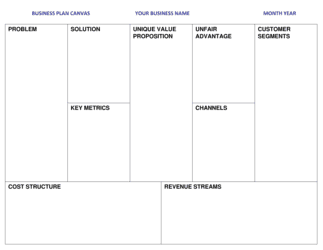
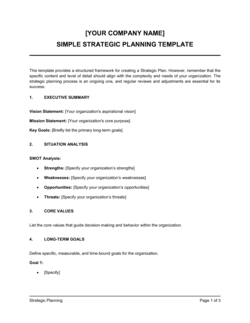
Go To Market Strategies

Free Word download β€’ Edit online β€’ Save & share with Drive β€’ Export to PDF

7 pagesβ€’1h 5m – 1h 25m to fillβ€’Difficulty: Expert
Learn more ↓
FreeGo To Market Strategies Template

At a glance

What it is
A Go To Market Strategy is a structured plan that maps how a company will bring a product or service to its target customers β€” covering positioning, pricing, channels, sales motion, and launch milestones in a single operational document. This free Word download gives you a ready-to-edit framework you can customize for a new product launch, market expansion, or competitive repositioning, then export as PDF to share with leadership, investors, or your sales and marketing teams.
When you need it
Use it before launching a new product or service, entering a new market segment, or repositioning an existing offering against new competition. A GTM strategy is also required when investors or boards ask for evidence that the team has a concrete, sequenced plan for acquiring customers.
What's inside
Target customer profiles and buyer personas, market sizing and competitive landscape, value proposition and messaging framework, pricing and packaging strategy, sales and distribution channels, marketing programs and budget allocation, launch timeline with milestones, and success metrics with defined KPIs for each phase.

What is a Go To Market Strategy?

A Go To Market Strategy is a structured operational plan that defines exactly how a company will bring a specific product or service to its target customers β€” covering who the buyer is, how the product is positioned and priced, which channels will be used to generate demand and close sales, and what milestones signal a successful launch. Unlike a general business plan or marketing plan, a GTM strategy is scoped to a single product launch or market entry event and is typically executed over a 6–12 month horizon. It functions as the connective tissue between product development and revenue generation, ensuring that engineering, marketing, sales, and customer success are operating from the same set of validated assumptions about the customer and the market.

Why You Need This Document

Without a documented GTM strategy, cross-functional teams default to conflicting assumptions about who the target customer is, what the product costs, and which channels deserve budget β€” producing a launch that generates activity but not pipeline. The consequences are concrete: sales teams sell to the wrong segment, marketing invests in channels the ICP does not use, and pricing is revised mid-launch, disrupting deals already in progress. Investors and boards routinely reject funding requests that include revenue projections but no documented path to customer acquisition. A completed GTM strategy forces the team to reconcile those assumptions before spending money, turning the launch from a coordinated guess into a sequenced, measurable plan. This template gives you the structure to build that plan in days rather than weeks.

Which variant fits your situation?

If your situation is…Use this template
Launching a net-new software product to enterprise buyersGo To Market Strategy (SaaS)
Entering a new geographic market or countryMarket Entry Strategy
Launching a physical consumer product through retail channelsProduct Launch Plan
Repositioning an existing product against new competitorsCompetitive Positioning Strategy
Building a partner or reseller channel strategyChannel Partner Strategy
Planning a full marketing campaign tied to a product launchMarketing Plan
Quick internal alignment without a full strategic documentOne-Page Business Plan

Common mistakes to avoid

❌ Building personas from internal assumptions

Why it matters: A persona that was never validated with real buyers generates messaging, pricing, and channel choices that do not match how actual customers make purchase decisions.

Fix: Conduct a minimum of five structured interviews with target customers or recent wins and losses before finalizing any section of the GTM strategy.

❌ Selecting all available marketing channels

Why it matters: Spreading a limited budget across eight channels means no single channel receives enough investment to generate statistically meaningful signal on what is and is not working.

Fix: Pick two to three channels that most efficiently reach the ICP, allocate 80% of the budget there, and treat the remaining 20% as a deliberate test budget for one new channel.

❌ Mismatching the sales motion to the ACV

Why it matters: Assigning a field sales team to close $4,000 ACV deals produces a CAC that exceeds first-year revenue before accounting for onboarding and support costs.

Fix: Calculate the maximum allowable CAC from the LTV (LTV Γ· 3 is a widely used ceiling) and work backward to the sales motion and headcount that fits within that constraint.

❌ Treating launch day as the end of the GTM plan

Why it matters: The initial GTM hypothesis is almost always partially wrong. Without a scheduled post-launch review cycle, incorrect assumptions run for months before anyone recognizes the signal in the data.

Fix: Schedule a structured win/loss and KPI review at 30 and 60 days post-launch before the product ships, and assign an owner to present findings to the leadership team at each checkpoint.

❌ Omitting a pricing rationale section

Why it matters: A price point stated without competitive context or willingness-to-pay evidence cannot be defended to a board, and is frequently revised mid-launch β€” disrupting sales conversations already in progress.

Fix: Document the three competitive anchors used to set the price, the willingness-to-pay range from customer interviews, and the margin floor from unit economics. All three should support the same number.

❌ Using activity metrics as primary GTM KPIs

Why it matters: Reporting emails sent, blog posts published, and events attended creates the impression of momentum while masking a stalled pipeline and declining conversion rates.

Fix: Replace all activity metrics in the KPI dashboard with outcome metrics: SQLs generated, pipeline created, trial-to-paid conversion rate, and time-to-first-value for new customers.

The 10 key sections, explained

Executive Summary

Target Customer and Buyer Personas

Market Sizing and Opportunity

Competitive Landscape

Value Proposition and Messaging Framework

Pricing and Packaging Strategy

Sales and Channel Strategy

Marketing Programs and Budget

Launch Timeline and Milestones

Success Metrics and KPIs

How to fill it out

  1. 1

    Define the target customer before anything else

    Complete the ICP and buyer persona sections first. Every subsequent section β€” pricing, channels, messaging, budget β€” must be anchored to a specific, validated customer definition.

    πŸ’‘ Interview at least five existing customers or prospects before writing the persona section. Even two hours of calls will surface assumptions that would otherwise undermine the entire strategy.

  2. 2

    Build market sizing from the bottom up

    Count the number of companies or individuals matching your ICP using LinkedIn, industry databases, or your CRM. Multiply by your target ACV or unit price to get a realistic SOM for Year 1.

    πŸ’‘ Your bottom-up SOM and your top-down SAM should be within 30–40% of each other. A larger gap usually means your ICP definition and your market data are not aligned.

  3. 3

    Map the competitive landscape with specifics

    Research at least four competitors β€” direct, indirect, and the status quo. For each, record their pricing, target segment, key strengths, and the one claim they make most loudly in their marketing.

    πŸ’‘ Run a trial of each competitor's product before completing this section. Positioning built from firsthand experience is substantially more credible than positioning built from their marketing website.

  4. 4

    Write a separate value proposition for each buyer persona

    Use the format: '[Product] helps [persona] achieve [outcome] in [timeframe] by [mechanism], unlike [alternative] which [limitation].' Validate the language against the interviews conducted in Step 1.

    πŸ’‘ If you cannot complete the '[alternative] which [limitation]' clause with a specific, concrete claim, your differentiation is not yet sharp enough to go to market.

  5. 5

    Set pricing based on value and competitive benchmarks

    Research three to five comparable products and establish where you want to sit on the price-value spectrum relative to them. Then validate willingness to pay against the personas by asking directly in interviews.

    πŸ’‘ The Van Westendorp Price Sensitivity Meter β€” four price-point questions asked in a survey β€” gives you an empirical acceptable price range in under two hours.

  6. 6

    Choose the primary sales motion before selecting channels

    Decide between product-led growth, inbound, outbound, and channel-partner models based on your ACV, deal complexity, and buyer's discovery behavior. Then select the two or three channels that best support that motion.

    πŸ’‘ Match the sales motion to ACV: below $3K ACV, self-serve or PLG; $3K–$25K, high-velocity inside sales; above $25K, consultative inside or field sales.

  7. 7

    Build the launch timeline with dated milestones and named owners

    Enter each milestone with a specific date, the person responsible, and any upstream dependencies. Phase the plan into pre-launch, launch week, and 30/60/90-day post-launch reviews.

    πŸ’‘ Identify the three milestones that are on the critical path β€” the ones that delay everything downstream if they slip. Put those in the executive summary so they stay visible to leadership.

  8. 8

    Define outcome KPIs for each phase before launch

    Set specific, time-bound targets for pipeline, conversion rate, ARR, and retention at 30, 60, 90, and 180 days post-launch. These become the triggers for strategy adjustments if the GTM is not performing.

    πŸ’‘ Pre-agree on the KPI thresholds that would trigger a pivot β€” for example, 'if trial-to-paid conversion is below 8% at Day 60, we revisit onboarding and pricing.' Waiting until the data arrives to have that conversation costs weeks.

Frequently asked questions

What is a go to market strategy?

A go to market (GTM) strategy is a plan that defines how a company will bring a specific product or service to its target customers. It covers who the customer is, what problem is being solved, how the product is priced and packaged, which channels will be used to reach buyers, how the sales motion works, and what milestones and metrics define a successful launch. A GTM strategy is distinct from a general marketing plan β€” it is specific to a single product or market entry event.

What should a go to market strategy include?

A complete GTM strategy covers ten areas: target customer profiles and buyer personas, market sizing (TAM, SAM, SOM), competitive landscape, value proposition and messaging framework, pricing and packaging, sales and channel strategy, marketing programs with budget allocation, launch timeline with milestones and owners, and success KPIs by phase. Skipping any of these creates gaps that surface as misalignment between teams during execution.

How is a go to market strategy different from a marketing plan?

A marketing plan covers the ongoing demand-generation programs and brand activities for an existing business over a fixed period β€” typically a fiscal year. A GTM strategy is specific to a single product launch or market entry event. It addresses the full cross-functional launch motion β€” product readiness, pricing, sales enablement, and channel activation β€” not just marketing campaigns. Most major launches require both: a GTM strategy for the launch event and a marketing plan for the programs that sustain demand afterward.

Who is responsible for the go to market strategy?

Ownership typically sits with the product marketing team or, in earlier- stage companies, with the founder or CMO. However, a GTM strategy requires active input from product management (feature readiness and positioning), sales (deal motion and ICP validation), and finance (pricing economics and budget approval). The most common failure mode is a GTM strategy written by one function without input from the others, which produces a plan that does not survive first contact with the sales team.

How long should a go to market strategy document be?

For most product launches, a GTM strategy runs 10–20 pages including a financial model appendix. A one-page summary is useful for executive alignment but is not a substitute for the full document when cross- functional teams need specific guidance on channels, messaging, and milestones. Documents longer than 25 pages are rarely read in full β€” move supporting research to appendices and keep the strategy body concise and decision-focused.

How do I size the market in a go to market strategy?

Use both a top-down and a bottom-up method and reconcile them. For top-down, cite an independent industry report and apply your target segment's share of the total. For bottom-up, count the number of companies or individuals matching your ICP from a database or CRM export, then multiply by your target ACV to produce a Year 1 SOM. If the two estimates are more than 40% apart, your ICP definition and your market data are not describing the same population.

What is the difference between a GTM strategy and a product launch plan?

A product launch plan is primarily a project management document β€” it tracks tasks, owners, and dates required to ship the product and announce it to the market. A GTM strategy is a strategic document that defines why the product will win with a specific customer, at a specific price, through specific channels. The launch plan operationalizes the GTM strategy. Most teams need both: the strategy first, then the launch plan to execute it.

How often should a go to market strategy be updated?

Review the GTM strategy formally at 30 and 60 days post-launch against actual pipeline, conversion, and retention data. After the initial launch phase, an annual refresh aligned to the product roadmap and competitive landscape is standard. Any significant pricing change, new competitive entrant, or shift in ICP definition should trigger an unscheduled review regardless of calendar timing.

Can a small business or startup use a go to market strategy template?

Yes β€” a structured template is particularly valuable for early-stage teams precisely because they lack the institutional processes that larger companies use to pressure-test launch assumptions. A template forces founders to address market sizing, pricing rationale, and channel economics before committing resources, which is the stage at which corrections are cheapest. The template can be scaled down for a lean launch β€” completing six of the ten sections thoroughly is more useful than completing all ten superficially.

How this compares to alternatives

vs Marketing Plan

A marketing plan covers the full set of demand-generation and brand programs for an existing business over a fiscal year. A GTM strategy is specific to a single product launch or market entry event and addresses the full cross-functional launch motion β€” pricing, sales enablement, and channel activation β€” not just campaigns. Most organizations need both: the GTM strategy for the launch, and the marketing plan to sustain demand afterward.

vs Product Launch Plan

A product launch plan is a project management document tracking tasks, owners, and dates required to ship and announce a product. A GTM strategy is the upstream strategic document that defines who the customer is, why the product wins, and how it will be sold. The launch plan operationalizes the GTM strategy β€” you need the strategy before the plan is meaningful.

vs Business Plan

A business plan covers the full company β€” market opportunity, team, operations, and multi-year financials β€” for an investor or lender audience. A GTM strategy covers one product or market entry event in tactical detail: personas, messaging, pricing, channels, and a 90-day launch schedule. A business plan may contain a summary GTM section, but the full GTM strategy is a separate, more operationally detailed document.

vs Strategic Plan

A strategic plan defines a company's 3–5 year goals, initiatives, and resource allocation across all business units. A GTM strategy is narrower and more time-bound β€” it focuses on a single product or segment launch and is typically measured over a 6–12 month horizon. Strategic plans set the direction; GTM strategies define the execution path for a specific market bet within that direction.

Industry-specific considerations

SaaS / Technology

Product-led growth vs. sales-led motion decision, trial-to-paid conversion optimization, and expansion revenue from existing accounts as a GTM lever alongside new logo acquisition.

Consumer Goods / E-commerce

Retail channel mix (DTC vs. marketplace vs. brick-and-mortar), category-entry points, and influencer or performance-marketing spend as primary acquisition channels.

Professional Services

Referral and partnership channels dominate acquisition; thought leadership and case studies function as primary demand-generation assets; pricing is often value-based per engagement rather than productized.

Healthcare / MedTech

Regulatory clearance timelines gate the launch schedule; reimbursement pathway and payer strategy are central GTM decisions; clinical evidence and KOL endorsement are key proof points in the messaging framework.

Manufacturing / Industrial

Distribution partner selection and training are often the primary GTM lever; long sales cycles require a channel strategy that sustains engagement across 6–18 month evaluations.

Financial Services / Fintech

Regulatory compliance messaging is a prerequisite trust signal; B2B fintech GTM often requires direct enterprise sales with procurement and legal review cycles factored into the launch timeline.

Template vs pro β€” what fits your needs?

PathBest forCostTime
Use the templateStartups, small businesses, and product teams launching a single product or entering one new market segmentFree1–2 weeks (15–30 hours)
Template + professional reviewGrowth-stage companies launching into a competitive market or presenting the GTM to a board or investors$500–$2,500 for a product marketing consultant or advisor review2–3 weeks
Custom draftedEnterprise launches with multi-channel complexity, regulated industries, or international market entry requiring primary research$5,000–$20,000 for a full-service product marketing or strategy engagement4–8 weeks

Glossary

Ideal Customer Profile (ICP)
A detailed description of the company or individual most likely to buy your product, defined by firmographic, demographic, and behavioral attributes.
Value Proposition
A clear statement of the specific outcome your product delivers, for whom, and why it is better than the alternative β€” expressed in the customer's language.
Positioning Statement
A one- to two-sentence internal declaration of where a product stands in the market relative to competitors and what makes it distinctly valuable.
Sales Motion
The specific sequence of steps a sales team follows to move a prospect from first contact to signed contract, matched to the buyer's decision process.
Total Addressable Market (TAM)
The total revenue opportunity available if a product captured 100% of its target market, used to size the prize and justify resource investment.
Go To Market (GTM)
The coordinated set of actions a company takes to bring a product or service to market and acquire its target customers.
Channel Strategy
The plan for how a product reaches customers β€” direct sales, self-serve, resellers, distributors, marketplaces, or a combination of these routes.
Launch Milestone
A specific, dated checkpoint β€” such as beta close, general availability, or first-revenue date β€” that marks a transition between phases of the launch plan.
Win/Loss Analysis
A structured review of why recent deals were won or lost, used to validate or update messaging, pricing, and competitive positioning assumptions.
Customer Acquisition Cost (CAC)
Total sales and marketing spend divided by the number of new customers acquired in the same period β€” a key test of whether a GTM motion is economically viable.
Product-Market Fit
The condition in which a product satisfies a strong market demand, evidenced by high retention, organic referrals, and customers who actively resist switching.

Part of your Business Operating System

This document is one of 3,000+ business & legal templates included in Business in a Box.

  • Fill-in-the-blanks β€” ready in minutes
  • 100% customizable Word document
  • Compatible with all office suites
  • Export to PDF and share electronically

Create your document in 3 simple steps.

From template to signed document β€” all inside one Business Operating System.
1
Download or open template

Access over 3,000+ business and legal templates for any business task, project or initiative.

2
Edit and fill in the blanks with AI

Customize your ready-made business document template and save it in the cloud.

3
Save, Share, Send, Sign

Share your files and folders with your team. Create a space of seamless collaboration.

Save time, save money, and create top-quality documents.

β˜…β˜…β˜…β˜…β˜…

"Fantastic value! I'm not sure how I'd do without it. It's worth its weight in gold and paid back for itself many times."

Managing Director Β· Mall Farm
Robert Whalley
Managing Director, Mall Farm Proprietary Limited
β˜…β˜…β˜…β˜…β˜…

"I have been using Business in a Box for years. It has been the most useful source of templates I have encountered. I recommend it to anyone."

Business Owner Β· 4+ years
Dr Michael John Freestone
Business Owner
β˜…β˜…β˜…β˜…β˜…

"It has been a life saver so many times I have lost count. Business in a Box has saved me so much time and as you know, time is money."

Owner Β· Upstate Web
David G. Moore Jr.
Owner, Upstate Web

Run your business with a system β€” not scattered tools

Stop downloading documents. Start operating with clarity. Business in a Box gives you the Business Operating System used by over 250,000 companies worldwide to structure, run, and grow their business.

Start freeΒ Β·Β No credit card required