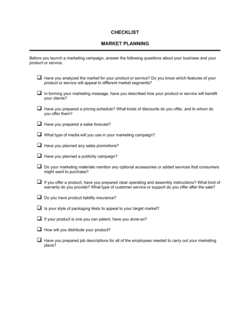
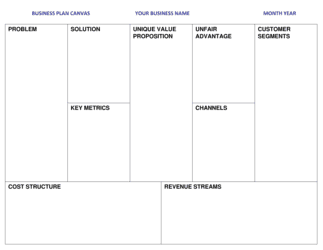
Checklist Go-To Market Plan

Free download β€’ Use as a template β€’ Print or share

1 pageβ€’40–55 min to useβ€’Difficulty: Expert
Learn more ↓
FreeChecklist Go-To Market Plan Template

At a glance

What it is
A Checklist Go To Market Plan is a structured operational document that walks a product or service launch team through every critical step required to bring an offering to market β€” from target audience definition and pricing through channel activation, messaging, and post-launch measurement. This free Word download gives you an editable, checkable framework you can adapt for a new product, a market expansion, or a feature release, then export as PDF to share with your team or stakeholders.
When you need it
Use it when preparing to launch a new product, enter a new market segment, roll out a new pricing model, or coordinate a cross-functional release across sales, marketing, and operations. It is equally useful for a startup shipping its first product and an established business expanding into a new geography.
What's inside
Target market and buyer persona definition, value proposition and positioning statement, competitive landscape summary, pricing and packaging decisions, channel and distribution plan, marketing and sales activation checklist, launch timeline with milestones, and success metrics with measurement cadence.

What is a Checklist Go To Market Plan?

A Checklist Go To Market Plan is a cross-functional operational document that converts a product or service launch strategy into a sequenced list of discrete, assignable action items β€” each with a named owner, a due date, and a clear completion criterion. Where a narrative GTM strategy explains what you intend to do, the checklist format governs who does what, by when, and confirms that every prerequisite β€” from positioning approval to sales training to channel readiness β€” is satisfied before the launch date is declared firm. It typically spans eight functional areas: target market definition, positioning, competitive analysis, pricing, channel activation, marketing asset production, sales enablement, and post-launch measurement.

Why You Need This Document

Launching without a structured GTM checklist is the operational equivalent of building a product without a spec β€” each team operates on its own assumptions about what "ready" means, and the gaps between those assumptions surface on launch day when the cost of fixing them is highest. Marketing campaigns that go live before the sales team is enabled generate leads no one can handle. Pricing that hasn't been loaded into the CRM before the first sales call creates billing disputes with your earliest customers. Metrics defined after launch invite goalpost shifting that makes retrospectives meaningless. A completed GTM checklist forces alignment across product, marketing, sales, and operations on a single set of go/no-go criteria before a dollar of launch budget is spent β€” and gives every stakeholder a shared, auditable record of what was agreed and what was delivered.

Which variant fits your situation?

If your situation is…Use this template
Launching a brand-new SaaS product to a defined buyer segmentProduct Launch Plan
Entering a new geographic market with an existing productMarket Expansion Plan
Rolling out a single new product feature to an existing user baseFeature Release Checklist
Building a full narrative strategy behind the GTM checklistGo To Market Strategy
Aligning the GTM plan to a broader 3-year business strategyStrategic Planning Template
Tracking post-launch marketing performance against GTM targetsMarketing Plan
Coordinating a large product launch across multiple departmentsProject Plan

Common mistakes to avoid

❌ Setting the launch date before validating milestone feasibility

Why it matters: An arbitrary date compresses every upstream milestone, forcing teams to cut steps β€” the most commonly skipped being sales enablement and QA β€” which degrades launch quality and wastes the marketing spend.

Fix: Build the timeline from kickoff forward, confirm each milestone is achievable with current resources, and set the launch date at the end of that exercise, not at the beginning.

❌ Targeting too broad an audience

Why it matters: Messaging designed for everyone resonates with no one. A GTM plan without a specific ICP produces campaigns with low conversion rates and a sales pipeline full of poor-fit prospects.

Fix: Define the ICP with at least four specific attributes β€” industry, company size, geography, and buyer job title β€” and resist expanding it until you have proven traction in the initial segment.

❌ Launching marketing before sales is ready

Why it matters: Leads generated before reps have positioning, pricing, and demo access are handled inconsistently or lost. Early bad experiences with prospects set a negative precedent that is hard to reverse.

Fix: Make sales enablement completion a hard go/no-go gate β€” no paid campaigns or PR until battlecards, demo environments, and pricing are in the CRM and confirmed by the sales manager.

❌ Defining success metrics after launch

Why it matters: Without pre-agreed targets, teams anchor on whatever early numbers look good and avoid accountability for the metrics that reveal problems. Post-launch retrospectives become subjective and fail to produce improvements.

Fix: Enter baseline, 30-day target, and 90-day target for each KPI in the checklist before the launch date, and get explicit stakeholder sign-off during the pre-launch review.

❌ No named owner for each checklist item

Why it matters: Items without a single named owner are treated as shared responsibility β€” which in practice means no one prioritizes them. Uncompleted items discovered on launch day cause delays and finger-pointing.

Fix: Every checklist item must have one owner and one due date. If an item cannot be assigned, escalate to a decision-maker before it becomes a launch-day blocker.

❌ Activating too many channels simultaneously

Why it matters: Spreading a fixed marketing and sales budget across six channels at once means none of them receive the investment needed to generate meaningful signal. It also makes it impossible to attribute results to a specific channel.

Fix: Launch with two to three primary channels where you have the clearest conviction and the team capacity to execute well, then add channels in the 60–90 day post-launch phase based on early data.

The 9 key sections, explained

Target market and buyer persona

Value proposition and positioning statement

Competitive landscape summary

Pricing and packaging

Channel and distribution plan

Marketing and content activation checklist

Sales enablement readiness

Launch timeline and milestone tracker

Success metrics and measurement plan

How to fill it out

  1. 1

    Define your target market and buyer persona

    Start by specifying the firmographic or demographic profile of the companies and individuals you are targeting. Include company size, industry, geography, and the job title of the primary buyer.

    πŸ’‘ If you have more than one buyer persona, create a separate row for each β€” avoid blending them into a single composite that describes no real person.

  2. 2

    Write the positioning and value proposition

    Complete the positioning statement template: for [TARGET], who [PROBLEM], [PRODUCT] is a [CATEGORY] that [BENEFIT], unlike [ALTERNATIVE], because [REASON TO BELIEVE]. Do not move to the next section until your team agrees on the final language.

    πŸ’‘ Test the positioning statement by reading it aloud to a target customer who has never heard of your product β€” if they cannot immediately understand it, revise it.

  3. 3

    Map the competitive landscape

    List at least three direct competitors and one indirect alternative. For each, note their pricing, primary strength, and primary weakness. Then confirm your product's specific win condition against each.

    πŸ’‘ Pull pricing and feature data from competitor websites and G2 or Capterra reviews the week before launch β€” positioning gets stale fast in competitive markets.

  4. 4

    Document pricing, packaging, and discounting policy

    Enter the approved price points, any tier structure, and the introductory offer if applicable. Record the maximum discount reps can offer without manager approval and who must sign off on exceptions.

    πŸ’‘ Lock pricing into your CRM and quoting tool before the first sales call β€” verbal pricing communicated before the system is updated creates support and billing disputes.

  5. 5

    Assign channel ownership and readiness dates

    For each channel in your plan β€” paid search, outbound SDR, content, partner β€” name a single owner and the date by which that channel must be fully operational.

    πŸ’‘ No owner means no accountability. If a channel does not have a named person responsible, either assign one or remove the channel from the launch plan.

  6. 6

    Complete the marketing and sales enablement checklists

    Work through each item in the marketing activation and sales enablement sections. Mark each item with a due date and owner. Items without a due date and owner are not committed β€” they are aspirational.

    πŸ’‘ Run a go/no-go review 72 hours before launch. Any unchecked critical item β€” live landing page, approved pricing in CRM, completed sales training β€” should trigger a launch delay discussion.

  7. 7

    Build the milestone timeline

    Map all milestones from kickoff to the 90-day post-launch review on a single timeline. Work backward from the launch date to confirm that each upstream milestone is achievable given the team's current capacity.

    πŸ’‘ Build in at least one buffer week before launch day for QA, stakeholder review, and final approvals β€” launches that hit an unexpected blocker in the final 48 hours rarely recover on schedule.

  8. 8

    Define success metrics before launch day

    For each KPI, enter the baseline, 30-day target, and 90-day target. Assign a metric owner and set the review cadence. Circulate and get explicit sign-off from stakeholders before the launch date.

    πŸ’‘ Limit your primary launch KPIs to three to five metrics β€” tracking more than that spreads attention and makes post-launch retrospectives inconclusive.

Frequently asked questions

What is a go-to-market plan checklist?

A go-to-market plan checklist is a structured operational document that walks a launch team through every step required to bring a product or service to market β€” from defining the target buyer and positioning through activating channels, enabling the sales team, and measuring post-launch results. Unlike a narrative GTM strategy, the checklist format makes each action item assignable, trackable, and auditable before and after launch.

What is the difference between a go-to-market plan and a marketing plan?

A go-to-market plan covers a single product or service launch β€” it is time-bound, cross-functional, and focused on the mechanics of getting a specific offering in front of buyers for the first time. A marketing plan covers a company's full marketing program over a fiscal year, including brand, demand generation, and retention across all products. A GTM plan feeds into and informs the broader marketing plan but is narrower in scope and shorter in horizon.

Who should be involved in completing the GTM checklist?

The checklist is designed for cross-functional use. Product management typically owns positioning and the competitive summary. Marketing owns the campaign activation and content sections. Sales leadership owns the sales enablement readiness section. Operations or a program manager usually maintains the milestone timeline and facilitates the go/no-go review. Having a single DRI (directly responsible individual) coordinate the full document prevents items from falling through the gaps between teams.

How far in advance should a go-to-market checklist be started?

For a significant product launch β€” new product, new market, or major pricing change β€” start the GTM checklist 8 to 12 weeks before the target launch date. For a smaller feature release or incremental update, 4 to 6 weeks is typically sufficient. Starting too late compresses upstream milestones and forces teams to skip critical steps like sales training and QA. The checklist's milestone timeline section will surface any feasibility issues early.

What should go-to-market success metrics include?

At a minimum: number of leads or trials generated in the first 30 days, pipeline value created, conversion rate from lead to qualified opportunity, customer acquisition cost, and revenue at 90 days. SaaS businesses add trial-to-paid conversion rate and time-to-first-value. Product-led growth teams track activation rate and day-7 retention. Choose three to five KPIs and agree on targets before launch day so the post-launch review has a clear standard to evaluate against.

Can a go-to-market checklist be reused for multiple launches?

Yes β€” and that is one of its primary operational benefits. After each launch, update the checklist template with items that were missing, modify timelines based on actual durations, and capture lessons learned in a notes column. Within two to three launches, a well-maintained GTM checklist becomes a reliable standard operating procedure that reduces planning time and launch risk across the organization.

What is a go/no-go review and when should it happen?

A go/no-go review is a structured meeting β€” typically held 48 to 72 hours before the planned launch date β€” where each team reviews the status of their checklist items and the group collectively decides whether to proceed, delay, or descope the launch. Any uncompleted item classified as critical should trigger a delay discussion. Documenting the go/no-go decision and its rationale creates accountability and protects the team if issues arise post-launch.

What is the difference between a GTM checklist and a product launch plan?

A product launch plan is typically a narrative document covering objectives, strategy, budget, and timeline in prose form. A GTM checklist converts that strategy into discrete, assignable action items with owners and due dates. Both documents are complementary β€” the launch plan explains why and what, the checklist governs who does what by when. For small teams, the checklist alone is often sufficient; larger organizations typically maintain both.

How detailed should each checklist item be?

Each item should be specific enough that the assigned owner can act on it without a follow-up conversation. 'Marketing assets ready' is too vague β€” 'Landing page live, tested on mobile, and approved by brand by [DATE]' is actionable. The effort to write specific items upfront pays back during execution by eliminating the ambiguity that causes delays and rework in the final stretch before launch.

How this compares to alternatives

vs Product Launch Plan

A product launch plan is a narrative strategy document covering objectives, positioning, budget, and timeline in prose form. A GTM checklist converts that strategy into discrete, trackable action items with owners and due dates. The two documents are complementary β€” most teams use both, with the launch plan driving the checklist.

vs Marketing Plan

A marketing plan governs the full annual marketing program across all products and channels. A GTM checklist is scoped to a single product or service launch and is time-bound to the launch window. The GTM checklist is narrower, more operational, and cross-functional in ways a standalone marketing plan typically is not.

vs Strategic Planning Template

A strategic plan defines a 3–5 year company direction, goals, and resource allocation. A GTM checklist operationalizes the launch of a specific product within that strategy. The strategic plan asks 'where are we going'; the GTM checklist asks 'how exactly do we get this product to market by this date.'

vs Project Plan

A project plan tracks tasks, dependencies, and resources across any type of initiative. A GTM checklist is a purpose-built version specifically for product or service launches, pre-loaded with the categories and milestones that market launches consistently require. Teams launching products save significant setup time using a GTM checklist rather than building a generic project plan from scratch.

Industry-specific considerations

SaaS / Technology

Trial activation rates, in-app onboarding completion, and feature adoption are tracked alongside revenue KPIs; engineering readiness and infrastructure scalability are explicit go/no-go gates.

Retail / E-commerce

Inventory availability, fulfilment readiness, and promotional campaign coordination across email, paid social, and marketplace channels must all be confirmed before launch day.

Professional Services

Service delivery capacity β€” billable headcount, project templates, and onboarding SOPs β€” must be validated before marketing generates demand the team cannot fulfill.

Healthcare / MedTech

Regulatory clearance, compliance training for the sales team, and reimbursement or billing code readiness are mandatory pre-launch checklist gates that marketing timelines must accommodate.

Template vs pro β€” what fits your needs?

PathBest forCostTime
Use the templateStartup teams, small business owners, and product managers launching a single product or featureFree2–4 hours to complete; 6–12 weeks of execution
Template + professional reviewGrowth-stage companies launching into a new market segment or with significant marketing budget at risk$500–$2,000 for a fractional CMO or product marketing review session1–2 weeks to finalize with external input
Custom draftedEnterprise launches, regulated industries, or multi-market simultaneous releases requiring a dedicated program manager$3,000–$15,000 for a product marketing consultant or launch management firm4–8 weeks

Glossary

Go-to-Market (GTM) Plan
A step-by-step action plan that defines how a company will launch a product or service, reach its target customers, and generate initial revenue.
Ideal Customer Profile (ICP)
A description of the company or individual most likely to buy your product, defined by firmographic, demographic, or behavioral attributes.
Value Proposition
A clear statement of the specific benefit your product delivers, for whom, and why it is better than the current alternative.
Positioning Statement
A single internal-facing sentence that defines the target segment, the category you compete in, the key benefit you deliver, and the reason to believe it.
Buyer Persona
A semi-fictional profile of a target buyer based on research β€” including their role, goals, pain points, and buying behavior.
Channel Strategy
The specific paths β€” direct sales, resellers, marketplaces, or organic and paid digital β€” through which you will reach and convert target customers.
Launch Milestone
A defined, date-bound deliverable that a team must complete before a product can advance to the next stage of launch readiness.
Go/No-Go Criteria
A predefined set of conditions β€” technical, operational, legal, or commercial β€” that must all be met before a launch proceeds on schedule.
CAC (Customer Acquisition Cost)
Total sales and marketing spend divided by the number of new customers acquired in the same period β€” used to evaluate channel efficiency post-launch.
Sales Enablement
The process of equipping sales representatives with the content, training, and tools they need to engage buyers and close deals effectively.

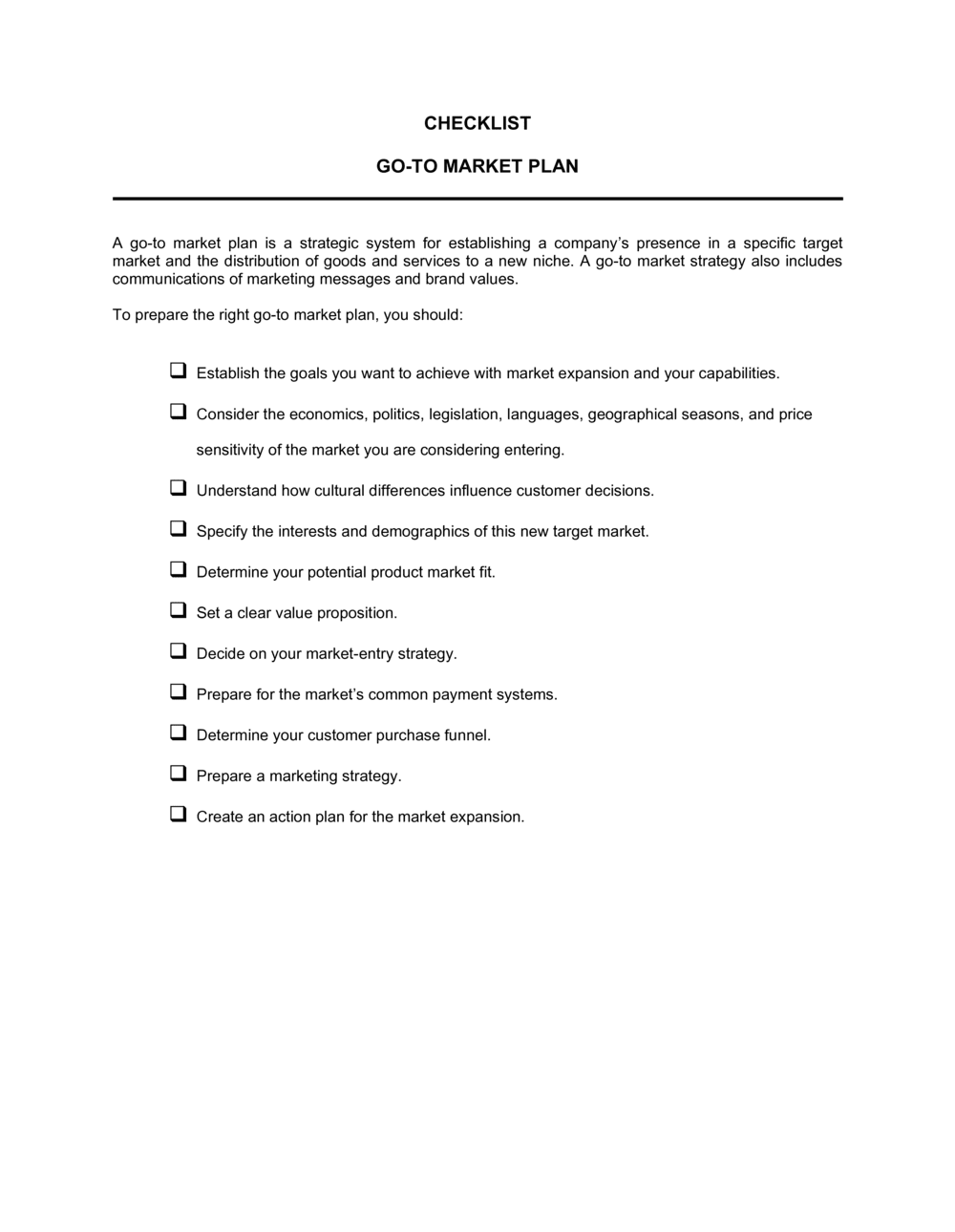
Part of your Business Operating System

This document is one of 3,000+ business & legal templates included in Business in a Box.

  • Fill-in-the-blanks β€” ready in minutes
  • 100% customizable Word document
  • Compatible with all office suites
  • Export to PDF and share electronically

Create your document in 3 simple steps.

From template to signed document β€” all inside one Business Operating System.
1
Download or open template

Access over 3,000+ business and legal templates for any business task, project or initiative.

2
Edit and fill in the blanks with AI

Customize your ready-made business document template and save it in the cloud.

3
Save, Share, Send, Sign

Share your files and folders with your team. Create a space of seamless collaboration.

Save time, save money, and create top-quality documents.

β˜…β˜…β˜…β˜…β˜…

"Fantastic value! I'm not sure how I'd do without it. It's worth its weight in gold and paid back for itself many times."

Managing Director Β· Mall Farm
Robert Whalley
Managing Director, Mall Farm Proprietary Limited
β˜…β˜…β˜…β˜…β˜…

"I have been using Business in a Box for years. It has been the most useful source of templates I have encountered. I recommend it to anyone."

Business Owner Β· 4+ years
Dr Michael John Freestone
Business Owner
β˜…β˜…β˜…β˜…β˜…

"It has been a life saver so many times I have lost count. Business in a Box has saved me so much time and as you know, time is money."

Owner Β· Upstate Web
David G. Moore Jr.
Owner, Upstate Web

Run your business with a system β€” not scattered tools

Stop downloading documents. Start operating with clarity. Business in a Box gives you the Business Operating System used by over 250,000 companies worldwide to structure, run, and grow their business.

Start freeΒ Β·Β No credit card required