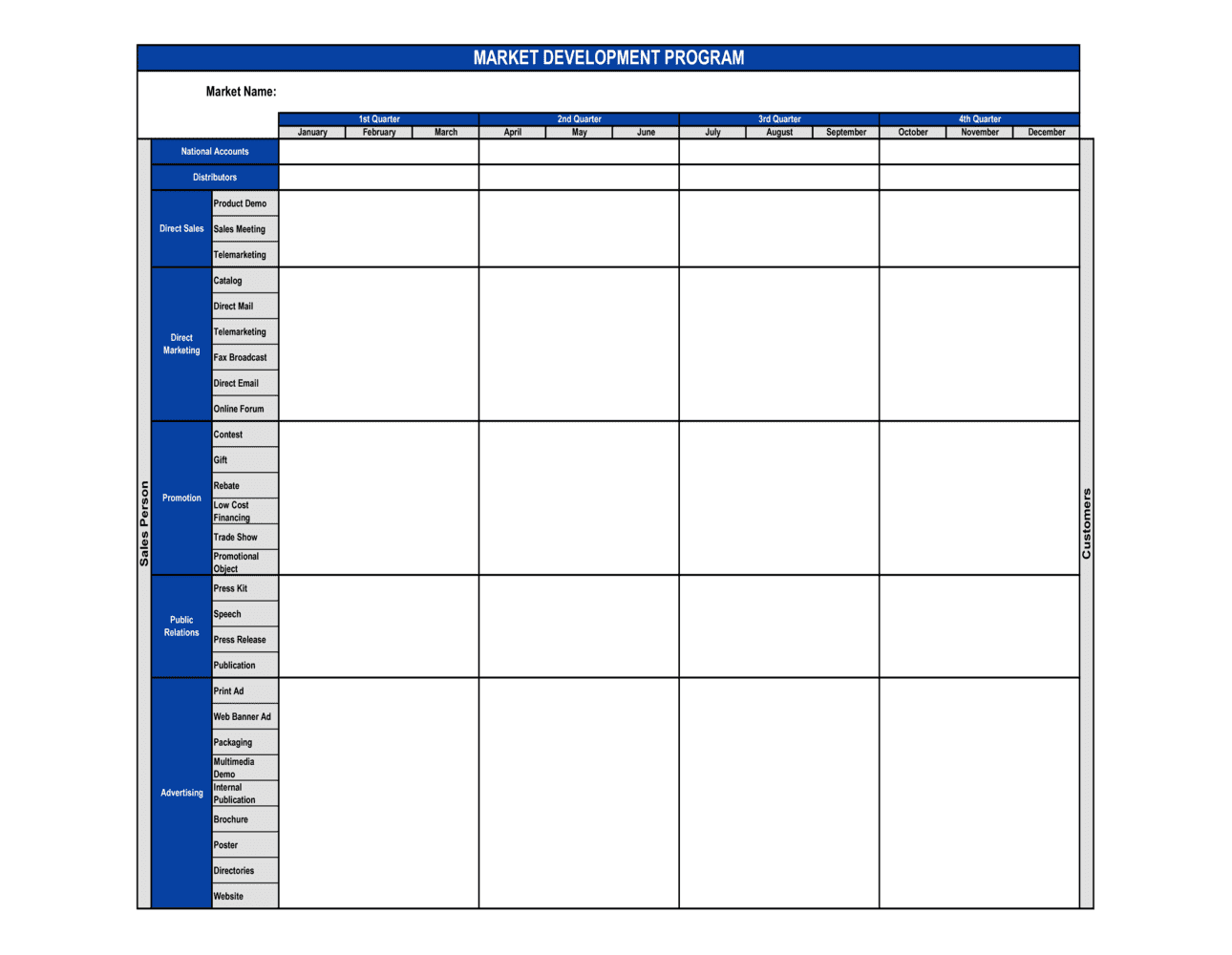
Market Development Program Template

Free Excel download • Edit online • Save & share with Drive • Export to PDF

1 page20–30 min to fillDifficulty: StandardSignature requiredLegal review recommended
Learn more ↓
FreeXLSMarket Development Program Template

At a glance

What it is
A Market Development Program is a binding agreement between a supplier, manufacturer, or brand and a distributor, reseller, or channel partner that formalizes how the two parties will jointly develop a defined market or territory. This free Word download covers territory rights, market development fund (MDF) allocations, performance targets, co-op marketing obligations, reporting requirements, and termination conditions — all in a single editable document you can export as PDF for signature.
When you need it
Use it when a supplier wants to engage a channel partner to penetrate a new territory or customer segment, and both parties are committing financial resources, promotional activities, and sales targets to the effort. It is also appropriate when an existing distributor relationship expands to include funded co-marketing, performance-based incentives, or exclusivity provisions.
What's inside
Territory definition and exclusivity terms, MDF allocation and eligible spend categories, performance milestones and minimum purchase commitments, co-op marketing obligations and pre-approval procedures, IP licensing for promotional use, reporting and audit rights, and termination with clawback provisions for unspent or misused funds.

What is a Market Development Program?

A Market Development Program is a binding agreement between a supplier, manufacturer, or brand owner and a channel partner — typically a distributor, reseller, or value-added partner — that formalizes how the two parties will jointly invest in growing sales within a defined territory or customer segment. It goes beyond a standard distribution agreement by committing the supplier to a funded Market Development Fund (MDF), specifying exactly how that money may be spent, and tying the partner's access to funds, exclusivity, and program benefits to measurable performance milestones. The agreement creates enforceable obligations on both sides: the supplier must make funds available on schedule and process reimbursements within defined timeframes; the partner must meet purchase commitments, submit activity pre-approvals, and document results through proof-of-performance submissions.

Why You Need This Document

Operating a co-op or MDF program without a written Market Development Program agreement exposes suppliers to significant financial and legal risk. Without defined eligible activities and a pre-approval requirement, partners routinely claim reimbursement for overhead, non-product advertising, and competitor-adjacent spend — with no contractual basis to refuse payment. Without a clawback clause, disbursed funds tied to missed performance targets are practically unrecoverable without expensive litigation. For channel partners, an undocumented program leaves territorial rights ambiguous, MDF entitlements subject to unilateral revision, and exclusivity vulnerable to erosion the moment a second reseller is appointed. A properly drafted Market Development Program agreement eliminates all of these gaps, creates an auditable record for both parties' financial reporting, and gives both sides a clear, enforceable framework for building a productive long-term territory relationship.

Which variant fits your situation?

If your situation is…Use this template
Supplier funds a distributor to develop a named territory exclusivelyMarket Development Program (Exclusive Territory)
Multiple resellers share a territory with co-op fund entitlementsChannel Partner Agreement
Broad ongoing product distribution without funded marketingDistribution Agreement
One-time co-marketing campaign between two brandsCo-Marketing Agreement
Agent sells on behalf of supplier without holding inventorySales Agency Agreement
Licensing brand assets to a partner for promotional use onlyTrademark License Agreement
Manufacturer authorizes reseller to sell in a defined retail channelAuthorized Reseller Agreement

Common mistakes to avoid

❌ Unconditional exclusivity with no performance trigger

Why it matters: A partner with guaranteed exclusivity and no minimum commitment has no commercial incentive to invest in territory development. The supplier is locked out of the market with no recourse.

Fix: Tie exclusivity directly to the Minimum Purchase Commitment. Include a conversion clause that shifts the territory to non-exclusive status automatically if the commitment is missed by more than a defined percentage.

❌ No pre-approval requirement for MDF spend

Why it matters: Without pre-approval, partners spend on ineligible activities — overhead, competitor co-marketing, or unrelated events — and the supplier has no contractual basis to refuse reimbursement after the fact.

Fix: Require a written Activity Request Form with a defined supplier approval window before any MDF spend. Unapproved activities are explicitly ineligible for reimbursement regardless of the nature of the spend.

❌ Vague eligible-activities definition with no exclusion list

Why it matters: Listing 'promotional and marketing activities' without an exclusion list invites creative interpretations. Partners have claimed MDF reimbursement for staff salaries, office renovation, and competitor trade show attendance.

Fix: Include a two-column table: eligible activities on the left, explicitly excluded categories on the right. Review and update the exclusion list annually as new spend categories emerge.

❌ No clawback clause for MDF misuse

Why it matters: If MDF is disbursed on good faith and the partner later fails performance targets or is found to have submitted false PoP, the supplier has no contractual mechanism to recover the funds without a clawback clause.

Fix: Add a broad clawback clause covering missed performance, ineligible spend, false documentation, and termination-for-cause scenarios — with a repayment deadline and an interest accrual provision for late recovery.

❌ Auto-renewal without a clear opt-out window

Why it matters: Missing a 30- or 60-day opt-out deadline locks both parties into another program year regardless of commercial fit. Suppliers are then liable for MDF allocations they did not budget for.

Fix: Set a notice window of at least 60 days before the renewal date. Add a calendar reminder in your contract management system to review the relationship 90 days before each anniversary.

❌ Reporting obligations without a defined format or data fields

Why it matters: Unstructured reports vary widely across partners and cannot be aggregated for supplier-wide analytics. Incomplete reports also make it impossible to verify sell-through rates or trigger performance remedies.

Fix: Attach a standardized Monthly Performance Report template as an exhibit. Specify at minimum: units sold, revenue by product SKU, MDF spent by activity category, and pipeline count.

The 10 key clauses, explained

Parties, recitals, and program purpose

In plain language: Identifies the supplier and the channel partner as legal entities, states the commercial relationship between them, and describes the specific market or territory the program is designed to develop.

Sample language
This Market Development Program Agreement is entered into on [DATE] between [SUPPLIER LEGAL NAME], a [STATE/COUNTRY] [ENTITY TYPE] ('Supplier'), and [PARTNER LEGAL NAME], a [STATE/COUNTRY] [ENTITY TYPE] ('Partner'). The parties wish to establish a funded market development program for the promotion and sale of [PRODUCT LINE] within the [TERRITORY DESCRIPTION].

Common mistake: Identifying the channel partner by trade name rather than registered legal entity. If the partner operates under a DBA, the agreement may be difficult to enforce against the correct legal person.

Territory definition and exclusivity

In plain language: Defines the geographic boundaries or customer segments the partner is authorized to develop, and states whether that authorization is exclusive, non-exclusive, or conditional on performance.

Sample language
Supplier grants Partner the [exclusive / non-exclusive] right to market and sell Products within [GEOGRAPHIC TERRITORY / NAMED ACCOUNTS LIST] ('Territory') during the Program Year. Exclusivity is conditioned upon Partner meeting the Minimum Purchase Commitment set out in Schedule A. If Partner fails to meet the commitment in any Program Year, exclusivity converts to non-exclusive with [30] days' written notice.

Common mistake: Granting unconditional exclusivity with no performance trigger. If the partner underperforms, the supplier has no mechanism to open the territory without breaching the agreement.

Market development fund allocation

In plain language: States the dollar amount or percentage of net purchases that constitutes the partner's MDF entitlement, when funds are made available, and the process for requesting disbursement.

Sample language
Supplier shall allocate to Partner an MDF of $[AMOUNT] per Program Year, or [X]% of Partner's net purchases in the prior Program Year, whichever is greater. MDF accrues quarterly and is available for reimbursement upon submission of an approved Activity Request and Proof of Performance to [SUPPLIER CONTACT] within [60] days of the activity completion date.

Common mistake: Omitting an accrual schedule and letting MDF accumulate without a use-it-or-lose-it deadline. Unused MDF that rolls forward creates unplanned liability on the supplier's books and is difficult to audit.

Authorized activities and eligible spend

In plain language: Lists the specific marketing and sales activities that qualify for MDF reimbursement and explicitly excludes categories the supplier will not fund.

Sample language
Eligible activities include: trade show participation directly promoting Products ([PRODUCT LINE]), digital advertising targeting [CUSTOMER SEGMENT], product demonstration events, customer-facing sales collateral, and co-branded email campaigns. Ineligible activities include: Partner overhead, salaries, non-product-specific advertising, entertainment, and any activity not pre-approved in writing by Supplier.

Common mistake: Using a vague eligible-activities list that includes 'marketing and promotional activities generally.' Without a defined exclusion list, partners claim reimbursement for overhead costs and activities with no measurable impact on the supplier's products.

Pre-approval and proof-of-performance procedures

In plain language: Requires the partner to obtain written approval before spending MDF and to submit documentation proving the activity occurred and met the agreed criteria before reimbursement is issued.

Sample language
Partner must submit an Activity Request Form at least [15] business days before the planned activity. Supplier shall approve or reject requests within [10] business days. Upon completion, Partner shall submit Proof of Performance — including invoices, screenshots, attendance records, or media placements — within [30] days. Supplier shall process approved reimbursements within [45] days of receiving complete PoP documentation.

Common mistake: No pre-approval requirement — allowing partners to spend first and seek reimbursement after. Without pre-approval, suppliers lose control over spend categories, brand consistency, and activity eligibility.

Performance milestones and minimum purchase commitments

In plain language: Sets quantified sales or purchase targets the partner must meet within the program year to retain full MDF entitlement, exclusivity, and program participation.

Sample language
Partner shall purchase a minimum of $[AMOUNT] of Products during each Program Year ('Minimum Commitment'). Failure to meet the Minimum Commitment by [DATE] shall result in (a) forfeiture of any unused MDF accrued in that Program Year, (b) conversion of any exclusivity grant to non-exclusive status, and (c) Supplier's right to terminate the Agreement on [60] days' written notice.

Common mistake: Setting a single annual minimum with no interim checkpoints. Without quarterly reviews, both parties reach year-end with no warning and no opportunity to course-correct before consequences are triggered.

IP license for promotional use

In plain language: Grants the partner a limited, non-transferable license to use the supplier's trademarks, logos, and product imagery solely for activities authorized under the program, subject to brand guidelines.

Sample language
Supplier grants Partner a limited, non-exclusive, non-sublicensable license to use Supplier's trademarks, trade names, and product imagery ('Supplier Marks') solely for Authorized Activities during the Term. All use of Supplier Marks must comply with Supplier's then-current Brand Guidelines. Partner shall not alter, combine, or use Supplier Marks in a manner that could disparage or damage Supplier's brand. Upon termination, Partner shall immediately cease all use of Supplier Marks.

Common mistake: No reference to the supplier's brand guidelines, leaving partners to use logos in non-compliant ways — wrong colors, unapproved taglines, or combined with competitor branding — without a contractual basis to require correction.

Reporting, audit rights, and records retention

In plain language: Requires the partner to submit regular sales and activity reports, and gives the supplier the right to audit partner records to verify MDF spend and performance metrics.

Sample language
Partner shall submit monthly reports detailing unit sales, sell-through rates, and MDF expenditures to Supplier by the [10th] day of each following month. Supplier reserves the right, upon [10] business days' written notice, to audit Partner's records relating to MDF use and Product sales during normal business hours. Partner shall retain all relevant records for a minimum of [3] years following the end of each Program Year.

Common mistake: Requiring reporting without specifying the format or data fields. Unstructured reports are inconsistent across partners and make it impossible to aggregate performance data or conduct audits efficiently.

Clawback and fund misuse remedies

In plain language: Defines the circumstances under which the supplier can demand repayment of disbursed MDF — including missed performance targets, ineligible spend, and false proof-of-performance submissions.

Sample language
Supplier may demand repayment of any MDF previously disbursed if: (a) Partner fails to meet the Minimum Commitment in the applicable Program Year; (b) funds were used for Ineligible Activities; (c) PoP documentation submitted was false or materially misleading; or (d) this Agreement is terminated for cause. Partner shall repay any such amounts within [30] days of written demand. Unpaid amounts accrue interest at [1.5]% per month from the due date.

Common mistake: No clawback clause at all, or clawback limited only to termination-for-cause scenarios. MDF misuse — submitting inflated invoices or spending on ineligible activities — is common without a broad, clearly defined repayment obligation.

Term, renewal, and termination

In plain language: Sets the program year duration, automatic renewal or opt-out mechanics, and the conditions allowing either party to terminate — for cause immediately, or without cause on notice.

Sample language
This Agreement commences on [START DATE] and continues for one Program Year ('Initial Term'), automatically renewing for successive one-year terms unless either party provides [60] days' written notice of non-renewal before the end of the then-current term. Either party may terminate for material breach on [30] days' written notice if the breach remains uncured. Supplier may terminate immediately upon Partner's insolvency, fraud, or material violation of the IP license.

Common mistake: Auto-renewal without a defined notice window. Suppliers who miss the opt-out deadline are locked into another program year with an underperforming partner and face liability if they attempt to terminate mid-term.

How to fill it out

  1. 1

    Identify both legal entities and define the relationship

    Enter the supplier's and partner's full registered legal names, entity types, and jurisdictions of incorporation. State the nature of the existing relationship — distributor, reseller, or agent — in the recitals.

    💡 Request a copy of the partner's corporate registration before execution. Using a DBA or trade name as the contracting party creates enforcement gaps.

  2. 2

    Define the territory with precision

    Specify the territory by country, state or province, postal code range, named customer accounts, or vertical market segment — whichever is most commercially relevant. Attach a Schedule if the territory definition is complex.

    💡 Ambiguous territory definitions are the single most litigated clause in distribution and channel agreements. Spend extra time here.

  3. 3

    Set the MDF allocation and accrual schedule

    Enter the annual MDF amount or the percentage of net purchases that will accrue as MDF. Specify whether it accrues monthly, quarterly, or annually, and set a firm expiry date for unused funds.

    💡 Cap carryforward MDF at no more than one quarter's worth. Unlimited rollover turns a marketing budget into an off-balance-sheet liability.

  4. 4

    List authorized and excluded activities explicitly

    Build a specific list of eligible activities — trade shows, digital ads, demo events — and a separate explicit exclusion list. Attach current brand guidelines as a schedule referenced in the IP license clause.

    💡 Review the exclusion list annually. New marketing channels (short-form video, influencer campaigns) often fall into gray areas that should be addressed proactively.

  5. 5

    Define performance milestones with quarterly checkpoints

    Enter the annual Minimum Purchase Commitment and add at least two interim checkpoints — at Q2 and Q3 — with defined remedies (written warning, MDF freeze) for missing each checkpoint.

    💡 Tie the Q2 checkpoint to a formal performance review meeting rather than just a reporting obligation. Early-stage course correction is far cheaper than year-end clawback disputes.

  6. 6

    Draft the pre-approval and PoP requirements

    Specify the Activity Request Form format, submission lead time, approval turnaround, and the exact documentation required as Proof of Performance for each eligible activity category.

    💡 Attach a sample completed Activity Request Form as an exhibit. Partners who see a filled-in example make far fewer submission errors.

  7. 7

    Set audit rights and records retention obligations

    State the notice period required for an audit, the scope of records covered, the retention period, and who bears audit costs (typically the auditing party unless a material discrepancy is found).

    💡 Include a right to audit not just financial records but also campaign analytics and CRM data. Sell-through rates and lead attribution are increasingly the key performance metrics in MDF programs.

  8. 8

    Execute before the program start date and distribute signed copies

    Both parties must sign before the program year begins. Backdating a market development program creates questions about which activities and purchases fall under the agreement. Store fully executed copies in a secure document repository.

    💡 Use a digital signature platform that timestamps execution. An undated or unsigned agreement makes clawback enforcement and exclusivity disputes significantly harder.

Frequently asked questions

What is a Market Development Program agreement?

A Market Development Program agreement is a binding contract between a supplier and a channel partner — distributor, reseller, or agent — that formalizes the terms of a funded joint effort to grow sales in a defined territory or customer segment. It covers MDF allocation, eligible marketing activities, performance targets, reporting obligations, IP licensing for promotional use, and the consequences of missing milestones. It creates enforceable obligations on both sides and replaces informal co-op arrangements with a documented, auditable structure.

What is a market development fund (MDF) and how does it work?

An MDF is a budget allocated by a supplier to a channel partner to fund sales and marketing activities that promote the supplier's products in a specific market. Funds typically accrue as a percentage of the partner's net purchases — commonly 1–5% — and are disbursed as reimbursements after the partner submits an approved Activity Request and Proof of Performance. MDF programs are standard practice in technology, consumer electronics, industrial distribution, and fast-moving consumer goods.

What is the difference between a Market Development Program and a Distribution Agreement?

A distribution agreement governs the basic commercial terms of a supplier-distributor relationship — pricing, order terms, delivery, and warranties — without a funded marketing component. A Market Development Program adds an explicit MDF allocation, co-op marketing obligations, territory development targets, and a performance framework with consequences. Most market development programs reference or incorporate an underlying distribution agreement and layer the funded program on top.

Is a market development program agreement legally binding?

Yes, when properly executed with offer, acceptance, and consideration on both sides. Consideration is present because the supplier commits MDF and exclusivity in exchange for the partner's minimum purchase commitments and marketing obligations. In most jurisdictions, the agreement is generally enforceable when signed by authorized representatives of both legal entities. Consulting a lawyer before execution is recommended, particularly for cross-border programs or agreements involving significant MDF commitments.

What happens if the channel partner misuses MDF funds?

If the agreement contains a properly drafted clawback clause — which this template includes — the supplier may demand repayment of any disbursed MDF used on ineligible activities or supported by false proof-of-performance documentation. Without a clawback clause, recovery typically requires litigation under unjust enrichment or fraud theories, which is more costly and uncertain. Proactive pre-approval and PoP requirements are the most effective way to prevent misuse before it occurs.

Can a Market Development Program grant exclusive territory rights?

Yes, but exclusivity should always be conditional on the partner meeting defined performance milestones. Unconditional exclusivity locks the supplier out of the territory regardless of how the partner performs. Most well-drafted programs tie exclusivity to quarterly or annual Minimum Purchase Commitments, with an automatic conversion to non-exclusive status — after reasonable written notice — if the commitment is missed.

What notice period is typically required to terminate a Market Development Program?

Common practice in the US and Canada is 30 days for termination for cause (uncured material breach) and 60 to 90 days for termination without cause or non-renewal. Some jurisdictions impose statutory minimum notice periods for distributor relationships — particularly in EU member states and Canada's Civil Code province of Quebec — that may exceed contractual notice periods. Always verify the applicable statutory minimum before setting termination terms.

Do I need a lawyer to draft a Market Development Program agreement?

For straightforward domestic programs with a single channel partner, a high-quality template is usually sufficient as a starting point. Engage a lawyer when the program involves significant MDF commitments (above $50,000 annually), cross-border distribution, exclusive territorial rights in a regulated market, or a partner relationship governed by applicable distribution-protection statutes (common in the EU, Quebec, and several US states). A 1–3 hour template review typically costs $300–$900 and is advisable for any exclusive arrangement.

How are MDF disputes typically resolved?

Most market development program agreements specify binding arbitration or a named jurisdiction for dispute resolution. The most common MDF disputes involve rejected reimbursement claims, clawback demands after missed performance targets, and disagreements over whether a specific activity qualifies as an authorized spend. Clear pre-approval records, archived PoP documentation, and monthly reporting trails are the most effective evidence in resolving these disputes without litigation.

How this compares to alternatives

vs Distribution Agreement

A distribution agreement establishes the basic commercial terms of the supplier-distributor relationship — pricing, delivery, warranties, and intellectual property use — without a funded marketing component. A Market Development Program layers MDF allocation, co-op marketing obligations, and territory performance targets on top of those commercial terms. Most market development programs reference an underlying distribution agreement and should be read together with it.

vs Channel Partner Agreement

A channel partner agreement broadly governs the authorization, responsibilities, and compensation structure for a reseller or referral partner without necessarily including a dedicated MDF fund or territory exclusivity. A Market Development Program is more specific: it commits financial resources from the supplier, imposes defined spend procedures, and ties exclusivity to measurable sales performance. Use a channel partner agreement for general reseller programs; use a Market Development Program when funded co-marketing and territory ownership are central to the arrangement.

vs Sales Agency Agreement

A sales agency agreement engages an agent to sell on behalf of the supplier for a commission, without the agent taking title to inventory or bearing purchase risk. A Market Development Program typically involves a distributor or reseller who buys and holds inventory, making minimum purchase commitments in exchange for MDF and territory rights. The two structures carry different tax, liability, and performance-incentive implications.

vs Co-Marketing Agreement

A co-marketing agreement governs a one-time or campaign-specific joint promotional effort between two parties — typically peers rather than a supplier-partner hierarchy — with shared costs and shared creative control. A Market Development Program is an ongoing, structured program in which the supplier funds the partner's activities within defined guardrails, retains brand control through approval processes, and measures partner performance against purchase and revenue targets. Co-marketing agreements lack the performance accountability and clawback mechanisms central to a Market Development Program.

Industry-specific considerations

Technology and SaaS

MDF programs fund partner-led demand generation — webinars, digital campaigns, and solution demos — with performance measured against pipeline generated and ARR closed, not just units purchased.

Consumer Electronics and Hardware

Retail co-op programs fund in-store displays, promotional pricing events, and feature placements, with sell-through rate and retail inventory turn as the primary performance metrics.

Food and Beverage Distribution

Market development agreements cover slotting fees, local promotional events, and trade marketing spend, with distribution point growth and velocity targets as the key milestones.

Professional Services and Consulting

Alliance and referral partners receive MDF to fund joint go-to-market activities such as co-branded thought leadership content, event sponsorships, and joint client workshops, with revenue attribution the central metric.

Jurisdictional notes

United States

The US has no single federal statute governing distribution or market development programs, but several states — including New Jersey, Wisconsin, and California — have dealer protection or franchise relationship laws that impose minimum notice periods and restrict termination without cause for qualifying distributor relationships. MDF arrangements that include territorial exclusivity may be subject to antitrust scrutiny under the Sherman Act; vertical territorial restrictions are evaluated under the rule of reason. Clawback provisions are generally enforceable as written if the agreement is clearly drafted.

Canada

Most Canadian provinces permit at-will termination of distribution relationships, but common-law reasonable notice requirements can extend well beyond contractual notice periods for long-standing distributor relationships — particularly in Ontario and British Columbia. Quebec's Civil Code imposes additional good-faith obligations and may require longer termination notice than elsewhere in Canada. French-language contract requirements apply to agreements with Quebec-based partners under the Charter of the French Language. MDF clawback provisions are generally enforceable in Canadian courts when clearly documented.

United Kingdom

The UK Commercial Agents Regulations 1993 apply to agents selling on a principal's behalf but generally do not apply to independent distributors buying and reselling on their own account. Post-Brexit, UK competition law (the Competition Act 1998) applies to vertical agreements including exclusive territorial grants. Restraints of trade — including post-termination non-compete provisions linked to market development programs — must be reasonable in scope to be enforceable. MDF documentation and audit rights should be retained for at least 6 years in line with the Limitation Act 1980.

European Union

EU competition law — particularly Article 101 TFEU and the Vertical Block Exemption Regulation (VBER 2022) — governs exclusive territorial grants in distribution agreements. Absolute territorial protection (preventing all parallel trade) is prohibited; passive sales into an exclusive territory by other distributors generally cannot be blocked. Member states including Germany, France, Belgium, and the Netherlands have national statutes providing additional protection for commercial agents and distributors, some requiring compensation upon termination regardless of contractual terms. MDF programs with exclusive territories should be reviewed against VBER thresholds before deployment.

Template vs lawyer — what fits your deal?

PathBest forCostTime
Use the templateDomestic programs with a single channel partner, annual MDF under $50,000, and no exclusive territorial rightsFree1–2 hours
Template + legal reviewExclusive territory grants, MDF above $50,000 annually, or partners operating in states or provinces with distribution-protection statutes$300–$9002–5 days
Custom draftedCross-border programs, multi-partner networks, regulated industries, or agreements involving significant exclusivity and performance-based clawback provisions$1,500–$5,000+2–4 weeks

Glossary

Market Development Fund (MDF)
A budget allocated by a supplier to a channel partner specifically for sales and marketing activities that promote the supplier's products in a defined market.
Territory
The geographic area, customer segment, or vertical market within which the channel partner is authorized to sell and promote the supplier's products under the program.
Exclusivity
A contractual restriction preventing the supplier from appointing additional channel partners in the same territory for the duration of the agreement.
Minimum Purchase Commitment
A contractually required purchase volume — expressed in units or dollars — the distributor must meet within a defined period to retain program benefits.
Co-op Marketing
A joint marketing arrangement where the supplier reimburses a portion of the partner's eligible promotional spend, typically subject to pre-approval and proof-of-performance requirements.
Clawback
A provision requiring the channel partner to return previously disbursed MDF if agreed performance milestones are not met or if funds were spent on ineligible activities.
Proof of Performance (PoP)
Documentation — receipts, invoices, campaign reports, or media placements — submitted by the partner to justify reimbursement of co-op marketing spend.
Sell-Through Rate
The percentage of purchased inventory the distributor has sold to end customers within a reporting period, used as a performance metric in market development programs.
Channel Conflict
A situation where two or more authorized partners — or the supplier's own direct sales team — compete for the same customer or transaction in violation of agreed territory or segment boundaries.
Program Year
The 12-month calendar or fiscal period during which MDF allocations, performance targets, and reporting obligations are measured and reset.
Authorized Activities
The specific marketing or sales activities — trade shows, digital campaigns, product demos, customer events — that qualify for MDF reimbursement under the program terms.

Part of your Business Operating System

This document is one of 3,000+ business & legal templates included in Business in a Box.

  • Fill-in-the-blanks — ready in minutes
  • 100% customizable Word document
  • Compatible with all office suites
  • Export to PDF and share electronically

Create your document in 3 simple steps.

From template to signed document — all inside one Business Operating System.
1
Download or open template

Access over 3,000+ business and legal templates for any business task, project or initiative.

2
Edit and fill in the blanks with AI

Customize your ready-made business document template and save it in the cloud.

3
Save, Share, Send, Sign

Share your files and folders with your team. Create a space of seamless collaboration.

Save time, save money, and create top-quality documents.

★★★★★

"Fantastic value! I'm not sure how I'd do without it. It's worth its weight in gold and paid back for itself many times."

Managing Director · Mall Farm
Robert Whalley
Managing Director, Mall Farm Proprietary Limited
★★★★★

"I have been using Business in a Box for years. It has been the most useful source of templates I have encountered. I recommend it to anyone."

Business Owner · 4+ years
Dr Michael John Freestone
Business Owner
★★★★★

"It has been a life saver so many times I have lost count. Business in a Box has saved me so much time and as you know, time is money."

Owner · Upstate Web
David G. Moore Jr.
Owner, Upstate Web

Run your business with a system — not scattered tools

Stop downloading documents. Start operating with clarity. Business in a Box gives you the Business Operating System used by over 250,000 companies worldwide to structure, run, and grow their business.

Start free · No credit card required