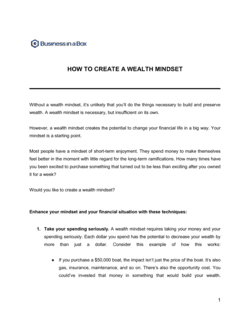
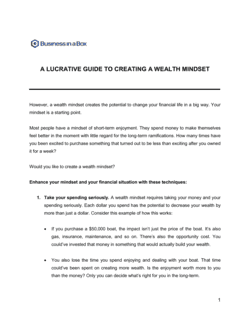
Strategies For Building Wealth

Free Word download • Edit online • Save & share with Drive • Export to PDF

2 pages20–30 min to fillDifficulty: StandardSignature requiredLegal review recommended
Learn more ↓
FreeStrategies For Building Wealth Template

At a glance

What it is
A Strategies For Building Wealth document is a formal, binding personal financial plan and policy statement that defines an individual's or household's investment objectives, asset allocation targets, risk tolerance, debt reduction framework, and long-term wealth accumulation milestones. This free Word download gives you a structured, adviser-ready starting point you can edit online and export as PDF to share with financial planners, fiduciaries, or co-signatories.
When you need it
Use it when formalizing a long-term investment policy with a financial adviser, establishing shared financial goals within a partnership or household, or documenting a structured wealth-building plan required by a fiduciary relationship or private banking arrangement.
What's inside
Parties and objectives, risk tolerance declaration, asset allocation policy, debt reduction schedule, income and savings targets, investment vehicle selection, tax strategy, estate and succession provisions, review cadence, and governing law.

What is a Strategies For Building Wealth Document?

A Strategies For Building Wealth document is a formal, binding personal financial policy statement that defines an individual's or household's investment objectives, asset allocation targets, risk tolerance thresholds, savings rate commitments, debt elimination schedule, tax-optimization approach, and long-term wealth accumulation milestones. Unlike an informal financial checklist, this document creates enforceable obligations between co-participants and provides the structured instruction set a financial adviser or fiduciary must follow when managing assets on the participant's behalf. It covers the full wealth lifecycle — from a documented net worth baseline through accumulation, retirement drawdown, and estate transfer — in a single, auditable record.

Why You Need This Document

Without a written wealth strategy, financial decisions default to habit and impulse rather than a consistent policy — and the compounding cost of inconsistency over a 20-year period is substantial. Advisers operating without a documented client policy statement lack a clear mandate, which creates suitability disputes, misaligned asset allocations, and missed tax optimization opportunities. Co-participants — spouses, partners, or business co-owners — making independent financial decisions without shared written goals routinely accumulate conflicting asset positions and duplicated liabilities. Regulators in the US, Canada, and the UK increasingly expect documented evidence that wealth strategies were established and followed; without it, fiduciary relationships are harder to defend and harder to enforce. This template gives you a professionally structured, adviser-ready document you can complete in hours rather than weeks — closing the gap between financial intention and binding financial policy.

Which variant fits your situation?

If your situation is…Use this template
Establishing a long-term personal investment policy with an adviserInvestment Policy Statement
Documenting financial goals within a marriage or domestic partnershipHousehold Financial Plan
Planning business owner exit and personal wealth transitionBusiness Exit and Wealth Transition Plan
Outlining a retirement income drawdown strategyRetirement Income Plan
Mapping a debt elimination and credit-building programDebt Reduction Plan
Documenting an estate and succession strategy alongside wealth plansEstate Planning Worksheet
Defining a tax-efficient charitable giving strategy as part of wealth buildingCharitable Giving Plan

Common mistakes to avoid

❌ Setting vague, unquantified wealth goals

Why it matters: A goal of 'become wealthy' or 'retire comfortably' provides no measurable threshold, making it impossible to evaluate whether the plan is on track or when to adjust.

Fix: Attach a specific dollar amount and target date to every goal — e.g., '$2M in investable assets by age 60' — so progress can be measured annually against a concrete benchmark.

❌ Omitting the net worth baseline

Why it matters: Without a documented starting point, there is no way to measure wealth accumulation progress or attribute it to specific strategy decisions over time.

Fix: Complete Schedule A with current balances for every asset and liability on the same valuation date before executing the document.

❌ Declaring risk tolerance without a drawdown limit

Why it matters: Labels like 'moderate' mean different things to different advisers; without a quantified maximum drawdown, the adviser has no objective trigger for rebalancing or raising a concern.

Fix: Pair every risk tolerance label with a maximum acceptable peak-to-trough drawdown percentage — e.g., 'moderate: no more than 20% in any rolling 12-month period.'

❌ No scheduled review or amendment process

Why it matters: Tax laws, interest rates, income levels, and personal circumstances change significantly over a 5–10 year period; a plan without a review schedule becomes a historical document, not an active strategy.

Fix: Embed a minimum annual review date in the document and list at least five life events — marriage, divorce, birth of a child, job change, inheritance — that trigger an unscheduled review.

❌ Specifying savings targets in dollars rather than percentages

Why it matters: A fixed dollar target produces a declining savings rate as income grows, meaning the participant systematically undersaves relative to their actual wealth-building capacity.

Fix: Express the savings commitment as a minimum percentage of gross annual income, reviewed and updated at each annual plan review.

❌ Ignoring asset location across account types

Why it matters: Holding tax-inefficient assets (high-turnover bonds, REITs) in taxable accounts while keeping tax-efficient index funds in IRAs inverts the optimal structure and increases the lifetime tax burden by tens of thousands of dollars.

Fix: Document an explicit asset-location policy: place tax-inefficient assets in tax-deferred or tax-exempt accounts and tax-efficient assets in taxable accounts.

The 10 key clauses, explained

Parties, Purpose, and Effective Date

In plain language: Identifies the individual(s) or household parties to the plan, states the overarching wealth-building purpose, and records the date the document takes effect.

Sample language
This Wealth Building Strategy is entered into as of [DATE] by [FULL LEGAL NAME(S)] ('Participant(s)'). The purpose of this document is to formalize the Participant's financial objectives, investment policy, and wealth accumulation framework.

Common mistake: Using a nickname or informal name instead of the full legal name as it appears on tax and financial account documents — creating a mismatch with brokerage and estate records.

Financial Goals and Time Horizon

In plain language: States specific, quantified wealth targets and the timeline for reaching each one — separating short-term (1–3 years), medium-term (3–10 years), and long-term (10+ years) objectives.

Sample language
Short-term goal: accumulate $[AMOUNT] in a liquid emergency reserve by [DATE]. Medium-term goal: reach a net worth of $[AMOUNT] by [YEAR]. Long-term goal: achieve financial independence with investable assets of $[AMOUNT] by age [AGE].

Common mistake: Setting aspirational goals without a defined time horizon or measurable threshold — making it impossible to evaluate progress or trigger a plan review.

Net Worth Baseline and Asset Inventory

In plain language: Documents the current financial position — all assets and liabilities — to establish a starting baseline against which future wealth growth is measured.

Sample language
As of [DATE], Participant's total assets are valued at $[AMOUNT], total liabilities are $[AMOUNT], and net worth is $[AMOUNT]. Asset detail is set out in Schedule A.

Common mistake: Omitting illiquid assets — closely held business equity, real estate equity, or pension value — which can distort the true net worth picture and skew allocation decisions.

Risk Tolerance and Investment Constraints

In plain language: Declares the participant's risk tolerance level, maximum acceptable portfolio drawdown, and any investment constraints such as excluded sectors, ESG criteria, or concentration limits.

Sample language
Participant's risk tolerance is [CONSERVATIVE / MODERATE / AGGRESSIVE]. Maximum acceptable annual drawdown: [X]%. Excluded asset classes: [LIST]. ESG screen: [NONE / NEGATIVE SCREEN / POSITIVE SCREEN].

Common mistake: Stating risk tolerance as a vague label ('moderate') without a quantified drawdown limit — leaving the adviser with no objective trigger for rebalancing or escalation.

Asset Allocation Policy

In plain language: Sets target percentage allocations across asset classes and establishes rebalancing bands — the percentage deviation that triggers a rebalancing trade.

Sample language
Target allocation: Equities [X]%, Fixed Income [X]%, Real Estate [X]%, Alternatives [X]%, Cash [X]%. Rebalancing trigger: any asset class deviates more than [±X]% from target. Rebalancing frequency: at minimum [ANNUALLY / QUARTERLY].

Common mistake: Setting a target allocation without rebalancing bands — so the portfolio drifts significantly from policy over time without any documented trigger to correct it.

Savings Rate and Income Strategy

In plain language: Defines the minimum percentage of gross income to be saved and invested each year, priority order for account types, and strategy for increasing savings as income grows.

Sample language
Participant commits to saving a minimum of [X]% of gross annual income. Contribution priority: (1) employer 401(k) to full match, (2) HSA to annual limit, (3) Roth IRA to annual limit, (4) taxable brokerage account.

Common mistake: Specifying only a dollar amount rather than a percentage — as income grows, a fixed dollar target produces a declining savings rate that underperforms the wealth goal.

Debt Reduction and Credit Strategy

In plain language: Identifies all outstanding liabilities, prioritizes repayment order, and sets a target debt-free date for each category.

Sample language
Outstanding liabilities: [MORTGAGE — $X at X%, target payoff YEAR], [AUTO LOAN — $X at X%, target payoff YEAR], [STUDENT LOAN — $X at X%, target payoff YEAR]. Repayment method: [AVALANCHE / SNOWBALL]. Target consumer-debt-free date: [DATE].

Common mistake: Treating all debt identically — paying minimum balances across all accounts when concentrating on the highest-rate debt first (avalanche method) would reduce total interest paid substantially.

Tax Strategy and Account Optimization

In plain language: Documents the tax-advantaged accounts to be used, the approach to tax-loss harvesting, and the asset-location strategy — placing tax-inefficient assets in tax-advantaged accounts.

Sample language
Tax-advantaged accounts: 401(k) at [PROVIDER], Roth IRA at [PROVIDER], HSA at [PROVIDER]. Asset location policy: bonds and REITs held in tax-deferred accounts; equities held in taxable accounts. Tax-loss harvesting: reviewed [ANNUALLY / QUARTERLY].

Common mistake: Placing tax-efficient index funds inside a tax-deferred IRA and holding high-turnover bond funds in a taxable account — inverting the optimal asset-location strategy and increasing the lifetime tax burden.

Review, Amendment, and Accountability

In plain language: Establishes a scheduled review cadence, defines the events that trigger an unscheduled review, and identifies who is responsible for initiating amendments.

Sample language
This plan shall be reviewed no less than [ANNUALLY] by the Participant and [ADVISER / ACCOUNTABILITY PARTNER]. A review is also triggered by: change in marital status, birth or adoption of a child, income change exceeding [X]%, or net worth milestone reached. Amendments require written agreement of all Parties.

Common mistake: No defined review schedule — the plan is filed and forgotten, becoming irrelevant as income, tax law, and market conditions change.

Governing Law and Entire Agreement

In plain language: Specifies the jurisdiction whose laws govern the document and confirms it supersedes all prior financial planning discussions, letters, and informal agreements.

Sample language
This Agreement is governed by the laws of [STATE / PROVINCE / COUNTRY]. This document constitutes the entire wealth strategy agreement between the Parties and supersedes all prior discussions, correspondence, and understandings relating to the subject matter herein.

Common mistake: Omitting a governing-law clause when parties or advisers operate across multiple states or provinces — creating ambiguity about which statutory framework and fiduciary standards apply.

How to fill it out

  1. 1

    Record all parties and set an effective date

    Enter full legal names of all participants as they appear on financial and tax accounts. Set an effective date that aligns with the start of a calendar quarter or tax year for cleaner record-keeping.

    💡 If a financial adviser is a formal party, include their registration number and firm name to satisfy compliance documentation requirements.

  2. 2

    Define specific, time-bound financial goals

    Write at least one goal for each time horizon — short (1–3 years), medium (3–10 years), and long-term (10+ years). Each goal must include a dollar amount and a target date.

    💡 Anchor long-term goals to a specific financial independence number — annual spending divided by 0.04 (the 4% rule) gives a useful starting target.

  3. 3

    Complete the net worth baseline and Schedule A

    List every asset (checking, savings, brokerage, retirement accounts, real estate equity, business equity) and every liability (mortgage, auto, student, credit card) with current balances.

    💡 Use the same valuation date for all assets — the first business day of the current month — so the baseline is internally consistent.

  4. 4

    Declare risk tolerance with a quantified drawdown limit

    Choose a tolerance label (conservative, moderate, aggressive) and pair it with a maximum acceptable drawdown — e.g., 'moderate, maximum 20% peak-to-trough decline in any 12-month period.'

    💡 Test your stated tolerance against historical drawdowns: the S&P 500 fell 34% in 2020 and 57% in 2008–2009. Would you hold, or would you sell?

  5. 5

    Set asset allocation targets and rebalancing bands

    Assign target percentages to each asset class. Set rebalancing bands at ±5% for most classes — meaning if equities drift from 60% to 65%, a rebalancing trade is triggered.

    💡 Keep the allocation simple enough to execute: three to five asset classes is sufficient for most individual wealth plans.

  6. 6

    Document savings rate, debt payoff, and account priority

    Set a minimum savings rate as a percentage of gross income, list debts in payoff-priority order with target dates, and define which accounts to fund first each year.

    💡 Always capture the full employer 401(k) match before funding any other account — it is an immediate 50–100% return on the contributed dollar.

  7. 7

    Define the review schedule and amendment process

    Set a minimum annual review date (linked to a recurring calendar event), list life events that trigger an unscheduled review, and specify that amendments require written signatures from all parties.

    💡 Schedule the annual review in January to align with tax season — you will have year-end account statements available and can coordinate with your tax filing.

  8. 8

    Execute the document before acting on the strategy

    All parties must sign the document before implementing any investment or debt-payoff decisions governed by it. Retain a signed copy with your financial records and provide a copy to your adviser if applicable.

    💡 Use a dated, witnessed signature block — not just an electronic checkbox — if the document will be shared with a fiduciary or financial institution.

Frequently asked questions

What is a Strategies For Building Wealth document?

A Strategies For Building Wealth document is a formal written plan that defines an individual's or household's financial goals, asset allocation policy, savings rate commitments, debt reduction schedule, tax strategy, and wealth review process. It functions as both a binding personal policy statement and a communication tool between the participant and any financial adviser, fiduciary, or co-planning partner.

Is a wealth-building strategy document legally binding?

When properly executed by all parties, the document is generally enforceable as a contract in most jurisdictions — particularly the fiduciary obligations, amendment procedures, and governing-law clauses. However, the enforceability of specific financial commitments between private individuals varies by jurisdiction. Consider consulting a financial or legal adviser to confirm how the document interacts with applicable fiduciary and consumer-protection laws in your location.

Who should sign a wealth-building strategy document?

At minimum, all participating individuals — spouses, domestic partners, or co-investors — should sign. If a registered financial adviser or wealth manager is implementing the strategy, include them as a formal party with their registration details. A witness or notary is advisable when the document accompanies estate planning or fiduciary arrangements.

How is this different from a financial plan prepared by an adviser?

A financial plan prepared by an adviser is typically a proprietary analysis document the adviser owns and delivers to the client. A Strategies For Building Wealth document is a policy statement the participant controls — it sets the parameters the adviser must follow. Think of the adviser's plan as the research and the wealth strategy document as the binding instruction set derived from that research.

How often should a wealth-building strategy be updated?

A formal annual review is the minimum standard. In practice, any significant life event — marriage, divorce, birth of a child, job change, inheritance, major market dislocation, or approach of a key milestone — should trigger an unscheduled review. Plans more than 18 months old without an update are unlikely to reflect current income, tax laws, or financial circumstances accurately.

What financial accounts should be listed in the document?

Include every account that contributes to or detracts from net worth: checking and savings accounts, brokerage and investment accounts, all retirement accounts (401(k), IRA, Roth IRA, pension, RRSP, ISA), real estate equity, closely held business interests, and all liabilities including mortgage, auto loans, student loans, and credit card balances. A complete Schedule A is essential for an accurate baseline.

Can I use this document without a financial adviser?

Yes — many individuals use a wealth-building strategy document as a self-directed personal policy statement, sometimes with an accountability partner rather than a licensed adviser. However, if the strategy involves complex tax planning, trust or estate structures, significant business equity, or cross-border assets, engaging a registered financial planner or tax attorney is typically worthwhile.

What is the difference between a wealth-building strategy and a budget?

A budget is a monthly or annual spending and income plan — a tactical cash-flow tool. A wealth-building strategy is a long-horizon policy document that governs investment allocation, savings rates, debt elimination, tax structure, and estate provisions over a 10–30 year period. A budget supports the strategy by ensuring the month-to-month cash flows needed to fund savings commitments are available.

Should this document be stored with estate planning documents?

Yes. A wealth-building strategy that includes asset allocation policy, account inventory, and estate provisions should be stored alongside — or referenced by — your will, trust documents, power of attorney, and beneficiary designation records. This ensures that executors and trustees have a complete picture of the financial structure in place.

How this compares to alternatives

vs Investment Policy Statement

An investment policy statement (IPS) focuses narrowly on portfolio management parameters — asset allocation, benchmarks, rebalancing rules, and prohibited investments — and is typically maintained by a registered adviser. A Strategies For Building Wealth document is broader, covering savings rates, debt reduction, tax strategy, and estate provisions alongside the investment policy. The IPS is a subset of the wealth strategy.

vs Financial Plan (Adviser-Prepared)

An adviser-prepared financial plan is an analytical deliverable — projections, scenarios, and recommendations — that the adviser produces and delivers to the client. A Strategies For Building Wealth document is the binding policy statement the participant controls, setting the parameters the adviser must follow. The two documents are complementary: the financial plan informs the strategy; the strategy governs execution.

vs Retirement Plan

A retirement plan focuses on the accumulation and drawdown of assets for post-work income — contribution rates, account types, and withdrawal sequencing. A Strategies For Building Wealth document covers the full wealth lifecycle from current net worth baseline through retirement and estate transfer. Use the retirement plan as a component of — or an appendix to — the broader wealth strategy.

vs Personal Budget Template

A personal budget manages monthly cash inflows and outflows — income, expenses, and short-term savings. A Strategies For Building Wealth document governs long-horizon decisions: asset allocation, debt elimination timelines, tax structure, and estate provisions over 10–30 years. The budget is a tactical tool that funds the strategic commitments defined in the wealth strategy.

Industry-specific considerations

Financial Services and Wealth Management

Advisers use the document to satisfy fiduciary documentation obligations, record client-directed investment policy, and demonstrate suitability compliance under FINRA, FCA, or provincial securities regulations.

Legal and Professional Services

High-earning lawyers, accountants, and consultants use the document to formalize personal wealth separation from professional practice equity and coordinate with estate planning counsel.

Technology and SaaS

Startup founders and executives document personal wealth diversification plans to manage concentration risk from unvested equity and plan for liquidity events or secondary sales.

Real Estate and Construction

Investors and developers use the strategy document to separate active real estate income from long-term portfolio assets and define reinvestment vs. distribution policies across projects.

Healthcare

Physicians and medical practice owners document personal wealth plans that account for student loan elimination, practice buyout obligations, and late-career retirement savings catch-up strategies.

Manufacturing and Closely Held Business

Business owners document personal wealth accumulation strategies independently from business reinvestment plans, with explicit triggers for drawing dividends or initiating a succession-driven exit.

Jurisdictional notes

United States

Registered investment advisers (RIAs) are subject to SEC or state fiduciary standards and typically require a documented investment policy statement from clients. Tax-advantaged account limits (401(k), IRA, HSA) are set annually by the IRS and should be referenced by limit category rather than specific dollar amounts to avoid annual amendments. State community property laws in California, Texas, Arizona, and eight other states affect how jointly held assets are characterized in the document.

Canada

Canadian wealth strategy documents should reference TFSA, RRSP, and FHSA contribution room rather than US account types. Provincial securities commissions regulate adviser suitability and Know Your Client (KYC) obligations, which a documented wealth strategy helps satisfy. Quebec civil law differs from common-law provinces in how financial agreements between spouses are interpreted — Quebec residents should have the document reviewed by a notary.

United Kingdom

UK wealth strategies should reference ISA annual allowances, pension annual allowance and lifetime allowance considerations, and the role of onshore and offshore bonds in tax planning. The Financial Conduct Authority (FCA) requires advisers to demonstrate suitability — a documented client wealth strategy supports this obligation. Inheritance tax planning (currently 40% on estates above £325,000) is a material consideration that should be referenced in the estate provisions clause.

European Union

EU member states vary significantly in wealth tax regimes — Spain, Norway, and Switzerland impose annual wealth taxes that materially affect accumulation strategy. The EU's MiFID II directive requires investment firms to assess and document client suitability and risk tolerance, which a formal wealth strategy document supports. GDPR considerations apply when sharing the document electronically with advisers or institutions — ensure data handling clauses are consistent with applicable privacy obligations.

Template vs lawyer — what fits your deal?

PathBest forCostTime
Use the templateIndividuals and couples establishing a self-directed personal wealth policy without complex estate or cross-border considerationsFree2–4 hours
Template + legal reviewHigh-income individuals, business owners with practice equity, or anyone working with a registered financial adviser who requires a documented IPS$300–$800 (financial planner or attorney review)1–5 days
Custom draftedUltra-high-net-worth individuals, cross-border asset structures, trust and estate integration, or fiduciary relationships requiring regulatory documentation$2,000–$10,000+2–6 weeks

Glossary

Investment Policy Statement (IPS)
A formal document that defines an investor's goals, risk tolerance, time horizon, and asset allocation guidelines — used by advisers to make investment decisions on the client's behalf.
Asset Allocation
The percentage distribution of a portfolio across asset classes such as equities, fixed income, real estate, and cash equivalents.
Risk Tolerance
The degree of variability in investment returns an individual is willing to accept, expressed as conservative, moderate, or aggressive — or as a maximum acceptable drawdown percentage.
Net Worth
Total assets minus total liabilities at a point in time — the primary metric for tracking wealth accumulation progress.
Compound Growth
The process by which investment returns generate their own returns over time, producing exponential rather than linear wealth growth.
Fiduciary Duty
The legal obligation of a financial adviser to act solely in the client's best financial interest, not merely to recommend suitable products.
Drawdown
The peak-to-trough decline in portfolio value over a specified period — used as a risk measurement metric and a trigger for rebalancing.
Rebalancing
Periodically buying and selling assets to restore a portfolio to its target allocation after market movements have shifted the actual percentages.
Tax-Advantaged Account
A government-designated account — such as a 401(k), IRA, TFSA, ISA, or RRSP — that defers or eliminates tax on contributions, growth, or withdrawals.
Liquidity Reserve
Cash or near-cash assets set aside to cover 3–6 months of living expenses, kept outside investment portfolios to avoid forced selling in downturns.
Estate Plan
The set of legal documents — will, trust, power of attorney, and beneficiary designations — that govern how wealth is transferred at death or incapacity.

Part of your Business Operating System

This document is one of 3,000+ business & legal templates included in Business in a Box.

  • Fill-in-the-blanks — ready in minutes
  • 100% customizable Word document
  • Compatible with all office suites
  • Export to PDF and share electronically

Create your document in 3 simple steps.

From template to signed document — all inside one Business Operating System.
1
Download or open template

Access over 3,000+ business and legal templates for any business task, project or initiative.

2
Edit and fill in the blanks with AI

Customize your ready-made business document template and save it in the cloud.

3
Save, Share, Send, Sign

Share your files and folders with your team. Create a space of seamless collaboration.

Save time, save money, and create top-quality documents.

★★★★★

"Fantastic value! I'm not sure how I'd do without it. It's worth its weight in gold and paid back for itself many times."

Managing Director · Mall Farm
Robert Whalley
Managing Director, Mall Farm Proprietary Limited
★★★★★

"I have been using Business in a Box for years. It has been the most useful source of templates I have encountered. I recommend it to anyone."

Business Owner · 4+ years
Dr Michael John Freestone
Business Owner
★★★★★

"It has been a life saver so many times I have lost count. Business in a Box has saved me so much time and as you know, time is money."

Owner · Upstate Web
David G. Moore Jr.
Owner, Upstate Web

Run your business with a system — not scattered tools

Stop downloading documents. Start operating with clarity. Business in a Box gives you the Business Operating System used by over 250,000 companies worldwide to structure, run, and grow their business.

Free Forever Plan · No credit card required