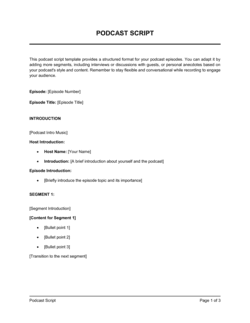
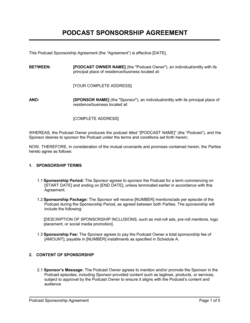
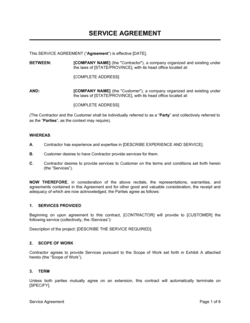
Starting A Podcast To Market Your Business Template

Free Word download • Edit online • Save & share with Drive • Export to PDF

3 pages25–30 min to fillDifficulty: StandardSignature requiredLegal review recommended
Learn more ↓
FreeStarting A Podcast To Market Your Business Template

At a glance

What it is
A Starting A Podcast To Market Your Business agreement is a legally binding document that governs the relationship between a business launching a branded podcast and any guests, co-hosts, production contractors, or sponsors involved. This free Word download covers IP assignment, content release, recording consent, editorial control, sponsorship terms, and distribution rights in a single template you can edit online and export as PDF.
When you need it
Use it before recording your first episode — whether you are bringing on a guest, engaging a podcast producer, formalizing a sponsorship deal, or establishing internal ownership of the content your team creates. It is especially important when the podcast will feature third-party voices, proprietary business content, or paid promotional mentions.
What's inside
Parties and podcast description, recording consent and release, IP and content ownership assignment, editorial control and approval rights, sponsorship and advertising terms, distribution and repurposing rights, guest and host obligations, confidentiality, term and termination, and governing law.

What is a Starting A Podcast To Market Your Business Agreement?

A Starting A Podcast To Market Your Business agreement is a legally binding document that governs every material relationship involved in producing and distributing a branded business podcast — including guest appearances, contractor production services, sponsorship integrations, and content distribution rights. It establishes who owns the recordings, who controls editorial decisions, who can repurpose content, and what participants consent to before a single episode is recorded. Unlike informal email confirmations or verbal arrangements, a signed agreement creates enforceable obligations and eliminates the legal ambiguity that arises when podcast content features third-party voices, proprietary business information, or paid promotional mentions.

Why You Need This Document

Launching a podcast without a signed agreement exposes your business to four serious risks simultaneously. First, any freelance producer, editor, or composer you engage retains copyright over their work product until it is explicitly assigned in writing — meaning you may not own your own episodes. Second, recording guests without documented all-party consent violates wiretapping statutes in 15 US states, Canada, and across the EU, with criminal penalties in the most serious cases. Third, using a guest's name or likeness in paid promotional clips without explicit authorization creates right-of-publicity liability that a post-production legal dispute cannot easily undo. Fourth, undisclosed paid sponsorships violate FTC guidelines and equivalent regulations in the UK and Canada, regardless of whether the disclosure obligation was agreed in writing. A properly executed podcast agreement, signed before the first recording session, closes all four gaps — and this template gives you the structure to do it in under 30 minutes.

Which variant fits your situation?

If your situation is…Use this template
Recording a single guest interview episodePodcast Guest Release Form
Engaging a freelance audio editor or producerIndependent Contractor Agreement
Formalizing a paid sponsorship or ad-read dealPodcast Sponsorship Agreement
Co-hosting a podcast with a business partnerJoint Venture Agreement
Licensing existing podcast episodes to another platformContent Licensing Agreement
Protecting proprietary business information discussed on airNon-Disclosure Agreement
Commissioning a full podcast series from a production companyMedia Production Agreement

Common mistakes to avoid

❌ No IP assignment for freelance producers

Why it matters: Without a written assignment, a freelance audio editor or producer retains copyright in their edits, music selections, and production elements — meaning the business does not own its own episodes.

Fix: Include an IP assignment clause covering all contractor deliverables and add a backup assignment for rights that cannot transfer as work-for-hire under the governing jurisdiction's copyright law.

❌ Verbal recording consent only

Why it matters: In two-party-consent US states (California, Florida, and 13 others), recording a conversation without documented consent from all parties constitutes a criminal offense, not just a civil one.

Fix: Obtain written consent in the signed agreement before recording begins. For spontaneous or short-notice recordings, a brief email acknowledgment confirming consent is better than nothing but a signed agreement is the correct standard.

❌ Granting editorial approval rights to guests without a response deadline

Why it matters: An open-ended approval right gives the guest an indefinite veto. Episodes can sit unpublished for weeks while a guest delays review — stalling your content calendar and marketing pipeline.

Fix: If you grant review rights at all, cap the response window at 48–72 hours and state that silence constitutes approval. Document this in the agreement, not just in an email.

❌ No FTC-required sponsorship disclosure obligation

Why it matters: The FTC has issued civil penalties for undisclosed paid endorsements in podcasts. Without a contractual obligation to disclose, neither party is accountable and both face regulatory exposure.

Fix: Include a clause requiring the Host to include a verbal and written FTC-compliant disclosure in every sponsored episode, and add a Schedule A listing current sponsors and the nature of each material relationship.

❌ Listing specific distribution platforms without a forward-looking catch-all

Why it matters: A contract that names only Spotify and Apple Podcasts leaves the business in a grey area if it later distributes on YouTube, Amazon Music, or a proprietary app — technically outside the consent granted.

Fix: After listing current platforms, add 'and any other audio or video distribution channels selected by Host from time to time' to cover future expansion without requiring fresh consent.

❌ No takedown or episode removal clause

Why it matters: Without a documented takedown right, a guest who is later involved in litigation, reputational controversy, or who simply changes their mind can argue the business has no right to unpublish the episode — or conversely, that the business is obligated to keep it up.

Fix: Include a Host-only unilateral takedown right and a limited guest takedown request procedure triggered only by documented legal violations. Both protections belong in the same clause.

The 10 key clauses, explained

Parties and Podcast Description

In plain language: Identifies the business host, any guests or co-hosts, and describes the podcast by name, format, subject matter, and intended distribution channels.

Sample language
This Agreement is entered into between [BUSINESS LEGAL NAME] ('Host') and [GUEST / CONTRACTOR FULL NAME] ('Participant') regarding the podcast series titled '[PODCAST NAME],' a [DESCRIPTION] distributed via [PLATFORMS].

Common mistake: Using the podcast brand name instead of the business's registered legal entity. If a dispute arises, enforcement actions must be brought by the legal entity — mismatches create standing problems.

Recording Consent and Release

In plain language: Obtains the participant's written consent to be recorded and releases the business from liability for the authorized use of that recording.

Sample language
Participant irrevocably consents to being recorded in audio and video format and releases [BUSINESS LEGAL NAME] from any claims arising from the authorized use, reproduction, and distribution of such recordings worldwide.

Common mistake: Relying on verbal consent obtained before recording begins. In two-party-consent US states and under the UK GDPR, verbal consent is difficult to document and may not satisfy the required standard.

Intellectual Property Ownership

In plain language: Assigns ownership of all podcast content — episodes, show notes, transcripts, artwork, and music — to the business, and addresses work-made-for-hire for contractor contributions.

Sample language
All recordings, scripts, show art, transcripts, and derivative works produced in connection with the podcast are the sole property of [BUSINESS LEGAL NAME] and are deemed works made for hire to the maximum extent permitted by law. Any rights not automatically vesting are hereby irrevocably assigned.

Common mistake: No IP assignment clause when working with a freelance producer. Under US and UK copyright law, a contractor retains ownership of their work unless a written assignment exists — leaving the business without clear title to its own episodes.

Likeness and Name Rights

In plain language: Grants the business the right to use the participant's name, voice, image, and biography in the podcast and in promotional materials for the podcast.

Sample language
Participant grants [BUSINESS LEGAL NAME] a perpetual, royalty-free, worldwide license to use Participant's name, voice, likeness, and biographical information to promote and distribute the podcast and related content.

Common mistake: Granting likeness rights for 'the podcast' without specifying promotional use. Businesses frequently clip episodes for paid ads — using a guest's likeness in paid advertising without explicit permission creates right-of-publicity exposure.

Editorial Control and Approval Rights

In plain language: Clarifies that the business retains final editorial authority and specifies whether guests have any review or approval rights before an episode is published.

Sample language
Host retains sole editorial discretion over all content, editing, and publication decisions. Participant acknowledges that no pre-publication review or approval rights are granted unless expressly agreed in writing.

Common mistake: Promising guests informal pre-publication review without documenting it. An undocumented approval promise can give the guest grounds to block or delay publication — or to claim breach if you publish without their sign-off.

Distribution and Repurposing Rights

In plain language: Grants the business the right to publish episodes on specified platforms and to repurpose content as clips, transcripts, blog posts, and social media assets.

Sample language
Host is authorized to distribute episodes via [LIST OF PLATFORMS] and to repurpose recordings as video clips, written transcripts, email content, and social media posts without further consent or compensation to Participant.

Common mistake: Listing only current platforms without a catch-all for future channels. Platforms change — without a forward-looking clause, the business may need fresh consent every time it expands distribution.

Sponsorship and Advertising Terms

In plain language: Addresses paid sponsorship integrations — who controls ad content, what disclosures are required, and how revenue is allocated if a co-host or guest shares in sponsorship income.

Sample language
Host reserves the right to include paid sponsorship integrations in all episodes. Host will include FTC-compliant disclosures for all material relationships. Unless otherwise agreed in Schedule A, Participant receives no share of sponsorship revenue.

Common mistake: No FTC disclosure clause. Under FTC guidelines, failure to disclose paid sponsorships or gifted products can result in enforcement action — and the lack of a contractual obligation to disclose creates no accountability for either party.

Confidentiality

In plain language: Prevents participants and contractors from disclosing non-public business information they encounter through podcast involvement — business strategy, customer data, or unreleased products.

Sample language
Participant agrees not to disclose any Confidential Information of [BUSINESS LEGAL NAME] obtained through participation in the podcast. 'Confidential Information' includes business strategies, customer data, financial results, and any information marked confidential.

Common mistake: No confidentiality clause when guests include competitors, journalists, or industry analysts. Podcast pre-interviews frequently expose business metrics, product roadmaps, or customer details that the business has not yet made public.

Term, Termination, and Episode Takedown

In plain language: Sets the contract duration, specifies grounds for early termination by either party, and addresses whether and under what conditions an episode can be taken down after publication.

Sample language
This Agreement commences on [START DATE] and continues until terminated by either party on [X] days' written notice. Host reserves the right to remove any episode from distribution at its sole discretion. Participant may request takedown only upon documented legal violation by Host.

Common mistake: No takedown provision. Without one, a guest who later becomes the subject of litigation — or whose views create reputational risk — has no clear contractual path for requesting removal, and the business has no documented right to remove the episode unilaterally.

Governing Law and Dispute Resolution

In plain language: Specifies which jurisdiction's law governs the agreement and how disputes are handled — arbitration, mediation, or court proceedings.

Sample language
This Agreement is governed by the laws of [STATE / PROVINCE / COUNTRY]. Any dispute arising hereunder shall be submitted to binding arbitration administered by [AAA / JAMS / ICDR] in [CITY], except claims for injunctive relief relating to IP or confidentiality.

Common mistake: Choosing a governing law with no connection to where the business or guest operates. International podcast guests may be subject to local privacy laws — GDPR, PIPEDA, or UK GDPR — regardless of what the contract specifies as governing law.

How to fill it out

  1. 1

    Enter legal entity names and the podcast description

    Use the business's full registered corporate name — not the podcast brand name — and the participant's legal name as it appears on government ID. Describe the podcast by name, format (interview, solo, panel), topics covered, and intended platforms.

    💡 List every distribution platform you currently use and add a catch-all phrase such as 'and any future platforms selected by Host' to avoid needing amendments as your distribution expands.

  2. 2

    Complete the recording consent block

    Confirm that consent covers both audio and video recording, worldwide distribution, and any synchronized use such as YouTube video podcasts. Note whether consent is episode-specific or covers the participant's recurring involvement.

    💡 For recurring co-hosts, a single master agreement covering all episodes is cleaner than per-episode consents — but make sure the agreement's scope is explicitly unlimited in episode count.

  3. 3

    Tailor the IP ownership and work-made-for-hire clause

    If engaging a freelance producer, editor, or composer, confirm the work-made-for-hire language applies to their deliverables and add a backup assignment clause for rights that cannot be transferred as work-for-hire under applicable law.

    💡 In the UK and Canada, 'work made for hire' does not operate the same way it does under US copyright law — always include an explicit assignment clause as a belt-and-suspenders measure.

  4. 4

    Define likeness rights and promotional scope

    Specify whether the likeness grant covers organic social posts only, or also paid advertising. If you plan to run paid clips featuring the guest, include explicit language authorizing use in paid digital advertising.

    💡 Right-of-publicity claims are among the most common disputes in podcast marketing — spending 60 seconds expanding the likeness clause now is cheaper than a cease-and-desist letter after you've paid for an ad campaign.

  5. 5

    Set editorial control and any guest review rights

    If you are willing to give guests a short review window — common for high-profile executives — document the timeline explicitly: e.g., 'Participant has 48 hours to flag factual errors; failure to respond constitutes approval.'

    💡 Avoid granting approval rights to guests if you can. A courtesy review window with a short response deadline preserves your publishing schedule without creating a veto right.

  6. 6

    Add the sponsorship and FTC disclosure clause

    List any current sponsors by name in a Schedule A, and include a forward-looking clause covering future sponsors. Confirm that the FTC disclosure obligation is explicitly assigned to the Host rather than left ambiguous.

    💡 If a guest is also an affiliate or has a paid relationship with any product mentioned in the episode, document it here — both the FTC and the UK ASA treat non-disclosure of affiliate relationships as a violation.

  7. 7

    Set the term, termination notice, and takedown rights

    For recurring participants, set a defined notice period for termination — 30 days is standard. Include an explicit Host-only right to remove any episode from distribution at any time without compensation.

    💡 A unilateral takedown right protects the business if a guest is later involved in legal proceedings, reputational events, or if episode content becomes legally problematic — include it even if you expect never to use it.

  8. 8

    Execute before recording begins

    Both parties must sign the agreement before the recording session. Post-recording signatures raise consent and consideration questions — the recording already exists, and the participant has given nothing new in exchange for restrictions.

    💡 Send the agreement at the same time as the recording scheduling confirmation. Framing it as standard onboarding paperwork reduces friction and avoids last-minute negotiation on recording day.

Frequently asked questions

Do I need a contract to start a business podcast?

Yes — for any podcast involving guests, contractors, or sponsors, a written agreement is essential. Without one, you have no documented recording consent, no IP ownership over contractor-produced content, and no enforceable editorial control. For a fully solo podcast where you produce all content yourself, the risk is lower, but a contractor agreement is still needed the moment you hire an editor or producer.

Who owns the content on a business podcast?

By default, the creator of each contribution owns it. That means your freelance editor owns their edits, your guest owns their spoken words, and your composer owns the intro music — unless written agreements assign those rights to you. A properly drafted podcast agreement with an IP assignment clause transfers all content ownership to the business, which is essential for unencumbered distribution and repurposing.

Can a guest take down a podcast episode after it has been published?

Without a contract, a guest may have grounds to demand removal based on privacy law, right-of-publicity claims, or copyright in their own spoken contributions. With a properly signed agreement that includes a recording consent and release clause, the guest has irrevocably consented to publication and waived those claims for authorized uses. Include a clause in the agreement specifying that takedown requests are limited to documented legal violations only.

Do I need to disclose sponsorships on my business podcast?

Yes. The US Federal Trade Commission, the UK Advertising Standards Authority, and equivalent bodies in Canada and the EU require clear disclosure whenever a material relationship — paid placement, gifted products, or affiliate commission — exists between a podcaster and a brand mentioned on the show. Failure to disclose can result in civil enforcement action. Your podcast agreement should explicitly assign the disclosure obligation to the host and reference FTC or applicable local guidelines.

What is the difference between a podcast guest release and a full podcast agreement?

A guest release form is a narrower document focused on recording consent, likeness rights, and a liability release for a single appearance. A full podcast marketing agreement covers all of those elements plus IP assignment, editorial control, sponsorship terms, distribution rights, confidentiality, and termination — making it the appropriate choice for recurring participants, co-hosts, production contractors, and any episode involving business-sensitive content.

Can I repurpose podcast episodes as blog posts or social media clips without additional consent?

Only if your agreement explicitly grants repurposing rights. A recording consent covering distribution as an audio file does not automatically extend to video clips, written transcripts, email newsletter excerpts, or paid social advertisements. Include a broad repurposing clause in the agreement covering all derivative formats, and if you plan to use clips in paid ads, add explicit language authorizing paid advertising use of the guest's likeness.

Do podcast agreements need to be notarized?

No. A podcast marketing agreement does not require notarization to be enforceable in any major jurisdiction. Both parties' signatures — wet ink or electronic — are sufficient. Electronic signatures executed through a recognized platform are generally enforceable under the US E-SIGN Act, Canada's PIPEDA and provincial e-commerce statutes, and the UK Electronic Communications Act 2000.

What should I do if a guest refuses to sign a podcast agreement?

Do not record without documented consent — the legal and reputational risk outweighs any individual episode. If a guest objects to specific clauses, negotiate the scope of repurposing rights or the editorial approval window, which are the most common friction points. If a guest insists on retaining rights to their contribution, a narrow license in their favor — rather than a full assignment — may be an acceptable compromise, but have a lawyer review any material departures from your standard agreement.

How this compares to alternatives

vs Independent Contractor Agreement

An independent contractor agreement governs the engagement of a freelance producer, editor, or sound engineer — covering payment, deliverables, and IP assignment for production services. A podcast marketing agreement is broader, also covering guest consent, distribution rights, sponsorship terms, and editorial control. For a fully produced podcast, you typically need both documents: one for your production team and one for on-air participants.

vs Non-Disclosure Agreement

An NDA focuses exclusively on protecting confidential information shared between parties. A podcast agreement includes a confidentiality clause as one component but also addresses recording consent, IP ownership, likeness rights, and distribution — making it the appropriate document for podcast participants. Use a standalone NDA for pre-interview conversations before the full podcast agreement is signed.

vs Content Licensing Agreement

A content licensing agreement is used when a business already owns podcast content and wants to license specific episodes or clips to a third-party platform or publisher. A podcast marketing agreement is signed before content is created and governs the original production relationship. These documents operate at different stages: the marketing agreement creates the content; the licensing agreement monetizes or distributes it later.

vs Joint Venture Agreement

A joint venture agreement is appropriate when two businesses co-produce and co-own a podcast series as equal partners — sharing costs, revenue, and editorial responsibility. A podcast marketing agreement is designed for the more common scenario where one business owns the podcast and engages guests, contractors, or sponsors in defined supporting roles. Use a joint venture agreement when ownership and profit-sharing are genuinely split between two entities.

Industry-specific considerations

Professional Services

Law firms, accounting practices, and consultancies use branded podcasts to demonstrate subject-matter expertise — requiring strict confidentiality clauses to prevent inadvertent disclosure of client information during guest conversations.

SaaS / Technology

Tech companies use podcasts to build developer and buyer communities, often featuring competitor employees or analysts as guests — making non-disclosure and editorial control clauses especially important to protect unreleased product roadmaps.

Healthcare

Healthcare businesses must ensure podcast agreements prohibit the discussion of any patient information and include HIPAA-aligned confidentiality obligations, particularly when guests include clinicians or researchers.

Financial Services

Financial services firms face regulatory restrictions on investment commentary and advertising disclosures — podcast agreements should include compliance review rights and require FCA, SEC, or FINRA disclosure language in sponsored episodes.

Retail / E-commerce

E-commerce brands use podcasts to drive affiliate and influencer campaigns, making FTC-compliant sponsorship disclosure clauses and affiliate relationship documentation critical components of every episode agreement.

Creative and Marketing Agencies

Agencies producing branded podcasts for multiple clients need master production agreements with clear IP assignment ensuring all episode ownership flows to the client brand, not the agency.

Jurisdictional notes

United States

Recording consent law varies by state — 15 states require all-party consent, with California and Florida being the most consequential for podcast producers. The FTC requires clear disclosure of all material relationships in podcast content. Work-made-for-hire doctrine under the Copyright Act requires a written agreement to cover contractor contributions. Right-of-publicity laws vary significantly by state, with New York and California having the most developed statutory frameworks.

Canada

PIPEDA and provincial privacy legislation treat voice recordings as personal information requiring informed consent before collection and use. Quebec's Law 25 imposes additional obligations on data processing and consent documentation. Canadian copyright law does not recognize work-made-for-hire for independent contractors in the same way US law does — explicit written assignment clauses are essential. Non-compete and editorial control clauses must be reasonable in scope to be enforceable under provincial contract law.

United Kingdom

Voice recordings constitute personal data under the UK GDPR, requiring a documented lawful basis for processing — typically explicit consent. Moral rights under the Copyright, Designs and Patents Act 1988 cannot be fully waived by employees, though they can be waived by contractors in a written agreement. The UK Advertising Standards Authority (ASA) and CAP Code require clear labeling of paid podcast sponsorships. Electronic signatures are enforceable under the Electronic Communications Act 2000.

European Union

GDPR requires that recording consent be freely given, specific, informed, and unambiguous — pre-ticked boxes or bundled consent are not sufficient. Moral rights protections vary by member state but are generally stronger than in common-law jurisdictions. The EU Audiovisual Media Services Directive (AVMSD) may apply to video podcasts with significant audiences, requiring commercial communication disclosures. Cross-border podcast distribution involving EU residents' data requires GDPR-compliant data transfer mechanisms if processed outside the EEA.

Template vs lawyer — what fits your deal?

PathBest forCostTime
Use the templateSmall business owners and marketers starting a guest-interview or solo podcast with standard distribution and no paid sponsorshipsFree20–30 minutes per agreement
Template + legal reviewBusinesses adding recurring co-hosts, paid sponsorships, video distribution, or engaging professional production companies$300–$700 for a lawyer review session2–5 days
Custom draftedEnterprise podcast programs, cross-border productions with international guests, regulated industries (healthcare, finance), or podcasts with material sponsorship revenue$1,500–$4,000+1–3 weeks

Glossary

Recording Consent
A participant's explicit written permission to be recorded for audio and video, without which distributing the recording may expose the producer to privacy and wiretapping liability.
IP Assignment
A clause transferring ownership of content, recordings, scripts, and show art created in connection with the podcast to the business commissioning the work.
Editorial Control
The contractual right to approve, edit, or decline to publish content — specifying who has the final say over episode tone, messaging, and release timing.
Distribution Rights
The licensed permission to publish and distribute recordings across specified platforms — podcast directories, YouTube, social clips, and internal intranets.
Repurposing Rights
The right to convert podcast content into other formats — blog posts, video clips, email newsletters, and social media snippets — without additional guest consent.
Sponsorship Integration
A paid arrangement in which a brand's product or service is mentioned, read, or featured within an episode, typically governed by FTC disclosure requirements.
Moral Rights
An author's non-economic rights — primarily the right of attribution and the right to object to distortion of their work — which exist in many jurisdictions independently of copyright ownership.
Likeness Release
Written consent for a business to use a person's name, voice, image, and biographical information in connection with the podcast and related promotional materials.
FTC Disclosure
A statement required by the US Federal Trade Commission whenever a material connection exists between a podcaster and a brand being endorsed — including paid placements and free products.
Work Made for Hire
A US copyright doctrine under which work created by an employee within the scope of employment, or by a contractor under a written agreement, is owned by the commissioning party rather than the creator.
Territorial Scope
The geographic boundaries within which granted rights — distribution, licensing, or exclusivity — apply, which matters for international podcast audiences and GDPR compliance.

Part of your Business Operating System

This document is one of 3,000+ business & legal templates included in Business in a Box.

  • Fill-in-the-blanks — ready in minutes
  • 100% customizable Word document
  • Compatible with all office suites
  • Export to PDF and share electronically

Create your document in 3 simple steps.

From template to signed document — all inside one Business Operating System.
1
Download or open template

Access over 3,000+ business and legal templates for any business task, project or initiative.

2
Edit and fill in the blanks with AI

Customize your ready-made business document template and save it in the cloud.

3
Save, Share, Send, Sign

Share your files and folders with your team. Create a space of seamless collaboration.

Save time, save money, and create top-quality documents.

★★★★★

"Fantastic value! I'm not sure how I'd do without it. It's worth its weight in gold and paid back for itself many times."

Managing Director · Mall Farm
Robert Whalley
Managing Director, Mall Farm Proprietary Limited
★★★★★

"I have been using Business in a Box for years. It has been the most useful source of templates I have encountered. I recommend it to anyone."

Business Owner · 4+ years
Dr Michael John Freestone
Business Owner
★★★★★

"It has been a life saver so many times I have lost count. Business in a Box has saved me so much time and as you know, time is money."

Owner · Upstate Web
David G. Moore Jr.
Owner, Upstate Web

Run your business with a system — not scattered tools

Stop downloading documents. Start operating with clarity. Business in a Box gives you the Business Operating System used by over 250,000 companies worldwide to structure, run, and grow their business.

Start free · No credit card required