1
Identify the brand owner and any bound counterparty
Enter the full registered legal name of the brand-owning entity and the name of any partner, agency, or licensee who will be contractually bound by the positioning. Confirm the brand owner is the registered trademark holder if a trademark exists.
💡 If the brand is unregistered, note that in the parties section — it affects which IP clauses are enforceable and signals to partners that registration is pending.
2
Define the target audience with measurable specificity
Write a target audience definition that includes at least one demographic parameter (age range, job title, industry), one behavioral parameter (frequency of purchase, switching behavior), and one need-state descriptor (outcome they are trying to achieve).
💡 Test your target audience definition by asking: 'Could our media buyer use this to set targeting parameters on a paid campaign?' If not, it is too vague.
3
Select and document the frame of reference
Name the category or product set you compete within. This should match how your target audience mentally categorizes your product — not how your internal team would classify it.
💡 Run a quick customer survey asking 'What would you use instead of [BRAND]?' The most common answer is your real frame of reference.
4
Write a single unique value proposition
Draft one benefit statement that is specific to your brand and meaningful to the target audience. Avoid category-level claims any competitor could make — they belong in the points of parity section, not the UVP.
💡 Test the UVP against your top three competitors. If any of them could truthfully claim the same statement, it is not yet a point of difference.
5
Document three to five verified reasons to believe
List only proof points you can substantiate today — patents, published studies, certifications, verifiable performance metrics. Include the source or reference for each RTB so reviewers can validate them.
💡 Rank RTBs by credibility and lead with the most defensible one. Regulatory bodies and competitors will attack your weakest RTB first.
6
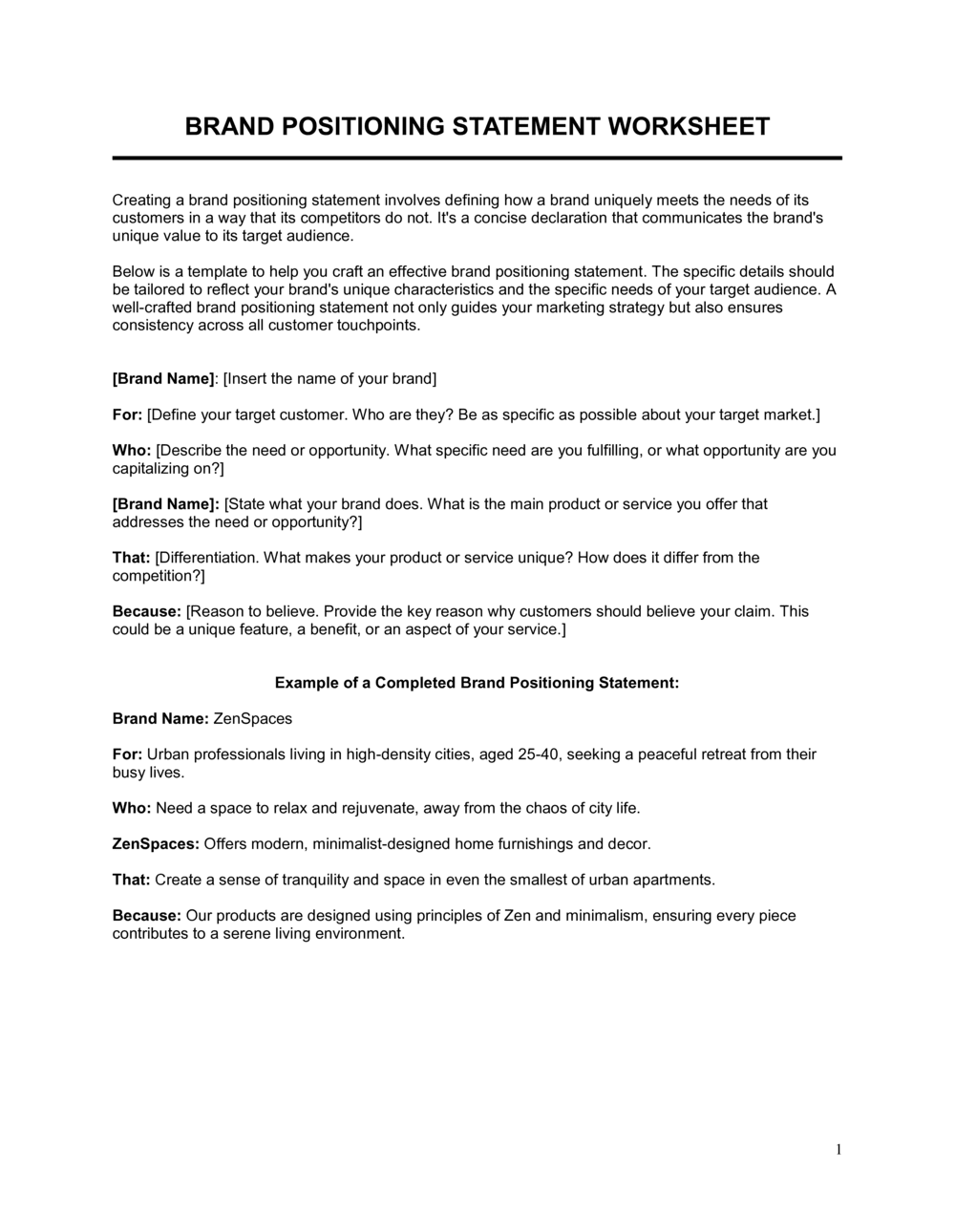
Draft the consolidated positioning statement
Use the standard format: 'For [TARGET AUDIENCE], [BRAND NAME] is the [FRAME OF REFERENCE] that [UNIQUE BENEFIT] because [TOP RTB].' This single sentence is what both parties sign off on and what governs all downstream brand work.
💡 Read the finished statement aloud to someone unfamiliar with your brand. If they cannot explain it back in plain English, simplify it further.
7
Complete the usage restrictions and amendment terms
Specify at least two categories or segments the brand must not be extended into without further approval, and set the review cadence — annually is standard for fast-moving consumer categories; every two years suits stable B2B brands.
💡 Think about the three most damaging ways a partner could misrepresent the brand, and write a restriction for each one explicitly.
8
Execute before any creative or campaign work begins
Both parties must sign the completed worksheet before any agency, vendor, or internal team begins creative execution. A positioning statement signed after a campaign is in production is difficult to enforce retroactively.
💡 Use a dated electronic signature with a timestamp so the execution date is unambiguous — particularly important when an agency starts discovery or strategy work on the same day.