Cost Analysis of Market Research Methods Template

Free download β€’ Use as a template β€’ Print or share

1 pageβ€’20–25 min to useβ€’Difficulty: Standard
Learn more ↓
FreeCost Analysis of Market Research Methods Template

At a glance

What it is
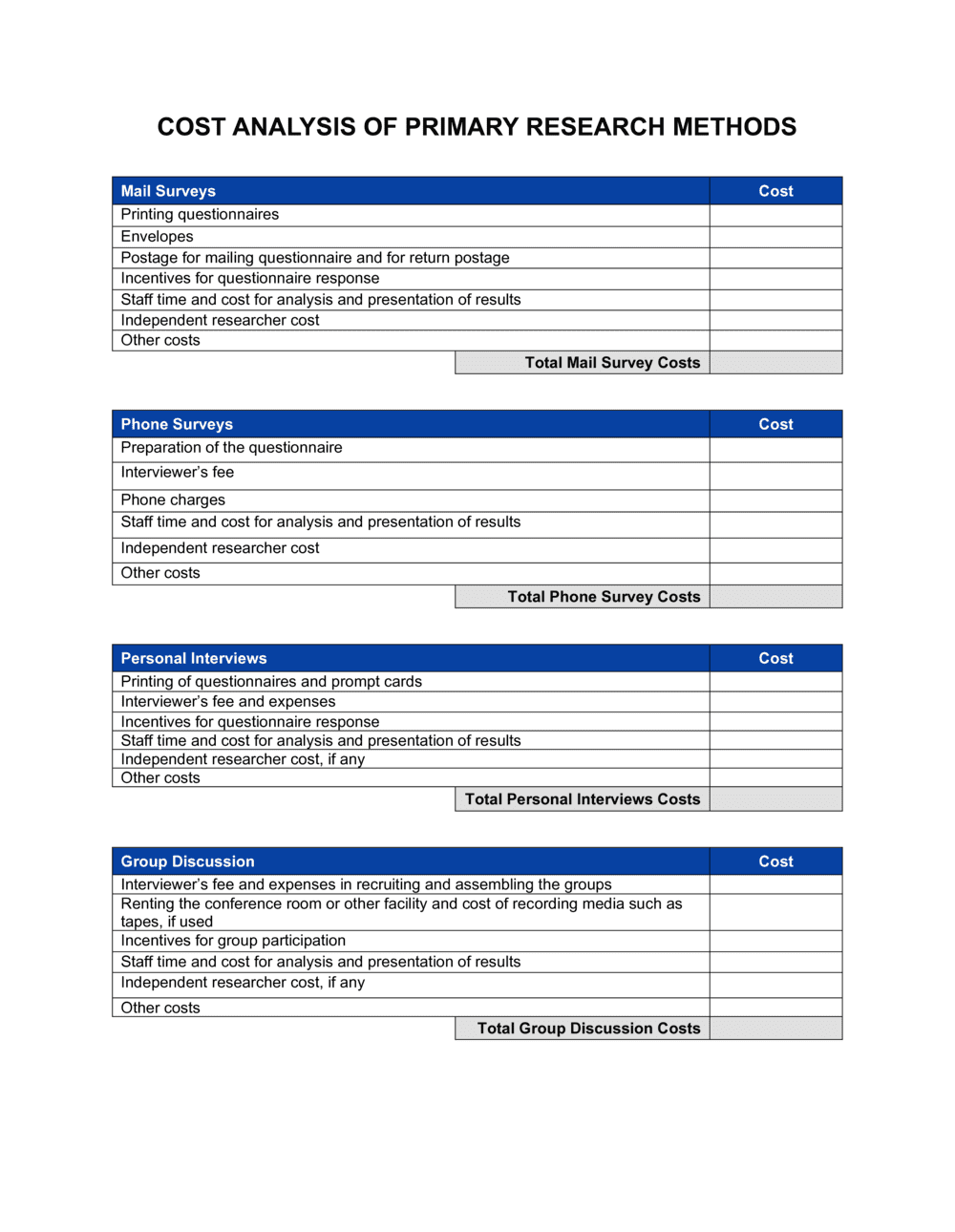
A Cost Analysis of Market Research Methods is a structured operational report that evaluates and compares the financial and time investment required for each major research approach β€” surveys, focus groups, interviews, secondary research, ethnography, and more. This free Word download gives you a ready-to-edit framework for presenting method-by-method cost breakdowns, trade-offs, and budget recommendations to stakeholders.
When you need it
Use it when planning a research project and deciding which methods to fund, when justifying a research budget to leadership or a client, or when benchmarking your current research spend against alternative approaches.
What's inside
An executive summary of research objectives and budget constraints, a method-by-method cost breakdown covering direct costs and time investment, a comparison matrix of cost versus data quality and speed, and a recommended research mix with budget allocation rationale.

What is a Cost Analysis of Market Research Methods?

A Cost Analysis of Market Research Methods is a structured operational report that evaluates and compares the financial investment, time commitment, and data quality trade-offs of the major market research approaches available for a given project. It covers both out-of-pocket costs β€” panel fees, incentives, platform subscriptions, and moderator or analyst fees β€” and internal labor costs, then presents the findings as a method-by-method comparison matrix and a set of budget scenarios. The document is used to guide resource allocation decisions before research begins, replacing informal cost estimates with a defensible, documented analysis that can be reviewed and approved by finance or senior leadership.

Why You Need This Document

Without a formal cost analysis, research budgets are routinely underestimated, methods are selected on familiarity rather than fit, and stakeholders have no basis for evaluating what they are getting for their spend. Internal labor costs β€” consistently the largest single line item in small-to-mid-sized research projects β€” are almost never captured when costs are estimated informally, meaning approved budgets routinely fall short of what delivery actually requires. A structured cost analysis forces the evaluator to compare methods against the same criteria, document every assumption, and present alternative budget scenarios rather than a single take-it-or-leave-it number. For teams that conduct research regularly, this template also builds an institutional benchmark library that makes each subsequent analysis faster and more accurate. The result is fewer budget surprises, faster stakeholder approvals, and research designs that are matched to both the business question and the funds available.

Which variant fits your situation?

If your situation is…Use this template
Comparing research methods for a new product launchCost Analysis of Market Research Methods
Building a full marketing budget from scratchMarketing Budget Template
Presenting a research proposal to a client or boardMarket Research Report
Evaluating a single vendor's research services proposalVendor Evaluation Scorecard
Conducting a general cost-benefit analysis for a business decisionCost Benefit Analysis Template
Tracking actual research project expenses against budgetProject Budget Template
Summarizing findings after research is completeMarket Research Report

Common mistakes to avoid

❌ Omitting internal labor from cost estimates

Why it matters: An online survey that appears to cost $1,500 in platform fees can easily require 30–50 hours of staff time β€” adding $3,000–$7,500 in real cost that never appears in the budget.

Fix: Add a labor cost line for every method using a documented fully-loaded internal rate. Present total cost of method, not just out-of-pocket spend.

❌ Using a single-point cost estimate with no range

Why it matters: Research costs vary based on incidence rate, panel availability, and vendor pricing. A single number with no stated assumptions breaks trust when actuals differ by 20–30%.

Fix: Present a low-to-high range for each method and document the two or three assumptions that drive the most variance.

❌ Evaluating methods on cost alone without scoring data quality

Why it matters: Choosing the cheapest method β€” such as a 100-person convenience survey β€” can produce data that leads to a wrong product or positioning decision, costing far more than a rigorous study would have.

Fix: Include an explicit data quality and confidence-level column in the comparison matrix so cost is always evaluated alongside fitness for purpose.

❌ Presenting only one budget option

Why it matters: A single recommendation forces stakeholders into an approve-or-reject decision. If the budget is cut, there is no documented fallback, and the analyst is left scrambling.

Fix: Always present at least two scenarios β€” a minimum viable option and a recommended option β€” with the incremental cost and quality improvement of each clearly stated.

❌ Citing benchmark costs without source dates

Why it matters: Panel and platform costs have shifted 20–40% in some segments over the past three years. An undated benchmark can make the analysis appear credible while producing a materially inaccurate estimate.

Fix: Add a date and source to every benchmark figure β€” even a note like 'vendor quote, [MONTH YEAR]' is sufficient.

❌ Recommending a blended method design without flagging integration complexity

Why it matters: Combining qualitative and quantitative methods adds project management, timeline, and analysis costs that are easy to underestimate and often omitted from the budget.

Fix: Add a project management line item β€” typically 10–15% of total research cost β€” for any study using two or more methods.

The 10 key sections, explained

Executive summary

Research objectives and scope

Method overview and suitability matrix

Direct cost breakdown by method

Time and resource investment

Cost-quality-speed trade-off comparison

Budget scenarios

Recommended research mix and rationale

Vendor and platform cost benchmarks

Assumptions and limitations

How to fill it out

  1. 1

    Define the research objectives before opening the template

    Write out two to five specific business questions the research must answer. Each objective should be concrete enough that you can evaluate whether a given method is capable of answering it.

    πŸ’‘ Frame objectives as questions β€” 'What percentage of [SEGMENT] is aware of [BRAND]?' β€” not outcomes. Questions drive method selection; outcomes drive expectations.

  2. 2

    List every method you are considering

    Enter each candidate method in the method overview section: online survey, in-depth interviews, focus groups, secondary research, observational studies, or others relevant to your objectives.

    πŸ’‘ Start with five or six methods even if you expect to eliminate most of them β€” the act of costing out alternatives strengthens the rationale for your final recommendation.

  3. 3

    Complete the direct cost breakdown for each method

    For each method, itemize recruitment, incentives, platform or venue fees, moderator or analyst fees, and reporting costs. Pull actual vendor quotes where possible; use the benchmark section for everything else.

    πŸ’‘ Get at least two vendor quotes for any line item over $2,000 β€” single-source estimates are hard to defend in budget reviews.

  4. 4

    Estimate internal staff hours and convert to cost

    For each method, add up design, recruitment, fieldwork, analysis, and reporting hours. Multiply by the applicable fully-loaded internal rate β€” typically $50–$150/hr for marketing and research staff.

    πŸ’‘ Use a blended rate for the whole team rather than individual rates β€” the exact allocation will shift, and a blended figure is easier to defend.

  5. 5

    Build the cost-quality-speed matrix

    Score each method on cost (lower is better), data depth, and speed. Weight the criteria to reflect your project's actual priorities β€” if time-to-decision is critical, weight speed at 40% of the score.

    πŸ’‘ Show the weighting scheme explicitly so stakeholders can adjust it if their priorities differ from yours.

  6. 6

    Draft the three budget scenarios

    Build a minimum viable scenario using only the one or two most efficient methods, a standard scenario with your recommended mix, and a premium scenario adding methods that would meaningfully improve data quality.

    πŸ’‘ Price the standard scenario first, then derive the others β€” it is easier to cut or add methods once you have a solid baseline.

  7. 7

    Write the recommendation section with explicit trade-off language

    State your recommended method mix, total cost, and timeline. For each method not recommended, note in one sentence why it was excluded β€” cost, timeline, or lack of fit with objectives.

    πŸ’‘ Anticipate the most likely objection β€” usually 'can we do it cheaper?' β€” and address it directly in the rationale rather than waiting for the meeting.

  8. 8

    Document assumptions and add the executive summary last

    List all pricing assumptions with dates and sources. Then write the executive summary, pulling the total budget, recommended scenario, and top-line rationale from the completed sections.

    πŸ’‘ The executive summary should fit on one page β€” if it runs longer, cut to the three numbers that matter most: total cost, timeline, and the business question being answered.

Frequently asked questions

What is a cost analysis of market research methods?

A cost analysis of market research methods is a structured report that compares the financial investment, time commitment, and data quality of different research approaches β€” surveys, focus groups, interviews, and secondary research β€” to help decision-makers choose the most cost-effective method for a specific business objective. It typically includes a method-by-method cost breakdown, a trade-off matrix, and a recommended budget scenario with rationale.

How much does market research typically cost?

Costs vary widely by method. A standard online consumer survey of 500 respondents typically runs $3,000–$8,000 including panel, incentives, and analysis. A series of 10 in-depth interviews runs $5,000–$15,000 depending on the target audience and analyst fees. A two-session focus group study typically costs $10,000–$25,000. Secondary research using published industry reports can range from $500 to $5,000 depending on whether reports are purchased or accessed through a subscription. Internal labor costs add 30–60% to all of the above.

What are the most cost-effective market research methods?

Online surveys using panel providers are generally the lowest cost-per-respondent method for quantitative data, ranging from $3 to $8 per completed general-consumer response. Secondary research β€” analyzing existing reports, government data, and trade publications β€” is the least expensive method overall but cannot answer bespoke business questions. For qualitative insights, online interviews are typically 30–40% cheaper than in-person sessions due to eliminated travel and facility costs.

How do I choose the right market research method for my budget?

Start with your research objectives β€” qualitative methods like interviews are suited to exploratory questions, while quantitative surveys answer measurement and frequency questions. Then map available budget to the minimum sample size required for statistical validity for your target audience. If budget is constrained, prioritize the method that directly answers your highest-priority business question and treat secondary research as a cost-efficient complement.

Should I include internal staff time in my market research budget?

Yes, and most research budgets underestimate this significantly. A 500-person online survey typically requires 20–40 internal hours for design, programming review, analysis, and reporting. In-depth interview studies can require 60–100 internal hours across the project. Using a fully-loaded internal rate of $60–$120 per hour, these costs can match or exceed out-of-pocket vendor spend for smaller studies.

What is the difference between primary and secondary market research in terms of cost?

Secondary research β€” using existing sources like industry reports, census data, or competitor filings β€” typically costs $500–$5,000 and can often be completed in days. Primary research, where you collect original data from respondents, starts at $3,000 for a simple online survey and can exceed $50,000 for a complex multi-method study. The trade-off is that secondary research rarely answers bespoke strategic questions, while primary research can be designed precisely for your objective.

How do I justify a market research budget to leadership?

Frame the research cost against the value of the decision it informs. If the research will inform a $500,000 product launch, spending $15,000 to reduce the risk of a poor positioning decision represents a 3% insurance cost. Use the cost analysis template to present a minimum viable scenario alongside the recommended option so leadership can calibrate investment to the stakes involved.

What is a blended research design and when is it worth the extra cost?

A blended design combines qualitative and quantitative methods in sequence β€” typically exploratory interviews or focus groups followed by a survey to validate findings at scale. It is worth the extra cost when the business question involves both understanding why customers behave a certain way and measuring how many do so. Budget an additional 10–15% for project management and integration costs when using two or more methods.

How often should a cost analysis of market research methods be updated?

Update it at the start of each new research project, as panel costs, platform pricing, and vendor rates shift meaningfully year over year. If your organization conducts research regularly, a benchmarking review every 12 months helps ensure your cost estimates remain credible in budget conversations and that you are not overpaying for methods where market rates have dropped.

How this compares to alternatives

vs Market Research Report

A market research report presents findings and insights gathered after research is complete. A cost analysis of market research methods is a planning document used before the research begins to compare methods and justify budget allocation. The two documents serve opposite phases of the research process β€” planning versus reporting β€” and are often used in sequence.

vs Cost Benefit Analysis

A cost benefit analysis evaluates a business decision by weighing total costs against expected financial benefits across any domain. A cost analysis of market research methods is specifically scoped to comparing research methodologies on cost, quality, and speed. Use a cost benefit analysis when the question is whether to invest in research at all; use the research cost analysis when the question is which method to use.

vs Marketing Plan

A marketing plan covers the full scope of marketing strategy, channels, messaging, and budget allocation across all activities. A cost analysis of market research methods covers only the research component of the marketing function β€” specifically the cost and trade-offs of data-collection approaches. The research cost analysis feeds into the marketing plan's insight and budget sections.

vs Project Budget Template

A project budget template tracks all costs for a defined project from initiation to close. A cost analysis of market research methods is an analytical comparison document, not a live budget tracker. Use the cost analysis to select and justify your method mix, then carry those approved figures into a project budget for ongoing tracking and variance reporting.

Industry-specific considerations

Consumer goods and retail

High survey volume for product and packaging testing keeps per-study costs low, but B2C panel quality and incidence rates vary significantly by category and require careful vendor vetting.

Technology and SaaS

User interviews and usability studies dominate the method mix; recruiting from an existing customer base reduces sampling costs but requires CRM segmentation to avoid response bias.

Healthcare and pharmaceuticals

Physician and patient recruitment costs run 5–10 times consumer norms, making secondary data and claims database analysis a high-value cost-reduction complement to primary fieldwork.

Professional services and consulting

B2B decision-maker surveys require specialist panels at $40–$80 per response, making sample efficiency and questionnaire length critical levers for controlling total cost.

Financial services

Regulatory sensitivity restricts some research designs and increases compliance review time; secondary research from regulatory filings and industry benchmarks offsets primary research costs.

Food and beverage

Sensory and in-home use tests require physical product delivery, which adds logistics costs not present in other categories and must be itemized separately in any cost analysis.

Template vs pro β€” what fits your needs?

PathBest forCostTime
Use the templateMarketing managers and analysts building an internal budget justification or vendor comparisonFree4–8 hours
Template + professional reviewTeams preparing a research budget for board or executive approval where the spend exceeds $50,000$500–$2,000 for a research strategy consultant review1–3 days
Custom draftedLarge organizations commissioning a formal research procurement process or multi-market study design$3,000–$10,000 for a specialist research consultancy2–4 weeks

Glossary

Primary Research
Original data collected directly from sources β€” through surveys, interviews, or observations β€” for a specific research objective.
Secondary Research
Analysis of data already collected by others, such as industry reports, government statistics, or academic studies, typically at lower cost than primary research.
Cost Per Respondent
The total cost of a research method divided by the number of usable responses, used to compare efficiency across methods.
Fieldwork Costs
Direct expenses incurred during data collection β€” including participant incentives, interviewer fees, venue hire, and travel.
Incidence Rate
The percentage of the general population that qualifies for a specific research study, which directly affects recruitment cost and time.
Panel Survey
A survey administered to a pre-recruited group of respondents who have agreed to participate in research over time, reducing recruitment costs per study.
Qualitative Research
Research that collects non-numerical data β€” opinions, motivations, and behaviours β€” through methods such as focus groups or in-depth interviews.
Quantitative Research
Research that collects numerical data at scale, typically through structured surveys, to measure frequency, preference, or statistical significance.
Research ROI
The business value generated by a research investment relative to its cost, often measured by the revenue impact of decisions informed by the findings.
Blended Research Design
A study that combines two or more methods β€” for example, qualitative interviews followed by a quantitative survey β€” to balance depth with statistical validity.
Sampling Cost
The expense of recruiting a representative or targeted group of participants, including screening, incentives, and panel access fees.

Part of your Business Operating System

This document is one of 3,000+ business & legal templates included in Business in a Box.

  • Fill-in-the-blanks β€” ready in minutes
  • 100% customizable Word document
  • Compatible with all office suites
  • Export to PDF and share electronically

Create your document in 3 simple steps.

From template to signed document β€” all inside one Business Operating System.
1
Download or open template

Access over 3,000+ business and legal templates for any business task, project or initiative.

2
Edit and fill in the blanks with AI

Customize your ready-made business document template and save it in the cloud.

3
Save, Share, Send, Sign

Share your files and folders with your team. Create a space of seamless collaboration.

Save time, save money, and create top-quality documents.

β˜…β˜…β˜…β˜…β˜…

"Fantastic value! I'm not sure how I'd do without it. It's worth its weight in gold and paid back for itself many times."

Managing Director Β· Mall Farm
Robert Whalley
Managing Director, Mall Farm Proprietary Limited
β˜…β˜…β˜…β˜…β˜…

"I have been using Business in a Box for years. It has been the most useful source of templates I have encountered. I recommend it to anyone."

Business Owner Β· 4+ years
Dr Michael John Freestone
Business Owner
β˜…β˜…β˜…β˜…β˜…

"It has been a life saver so many times I have lost count. Business in a Box has saved me so much time and as you know, time is money."

Owner Β· Upstate Web
David G. Moore Jr.
Owner, Upstate Web

Run your business with a system β€” not scattered tools

Stop downloading documents. Start operating with clarity. Business in a Box gives you the Business Operating System used by over 250,000 companies worldwide to structure, run, and grow their business.

Start freeΒ Β·Β No credit card required