Market Analysis Template

Free download β€’ Use as a template β€’ Print or share

10 pagesβ€’25–35 min to useβ€’Difficulty: Complex
Learn more ↓
FreeMarket Analysis Template

At a glance

What it is
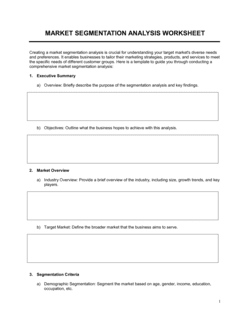
A Market Analysis is a structured research document that measures the size, dynamics, customer segments, and competitive landscape of a specific market to support a strategic or investment decision. This free Word download gives you a ready-made framework you can edit online and export as PDF for business plans, investor decks, new product launches, or internal strategy reviews.
When you need it
Use it when entering a new market, launching a product, raising capital, applying for a business loan, or refreshing a strategic plan β€” any situation where you need evidence-based answers about market size, growth trajectory, and who you are competing against.
What's inside
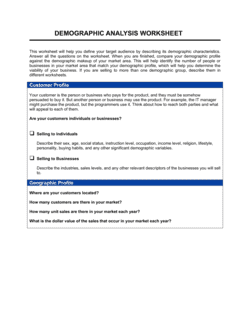
Market definition and scope, TAM/SAM/SOM sizing with supporting data, customer segmentation and buyer personas, competitive landscape mapping, industry trend analysis, regulatory environment, and strategic implications drawn from the findings.

What is a Market Analysis?

A Market Analysis is a structured research document that quantifies the size, growth trajectory, customer composition, and competitive dynamics of a specific market to support a strategic or investment decision. It moves from raw data β€” industry reports, customer interviews, competitor pricing, regulatory filings β€” to a set of evidence-based conclusions about where opportunity exists, who the buyers are, and what it will take to win. Unlike a general industry overview, a market analysis is built around a specific question: is this market worth entering, how large is the reachable opportunity, and what are the conditions required to capture it?

Why You Need This Document

Entering a market, launching a product, or raising capital without a written market analysis forces every stakeholder to rely on assumptions that have never been tested. Investors who ask for market data and receive an unsupported TAM figure move on; lenders require documented market evidence for business loans; product teams that skip segmentation build for an imagined customer rather than a real one. The cost of proceeding without this analysis is concrete β€” misdirected marketing spend, product features nobody wants, and capital raises that stall at the first diligence question. A rigorous market analysis, built on cited sources and real customer data, converts those risks into decisions you can act on before they become expensive mistakes. This template gives you the structure to produce that analysis in days rather than weeks.

Which variant fits your situation?

If your situation is…Use this template
Building the market section inside a fundraising business planBusiness Plan
Scanning the competitive landscape only, without full market sizingCompetitive Analysis
Summarizing findings for an investor pitch on a single slide deckPitch Deck
Analyzing macro trends using PESTLE factorsPESTLE Analysis
Mapping internal strengths alongside market opportunitiesSWOT Analysis
Sizing revenue potential for a specific new product lineNew Product Launch Plan
Presenting findings to a board or leadership teamExecutive Summary Report

Common mistakes to avoid

❌ Top-down market sizing with no bottom-up validation

Why it matters: Claiming 1% of a $10B market sounds plausible in isolation, but without a bottom-up model investors immediately see that reaching 1% may require 50,000 customers β€” and ask how you plan to get there.

Fix: Build a parallel bottom-up estimate: count reachable accounts, apply a realistic win rate, and multiply by ACV. Present both numbers side by side and explain any gap.

❌ Ignoring indirect competitors and status-quo substitutes

Why it matters: For most markets, the majority of potential customers are not using any direct competitor β€” they are using a spreadsheet, a manual process, or doing nothing. Ignoring this overstates addressability and understates the real sales challenge.

Fix: Add a 'current alternatives' row to the competitive table and explicitly address why your solution wins against inertia, not just against named rivals.

❌ Writing persona profiles from assumptions rather than research

Why it matters: Fabricated personas produce messaging and product decisions that miss the real buyer. Marketing teams that build campaigns on assumed pain points consistently underperform against those using interview-validated data.

Fix: Conduct at least three customer or prospect interviews before writing each persona. Treat any field you cannot support with a real data point as a hypothesis to be tested.

❌ Listing trends without stating their business implications

Why it matters: A trend section that enumerates shifts without connecting them to the opportunity leaves decision-makers to draw their own conclusions β€” which may not support your thesis.

Fix: For each trend, add a one-sentence 'so what' statement: 'This trend accelerates adoption of [SOLUTION] because [SPECIFIC REASON], increasing our TAM by an estimated [X]% by [YEAR].'

The 9 key sections, explained

Market definition and scope

Market size and growth (TAM / SAM / SOM)

Market trends and drivers

Customer segmentation

Buyer persona profiles

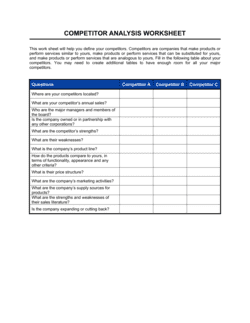
Competitive landscape

Regulatory and environmental factors

Market entry barriers and risks

Strategic implications and recommendations

How to fill it out

  1. 1

    Define the market scope precisely

    Write one sentence stating the product category, target geography, customer type, and analysis period. Every data point in the document must fit within this definition.

    πŸ’‘ If you cannot define the market in one sentence, it is too broad β€” narrow it until you can.

  2. 2

    Size the market with two independent sources

    Find at least two published sources (industry report, trade association, government statistics) for TAM. Then build a bottom-up SAM by counting reachable customers and multiplying by average contract value or spend.

    πŸ’‘ If your top-down and bottom-up estimates diverge by more than 30%, audit your assumptions β€” one of them has an error.

  3. 3

    Document trends with specific data points

    List 3–5 market drivers and 1–2 headwinds, each supported by a specific data point and source. For each trend, write one sentence on what it means for the opportunity.

    πŸ’‘ Industry analyst reports (Gartner, Forrester, IBISWorld) are acceptable citations β€” note the publication date since market data older than 3 years loses credibility.

  4. 4

    Segment the market by behavior, not just demographics

    Group potential customers by their buying trigger, use case, or problem β€” not just by age or company size. Size each segment and rank them by attractiveness based on growth rate, deal size, and acquisition cost.

    πŸ’‘ Limit yourself to 3–4 segments β€” more than that dilutes focus and signals an inability to prioritize.

  5. 5

    Interview at least three target customers before writing personas

    Each buyer persona should be grounded in at least one real customer or prospect interview. Record their exact words for the pain-points and goals sections β€” direct quotes are more persuasive than paraphrases.

    πŸ’‘ Ask 'what would you do if our product didn't exist?' β€” the answer reveals the real substitute and the true severity of the problem.

  6. 6

    Map competitors on two meaningful axes

    Choose two dimensions that matter to buyers β€” price vs. capability, speed vs. breadth, self-serve vs. full-service β€” and plot each competitor on a 2Γ—2. Write a one-paragraph differentiation statement explaining your position.

    πŸ’‘ If your positioning lands in the same quadrant as an entrenched incumbent, rethink the axes until you find a defensible white space.

  7. 7

    Close with numbered strategic recommendations

    Write 3–5 numbered action items drawn directly from the analysis β€” segment to prioritize, competitor to target, trend to exploit, risk to monitor. Each recommendation should name a responsible owner and a timeframe.

    πŸ’‘ If a recommendation could apply to any market in any industry, it is too generic β€” make it specific enough that someone could begin executing it tomorrow.

  8. 8

    Cite every data point and date-stamp the document

    Add a references section and include the retrieval date for any online source. Add a 'Last Updated' date on the cover β€” market data degrades quickly and readers need to assess its currency.

    πŸ’‘ Replace any data older than 36 months before sharing with investors or lenders β€” stale figures undermine the credibility of the entire document.

Frequently asked questions

What is a market analysis?

A market analysis is a structured research document that quantifies the size, growth rate, customer segments, competitive landscape, and key trends of a specific market. It provides the evidence base for strategic decisions β€” entering a new market, launching a product, raising capital, or reallocating resources. Unlike a SWOT or competitive analysis, it covers the full external market environment rather than a single dimension.

What should a market analysis include?

A complete market analysis covers eight core areas: market definition and scope, TAM/SAM/SOM sizing with sources, market trends and growth drivers, customer segmentation, buyer personas, competitive landscape, regulatory environment, and strategic recommendations. Plans submitted to investors or lenders are expected to include all eight sections with cited data points and a dated methodology.

How do I calculate TAM, SAM, and SOM?

TAM is the total annual revenue if you captured every potential buyer β€” typically estimated from industry reports or government statistics. SAM is the portion reachable with your current model: count the addressable customers in your target segments and multiply by average contract value. SOM is your realistic near-term capture: apply your expected win rate to SAM given competitive position and go-to-market capacity. Always build both a top-down and a bottom-up estimate and reconcile any gap.

What is the difference between a market analysis and a competitive analysis?

A competitive analysis focuses specifically on identifying rivals, mapping their strengths and weaknesses, and articulating your differentiation. A market analysis is broader β€” it includes market sizing, customer segmentation, trend analysis, and regulatory context in addition to competition. A competitive analysis is typically one section within a full market analysis, not a replacement for it.

How long should a market analysis be?

For a standalone report shared with investors or lenders, 10–20 pages is the standard range, plus a data appendix with sources. As a section within a business plan, 3–6 pages is typical. Internal strategy documents can run longer. Regardless of length, every claim should be supported by a cited source β€” an unsupported market size figure is treated as an assumption, not a fact.

What data sources should I use for a market analysis?

Reliable secondary sources include industry research firms (IBISWorld, Statista, Gartner, Forrester), government databases (U.S. Census Bureau, Bureau of Labor Statistics, Eurostat), trade associations, and SEC filings from public competitors. Supplement with primary research β€” customer interviews, surveys, or sales data β€” to validate secondary findings against real buyer behavior in your specific segment.

How often should a market analysis be updated?

For active fundraising or major strategic decisions, update it before every material conversation β€” market conditions shift quickly. For operating businesses, an annual refresh aligned to strategic planning cycles is standard, with a mid-year check on competitive landscape changes. Any market analysis using data older than 36 months should be treated as a historical baseline, not a current decision-support document.

Can I use a market analysis template instead of hiring a consultant?

For most early-stage and mid-market use cases β€” business plans, product launches, internal strategy reviews β€” a structured template covers the framework effectively. Hire a market research consultant when the decision involves more than $1M in investment, when primary research across hundreds of respondents is required, or when the market is highly specialized with limited published data. A template with rigorous sourcing typically satisfies investor and lender requirements for Series A rounds and SBA loans.

What makes investors reject a market analysis?

The four most common rejection triggers are: TAM claims with no methodology or cited sources, a competitive section that omits the status quo and indirect substitutes, market sizing that relies on a single industry report with no bottom-up validation, and trend listings with no connection to the specific business opportunity. Each of these signals that the founder has not pressure-tested their own market assumptions.

How this compares to alternatives

vs Competitive Analysis

A competitive analysis maps rivals, their positioning, and your differentiation β€” it is one component of a market analysis. A market analysis also covers market sizing, customer segmentation, trends, and regulatory factors. Use a competitive analysis when your primary question is 'who are we up against and how do we win?' Use a full market analysis when the question is 'is this market worth entering and how large is the opportunity?'

vs SWOT Analysis

A SWOT analysis maps internal strengths and weaknesses alongside external opportunities and threats. It synthesizes conclusions but does not generate the market data that feeds them. A market analysis is the research input that makes the Opportunities and Threats quadrants of a SWOT credible and evidence-based.

vs PESTLE Analysis

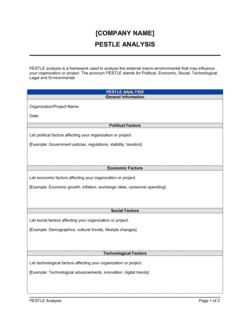
A PESTLE analysis scans macro-environmental factors β€” political, economic, social, technological, legal, and environmental β€” that affect any business in a given context. A market analysis is narrower and more quantitative: it sizes a specific market, maps buyers and competitors, and produces actionable recommendations. PESTLE findings typically feed the trends and regulatory sections of a market analysis.

vs Business Plan

A business plan is a comprehensive external-facing document that includes a market analysis section alongside operational, financial, and team sections. A standalone market analysis goes deeper on market sizing, segmentation, and competitive dynamics than a business plan section typically allows. Prepare the standalone analysis first and then condense it into the market section of your business plan.

Industry-specific considerations

SaaS / Technology

Market sizing anchored to number of target accounts by employee count and tech stack, with competitive mapping against both direct SaaS rivals and legacy on-premise alternatives.

Retail / E-commerce

Segment sizing by channel (DTC, marketplace, wholesale), seasonal demand patterns, and consumer behavior trends driven by mobile commerce and same-day delivery expectations.

Healthcare / MedTech

Market segmentation by care setting (hospital, outpatient, home health) and payer type, with regulatory pathway and reimbursement code analysis as required market-entry factors.

Food & Beverage

Category sizing by distribution channel (foodservice vs. retail), consumer trend analysis (health, sustainability, convenience), and shelf placement competitive dynamics.

Professional Services

Market sizing by vertical and firm size, competitive positioning against both specialized boutiques and Big Four generalists, and demand drivers tied to regulatory or technology change cycles.

Manufacturing

Supply chain concentration risk, raw material cost trend analysis, customer industry end-market sizing, and competitive landscape mapping across domestic and international producers.

Template vs pro β€” what fits your needs?

PathBest forCostTime
Use the templateFounders, small business owners, and analysts conducting market analysis for internal strategy reviews, business plans, or seed-stage fundraisingFree1–3 weeks (20–50 hours depending on primary research scope)
Template + professional reviewSeries A fundraising, bank loans above $500K, or market entry decisions involving significant capital commitment$500–$3,000 for a market research advisor or business consultant review2–4 weeks
Custom draftedInstitutional investors, M&A due diligence, or highly specialized markets with limited published data requiring primary research at scale$5,000–$25,000+ for a professional market research firm4–12 weeks

Glossary

TAM (Total Addressable Market)
The total annual revenue opportunity if a product or service captured 100% of every potential buyer in a defined market.
SAM (Serviceable Addressable Market)
The portion of TAM that a company can realistically reach given its current business model, distribution channels, and geography.
SOM (Serviceable Obtainable Market)
The share of SAM a company can realistically capture within a defined time horizon, based on competitive position and go-to-market capacity.
Market Segmentation
Dividing a broad market into distinct groups of buyers who share similar needs, behaviors, or characteristics β€” such as by geography, company size, or use case.
CAGR (Compound Annual Growth Rate)
The annualized rate at which a market's value grows over a multi-year period, used to compare growth trajectories across markets.
Buyer Persona
A research-based profile of a specific type of customer, describing their role, goals, pain points, and purchasing behavior.
Market Penetration Rate
The percentage of potential customers in a defined market who are already using a product or service β€” used to gauge adoption and remaining opportunity.
Porter's Five Forces
A framework that assesses industry competitiveness by analyzing supplier power, buyer power, threat of new entrants, threat of substitutes, and rivalry among existing competitors.
PESTLE Analysis
An environmental scanning framework covering Political, Economic, Social, Technological, Legal, and Environmental factors that affect a market.
Competitive Moat
A durable structural advantage β€” such as network effects, proprietary data, or high switching costs β€” that protects a market position from erosion by competitors.
Primary Research
Market data collected directly from sources β€” surveys, interviews, focus groups β€” rather than from published reports or databases.
Secondary Research
Market data gathered from existing published sources such as industry reports, government statistics, and trade publications.

Part of your Business Operating System

This document is one of 3,000+ business & legal templates included in Business in a Box.

  • Fill-in-the-blanks β€” ready in minutes
  • 100% customizable Word document
  • Compatible with all office suites
  • Export to PDF and share electronically

Create your document in 3 simple steps.

From template to signed document β€” all inside one Business Operating System.
1
Download or open template

Access over 3,000+ business and legal templates for any business task, project or initiative.

2
Edit and fill in the blanks with AI

Customize your ready-made business document template and save it in the cloud.

3
Save, Share, Send, Sign

Share your files and folders with your team. Create a space of seamless collaboration.

Save time, save money, and create top-quality documents.

β˜…β˜…β˜…β˜…β˜…

"Fantastic value! I'm not sure how I'd do without it. It's worth its weight in gold and paid back for itself many times."

Managing Director Β· Mall Farm
Robert Whalley
Managing Director, Mall Farm Proprietary Limited
β˜…β˜…β˜…β˜…β˜…

"I have been using Business in a Box for years. It has been the most useful source of templates I have encountered. I recommend it to anyone."

Business Owner Β· 4+ years
Dr Michael John Freestone
Business Owner
β˜…β˜…β˜…β˜…β˜…

"It has been a life saver so many times I have lost count. Business in a Box has saved me so much time and as you know, time is money."

Owner Β· Upstate Web
David G. Moore Jr.
Owner, Upstate Web

Run your business with a system β€” not scattered tools

Stop downloading documents. Start operating with clarity. Business in a Box gives you the Business Operating System used by over 250,000 companies worldwide to structure, run, and grow their business.

Free Forever PlanΒ Β·Β No credit card required