Funding Request Letter Template

Free Word download • Edit online • Save & share with Drive • Export to PDF

1 page15–20 min to fillDifficulty: Standard
Learn more ↓
FreeFunding Request Letter Template

At a glance

What it is
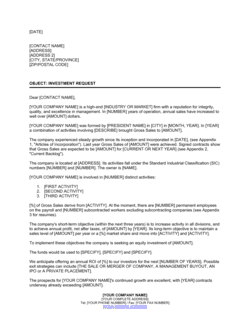
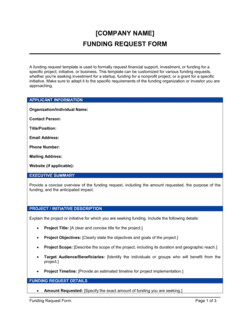
A Funding Request Letter is a formal one-to-two page letter sent to an investor, bank, foundation, or grant program to request a specific amount of capital for a defined business purpose. This free Word download gives you a structured template you can edit online and export as PDF — covering your business overview, the exact amount requested, intended use of funds, repayment or return terms, and a clear call to action.
When you need it
Use it when approaching any funding source that expects a written introduction before a formal application or pitch meeting — including angel investors, community development lenders, corporate foundations, and government grant programs. It is also the standard opening document for small business bank loan inquiries.
What's inside
A professional header with sender and recipient details, a concise business description, a specific funding amount with justification, a breakdown of intended use of funds, supporting financial context or traction, proposed terms or repayment approach, and a direct call to action with contact information.

What is a Funding Request Letter?

A Funding Request Letter is a formal one-to-two page document sent to an investor, bank, foundation, or grant program to request a specific amount of capital for a defined business purpose. It introduces the sender, describes the business in plain terms, states the exact funding amount and instrument, explains how the funds will be used and what outcomes they will produce, and closes with a direct invitation to take the next step. Unlike a full business plan or pitch deck, the funding request letter is designed to open the door — to secure a meeting, trigger a formal application review, or prompt a request for additional materials.

Why You Need This Document

Approaching a funder without a written request puts you at an immediate disadvantage: there is no record of the ask, no structured case for the capital, and no professional signal that you have prepared seriously. A funding request letter forces you to articulate the amount, the purpose, and the expected outcome in terms a non-specialist can evaluate — which is exactly what loan officers, program directors, and angel investors need to decide whether to proceed. Without one, promising conversations stall because the funder has nothing concrete to route internally for review. This template gives you a proven structure that leads with the ask, supports it with specific evidence, and closes with a clear next step — the three elements that consistently move funding conversations forward.

Which variant fits your situation?

If your situation is…Use this template
Requesting a bank loan for a small businessBusiness Loan Request Letter
Applying for a nonprofit or charitable foundation grantGrant Proposal Letter
Seeking equity investment from an angel or VCInvestor Pitch Cover Letter
Requesting government or SBA program financingSBA Loan Request Letter
Following up after an initial investor meetingInvestment Follow-Up Letter
Requesting a line of credit from an existing banking relationshipLine of Credit Request Letter
Approaching a corporate partner for strategic investmentStrategic Investment Proposal Letter

Common mistakes to avoid

❌ Burying the funding ask in the body of the letter

Why it matters: Program officers and loan officers read dozens of letters per week. If the amount and purpose are not clear by the end of the first paragraph, the letter is set aside.

Fix: State the specific dollar amount and funding type in the first sentence, with the company name and a one-line business description.

❌ Requesting a dollar range instead of a specific amount

Why it matters: A range signals that you have not modeled your capital requirements with precision, which raises doubt about your ability to manage the funds responsibly.

Fix: Build a use-of-funds breakdown that ties to a specific total, then request that exact figure.

❌ Using the same letter for every funder without tailoring

Why it matters: Funders recognize template language immediately. A letter that does not reference the funder's stated priorities or portfolio thesis gets screened out before the second paragraph.

Fix: Add one to two sentences in the opening paragraph that connect your request specifically to the funder's focus area, recent investments, or stated mission.

❌ Omitting a specific call to action

Why it matters: A closing line like 'I hope to hear from you' puts the entire burden on the funder to determine next steps — most will not.

Fix: Request a specific action: 'I would like to schedule a 30-minute call in the next two weeks to discuss this request' and include your direct phone number and email.

The 8 key clauses, explained

Header and salutation

In plain language: Your name, title, company, date, and the recipient's full name, title, and organization — followed by a formal salutation.

Sample language
[YOUR NAME] | [TITLE], [COMPANY NAME] | [DATE] | [RECIPIENT NAME], [TITLE] | [ORGANIZATION] | Dear [RECIPIENT NAME],

Common mistake: Addressing the letter to a title or department rather than a named individual. Letters addressed to 'Dear Investor' or 'To Whom It May Concern' signal a mass send and are deprioritized.

Opening — purpose and credibility statement

In plain language: States the reason for writing in the first sentence and establishes your credibility in one to two sentences — who you are and why you are qualified to make this ask.

Sample language
I am writing to request $[AMOUNT] in [FUNDING TYPE] funding for [COMPANY NAME], a [BRIEF DESCRIPTION] that has achieved [TRACTION METRIC] since launching in [YEAR].

Common mistake: Opening with a company history instead of the ask. Funders read dozens of letters per week — burying the request in paragraph three loses them before they reach it.

Business overview

In plain language: A three-to-four sentence description of what the business does, who it serves, and the problem it solves — written for a reader who has never heard of you.

Sample language
[COMPANY NAME] is a [DESCRIPTION] that helps [TARGET CUSTOMER] to [OUTCOME]. We operate in the [MARKET] market and currently serve [NUMBER] customers generating $[ARR/MRR] in annual revenue.

Common mistake: Using industry jargon without defining it. If the recipient is a generalist bank officer or foundation program director, technical acronyms cause confusion and reduce confidence.

Specific funding amount and type

In plain language: States the exact dollar amount requested, the instrument (equity, debt, grant, convertible note), and the proposed terms if applicable.

Sample language
We are seeking $[AMOUNT] in [equity / a term loan / grant funding / a convertible note] to fund the activities described below. [If debt: We propose a [X]-year term at [X]% interest with monthly repayments beginning [DATE].]

Common mistake: Requesting a range ('$50K–$200K') instead of a specific amount. A range signals you have not modeled your needs precisely and makes it difficult for the funder to evaluate the request.

Use of funds

In plain language: A clear breakdown of how the capital will be deployed, with percentage or dollar allocations and the business outcome each bucket enables.

Sample language
The requested funds will be allocated as follows: [X]% ($[AMOUNT]) for [PURPOSE 1]; [X]% ($[AMOUNT]) for [PURPOSE 2]; [X]% ($[AMOUNT]) for [PURPOSE 3]. This investment will enable [COMPANY NAME] to [MILESTONE] by [DATE].

Common mistake: Listing spending categories without connecting them to outcomes. 'Marketing: $50,000' is uninformative; 'Paid acquisition to reach 500 paying customers by Q3: $50,000' is fundable.

Financial context and traction

In plain language: Two to three sentences of current financial performance or traction — revenue, growth rate, customers, or prior funding — that demonstrate the business is real and progressing.

Sample language
[COMPANY NAME] generated $[REVENUE] in the past [PERIOD], representing [X]% growth year-over-year. We have [NUMBER] paying customers and $[AMOUNT] in contracted recurring revenue. [If applicable: We have previously raised $[AMOUNT] from [SOURCE].]

Common mistake: Omitting financial context entirely for early-stage businesses. Even pre-revenue companies can cite user signups, LOIs, pilot agreements, or accelerator acceptance to establish credibility.

Return or repayment terms

In plain language: Describes what the funder receives in exchange — equity percentage, interest rate and repayment schedule, grant reporting requirements, or expected ROI timeline.

Sample language
[For equity: In exchange, we are offering [X]% equity at a pre-money valuation of $[AMOUNT].] [For debt: Repayment will begin [DATE] over [X] months at [X]% annual interest.] [For grant: Reporting will be provided quarterly per [PROGRAM] requirements.]

Common mistake: Omitting proposed terms for equity asks on the assumption that terms are negotiated later. Funders want to know you understand valuation basics and are not expecting unrealistic terms.

Call to action and closing

In plain language: A direct, confident next-step request — a meeting, a call, or a formal application — with your contact information and an expression of interest in discussing further.

Sample language
I would welcome the opportunity to discuss this request in more detail at your convenience. Please contact me at [PHONE] or [EMAIL]. I have attached an executive summary and am happy to provide financial statements, references, or any additional information you require.

Common mistake: Closing with a passive 'I hope to hear from you.' A specific, actionable request — 'I would like to schedule a 30-minute call in the next two weeks' — produces a measurably higher response rate.

How to fill it out

  1. 1

    Research the specific funder before writing

    Identify the funder's stated investment thesis, preferred deal size, and sector focus before filling in a single field. Tailor the letter to match their criteria explicitly — generic letters are screened out at the first read.

    💡 Check the funder's portfolio or grants list for the average deal size they have approved in the past two years. Request exactly within that range unless you have a compelling reason to exceed it.

  2. 2

    Address the letter to a named individual

    Find the name and correct title of the specific person — investment manager, program officer, or loan officer — who handles requests of your type. Verify spelling and current title on LinkedIn or the organization's website.

    💡 Call the organization's main number if you cannot confirm the name online. A correctly addressed letter from an unknown sender outperforms a perfectly written letter addressed to the wrong person.

  3. 3

    Write the opening with the ask in the first sentence

    State the dollar amount, the funding type, and your company's name and one-line description in sentence one. Do not build to the ask — lead with it.

    💡 Read your opening sentence aloud. If someone could not repeat the ask and the business description from memory after one read, rewrite it.

  4. 4

    Complete the use-of-funds breakdown with outcomes

    Allocate the total amount across three to five spending buckets. For each bucket, state the dollar amount, the activity, and the business outcome it produces. Use specific numbers, not percentages alone.

    💡 If your use-of-funds breakdown totals more or less than the amount requested, the discrepancy will be noticed immediately. Double-check the arithmetic.

  5. 5

    Add two to three traction or credibility data points

    Pull the strongest evidence of momentum — revenue, growth rate, customer count, prior funding, awards, or signed LOIs — and include them in the financial context paragraph. Cite the time period for each metric.

    💡 Use the most recent 12-month period for growth metrics. Citing growth from an anomalous period (post-launch spike, one-time contract) without context raises skepticism.

  6. 6

    State proposed terms clearly

    For equity, include a pre-money valuation and the percentage being offered. For debt, state term length, interest rate, and repayment start date. For grants, reference the program's reporting requirements.

    💡 If you are genuinely open to negotiating terms, you can note that — but still provide a starting position. 'Open to discussion' with no anchor signals lack of preparation.

  7. 7

    Close with a specific next step and attach supporting documents

    End with a concrete request — a call, a meeting, or a formal application submission — and list what you are attaching: executive summary, financial projections, or pitch deck.

    💡 Keep attachments to two documents maximum for a first contact. A one-page executive summary and a 12-month financial model cover what most funders need to decide whether to proceed.

Frequently asked questions

What is a funding request letter?

A funding request letter is a formal one-to-two page document sent to an investor, bank, foundation, or grant program to request a specific amount of capital. It states who you are, what your business does, the exact amount requested, how the funds will be used, and what the funder receives in return. It is typically the first written communication in a funding process and determines whether a funder moves to the next step.

What should a funding request letter include?

A complete funding request letter includes a named salutation, a first sentence stating the amount and funding type, a brief business overview, a specific use-of-funds breakdown with outcomes, two to three traction or financial data points, proposed terms or repayment structure, and a direct call to action with contact information. Most funders also expect an executive summary or one-page financial summary as an attachment.

How long should a funding request letter be?

One to two pages is the accepted standard. Most experienced funders will not read beyond two pages for an introductory letter. If you cannot make your case in two pages, the underlying pitch needs refinement — not a longer letter. Supporting detail belongs in attached documents such as a business plan or financial projections.

What is the difference between a funding request letter and a grant proposal?

A funding request letter is a short introductory document sent to open a conversation with any funder — investor, lender, or foundation. A grant proposal is a detailed formal application submitted in response to a specific grant program's requirements, often running 10–30 pages with structured sections, budgets, and program narratives. The funding request letter often precedes and leads to a full grant proposal.

Should I include financial statements with my funding request letter?

For a first contact, a one-page executive summary and a 12-month pro forma financial model are typically sufficient. Full audited financials, tax returns, or a detailed business plan are better reserved for the due diligence stage after the funder expresses interest. Sending too many documents upfront can overwhelm the reader and obscure your core message.

How specific should the use-of-funds section be?

Specific enough that the funder can evaluate whether the allocation is reasonable and the outcomes are credible. List three to five spending buckets with a dollar amount and the business result each bucket produces. Vague categories like 'marketing' or 'operations' without an attached outcome signal that you have not thought through execution.

Can I send the same funding request letter to multiple funders?

You can use the same template structure, but each letter should be individually tailored to reference the specific funder's focus area, recent portfolio, or stated priorities. Funders recognize generic language immediately, and a letter that could have been sent to anyone signals low conviction. One to two tailored sentences in the opening paragraph makes a material difference in response rates.

What tone should a funding request letter use?

Professional, direct, and confident — without being aggressive or apologetic. State your ask clearly, support it with specific evidence, and close with a defined next step. Avoid hedging language like 'we believe we might be able to' or 'we hope this could potentially.' Funders respond to founders and operators who communicate with clarity and precision.

How this compares to alternatives

vs Business Plan

A business plan is a 20-to-35-page document covering market analysis, competitive positioning, operations, and full financial projections. A funding request letter is a one-to-two page introduction designed to open a conversation and prompt the funder to request the full plan. Send the letter first; share the plan during due diligence.

vs Pitch Deck

A pitch deck is a 10-to-15-slide visual presentation built for a live meeting or video call. A funding request letter is a written document designed to secure that meeting in the first place. Both communicate the same core information, but in different formats suited to different stages of the funding conversation.

vs Executive Summary

An executive summary is a one-to-two page distillation of a full business plan, typically attached to a funding request letter as supporting context. The letter is the ask; the executive summary is the evidence. Most funders expect both together for a first written contact.

vs Letter of Intent

A letter of intent is issued by the funder to signal preliminary interest after reviewing a funding request — it is a response document, not a request. A funding request letter initiates the conversation; a letter of intent confirms the funder wants to proceed to due diligence.

Industry-specific considerations

Technology / SaaS

Funding requests for SaaS businesses emphasize MRR, churn rate, CAC payback period, and a clear path to the next revenue milestone the capital will enable.

Nonprofit and Social Sector

Grant-focused requests must align explicitly with the funder's mission criteria, cite program outcomes with measurable impact metrics, and address reporting and accountability requirements.

Retail / E-commerce

Retail funding letters typically center on inventory financing, working capital cycles, or expansion capital — supported by sell-through rates, average order value, and supplier terms.

Food and Beverage

Requests in this sector often cover equipment purchase, facility build-out, or franchise expansion — requiring detailed cost-of-goods and gross margin data to support the ask.

Template vs pro — what fits your needs?

PathBest forCostTime
Use the templateFounders, small business owners, and nonprofit executives making standard funding requests to banks, angels, or grant programsFree1–2 hours per tailored letter
Template + professional reviewRequests above $500K, first-time fundraisers, or letters targeting institutional investors with specific formatting requirements$150–$500 for a business advisor or grant writer review1–2 days
Custom draftedHigh-stakes capital raises, government grant applications with strict compliance requirements, or complex multi-funder syndication$500–$3,000 for a professional grant writer or fundraising consultant3–7 days

Glossary

Funding Request
A formal ask for a specific dollar amount from an investor, lender, or grant-making body, accompanied by a stated purpose and supporting business context.
Use of Funds
A breakdown of how the requested capital will be allocated across categories such as product development, hiring, equipment, or working capital.
Angel Investor
An individual who provides early-stage capital to startups, typically in exchange for equity or a convertible instrument, often before institutional funding is available.
Grant
Non-repayable funds awarded by a foundation, government body, or corporation to an organization that meets specific eligibility criteria.
Convertible Note
A short-term debt instrument that converts into equity at a future funding round, typically at a discount to the round price or subject to a valuation cap.
Collateral
An asset pledged by a borrower to a lender as security for a loan — if the borrower defaults, the lender may seize the collateral.
Debt-to-Equity Ratio
A measure of financial leverage calculated by dividing total liabilities by total shareholder equity — lenders use it to assess repayment risk.
Pro Forma
Forward-looking financial statements built on stated assumptions, used to demonstrate projected revenue, expenses, and cash flow to potential funders.
Letter of Intent (LOI)
A non-binding document signaling a funder's preliminary interest in proceeding, typically issued after reviewing a funding request letter and before due diligence.
Executive Summary
A concise overview of a business and its opportunity, often attached to a funding request letter as a one-to-two page supporting document.

Part of your Business Operating System

This document is one of 3,000+ business & legal templates included in Business in a Box.

  • Fill-in-the-blanks — ready in minutes
  • 100% customizable Word document
  • Compatible with all office suites
  • Export to PDF and share electronically

Create your document in 3 simple steps.

From template to signed document — all inside one Business Operating System.
1
Download or open template

Access over 3,000+ business and legal templates for any business task, project or initiative.

2
Edit and fill in the blanks with AI

Customize your ready-made business document template and save it in the cloud.

3
Save, Share, Send, Sign

Share your files and folders with your team. Create a space of seamless collaboration.

Save time, save money, and create top-quality documents.

★★★★★

"Fantastic value! I'm not sure how I'd do without it. It's worth its weight in gold and paid back for itself many times."

Managing Director · Mall Farm
Robert Whalley
Managing Director, Mall Farm Proprietary Limited
★★★★★

"I have been using Business in a Box for years. It has been the most useful source of templates I have encountered. I recommend it to anyone."

Business Owner · 4+ years
Dr Michael John Freestone
Business Owner
★★★★★

"It has been a life saver so many times I have lost count. Business in a Box has saved me so much time and as you know, time is money."

Owner · Upstate Web
David G. Moore Jr.
Owner, Upstate Web

Run your business with a system — not scattered tools

Stop downloading documents. Start operating with clarity. Business in a Box gives you the Business Operating System used by over 250,000 companies worldwide to structure, run, and grow their business.

Start free · No credit card required