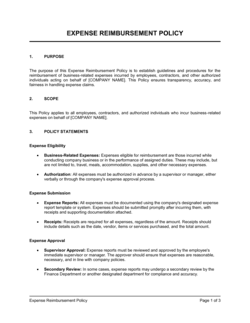
Policy Letter on Vehicle Expense Reimbursement Template

Free Word download β€’ Edit online β€’ Save & share with Drive β€’ Export to PDF

1 pageβ€’15–25 min to fillβ€’Difficulty: Standard
Learn more ↓
FreePolicy Letter on Vehicle Expense Reimbursement Template

At a glance

What it is
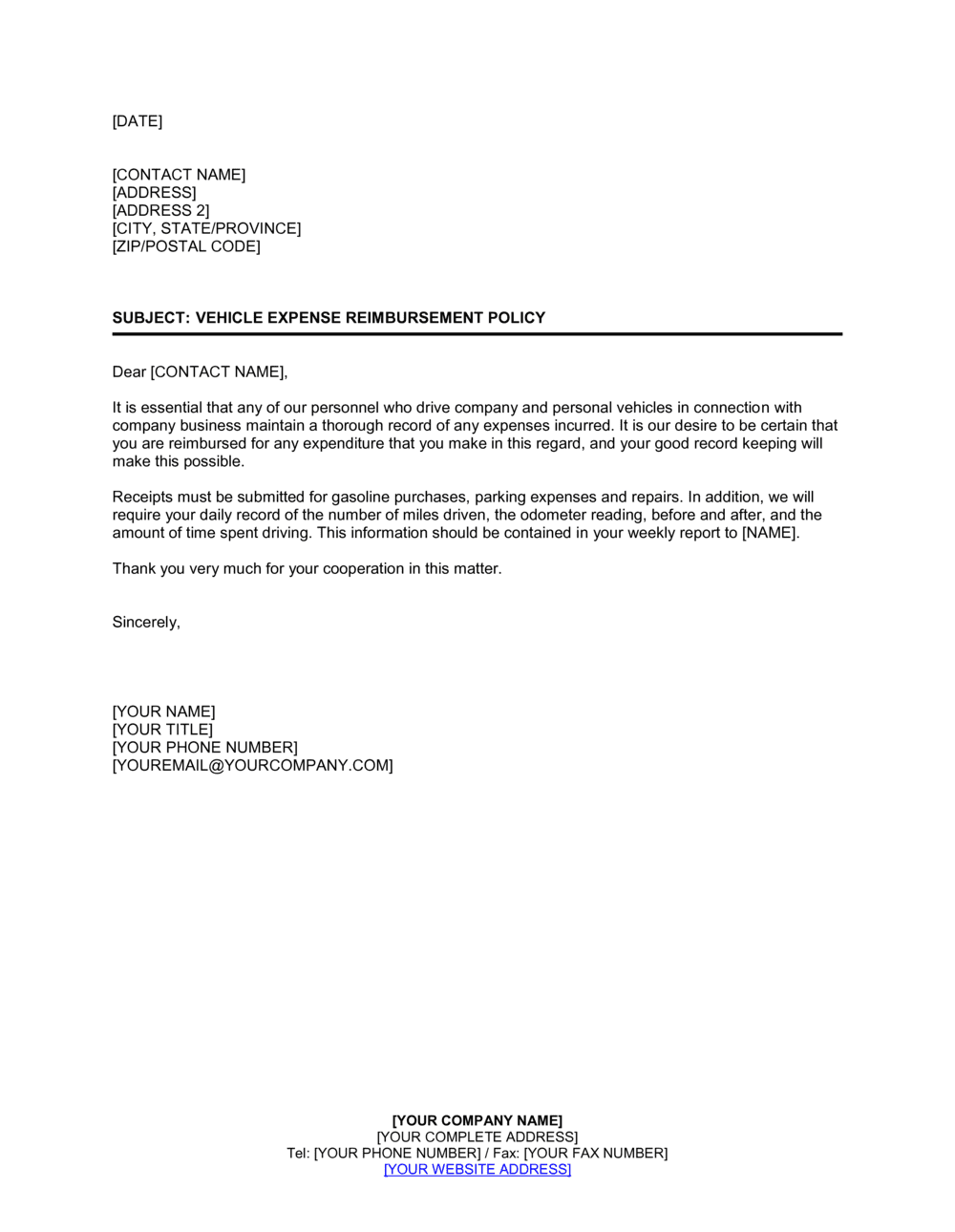
A Policy Letter on Vehicle Expense Reimbursement is a formal internal communication that informs employees of the company's rules for claiming reimbursement when they use a personal or company vehicle for business purposes. This free Word download gives you a ready-to-edit letter covering eligible expenses, mileage rates, documentation requirements, and submission deadlines β€” export as PDF and distribute to staff in minutes.
When you need it
Use it when onboarding employees who will drive for work, when updating your reimbursement rate to match the current IRS standard mileage rate, or when inconsistent claims signal that staff need a written policy reminder.
What's inside
The letter covers the policy's effective date, which trips and expenses qualify, the reimbursement rate per mile or per category, required documentation such as mileage logs and receipts, the submission and approval process, and the consequence of non-compliance.

What is a Policy Letter on Vehicle Expense Reimbursement?

A Policy Letter on Vehicle Expense Reimbursement is a formal internal business communication that notifies employees of the company's rules for claiming reimbursement when they use a personal vehicle for approved business travel. It states the applicable mileage rate, defines which trips qualify, specifies the documentation employees must provide, and sets the deadlines and approval steps for submitting claims. Unlike a full expense policy embedded in an employee handbook, this letter is designed to be issued quickly β€” when a new rate takes effect, when a policy is introduced for the first time, or when a pattern of inconsistent claims requires a written reminder.

Why You Need This Document

Without a written vehicle reimbursement policy letter, employees submit claims based on their own interpretation of what qualifies β€” and finance teams spend significant time resolving disputes over commute miles, unsupported receipts, and inflated mileage logs. The absence of a stated rate creates tax exposure: reimbursements made without proper documentation under an accountable plan may be treated as taxable wages, triggering payroll tax liability for the employer. A clear, distributed policy letter closes these gaps before they become payroll errors or employee grievances. This template gives you a professional, complete letter you can edit, brand, and send to your entire workforce in under 15 minutes.

Which variant fits your situation?

If your situation is…Use this template
Reimbursing employees at the IRS standard mileage ratePolicy Letter on Vehicle Expense Reimbursement (Mileage Rate)
Providing a fixed monthly vehicle allowance instead of per-mile reimbursementVehicle Allowance Policy Letter
Assigning a company-owned vehicle to an employeeCompany Vehicle Use Policy
Reimbursing travel expenses beyond mileage (tolls, parking, fuel)Employee Expense Reimbursement Policy
Disciplining an employee for submitting fraudulent mileage claimsEmployee Warning Letter
Documenting the full travel and expense policy in an employee handbook sectionEmployee Handbook

Common mistakes to avoid

❌ Not specifying the per-mile dollar amount

Why it matters: Employees cannot calculate what they are owed, and managers cannot audit submissions against an unstated benchmark β€” claims become a negotiation instead of a math problem.

Fix: State the exact rate β€” e.g., '$0.70 per mile' β€” in the reimbursement clause and update it every January when the IRS publishes the new standard rate.

❌ Omitting the commute exclusion

Why it matters: Without an explicit exclusion, employees commonly add home-to-office miles to their business mileage, inflating claims and creating a tax liability for the company under a non-accountable plan.

Fix: Add a single sentence defining commute miles and stating they are not reimbursable, regardless of whether the employee's day included other business travel.

❌ No stated deadline for submitting claims

Why it matters: Finance teams receive mileage claims from two or three months prior, making accruals inaccurate and payroll cycles unpredictable.

Fix: Set a specific monthly cutoff β€” such as the 5th business day of the following month β€” and state that claims submitted after that date will be held for the next cycle.

❌ Listing no consequences for false claims

Why it matters: A policy without stated consequences is treated as a guideline, not a rule β€” fraudulent mileage submissions are more common when employees believe the only outcome is having the claim denied.

Fix: Include a single sentence stating that falsified claims are a policy violation subject to disciplinary action up to and including termination, and that significant fraud may be referred for legal action.

The 9 key clauses, explained

Header and addressee block

In plain language: Identifies the sender, recipient(s), date, and subject line so the letter is routed and filed correctly.

Sample language
TO: All Employees | FROM: [NAME], [TITLE] | DATE: [DATE] | RE: Vehicle Expense Reimbursement Policy β€” Effective [DATE]

Common mistake: Addressing the letter to a department rather than 'All Employees' or a named group β€” employees who receive it indirectly assume it does not apply to them.

Policy purpose and effective date

In plain language: States why the letter is being issued β€” new policy, rate change, or compliance reminder β€” and the date the rules take effect.

Sample language
Effective [DATE], [COMPANY NAME] is updating its vehicle expense reimbursement policy to reflect the [YEAR] IRS standard mileage rate of $[RATE] per mile.

Common mistake: Omitting the effective date, which leaves employees unsure whether the new rate applies to trips already taken or only to future travel.

Eligible business trips

In plain language: Defines which driving activities qualify for reimbursement and explicitly excludes personal commuting.

Sample language
Reimbursable trips include travel to client sites, vendor locations, off-site meetings, and inter-office travel. Travel between your primary residence and your regular workplace is not reimbursable.

Common mistake: Failing to exclude home-to-office commuting in writing β€” employees frequently claim commute miles when the policy is ambiguous, creating tax and payroll headaches.

Reimbursement rate and method

In plain language: States the exact per-mile rate or fixed allowance amount, the currency, and whether payment is via payroll, expense check, or direct deposit.

Sample language
The Company will reimburse approved business mileage at $[RATE] per mile (USD). Reimbursement is processed through the standard payroll cycle on the last business day of each month.

Common mistake: Referencing 'the current IRS rate' without stating the actual dollar figure β€” employees cannot calculate their reimbursement and managers cannot audit submissions.

Required documentation

In plain language: Lists the specific records employees must submit with each claim β€” mileage log fields, receipts for tolls or parking, and any required receipts threshold.

Sample language
Each claim must be supported by a mileage log recording: date of travel, origin address, destination address, business purpose, and total miles driven. Receipts are required for tolls, parking, and fuel purchases exceeding $[AMOUNT].

Common mistake: Requiring receipts for fuel when reimbursing per mile β€” the mileage rate already covers fuel, so asking for fuel receipts too creates confusion and duplicate-payment risk.

Submission deadline and approval process

In plain language: Sets the deadline by which expense reports must be submitted, identifies who must approve them, and states the expected payment timeline.

Sample language
Expense reports must be submitted to your direct manager no later than the [5th] business day of the month following the travel date. Your manager will review and forward to Finance within [3] business days. Approved claims are paid on the next regular payroll date.

Common mistake: Setting a deadline without stating a consequence for late submission β€” employees treat the deadline as optional and finance teams receive claims months after the fact.

Non-reimbursable expenses

In plain language: Lists costs specifically excluded from reimbursement β€” traffic fines, vehicle repairs, insurance, and personal side trips β€” to prevent disputes.

Sample language
The following are not reimbursable: traffic or parking violations, vehicle insurance premiums, routine maintenance, car washes, and any personal detours added to a business trip.

Common mistake: Omitting this clause entirely and relying on employees to know what is excluded β€” ambiguity leads to claims for personal expenses and awkward individual conversations.

Consequences of non-compliance

In plain language: Informs employees that false or unsupported claims will be denied and may result in disciplinary action, up to and including termination.

Sample language
Claims submitted without required documentation will be returned unpaid. Submission of false or inflated mileage claims constitutes a violation of Company policy and may result in disciplinary action, up to and including termination of employment.

Common mistake: Using vague language like 'may be addressed by management' instead of specifying consequences β€” employees do not take the warning seriously without concrete stakes.

Contact and questions

In plain language: Directs employees to a specific person or team for questions about the policy, preventing confusion from reaching multiple inboxes.

Sample language
Questions regarding this policy should be directed to [NAME], [TITLE], at [EMAIL] or [PHONE NUMBER].

Common mistake: Listing a generic department email (e.g., hr@company.com) with no named contact β€” employees rarely follow up, and policy misunderstandings persist.

How to fill it out

  1. 1

    Set the effective date and reason for the letter

    Decide whether you are issuing this as a new policy, an annual rate update, or a compliance reminder. Enter the effective date in the purpose clause so employees know exactly when the rules apply.

    πŸ’‘ Align the effective date with the start of a payroll period so accounting does not need to split calculations mid-cycle.

  2. 2

    Enter the reimbursement rate

    Insert the exact dollar-per-mile rate β€” either the current IRS standard mileage rate or your company's approved rate β€” as a specific number. Do not reference 'the IRS rate' without stating the figure.

    πŸ’‘ Check the IRS website each January for the updated standard mileage rate; the rate can change mid-year for significant fuel cost swings.

  3. 3

    Define eligible and excluded trips

    List the specific trip types that qualify β€” client visits, off-site meetings, inter-office travel β€” and explicitly state that home-to-office commuting is excluded.

    πŸ’‘ If employees work from home some days, specify whether driving to the office on a remote-work day counts as a commute or a business trip.

  4. 4

    Specify required documentation

    List every field the mileage log must include: date, origin, destination, business purpose, and miles. Add any receipt thresholds for tolls, parking, or other ancillary costs.

    πŸ’‘ Recommend a free mileage-tracking app (such as MileIQ or Everlance) in this section β€” employees who use one submit cleaner, more complete logs.

  5. 5

    Set submission deadlines and the approval chain

    Enter the cutoff date for monthly submissions, name the approver role (direct manager, department head), and state the payment date. Be specific β€” '5th business day of the following month' beats 'monthly.'

    πŸ’‘ Calendar reminders sent to employees on the 1st of each month cut late submissions by more than half in most organizations.

  6. 6

    List non-reimbursable items

    Add a clear exclusion list covering fines, vehicle maintenance, insurance, and personal detours. Copy this list verbatim from your existing expense policy if one exists so the documents are consistent.

    πŸ’‘ Cross-reference this list against your most common disputed claims from the past 12 months β€” exclusions based on real disputes carry more weight with employees.

  7. 7

    Name a contact person and distribute

    Add a named individual β€” not just a department inbox β€” for employee questions. Send the letter by email with read receipts, or have employees sign an acknowledgment form for the personnel file.

    πŸ’‘ Attaching a one-page FAQ to the letter cuts inbound questions by approximately 40% in the first week after distribution.

Frequently asked questions

What is a vehicle expense reimbursement policy letter?

A vehicle expense reimbursement policy letter is a formal internal notice that tells employees exactly how and when the company will reimburse them for driving a personal or company vehicle on approved business trips. It states the mileage rate, eligible trip types, documentation requirements, submission deadlines, and consequences for non-compliance β€” all in a single document employees can reference when filing a claim.

What is the IRS standard mileage rate and should I use it?

The IRS standard mileage rate is a per-mile reimbursement figure updated annually β€” and sometimes mid-year β€” that covers fuel, depreciation, insurance, and maintenance costs. Reimbursing employees at or below this rate means the payment is not considered taxable income for the employee and is fully deductible for the employer. Most companies use it as their default rate because it simplifies payroll tax compliance. For 2025, check the IRS website for the current figure before issuing your policy letter.

Are vehicle reimbursements taxable income for employees?

Reimbursements made under an accountable plan β€” requiring employees to substantiate mileage with a log and return any excess advance β€” are generally not taxable income, provided the per-mile rate does not exceed the IRS standard mileage rate. Payments above that rate, or made without requiring documentation, are treated as taxable wages and must be included in payroll. Consult a tax adviser to confirm the treatment for your specific reimbursement structure.

What records must employees keep to support a mileage claim?

At minimum, a mileage log should record the date of each trip, the starting and ending addresses, the business purpose, and the total miles driven. Many companies also require the odometer reading at start and end. Digital mileage-tracking apps automatically capture GPS-verified records that satisfy IRS substantiation requirements and are harder to inflate than manual logs.

Does the policy letter replace the employee handbook section on expenses?

No β€” a policy letter is a targeted notice that communicates a specific rate or rule change quickly, typically at the start of a new year or following an IRS rate update. The employee handbook should contain the full, standing expense policy. The letter supplements the handbook; it does not replace it. Cross-reference the handbook in the letter so employees know where to find the complete terms.

How often should the vehicle reimbursement policy letter be reissued?

Reissue the letter whenever the IRS publishes a new standard mileage rate (typically each January, and sometimes mid-year), when your company changes its internal rate or approval workflow, or when a pattern of non-compliant claims signals employees need a reminder. Annual reissuance at the start of each fiscal year is a reliable baseline practice.

Can I use a fixed monthly vehicle allowance instead of per-mile reimbursement?

Yes. A fixed monthly allowance is simpler to administer β€” no mileage logs required β€” but carries a tax risk: because the payment is not tied to documented business mileage, the IRS may treat the full allowance as taxable wages rather than a non-taxable reimbursement. Per-mile reimbursement under an accountable plan is generally the more tax-efficient approach for both employer and employee. A tax adviser can help you choose the right method for your workforce.

What should I do if an employee submits an inflated mileage claim?

Deny the unsupported portion of the claim and request the employee's mileage log as documentation. If the log is missing or inconsistent with known travel, follow your standard progressive discipline process β€” verbal warning, written warning, and if a pattern continues, termination. For significant or repeated fraud, consult legal counsel before taking action. A written policy with clear consequences makes enforcement significantly easier.

How this compares to alternatives

vs Employee Expense Reimbursement Policy

A general expense reimbursement policy covers all business costs β€” meals, lodging, airfare, and supplies β€” in addition to vehicle use. A vehicle expense reimbursement policy letter addresses driving costs only and is shorter and more targeted. Use the full policy for onboarding; use the letter to communicate a mileage rate update or vehicle-specific rule change quickly.

vs Company Vehicle Use Policy

A company vehicle use policy governs employees driving employer-owned vehicles β€” covering personal use, accident reporting, insurance, and maintenance responsibilities. A vehicle expense reimbursement policy letter addresses employees using their own personal vehicles for business travel. The two documents serve different populations and should be issued separately.

vs Employee Handbook

An employee handbook is a comprehensive reference document covering all HR policies, including a section on expense reimbursement. A policy letter is a targeted, timely communication designed to announce a specific change or remind employees of an existing rule. The letter supplements the handbook β€” it does not replace it β€” and should cross-reference the relevant handbook section.

vs Expense Report Form

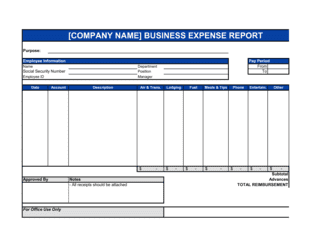
An expense report form is the submission tool employees use to request reimbursement for individual trips or periods. The policy letter defines the rules that govern how that form is completed and when it must be submitted. Both documents are needed: the letter sets expectations, and the form captures and records the actual claim.

Industry-specific considerations

Field Sales and Distribution

Sales reps driving to customer sites daily generate the highest mileage volume; a clear policy with a digital log requirement is essential to control reimbursement costs.

Healthcare and Home Services

Home health aides, visiting nurses, and mobile therapists drive between patient locations throughout the day; the policy must address multi-stop trip logging and the first-and-last-stop commute rule.

Construction and Trades

Foremen and project managers regularly drive between job sites, offices, and supplier locations; the policy should clarify whether the main job site counts as a regular workplace for commute purposes.

Professional Services

Consultants, accountants, and lawyers billing client engagements often need mileage records that align with time-tracking entries; the policy should require trip-level business-purpose notes for client billing support.

Template vs pro β€” what fits your needs?

PathBest forCostTime
Use the templateAny employer issuing or updating a standard vehicle mileage reimbursement notice to staffFree10–15 minutes
Template + professional reviewCompanies with complex multi-state workforces, fixed allowance structures, or employees asking about tax treatment$150–$400 (HR consultant or tax adviser review)1–2 business days
Custom draftedOrganizations with union agreements, regulated industries requiring specific reimbursement documentation, or international employees$500–$1,500 (employment counsel)3–5 business days

Glossary

IRS Standard Mileage Rate
The per-mile reimbursement rate published annually by the US Internal Revenue Service; reimbursements at or below this rate are not taxable income for the employee.
Mileage Log
A written or digital record of each business trip showing date, origin, destination, purpose, and miles driven β€” required to substantiate a mileage claim.
Reimbursable Expense
A cost that the company has agreed in advance to repay, because it was incurred while conducting approved company business.
Personal Commute
Travel between an employee's home and their regular workplace β€” generally not reimbursable and excluded from business mileage calculations.
Accountable Plan
An IRS-defined reimbursement arrangement that requires employees to substantiate expenses with documentation and return any excess advance; payments under an accountable plan are not treated as taxable wages.
Per Diem
A fixed daily allowance paid instead of actual-expense reimbursement for travel costs such as meals and incidentals.
Vehicle Allowance
A fixed monthly sum paid to an employee to offset the cost of using their personal vehicle for work, regardless of actual miles driven.
Expense Report
A standardized form employees submit to request reimbursement for business costs, attaching receipts or a mileage log as supporting documentation.
Approval Workflow
The defined chain of review β€” typically employee, direct manager, and finance β€” through which an expense claim must pass before payment is issued.
Effective Date
The specific date on which a new or revised policy takes effect, after which all claims must comply with the updated terms.

Part of your Business Operating System

This document is one of 3,000+ business & legal templates included in Business in a Box.

  • Fill-in-the-blanks β€” ready in minutes
  • 100% customizable Word document
  • Compatible with all office suites
  • Export to PDF and share electronically

Create your document in 3 simple steps.

From template to signed document β€” all inside one Business Operating System.
1
Download or open template

Access over 3,000+ business and legal templates for any business task, project or initiative.

2
Edit and fill in the blanks with AI

Customize your ready-made business document template and save it in the cloud.

3
Save, Share, Send, Sign

Share your files and folders with your team. Create a space of seamless collaboration.

Save time, save money, and create top-quality documents.

β˜…β˜…β˜…β˜…β˜…

"Fantastic value! I'm not sure how I'd do without it. It's worth its weight in gold and paid back for itself many times."

Managing Director Β· Mall Farm
Robert Whalley
Managing Director, Mall Farm Proprietary Limited
β˜…β˜…β˜…β˜…β˜…

"I have been using Business in a Box for years. It has been the most useful source of templates I have encountered. I recommend it to anyone."

Business Owner Β· 4+ years
Dr Michael John Freestone
Business Owner
β˜…β˜…β˜…β˜…β˜…

"It has been a life saver so many times I have lost count. Business in a Box has saved me so much time and as you know, time is money."

Owner Β· Upstate Web
David G. Moore Jr.
Owner, Upstate Web

Run your business with a system β€” not scattered tools

Stop downloading documents. Start operating with clarity. Business in a Box gives you the Business Operating System used by over 250,000 companies worldwide to structure, run, and grow their business.

Start freeΒ Β·Β No credit card required