Letter Examples for a Subscription of Shares Template

Free Word download β€’ Edit online β€’ Save & share with Drive β€’ Export to PDF

2 pagesβ€’20–25 min to fillβ€’Difficulty: Standard
Learn more ↓
FreeLetter Examples for a Subscription of Shares Template

At a glance

What it is
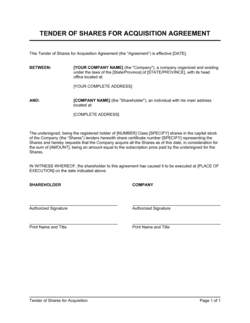
A Letter for a Subscription of Shares is a formal written communication sent by an investor or subscriber to a company to express intent and formally apply to purchase a defined number of shares at a stated price. This free Word download provides ready-to-use letter examples you can edit online and export as PDF, covering the key elements of a proper subscription notice.
When you need it
Use it when an individual or entity wishes to formally subscribe to newly issued shares during a capital raise, rights issue, or private placement. It is also used when a company invites shareholders or third-party investors to participate in a share offering and requires written confirmation of intent.
What's inside
Subscriber identification, details of the shares being subscribed for, the subscription price and payment terms, a declaration of intent to be bound, and the subscriber's signature block. The template includes multiple letter examples suited to different subscription scenarios.

What is a Letter for a Subscription of Shares?

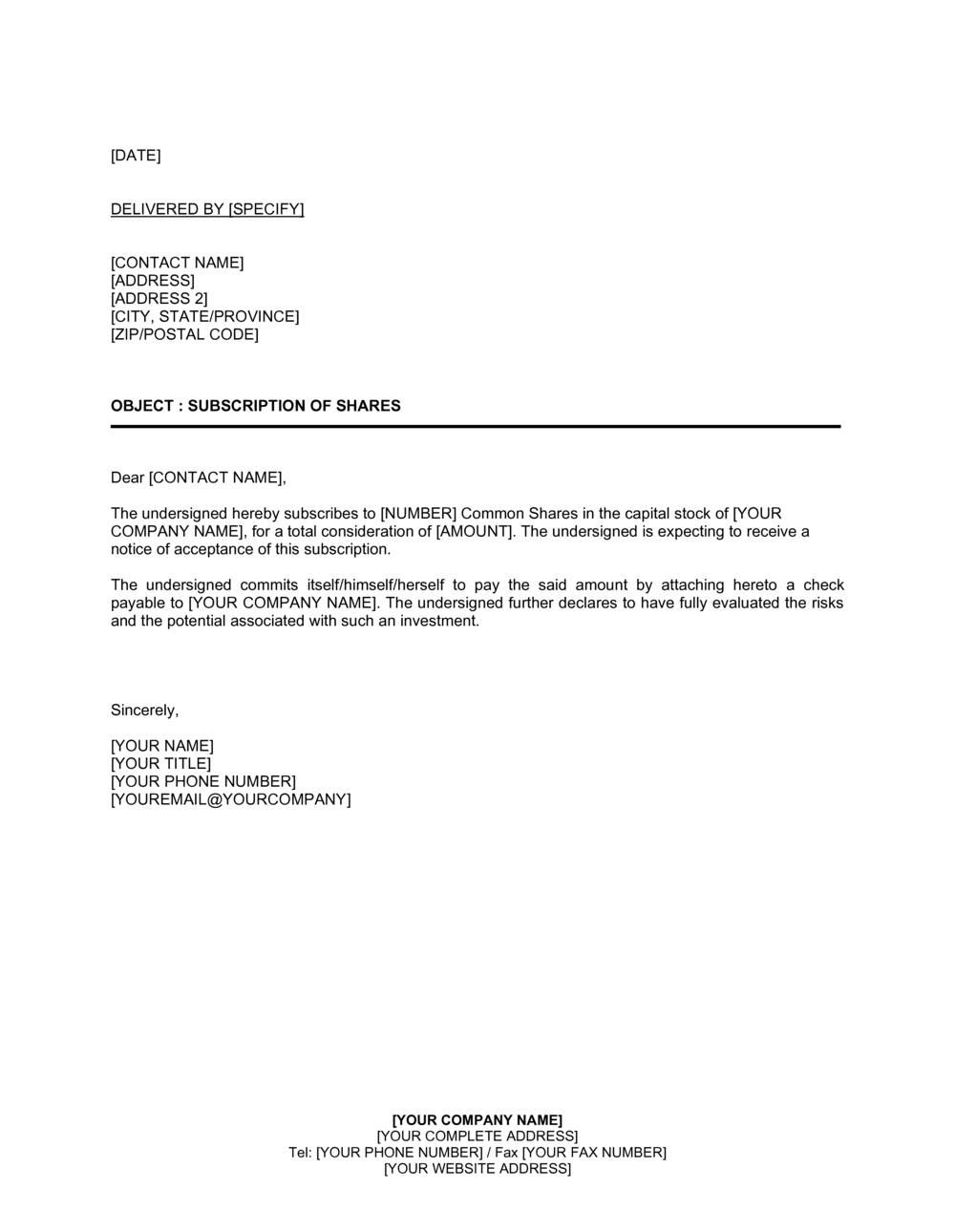
A Letter for a Subscription of Shares is a formal written application submitted by an investor or subscriber to a company, requesting to purchase a specified number of newly issued shares at an agreed price per share. Unlike a share transfer, which moves existing shares between parties, a subscription letter applies directly to the company for shares that do not yet exist β€” shares the board will create and allot upon accepting the application. The letter records the subscriber's identity, the share class and quantity, the total consideration, payment terms, and a declaration of binding intent, providing the documentary foundation the board needs to pass a valid allotment resolution.

Why You Need This Document

Without a formal subscription letter on file, a company has no clear written record of the terms on which new shares were issued β€” creating disputes over price, class, and quantity that are difficult to resolve after the fact. An undocumented subscription also leaves gaps in the share register audit trail, which buyers and investors scrutinize closely during due diligence. For the subscriber, a signed letter protects against the company later denying the agreed price or share count. This template provides ready-to-use letter examples covering the most common subscription scenarios, so both company and investor walk away from the transaction with a clean, unambiguous record from the moment the application is submitted.

Which variant fits your situation?

If your situation is…Use this template
Investor applying to subscribe for new shares in a startupShare Subscription Letter (Investor to Company)
Company formally inviting a named party to subscribe for sharesShare Subscription Invitation Letter (Company to Subscriber)
Existing shareholder exercising rights under a rights issueRights Issue Acceptance Letter
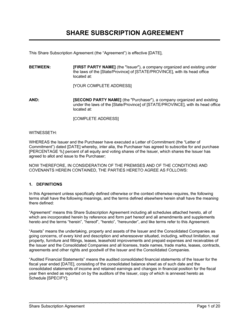
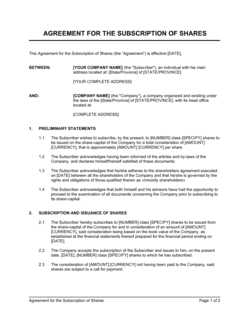
Formalizing equity terms agreed in a term sheetShare Subscription Agreement
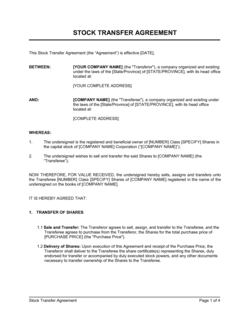
Transferring existing shares rather than issuing new onesShare Transfer Agreement
Recording the full terms of an equity investment roundShareholders Agreement
Documenting a convertible note or SAFE investmentConvertible Note Agreement

Common mistakes to avoid

❌ Using a vague expression of interest instead of a firm application

Why it matters: Phrases like 'I am interested in investing' do not constitute a subscription application and cannot support a board allotment resolution. The company cannot legally issue shares against an informal expression of interest.

Fix: Use definitive language β€” 'I hereby apply to subscribe for [NUMBER] shares' β€” so the letter functions as a formal offer the board can accept and act on.
❌ Omitting the share class when multiple classes exist

Why it matters: A subscription application that does not specify the share class is ambiguous β€” the company cannot allot without knowing which class, and the subscriber may receive a class with different voting or economic rights than intended.

Fix: Always state the specific share class and confirm it against the company's current capitalization table and articles before submitting.

❌ No defined payment deadline

Why it matters: Without a payment deadline tied to allotment, companies have updated their share register and issued share certificates before receiving funds β€” creating a debt-collection problem rather than a clean equity transaction.

Fix: State a specific deadline: 'Payment to be made within [X] business days of receipt of the allotment notice.'

❌ Corporate subscriber signed by an unauthorized individual

Why it matters: If the person signing on behalf of a corporate subscriber did not have board authorization to commit to the subscription, the application may be voidable β€” leaving both parties in a disputed position after the allotment resolution has passed.

Fix: Attach a certified copy of the corporate subscriber's board resolution or extract from its authorization documents confirming the signatory's authority.

The 10 key clauses, explained

Heading and Date

In plain language: Identifies the letter as a formal subscription notice and records the date on which it is submitted.

Sample language
[CITY], [DATE] Re: Application for Subscription of [NUMBER] Shares in [COMPANY NAME]

Common mistake: Omitting the date entirely β€” undated subscription letters create disputes about when the offer was made and whether it was accepted within a valid offering window.

Parties β€” Subscriber and Company

In plain language: States the full legal name and address of the subscriber and the company whose shares are being subscribed for.

Sample language
To: The Board of Directors [COMPANY NAME] [REGISTERED ADDRESS] From: [SUBSCRIBER FULL NAME / ENTITY NAME], [ADDRESS]

Common mistake: Using a trading name instead of the subscriber's or company's registered legal name, which can complicate share register entries and later transfers.

Statement of Intent to Subscribe

In plain language: A clear declaration that the subscriber wishes to apply for a defined number of shares and agrees to be bound by the terms of the subscription.

Sample language
I/We hereby apply to subscribe for [NUMBER] ordinary shares of [COMPANY NAME] at a subscription price of [CURRENCY][PRICE] per share, on the terms set out in this letter.

Common mistake: Writing a vague expression of interest rather than a firm application β€” phrases like 'I would like to invest' do not constitute a formal subscription and will not support an allotment resolution.

Share Class and Number of Shares

In plain language: Specifies the class of shares (e.g., ordinary, preference, Class A) and the exact number being subscribed for.

Sample language
The shares applied for are [NUMBER] [CLASS] shares, each with a par value of [CURRENCY][PAR VALUE].

Common mistake: Failing to specify the share class when the company has multiple classes β€” leaving the type of shares unresolved can invalidate the subscription or require a corrective resolution.

Subscription Price and Total Consideration

In plain language: States the agreed price per share, the total amount payable, and the currency.

Sample language
The total subscription price payable is [CURRENCY][TOTAL AMOUNT], being [NUMBER] shares at [CURRENCY][PRICE] per share.

Common mistake: Stating only the per-share price without the total β€” if the number of shares is later disputed, there is no agreed ceiling on the total consideration.

Payment Terms

In plain language: Describes when and how the subscription price will be paid β€” on application, in installments, or upon allotment.

Sample language
Payment in full will be made by [BANK TRANSFER / CHEQUE] to [ACCOUNT DETAILS] upon allotment of the shares, no later than [DATE].

Common mistake: Leaving payment timing undefined β€” companies have issued shares, updated the share register, and then been unable to collect payment because no deadline was recorded.

Representations and Acknowledgments

In plain language: Short declarations by the subscriber confirming they have authority to subscribe, are aware of risks, and have not relied on any unwritten representations.

Sample language
The undersigned confirms that (a) they have the legal capacity and authority to enter into this subscription; (b) they have not relied on any representations not contained in this letter or the offering documents; and (c) they understand that investment in shares carries risk of total loss.

Common mistake: Omitting this block entirely in simple subscription letters β€” without it, a subscriber who later suffers a loss may claim they were misled by verbal assurances.

Acceptance Mechanism

In plain language: Explains how the company will formally accept the subscription β€” typically by written allotment notice or board resolution β€” and what happens if the application is not accepted.

Sample language
This application shall be deemed accepted upon the Company issuing a written allotment notice to the subscriber. The Company reserves the right to accept or decline this application in whole or in part.

Common mistake: Not specifying how acceptance is communicated β€” subscribers have assumed their subscription was accepted (and transferred funds) when no allotment decision had been made.

Governing Terms and Reference to Offering Documents

In plain language: References any term sheet, shareholders agreement, or offering memorandum whose terms govern the shares being subscribed for.

Sample language
This subscription is made subject to the terms of the Shareholders Agreement dated [DATE] and the Company's Articles of Association as amended to date.

Common mistake: Failing to cross-reference the shareholders agreement β€” the subscriber receives shares without being contractually bound to the rights and restrictions agreed between existing shareholders.

Subscriber Signature Block

In plain language: The subscriber's name, title (if signing on behalf of an entity), and signature, confirming the application.

Sample language
Signed by: [SUBSCRIBER NAME] Title: [TITLE β€” if signing as authorized representative] Date: [DATE]

Common mistake: Having an unauthorized signatory sign on behalf of a corporate subscriber β€” if the individual lacked board authority, the subscription application may be voidable.

How to fill it out

  1. 1

    Identify the correct letter example for your scenario

    The template includes multiple letter examples β€” subscriber-to-company and company-to-subscriber formats. Select the version that matches who is initiating the communication.

    πŸ’‘ If the company is running a formal round with a term sheet, use the subscriber-to-company format and attach the term sheet as a reference exhibit.

  2. 2

    Enter the subscriber's full legal name and address

    Use the subscriber's registered legal name exactly as it appears on incorporation documents or government ID. For individual investors, use the full name as it will appear on the share register.

    πŸ’‘ If the subscriber is a trust or nominee entity, state the entity name and add a note identifying the beneficial owner β€” many company registries require this.

  3. 3

    State the share class, number of shares, and price

    Fill in the exact share class (e.g., ordinary shares, Series A preference shares), the number of shares being applied for, the price per share, and the total consideration.

    πŸ’‘ Confirm the share class and par value against the company's current articles of association before completing this section.

  4. 4

    Define payment terms and method

    Specify whether payment is due on application or upon allotment, the payment method (bank transfer, cheque), and provide full account details or instructions.

    πŸ’‘ Net 10 from allotment date is a practical standard for private placements β€” it gives the company time to pass the board resolution before funds are expected.

  5. 5

    Reference governing documents

    Insert the date and title of any shareholders agreement, subscription agreement, or offering memorandum whose terms apply to these shares.

    πŸ’‘ If no shareholders agreement exists yet, note that one will be executed concurrently β€” this prevents the subscriber from claiming they are not bound by future equity terms.

  6. 6

    Complete and send the letter

    Have the subscriber sign the letter and deliver it to the board of directors by the method specified in the offering documents β€” email with PDF attachment is standard for most private placements.

    πŸ’‘ Request a written acknowledgment of receipt from the company immediately β€” this timestamps the application and protects the subscriber if the offering closes oversubscribed.

Frequently asked questions

What is a letter for a subscription of shares?

A letter for a subscription of shares is a formal written application submitted by an investor to a company, requesting to purchase a defined number of newly issued shares at an agreed price. It documents the subscriber's intent, the number and class of shares applied for, the total consideration, and the payment terms. It is the foundational document that triggers the company's allotment process.

Is a subscription letter legally binding?

A properly drafted subscription letter functions as a formal offer that becomes binding on both parties once the company accepts it β€” typically through a board allotment resolution and written allotment notice. Until acceptance, the company is generally free to decline or partially accept the application. The letter itself does not transfer shares; allotment by board resolution does.

What is the difference between a subscription letter and a share subscription agreement?

A subscription letter is a shorter, simpler document used for straightforward private placements or early-stage rounds where the commercial terms are already set out in a term sheet or shareholders agreement. A share subscription agreement is a fuller contract that contains representations and warranties, conditions precedent, and investor protections. Use a subscription letter for simplicity; use a subscription agreement when the round involves material negotiated terms.

Do I need a lawyer to prepare a share subscription letter?

For most straightforward private placements between known parties, a well-drafted template is sufficient. Legal review is advisable when the subscription involves preference shares with complex economic rights, cross-border investors subject to securities regulations, or when the amount being subscribed is large relative to the company's overall capitalization. A template review typically takes 30–60 minutes and costs $150–$400.

Does a share subscription letter need to be signed?

A signature is not required to make the letter valid in most jurisdictions, but it is strongly recommended as evidence of the subscriber's intent and authority. For corporate subscribers, the signature of an authorized officer or director β€” supported by a board resolution β€” is standard practice and reduces the risk of the subscription being challenged later.

What happens after a subscription letter is submitted?

The company's board of directors reviews the application and passes an allotment resolution approving the issuance of the shares. The company then sends the subscriber an allotment notice confirming the number of shares allotted. The subscriber pays the agreed consideration, the share register is updated, and a share certificate is issued. The full process typically takes 5–15 business days for a private company.

Can a subscription letter be used for preference shares?

Yes β€” a subscription letter can be used for any class of shares, including preference shares. However, if the preference shares carry special economic rights (liquidation preference, anti-dilution protection, dividend priority), those terms should be set out in a full share subscription agreement or shareholders agreement rather than summarized in the letter, to avoid ambiguity about the rights being acquired.

What records should be kept after a share subscription?

Retain the signed subscription letter, the board allotment resolution, the allotment notice sent to the subscriber, proof of payment received, the updated share register, and the share certificate issued. These documents form the complete paper trail for the equity transaction and are required for regulatory filings, future due diligence, and any subsequent transfer or exit transaction.

How this compares to alternatives

vs Share Subscription Agreement

A share subscription agreement is a full contract with representations, warranties, conditions precedent, and investor protections β€” suited to structured rounds with negotiated terms. A subscription letter is a shorter, simpler instrument for straightforward private placements where terms are already agreed. Use the letter for simplicity; use the agreement when investor protections and conditions need to be formally documented.

vs Share Transfer Agreement

A share transfer agreement documents the sale of existing shares from one shareholder to another β€” no new shares are created. A subscription letter applies for newly issued shares from the company itself, increasing the total share count and diluting existing holders. The transaction type β€” new issuance vs. secondary transfer β€” determines which document is needed.

vs Shareholders Agreement

A shareholders agreement governs the ongoing rights and obligations of all shareholders β€” voting, dividends, drag-along, and tag-along rights. A subscription letter is a one-time transactional document used to apply for shares. The two documents work together: the subscription letter should cross-reference the shareholders agreement so the new subscriber is immediately bound by its terms on allotment.

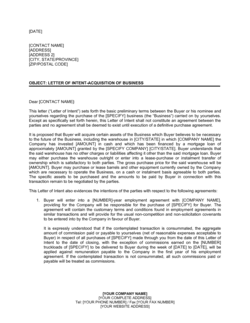
vs Letter of Intent

A letter of intent expresses a preliminary, typically non-binding interest in a transaction β€” used to agree on broad terms before drafting definitive documents. A subscription letter is a binding application to purchase shares at specific terms already agreed. If share price and terms are still being negotiated, a letter of intent comes first; the subscription letter follows once terms are settled.

Industry-specific considerations

Technology / SaaS

Used during seed and pre-Series A rounds to document early angel or founder share subscriptions before a full subscription agreement is warranted.

Professional Services

Law firms, accounting practices, and consultancies use subscription letters when admitting new equity partners who are purchasing shares in the partnership holding company.

Real Estate

Property investment vehicles and real estate holding companies use share subscription letters to bring in new equity investors for specific development projects.

Manufacturing

Family-owned manufacturers use subscription letters when issuing shares to new shareholders as part of succession planning or capital expansion without a full securities offering.

Template vs pro β€” what fits your needs?

PathBest forCostTime
Use the templateStraightforward private placements between known parties with agreed terms and ordinary share classesFree15–30 minutes
Template + professional reviewRounds involving preference shares, cross-border investors, or subscriptions above $100,000$150–$400 (lawyer or corporate secretary review)1–2 days
Custom draftedStructured investment rounds with negotiated investor protections, anti-dilution, or regulatory filing requirements$800–$3,000+1–2 weeks

Glossary

Subscription of Shares
The formal process by which an investor applies to receive newly issued shares from a company in exchange for payment.
Subscriber
The individual or entity applying to purchase shares directly from the company, as opposed to buying from an existing shareholder.
Subscription Price
The price per share agreed between the company and the subscriber at the time of the share offering.
Rights Issue
An offer by a company allowing existing shareholders to buy additional shares at a discount, typically in proportion to their current holdings.
Private Placement
The sale of shares to a select group of investors rather than the general public, typically without a public prospectus.
Allotment
The formal act by which a company's board approves and assigns newly issued shares to a subscriber following acceptance of a subscription application.
Par Value
The nominal face value of a share as stated in the company's articles of incorporation, often distinct from the market or subscription price.
Share Certificate
A document issued by the company to the shareholder confirming ownership of a specific number of shares following successful allotment.
Consideration
The payment or other value given by the subscriber in exchange for the shares, most commonly a cash sum at the agreed subscription price.
Capitalization Table (Cap Table)
A spreadsheet recording all equity owners, their share counts, and ownership percentages β€” updated each time new shares are issued or transferred.

Part of your Business Operating System

This document is one of 3,000+ business & legal templates included in Business in a Box.

  • Fill-in-the-blanks β€” ready in minutes
  • 100% customizable Word document
  • Compatible with all office suites
  • Export to PDF and share electronically

Create your document in 3 simple steps.

From template to signed document β€” all inside one Business Operating System.
1
Download or open template

Access over 3,000+ business and legal templates for any business task, project or initiative.

2
Edit and fill in the blanks with AI

Customize your ready-made business document template and save it in the cloud.

3
Save, Share, Send, Sign

Share your files and folders with your team. Create a space of seamless collaboration.

Save time, save money, and create top-quality documents.

β˜…β˜…β˜…β˜…β˜…

"Fantastic value! I'm not sure how I'd do without it. It's worth its weight in gold and paid back for itself many times."

Managing Director Β· Mall Farm
Robert Whalley
Managing Director, Mall Farm Proprietary Limited
β˜…β˜…β˜…β˜…β˜…

"I have been using Business in a Box for years. It has been the most useful source of templates I have encountered. I recommend it to anyone."

Business Owner Β· 4+ years
Dr Michael John Freestone
Business Owner
β˜…β˜…β˜…β˜…β˜…

"It has been a life saver so many times I have lost count. Business in a Box has saved me so much time and as you know, time is money."

Owner Β· Upstate Web
David G. Moore Jr.
Owner, Upstate Web

Run your business with a system β€” not scattered tools

Stop downloading documents. Start operating with clarity. Business in a Box gives you the Business Operating System used by over 250,000 companies worldwide to structure, run, and grow their business.

Start freeΒ Β·Β No credit card required