1
Enter your contact information and the date
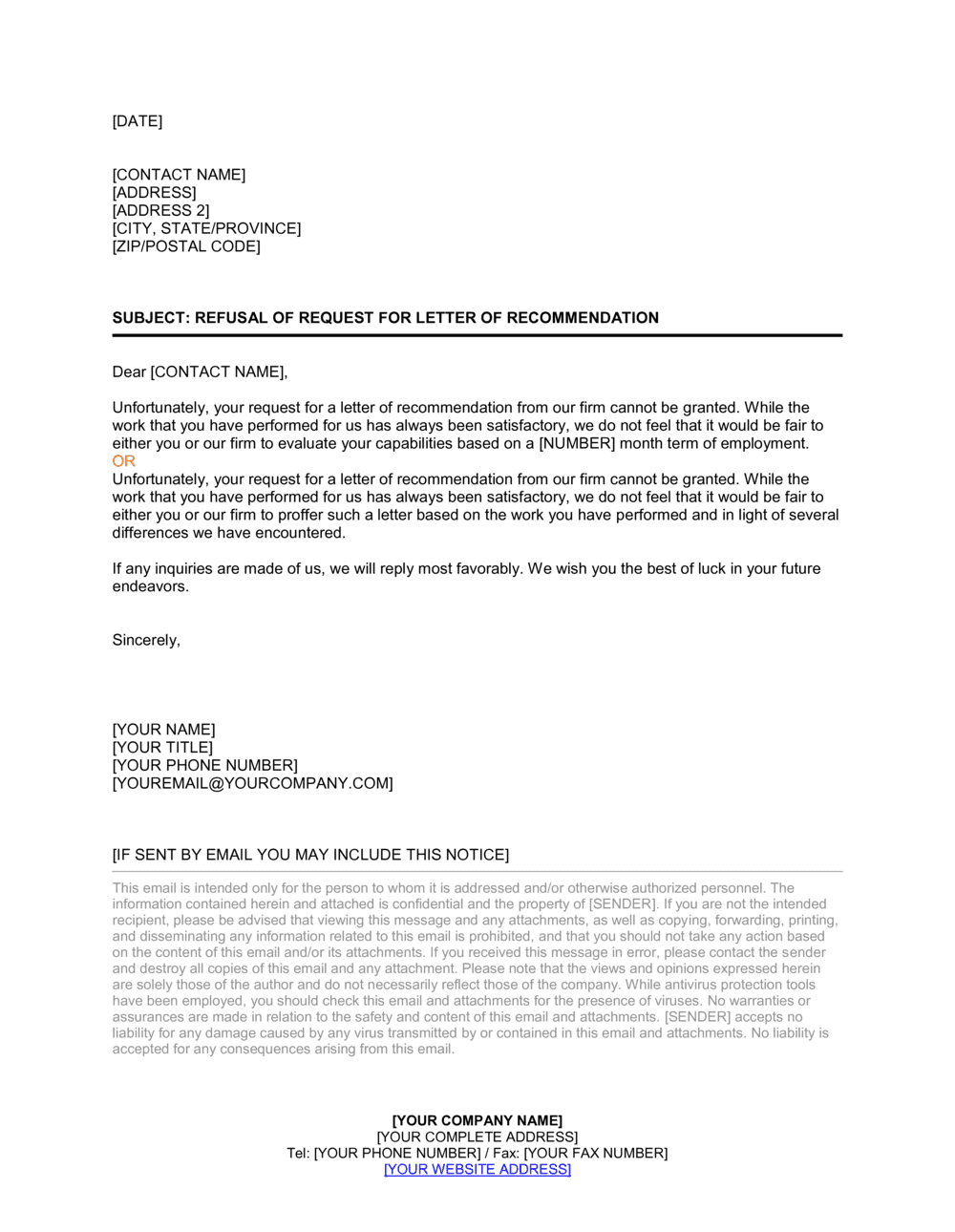
Add your full name, job title, company name, address, and the date at the top of the letter in standard block format.
💡 Use the same date the letter is sent, not the date the request was received — this keeps your records clean.
2
Address the requester by name and title
Enter the requester's full name and address. Use 'Mr.', 'Ms.', or 'Dr.' as appropriate in the salutation.
💡 If you are unsure of the person's preferred title or pronoun, use their full name: 'Dear [FULL NAME],' is always safe.
3
Acknowledge the request warmly
Open the first paragraph by thanking the requester for considering you. Reference the specific program, position, or institution they mentioned.
💡 A specific reference (e.g., 'your application to the MBA program at [SCHOOL NAME]') shows you read their request carefully and personalizes the response.
4
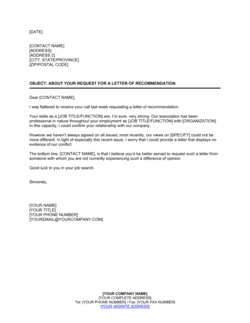
State the declination clearly
Write a single, direct sentence confirming you are unable to provide the letter. Do not hedge with phrases that leave the outcome ambiguous.
💡 Clarity is a courtesy — the requester needs enough time to find another referee before the application deadline.
5
Add a brief, neutral explanation
Provide one sentence explaining the reason without detail that could be construed as a negative evaluation. Acceptable reasons include limited direct interaction, company policy, or a scheduling conflict.
💡 If company policy is the reason, cite it explicitly — this depersonalizes the refusal and removes any suggestion of a personal judgment.
6
Include an alternative suggestion if appropriate
If you can genuinely point the requester toward a better-qualified referee, add this as a short optional paragraph before the closing.
💡 Only suggest someone you are confident will receive the approach positively — verify informally before naming them in writing.
7
Close with a goodwill statement and sign
End with a sincere wish for the requester's success, then add the complimentary close, your signature, and your printed name and title.
💡 Proofread the entire letter before sending — a typo in a refusal letter is especially noticeable because the letter is short.