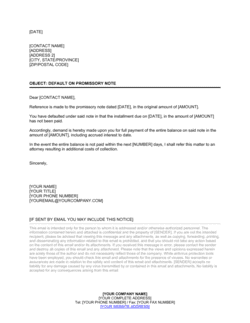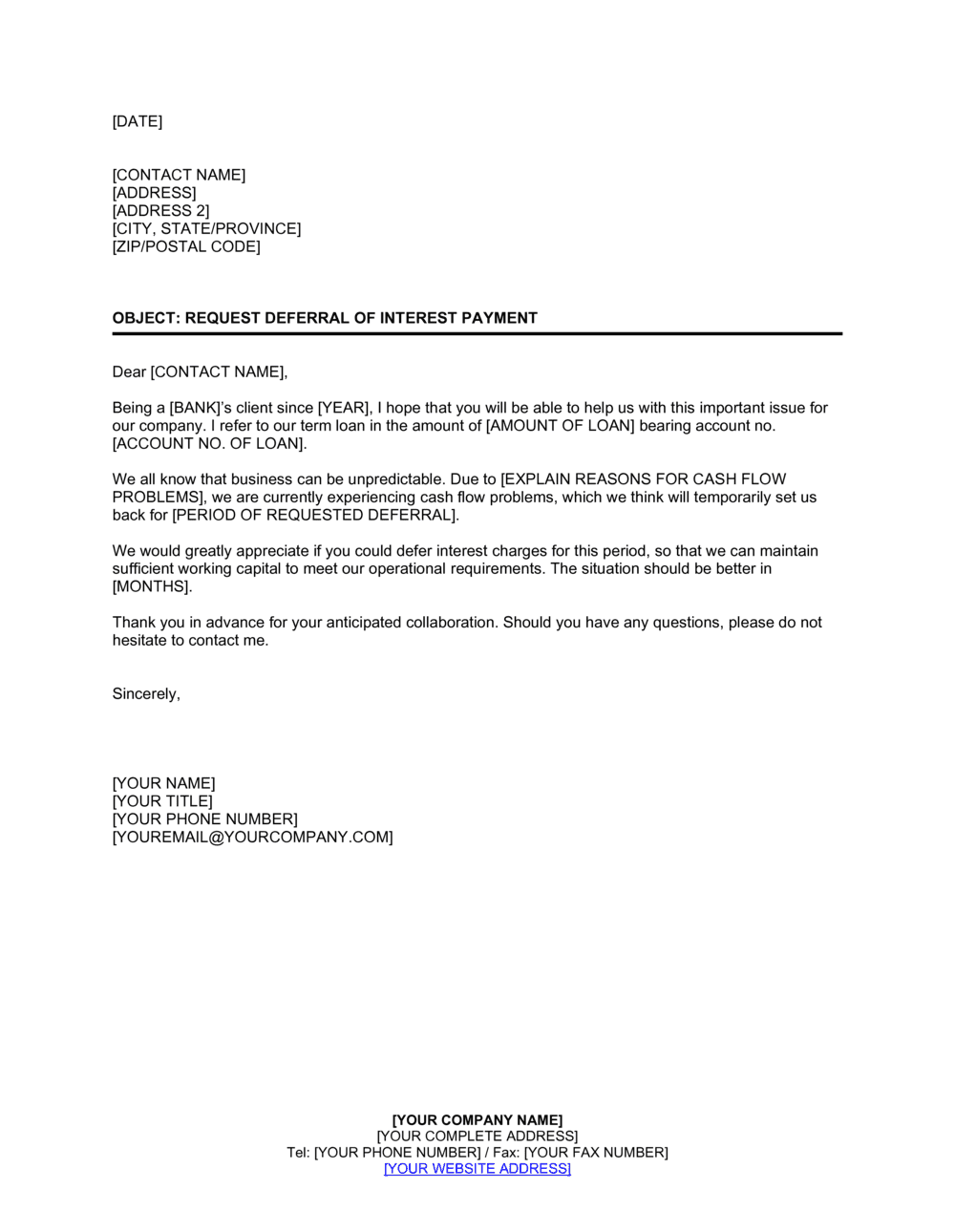
Request Deferral of Interest Payment Template

Free Word download β€’ Edit online β€’ Save & share with Drive β€’ Export to PDF

1 pageβ€’15–20 min to fillβ€’Difficulty: Standard
Learn more ↓
FreeRequest Deferral of Interest Payment Template

At a glance

What it is
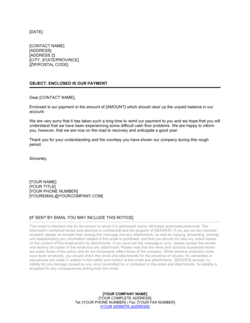
A Request for Deferral of Interest Payment is a formal letter a borrower sends to a lender asking to temporarily postpone one or more scheduled interest payments. This free Word download gives you a ready-to-edit structure that covers your circumstances, the specific payments you need deferred, the proposed deferral period, and your catch-up repayment plan.
When you need it
Use it when a short-term cash flow disruption β€” a delayed receivable, seasonal revenue gap, or unexpected operating expense β€” makes it temporarily difficult to meet a scheduled interest obligation. Sending a formal letter before the due date signals good faith and opens a structured negotiation with your lender.
What's inside
Opening identification of the loan and borrower, a clear statement of the deferral request, a factual explanation of the hardship, the proposed deferral period with specific dates, a catch-up or repayment plan, a commitment to continued communication, and a formal closing with contact details.

What is a Request for Deferral of Interest Payment?

A Request for Deferral of Interest Payment is a formal letter a borrower sends to a lender asking to temporarily postpone one or more scheduled interest payments to a later date. It identifies the specific loan and payment amounts involved, explains the short-term circumstances causing the cash flow difficulty, proposes a defined deferral period, and sets out how the deferred interest will be repaid. Unlike a default notice β€” which is reactive β€” this letter is proactive: sending it before the due date demonstrates good faith and gives the lender the information they need to approve an accommodation without escalating the account.

Why You Need This Document

Missing an interest payment without prior notice can trigger default provisions in your loan agreement immediately β€” including penalty interest, accelerated repayment clauses, and negative credit reporting. A formal deferral request sent in advance changes that dynamic entirely: it opens a documented negotiation, signals that you are managing the situation responsibly, and gives the lender a concrete proposal to approve rather than a missed payment to react to. Lenders prefer a negotiated deferral over a formal default because defaults carry their own regulatory and administrative costs. Without a written letter, any verbal arrangement you reach is difficult to enforce if the lender later applies late fees or reports a delinquency. This template gives you a professional, complete letter in under 30 minutes β€” covering every component a lender's credit team needs to process and approve your request.

Which variant fits your situation?

If your situation is…Use this template
Deferring both principal and interest on a term loanRequest for Loan Payment Deferral
Requesting a full payment holiday on a mortgageMortgage Forbearance Request Letter
Asking a supplier to extend payment terms on a trade accountRequest for Extension of Payment Terms
Formally acknowledging you cannot meet a debt obligationNotice of Default on Payment
Proposing a restructured repayment schedule after a missed paymentDebt Repayment Plan Agreement
Communicating cash flow hardship to multiple creditorsCreditor Hardship Letter

Common mistakes to avoid

❌ Sending the request after the due date has passed

Why it matters: A payment missed without prior notice is typically recorded as a default immediately, triggering penalty interest, credit reporting, and potential acceleration clauses in the loan agreement.

Fix: Send the deferral request at least five to ten business days before the due date to give the lender time to review and respond in writing.
❌ No specific catch-up proposal

Why it matters: Without a repayment plan, the lender has no basis to approve the request and may classify the letter as a de facto notice of inability to pay, escalating the account to collections.

Fix: Include a named repayment date or instalment schedule in the letter, even if it is subject to negotiation β€” a starting position is better than silence.

❌ Vague hardship explanation without figures

Why it matters: Generic statements like 'cash flow challenges' give the credit officer nothing to assess and no justification to record in the file when seeking internal approval.

Fix: Cite specific numbers: the dollar amount of the delayed receivable, the date it is expected, or the percentage of revenue affected by the disruption.

❌ Not requesting written confirmation of the agreed deferral

Why it matters: A verbal or informal acknowledgment from a lender representative is difficult to enforce; if the lender later applies late fees or reports a default, the borrower has no documented proof of the agreement.

Fix: Include a sentence in the closing paragraph explicitly requesting that any approved arrangement be confirmed in a written response or amended loan schedule.

The 8 key clauses, explained

Header and loan identification

In plain language: Opens the letter with the borrower's name and contact details, the date, the lender's name and address, and a reference line identifying the specific loan.

Sample language
[BORROWER FULL NAME / COMPANY NAME] | [ADDRESS] | [DATE] | Re: Request for Deferral of Interest Payment β€” Loan No. [LOAN NUMBER], dated [LOAN DATE]

Common mistake: Using a vague subject line like 'Regarding our loan' instead of citing the exact loan number and date β€” lenders manage hundreds of accounts and a missing reference causes processing delays.

Opening statement of request

In plain language: States immediately and clearly that the borrower is requesting a deferral of scheduled interest payments, naming the specific payment dates and amounts involved.

Sample language
I am writing to respectfully request a deferral of the interest payment of $[AMOUNT] due on [DUE DATE] under the above-referenced loan agreement.

Common mistake: Burying the actual request in background information β€” lenders need to route the letter to the right decision-maker immediately, which requires the request to appear in the first paragraph.

Explanation of circumstances

In plain language: Provides a factual, concise account of the hardship causing the cash flow difficulty, with specific figures or dates where possible.

Sample language
Due to [SPECIFIC CIRCUMSTANCE β€” e.g., a 45-day delay in payment from our largest client, representing $[AMOUNT] of expected receivables], our available cash for [MONTH] is insufficient to meet this obligation without affecting payroll and core operating expenses.

Common mistake: Writing a vague or overly emotional hardship explanation instead of citing specific figures, dates, and causes β€” concrete details build credibility and make the lender's credit assessment easier.

Proposed deferral period

In plain language: Specifies exactly how long the deferral is requested for β€” the start date, end date, and which payment(s) are covered β€” so the lender can assess a defined, bounded ask.

Sample language
I am requesting that the interest payment due on [DATE], and if necessary the payment due on [DATE], be deferred to [PROPOSED RESTART DATE], representing a deferral period of [X] days / [X] months.

Common mistake: Requesting an open-ended deferral with no specified end date β€” lenders rarely approve indefinite deferrals, and an undefined period signals the borrower has no recovery plan.

Catch-up repayment proposal

In plain language: Explains how and when the deferred interest will be repaid β€” either in a lump sum on a specific date or spread across future scheduled payments.

Sample language
I propose to repay the deferred interest of $[TOTAL AMOUNT] in [a lump sum on [DATE] / [X] equal monthly installments of $[AMOUNT] beginning [DATE]], in addition to the resumption of regular scheduled payments.

Common mistake: Offering no catch-up plan at all, or stating only 'when funds allow' β€” without a concrete proposal the lender has no basis to approve the request and will likely treat the letter as a notice of default.

Statement of loan-in-good-standing

In plain language: Confirms that the borrower has met all prior obligations and that this is an isolated, temporary request rather than an ongoing inability to service the debt.

Sample language
To date, [COMPANY NAME] has met all scheduled payments under this loan without delay. This request reflects a temporary and isolated cash flow disruption, not a deterioration in our overall financial position.

Common mistake: Skipping this paragraph when it is accurate β€” omitting a positive payment history leaves the lender no context to distinguish a reliable borrower experiencing a short-term difficulty from a higher-risk account.

Commitment to communication and documentation

In plain language: Offers to provide supporting documentation (financial statements, receivables aging, bank statements) and invites the lender to contact the borrower directly to discuss the request.

Sample language
I am happy to provide supporting documentation β€” including our most recent [bank statements / accounts receivable aging report / financial statements] β€” upon request. Please contact me at [PHONE] or [EMAIL] to discuss this arrangement.

Common mistake: Making no offer to provide supporting documents β€” lenders are far more likely to approve a deferral when the borrower volunteers financial evidence, as it reduces the need for the lender to formally demand it.

Formal closing and signature

In plain language: Thanks the lender for their consideration, requests a written response confirming the agreed terms, and closes with a professional sign-off and the borrower's full name and title.

Sample language
Thank you for considering this request. I kindly ask that any agreed deferral arrangement be confirmed in writing. Sincerely, [FULL NAME], [TITLE], [COMPANY NAME]

Common mistake: Not requesting written confirmation of the lender's decision β€” verbal approvals are difficult to enforce, and a confirmed written response protects both parties if a dispute arises later.

How to fill it out

  1. 1

    Gather your loan details

    Locate your original loan agreement and identify the loan number, the lender's formal name and address, the exact payment due dates you need deferred, and the dollar amounts.

    πŸ’‘ Check your most recent lender statement for the exact loan reference number β€” using an outdated or partial number slows processing.

  2. 2

    Fill in the header and reference line

    Enter your full legal name or company name, your address, today's date, the lender's full name and address, and a subject line referencing the loan number and origination date.

    πŸ’‘ Address the letter to the specific individual or department that handles loan servicing, not the general customer service address.

  3. 3

    Write the opening request clearly

    State in the first paragraph that you are requesting a deferral, name the specific payment amount and due date, and reference the loan agreement by number.

    πŸ’‘ Keep the opening to two sentences β€” the lender's first read is a triage; a clear, direct ask gets routed to the right decision-maker faster.

  4. 4

    Explain the hardship with specific details

    Describe the cause of your cash flow difficulty in one concise paragraph. Include specific figures β€” delayed receivable amounts, unexpected expense totals, or revenue shortfall percentages β€” rather than general statements.

    πŸ’‘ Avoid emotional language; a factual explanation with numbers is more persuasive to a credit officer than a narrative of difficulties.

  5. 5

    Define the deferral period precisely

    State the start date, end date, and which specific payments are covered. Keep the requested period as short as is genuinely necessary β€” typically 30 to 90 days.

    πŸ’‘ A shorter, well-justified deferral is approved far more often than a long or open-ended one; you can always write a follow-up if circumstances change.

  6. 6

    Propose a concrete catch-up plan

    Specify how you will repay the deferred interest β€” a lump sum on a named date, or additional amounts added to future scheduled payments. Include the total deferred amount and the timeline.

    πŸ’‘ Tie your catch-up date to a specific expected inflow β€” such as a client payment or contract close β€” so the lender can see the logic behind the timeline.

  7. 7

    Review, sign, and send before the due date

    Proofread the letter for factual accuracy, ensure all figures match your loan agreement, and send it to your lender at least five to ten business days before the interest payment is due.

    πŸ’‘ Send via email with read receipt and follow up with a hard copy by tracked mail β€” having a delivery record is essential if the lender later claims they did not receive the request.

Frequently asked questions

What is a request for deferral of interest payment?

A request for deferral of interest payment is a formal letter a borrower sends to a lender asking to postpone one or more scheduled interest payments to a later date. It explains the reason for the request, specifies the payments and dates involved, and proposes how the deferred interest will be repaid. Sending the letter before the due date β€” and receiving written approval β€” prevents the missed payment from being classified as a default.

Will a lender always approve an interest deferral request?

Approval is not guaranteed but lenders frequently accommodate well-documented, short-term requests from borrowers with a clean payment history. Lenders generally prefer a negotiated deferral over a formal default β€” defaults trigger regulatory reporting requirements and collection costs. A concise letter with specific figures, a defined deferral period, and a clear catch-up plan significantly improves the likelihood of approval.

Does deferred interest still accrue during the deferral period?

In most cases, yes. Deferring a payment postpones when you pay, not the interest that accumulates on the outstanding balance. The exact treatment depends on your loan agreement β€” some agreements capitalize accrued interest into the principal during a deferral, which increases the total amount owed. Confirm the accrual treatment with your lender before agreeing to the deferral terms.

How far in advance should I send the deferral request?

Send the letter at least five to ten business days before the payment due date. This gives the lender enough time to review, seek internal approval, and respond in writing before the deadline. Requests received after the due date are often processed as post-default requests, which typically involve stricter terms and may already have triggered penalty fees.

What documents should I attach to support the request?

Relevant supporting documents include recent bank statements showing current balances, an accounts receivable aging report if a delayed client payment is the cause, the most recent income statement or management accounts, and any written evidence of the hardship such as a client communication confirming a payment delay. Offering these proactively in the letter speeds up the lender's review.

What is the difference between a deferral and forbearance?

A deferral typically refers to postponing a specific payment or series of payments to a defined later date, with a concrete catch-up plan. Forbearance is a broader formal agreement β€” often used in mortgage and government-backed loan contexts β€” where the lender suspends or reduces payments for a set period without immediately classifying the account as delinquent. In practice the terms overlap, but forbearance agreements tend to be more structured and may require additional documentation.

Can I use this letter for a mortgage or personal loan?

Yes. The structure applies to any interest-bearing loan β€” commercial term loans, business lines of credit, private mortgages, and personal loans. Adjust the language to reflect whether you are writing as an individual or a business entity and reference the correct loan type and account number. For government-backed mortgages, your servicer may have a specific forbearance application process that supplements or replaces a free-form letter.

What happens if the lender does not respond before the due date?

If you sent the letter well in advance and have not received a response, follow up by phone and email before the due date and document both attempts. If no written approval is received, you face a choice between making the payment to avoid default or allowing it to pass and risking a technical default while your request is pending. In most cases, making a partial payment while the request is under review demonstrates good faith and reduces default risk.

How this compares to alternatives

vs Request for Extension of Payment Terms

A request for extension of payment terms is typically sent to a trade creditor or supplier to extend the due date on an invoice or account balance. A deferral of interest payment is addressed to a lender and concerns a scheduled loan obligation. The deferral letter requires a repayment plan and references a formal loan agreement, whereas a payment-terms extension is a simpler commercial negotiation.

vs Debt Repayment Plan Agreement

A debt repayment plan agreement is a bilateral contract that restructures an entire outstanding balance β€” often used after a default or serious financial difficulty. A deferral request is a proactive, one-page letter sent before a payment is missed, asking for a short-term accommodation. Use the deferral letter first; escalate to a formal repayment plan only if the underlying obligation needs broader restructuring.

vs Hardship Letter

A hardship letter is a general communication to a creditor explaining financial difficulty; it may accompany applications for loan modification, forbearance, or settlement. A request for deferral of interest payment is a more specific document with a defined ask β€” a bounded deferral period and a catch-up plan β€” making it more actionable for a lender's credit team to process and approve.

vs Loan Modification Request Letter

A loan modification request seeks to permanently change the terms of the loan β€” interest rate, amortization period, or payment amount. A deferral request is a temporary accommodation that leaves the original loan terms intact. If you anticipate a sustained inability to meet payments, a modification is more appropriate; if the difficulty is genuinely short-term, start with a deferral request.

Industry-specific considerations

Real estate

Borrowers with bridge loans or private mortgages commonly request interest deferrals during vacancy periods or construction delays when rental income is temporarily unavailable.

Retail and hospitality

Seasonal revenue cycles make periodic interest deferrals common practice, particularly for businesses carrying term debt through an off-peak quarter.

Professional services

Firms with project-based billing and lumpy receivables may need a short deferral when a large client payment is delayed beyond the interest due date.

Construction and trades

Progress-payment delays from general contractors or project owners frequently create short-term cash gaps that require temporary interest relief on equipment or operating loans.

Template vs pro β€” what fits your needs?

PathBest forCostTime
Use the templateBorrowers requesting a short, defined deferral on a straightforward commercial or personal loanFree15–30 minutes
Template + professional reviewBorrowers with complex loan structures, multiple creditors, or lenders who have already signaled non-cooperation$150–$400 for a financial advisor or accountant review1–2 days
Custom draftedLarge commercial loans, situations involving potential default proceedings, or borrowers seeking simultaneous deferral from multiple institutional lenders$500–$1,500 for legal or financial advisory assistance3–7 days

Glossary

Deferral
A lender-approved postponement of a scheduled payment to a later date, without treating the delay as a default.
Accrued Interest
Interest that has accumulated on a loan balance but has not yet been paid; deferred interest continues to accrue during the deferral period.
Forbearance
A formal agreement in which a lender temporarily reduces or suspends required payments while the borrower experiences financial hardship.
Catch-Up Payment
One or more additional payments made after a deferral period to repay the interest amounts that were postponed.
Loan Agreement
The original binding contract between borrower and lender that sets out the interest rate, repayment schedule, and conditions of the loan.
Hardship
A documented financial difficulty β€” such as a revenue shortfall, unexpected expense, or delayed receivable β€” that impairs a borrower's ability to meet scheduled obligations.
Good Faith
Honest, transparent communication with a lender, including proactive notification of payment difficulties before a due date is missed.
Default
Failure to meet a loan obligation by its due date; a formal deferral agreement prevents a missed payment from being classified as a default.
Repayment Schedule
A timetable listing the dates and amounts of all required loan payments, including principal and interest.
Working Capital
The short-term liquid funds a business uses to cover day-to-day operating expenses, calculated as current assets minus current liabilities.

Part of your Business Operating System

This document is one of 3,000+ business & legal templates included in Business in a Box.

  • Fill-in-the-blanks β€” ready in minutes
  • 100% customizable Word document
  • Compatible with all office suites
  • Export to PDF and share electronically

Create your document in 3 simple steps.

From template to signed document β€” all inside one Business Operating System.
1
Download or open template

Access over 3,000+ business and legal templates for any business task, project or initiative.

2
Edit and fill in the blanks with AI

Customize your ready-made business document template and save it in the cloud.

3
Save, Share, Send, Sign

Share your files and folders with your team. Create a space of seamless collaboration.

Save time, save money, and create top-quality documents.

β˜…β˜…β˜…β˜…β˜…

"Fantastic value! I'm not sure how I'd do without it. It's worth its weight in gold and paid back for itself many times."

Managing Director Β· Mall Farm
Robert Whalley
Managing Director, Mall Farm Proprietary Limited
β˜…β˜…β˜…β˜…β˜…

"I have been using Business in a Box for years. It has been the most useful source of templates I have encountered. I recommend it to anyone."

Business Owner Β· 4+ years
Dr Michael John Freestone
Business Owner
β˜…β˜…β˜…β˜…β˜…

"It has been a life saver so many times I have lost count. Business in a Box has saved me so much time and as you know, time is money."

Owner Β· Upstate Web
David G. Moore Jr.
Owner, Upstate Web

Run your business with a system β€” not scattered tools

Stop downloading documents. Start operating with clarity. Business in a Box gives you the Business Operating System used by over 250,000 companies worldwide to structure, run, and grow their business.

Start freeΒ Β·Β No credit card required