Firewood Business Plan Template

Free Word download β€’ Edit online β€’ Save & share with Drive β€’ Export to PDF

36 pagesβ€’2h 55m – 4h to fillβ€’Difficulty: Expert
Learn more ↓
FreeFirewood Business Plan Template

At a glance

What it is
A Firewood Business Plan is a structured operational document that maps your firewood venture's market opportunity, sourcing strategy, pricing model, delivery operations, and 3-year financial projections into a single reference document. This free Word download gives you a ready-to-edit framework you can customize for a startup firewood operation or an existing supplier expanding into new sales channels, then export as PDF for lenders, investors, or internal planning.
When you need it
Use it when launching a new firewood supply or delivery business, applying for a small business loan or rural enterprise grant, or restructuring an existing firewood operation around a scalable model with documented processes and financial targets.
What's inside
Executive summary, company overview, market and seasonal demand analysis, wood sourcing and inventory strategy, pricing and revenue model, sales and marketing plan, operations and delivery logistics, management team, and 3-year financial projections including P&L and cash flow.

What is a Firewood Business Plan?

A Firewood Business Plan is a structured operational document that maps a firewood supply operation's market opportunity, wood sourcing strategy, processing and delivery logistics, pricing model, and 3-year financial projections into a single reference document. It covers the full business cycle β€” from standing timber or cutting agreements through seasoning, splitting, delivery, and customer retention β€” and quantifies the seasonal cash flow patterns that define this business. Whether you are launching a new operation or formalizing an existing one for a loan application, the plan gives lenders, partners, and your own management a concrete picture of how the business generates revenue and manages costs across a highly seasonal demand cycle.

Why You Need This Document

Without a written firewood business plan, lenders and grant programs will not advance financing β€” and even self-funded operators who skip the planning stage routinely discover mid-season that their cost per cord exceeds their selling price, or that their supply cannot cover peak demand. The consequences are concrete: a sourcing shortfall in November means turning away customers at the highest-margin point of the year; a cash flow model that ignores the spring and summer trough can leave an operation unable to pay for equipment maintenance or pre-season inventory buildup. A completed business plan forces you to calculate your true cost per cord, model seasonal revenue month by month, and confirm that your local market will absorb your volume before you invest in equipment or cutting agreements. This template gives you the structure to do that analysis in 15–30 hours, in a format that meets the documentation requirements of SBA lenders, USDA rural business programs, and most state agricultural development funds.

Which variant fits your situation?

If your situation is…Use this template
Starting a firewood delivery service focused on residential customersFirewood Delivery Business Plan
Operating a roadside or retail firewood standRetail Business Plan
Selling firewood wholesale to campgrounds and resortsWholesale Distribution Business Plan
Planning a broader outdoor or agricultural product businessFarm Business Plan
Quick internal planning before a full plan is neededOne-Page Business Plan
Expanding an existing firewood operation into new marketsBusiness Expansion Plan
Applying for a small business or rural enterprise grantGrant Proposal Template

Common mistakes to avoid

❌ Projecting flat monthly revenue across all 12 months

Why it matters: Firewood revenue is concentrated October through February β€” a flat projection signals to lenders that the owner does not understand the business's cash flow dynamics.

Fix: Build Year 1 projections month by month, allocating 60–70% of annual volume to the five peak months and modeling the spring/summer trough explicitly.

❌ Relying on a single wood source

Why it matters: A single cutting agreement, land parcel, or tree service partner creates a single point of supply failure β€” a permit denial or partner exit can eliminate the entire season's inventory.

Fix: Document at least two independent sourcing channels and calculate what happens to Year 1 supply if one source delivers 50% of its projected yield.

❌ Setting price based on competitors without calculating cost per cord

Why it matters: If your cost structure is higher than a competitor's due to longer delivery distance or older equipment, matching their price may not cover your expenses or leave any profit margin.

Fix: Calculate your fully loaded cost per cord first, then compare to market pricing β€” if the gap is too narrow, adjust your service area, equipment, or customer mix before launching.

❌ Omitting equipment maintenance and replacement costs from the financial model

Why it matters: Log splitters, chainsaws, and delivery trucks require regular maintenance and eventual replacement β€” ignoring these costs overstates net income by 10–20% in most small firewood operations.

Fix: Add a monthly equipment reserve line equal to 5–8% of equipment value annually, and include a replacement schedule for major assets in the operations section.

The 9 key sections, explained

Executive Summary

Company Overview

Market and Demand Analysis

Wood Sourcing and Inventory Strategy

Pricing and Revenue Model

Sales and Marketing Plan

Operations and Delivery Logistics

Management Team and Staffing Plan

Financial Projections

How to fill it out

  1. 1

    Complete the company overview and define your service area

    Enter your legal business name, structure, registration state or province, and the geographic radius you will serve. The service area determines your addressable market and sets the boundary for delivery cost calculations.

    πŸ’‘ Map your service radius against known campground and residential density before committing β€” a 30-mile radius in a rural area may cover fewer customers than a 15-mile radius near a suburban edge.

  2. 2

    Research local demand and document your market data

    Gather county-level data on households using wood heat, identify local campgrounds and outdoor recreation sites, and note any competing firewood suppliers. Use U.S. EIA or Statistics Canada residential heating fuel surveys for household data.

    πŸ’‘ Interview two or three established firewood suppliers in adjacent areas β€” they often share seasonal volume and pricing norms freely since you are not direct competitors.

  3. 3

    Document your wood sourcing and calculate annual supply capacity

    List each source β€” owned land, cutting agreements, tree service partnerships β€” with estimated annual cord yield. Total your supply capacity and confirm it meets or exceeds your Year 1 sales target before building the rest of the plan.

    πŸ’‘ Build in a 15–20% supply buffer above your sales target to account for wood loss during seasoning and equipment downtime.

  4. 4

    Calculate your true cost per cord

    Add up every cost component: wood acquisition or stumpage, chainsaw and splitter fuel and maintenance, labor hours per cord, truck fuel per delivery, insurance allocation, and storage. Divide by total cords to get your cost per cord delivered.

    πŸ’‘ Time yourself processing a test batch β€” cords per operator-hour varies widely by species, equipment, and terrain. Real throughput data beats estimates every time.

  5. 5

    Set prices by customer segment and calculate gross margin

    Set your delivered residential price and wholesale campground price based on cost per cord plus your target margin. Confirm that your margin covers operating overhead and leaves net profit at realistic volume.

    πŸ’‘ Price your residential full cord at least 20–25% above your campground wholesale rate β€” direct customers cost more to service individually but generate higher per-cord margin.

  6. 6

    Build the seasonal financial model month by month for Year 1

    Allocate your projected cord sales across months, with 60–70% of volume in October through February. Map revenue and variable costs month by month, then layer in fixed monthly costs to identify your cash flow low point.

    πŸ’‘ Your cash flow trough typically hits in July or August β€” model whether existing capital covers that gap or whether a line of credit is needed.

  7. 7

    Write the executive summary last

    Pull the single most compelling figure from each section β€” total cords, Year 1 revenue, margin, and the specific milestone you are funding β€” and compress them into one to two pages.

    πŸ’‘ State the funding ask and use of funds in the first paragraph of the executive summary. Lenders decide whether to keep reading within the first 30 seconds.

Frequently asked questions

What is a firewood business plan?

A firewood business plan is a structured document that defines your firewood operation's market opportunity, sourcing strategy, pricing model, delivery logistics, and financial projections. It functions as both an internal operating roadmap and an external document for securing small business loans, rural enterprise grants, or investor backing. A complete plan covers market demand, cost per cord, seasonal cash flow, and a 3-year revenue target.

Do I need a business plan to start a firewood business?

You do not legally need one, but any bank or grant program will require a formal plan before approving financing. Even without external funding, writing a plan forces you to calculate your true cost per cord, model seasonal cash flow gaps, and confirm that your local market can absorb your target volume before you invest in equipment. Most firewood operators who skip the planning stage underestimate delivery costs or overestimate winter demand in their area.

How much money can a firewood business make?

A single-operator firewood business typically generates $20,000–$60,000 in annual revenue selling 100–300 cords per season at delivered prices of $200–$400 per full cord, depending on region and species mix. Net margins run 20–35% after equipment, labor, fuel, and sourcing costs. Operations with a log processor, owned timber land, and campground wholesale accounts can scale to $100,000+ annually with two to three seasonal employees.

What financial projections should a firewood business plan include?

At minimum: monthly revenue projections for Year 1 reflecting the October–February peak, a cost-per-cord breakdown covering wood acquisition, processing labor, fuel, and delivery, a full-year P&L, a monthly cash flow statement showing the spring and summer trough, and annual P&L for Years 2 and 3. If seeking a loan, also include a use-of- funds schedule tied to specific equipment purchases or inventory buildup.

What is the biggest operational challenge for a firewood business?

Seasoning time is the most underestimated constraint. Freshly cut wood needs 6–12 months to season below 20% moisture β€” meaning wood cut in spring sells the following fall. This lag requires either buying pre- seasoned wood at higher cost or carrying significant inventory through the off-season. Planning your sourcing and seasoning calendar 12 months ahead is the single most important operational discipline for a firewood business.

How do I price firewood for delivery?

Start with your fully loaded cost per cord: wood acquisition or stumpage, splitting labor, truck fuel per average delivery, insurance, and equipment maintenance. Add your target gross margin β€” typically 40–50% for residential delivered sales. Then compare to local market pricing; if your cost-based price exceeds the market rate by more than 10–15%, reduce delivery radius, improve processing efficiency, or focus on premium species commanding higher prices.

What equipment do I need to start a firewood business?

The core equipment set for a small firewood operation includes a chainsaw (40–60cc class), a log splitter (25–35 ton for hardwood), a truck or trailer rated for at least 2 tons, and covered storage for seasoning inventory. A used log processor ($8,000–$25,000) dramatically increases throughput and reduces per-cord labor cost but requires higher upfront capital. Your business plan's equipment section should list each item with purchase or lease cost and expected annual maintenance expense.

How seasonal is a firewood business?

Firewood demand is highly seasonal in northern climates β€” typically 60–70% of annual volume sells between October and February. A well-run operation uses the spring and summer months for sourcing, processing, and seasoning inventory in preparation for fall delivery. Some operators supplement off-season revenue by supplying campgrounds April through September or by adding a bundled campfire wood product for retail sale at gas stations and convenience stores.

Can I get an SBA loan to start a firewood business?

Yes β€” a firewood business qualifies as a small business and is eligible for SBA 7(a) loans, USDA Rural Development Business Loans, and in some states, rural enterprise or agricultural diversification grants. Lenders will require a formal business plan with financial projections, a cost- per-cord model, evidence of sourcing agreements, and documentation of any existing customer relationships or contracts.

How this compares to alternatives

vs One-Page Business Plan

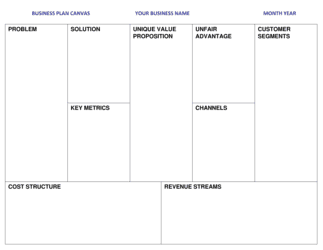
A one-page business plan captures the core concept in a single canvas β€” useful for early ideation or internal alignment but insufficient for lenders or grant applications. A full firewood business plan includes detailed financial projections, a sourcing strategy, and a seasonal cash flow model that a one-pager cannot accommodate. Use the one-pager to test your concept, then build the full plan before any financing conversation.

vs Farm Business Plan

A farm business plan covers agricultural production, crop or livestock cycles, and land management across multiple revenue streams. A firewood business plan focuses specifically on wood sourcing, processing throughput, delivery logistics, and seasonal demand β€” making it more operationally specific for a timber-adjacent venture. Landowners with mixed agricultural and timber operations may need elements of both.

vs Marketing Plan

A marketing plan focuses exclusively on customer acquisition channels, messaging, and campaign budgets. A firewood business plan includes a marketing section but also covers sourcing, operations, equipment, staffing, and 3-year financials. A standalone marketing plan is appropriate once the business is operational and ready to scale a specific channel β€” not as a substitute for a full business plan.

vs Financial Projections Template

A financial projections template produces the P&L, cash flow, and balance sheet that form one section of a business plan. Lenders and investors evaluate financial projections in context β€” they need the market analysis, sourcing strategy, and operational model to assess whether the numbers are credible. A firewood business plan provides that context; a standalone projections spreadsheet does not.

Industry-specific considerations

Outdoor Recreation and Campgrounds

Campgrounds and RV parks require reliable bulk firewood supply by the cord from April through October, with bundled retail packaging for individual camper sales.

Timber and Logging

Logging operations monetize slash, offcuts, and low-grade timber as firewood, turning waste material into a supplemental revenue stream with minimal additional land disturbance.

Landscaping and Tree Services

Tree removal companies convert client-site wood waste into seasoned firewood, eliminating disposal costs and generating additional revenue from material already in their possession.

Agriculture and Rural Enterprise

Farmers and rural landowners with wood lots use firewood operations to generate off-season income, often qualifying for agricultural land use tax benefits and USDA rural business grants.

Template vs pro β€” what fits your needs?

PathBest forCostTime
Use the templateSolo operators and rural landowners launching or formalizing a firewood business without outside fundingFree1–2 weeks (15–30 hours)
Template + professional reviewOperators applying for an SBA loan, USDA rural business loan, or state agricultural grant requiring a reviewed plan$300–$800 for a SCORE mentor session or small business advisor review2–3 weeks
Custom draftedLarger firewood or timber operations seeking bank financing above $150,000 or equity investment from a rural development fund$1,500–$4,000 for a professional business plan writer3–5 weeks

Glossary

Cord
The standard unit of firewood volume β€” a stack measuring 4 feet high Γ— 4 feet wide Γ— 8 feet long, totaling 128 cubic feet.
Face Cord
A stack of firewood 4 feet high Γ— 8 feet long but only as deep as the individual log length, typically 16 inches β€” roughly one-third of a full cord.
Seasoning
The process of drying cut firewood to reduce moisture content, typically to below 20%, so it burns efficiently with less smoke.
Moisture Content
The percentage of water weight relative to total wood weight β€” firewood under 20% moisture is considered ready to burn.
Log Processor
A machine that simultaneously splits and cuts logs to length, dramatically increasing throughput compared to manual splitting.
Delivered Price
The all-in price charged to a customer including wood cost, splitting, loading, transport, and stacking β€” the primary retail pricing unit.
Species Mix
The combination of wood species in a firewood supply β€” hardwoods like oak and hickory burn longer and hotter than softwoods like pine.
Burn Rate (Operational)
Monthly cash outflow for ongoing operating costs β€” equipment fuel, labor, insurance, and vehicle maintenance β€” before revenue is collected.
Seasonality
The predictable fluctuation in firewood demand across months β€” peak demand runs October through February in northern climates, with sharp drop-offs in spring.
Wood Lot
A parcel of forested land managed as a source of timber or firewood, either owned outright or harvested under a cutting agreement.

Part of your Business Operating System

This document is one of 3,000+ business & legal templates included in Business in a Box.

  • Fill-in-the-blanks β€” ready in minutes
  • 100% customizable Word document
  • Compatible with all office suites
  • Export to PDF and share electronically

Create your document in 3 simple steps.

From template to signed document β€” all inside one Business Operating System.
1
Download or open template

Access over 3,000+ business and legal templates for any business task, project or initiative.

2
Edit and fill in the blanks with AI

Customize your ready-made business document template and save it in the cloud.

3
Save, Share, Send, Sign

Share your files and folders with your team. Create a space of seamless collaboration.

Save time, save money, and create top-quality documents.

β˜…β˜…β˜…β˜…β˜…

"Fantastic value! I'm not sure how I'd do without it. It's worth its weight in gold and paid back for itself many times."

Managing Director Β· Mall Farm
Robert Whalley
Managing Director, Mall Farm Proprietary Limited
β˜…β˜…β˜…β˜…β˜…

"I have been using Business in a Box for years. It has been the most useful source of templates I have encountered. I recommend it to anyone."

Business Owner Β· 4+ years
Dr Michael John Freestone
Business Owner
β˜…β˜…β˜…β˜…β˜…

"It has been a life saver so many times I have lost count. Business in a Box has saved me so much time and as you know, time is money."

Owner Β· Upstate Web
David G. Moore Jr.
Owner, Upstate Web

Run your business with a system β€” not scattered tools

Stop downloading documents. Start operating with clarity. Business in a Box gives you the Business Operating System used by over 250,000 companies worldwide to structure, run, and grow their business.

Start freeΒ Β·Β No credit card required