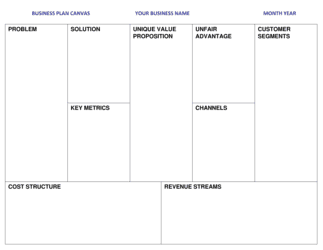
Consultant Business Plan Template

Free Word download β€’ Edit online β€’ Save & share with Drive β€’ Export to PDF

21 pagesβ€’2h – 2h 40m to fillβ€’Difficulty: Expert
Learn more ↓
FreeConsultant Business Plan Template

At a glance

What it is
A Consultant Business Plan is a structured document that maps a consulting practice's service offerings, target client segments, competitive positioning, pricing model, marketing strategy, and financial projections into a single reference document. This free Word download gives you an editable, professional starting point you can customize online and export as PDF to share with lenders, partners, or prospective clients.
When you need it
Use it when launching a new consulting practice, applying for a small business loan, pitching an anchor client who wants to vet your business stability, or realigning an existing practice around a new service line or target market.
What's inside
Executive summary, company overview, service offerings, target market and client profiles, competitive analysis, marketing and business development strategy, operations and delivery model, management and team structure, and three-year financial projections including revenue, expenses, and cash flow.

What is a Consultant Business Plan?

A Consultant Business Plan is a structured planning document that defines a consulting practice's service offerings, target client segments, competitive positioning, marketing and business development approach, delivery model, and multi-year financial projections. Unlike a general business plan, it is built around expertise-driven revenue β€” billable days, day rates, retainers, and project fees β€” rather than product sales or inventory. It functions as both an internal operating roadmap for the consultant and an external document for bank lenders, prospective partners, and enterprise clients who require evidence of business viability before committing to a relationship.

Why You Need This Document

Without a formal plan, the most common failure modes in a consulting practice are invisible until they become expensive: a pricing model that looks profitable on paper but collapses once non-billable time is accounted for, a business development approach that depends entirely on referrals that dry up after the first year, and a cash flow problem caused by long payment terms on large engagements with no working capital buffer. A consultant business plan forces you to model utilization realistically, define a specific target client, and map a structured pipeline before you need revenue to survive. For lenders, it is the baseline requirement for any SBA or small business loan application. For anchor clients, it signals that the practice is professionally run, not improvised. This template gives you the structure to produce a credible, complete plan in days rather than weeks.

Which variant fits your situation?

If your situation is…Use this template
Launching a one-person independent consulting practiceConsultant Business Plan (Solo Practice)
Starting a management or strategy consulting firm with partnersConsulting Firm Business Plan
Pitching a specific client engagement rather than the whole businessConsulting Proposal
Early-stage ideation or quick internal alignmentOne-Page Business Plan
Raising equity investment in a consulting startupInvestor Business Plan
Planning an IT or technology consulting practice specificallyIT Consulting Business Plan
Documenting an HR or organizational development consultancyHR Consulting Business Plan

Common mistakes to avoid

❌ Projecting revenue at 100% billable utilization

Why it matters: A solo consultant working 250 days per year at full billing capacity leaves zero time for proposals, admin, business development, and training β€” making the revenue figure unreachable and the plan not credible to lenders.

Fix: Apply a 60–70% utilization rate to your total available working days. Document the assumption explicitly in the financial section so reviewers can see your reasoning.

❌ Defining target clients too broadly

Why it matters: A plan that targets 'mid-sized businesses across all industries' provides no basis for a focused marketing strategy, no reference clients to name, and no credible win-rate assumption in the pipeline model.

Fix: Narrow the target to one or two industries, a specific company size range, and a specific buyer title. A tighter niche makes the plan more credible and the business easier to market.

❌ Omitting a business development strategy and relying only on referrals

Why it matters: Referrals are unpredictable and typically drop precisely when a practice is under revenue pressure β€” the moment when a structured pipeline matters most.

Fix: Add at least two proactive outreach channels with monthly volume targets. Even a LinkedIn content plan or a structured follow-up cadence with past clients qualifies.

❌ No defined delivery process in the operations section

Why it matters: Without a documented engagement model, scope creep, unclear deliverables, and client expectation gaps are almost inevitable β€” each of which increases non-billable time and reduces effective utilization.

Fix: Map the standard phases of a typical engagement (discovery, proposal, kickoff, delivery, review) with time estimates for each. This also becomes the basis for your client-facing proposal template.

❌ Writing service descriptions around consultant activities instead of client outcomes

Why it matters: A description that says 'we conduct process audits and stakeholder interviews' gives a prospective client no basis to assess value or justify budget approval internally.

Fix: Rewrite every service description to lead with the client outcome: 'Clients typically reduce procurement cycle time by 20–30% within 60 days of engagement completion.'

❌ Requesting funding without itemizing the use of proceeds

Why it matters: A loan application or investor conversation that asks for $50,000 for 'working capital' without a line-item breakdown signals that the founder has not planned their spending β€” the single fastest way to lose lender confidence.

Fix: Break every funding request into at least four specific buckets with a dollar amount and a rationale for each: working capital reserve, technology and tools, marketing, and professional fees.

The 10 key sections, explained

Executive Summary

Company Overview

Service Offerings

Target Market and Client Profiles

Competitive Analysis

Marketing and Business Development Strategy

Operations and Delivery Model

Management and Team

Financial Projections

Funding Requirements and Use of Funds

How to fill it out

  1. 1

    Define your practice's mission and entity structure

    Start with the legal entity name, structure (LLC, S-Corp, or sole proprietorship), founding date, and a one-sentence mission statement. This anchors every subsequent section.

    πŸ’‘ If you have not yet incorporated, deciding on your entity structure before writing the plan prevents you from revising these details later β€” S-Corp elections in particular have annual deadlines.

  2. 2

    Document each service offering with outcome-based language

    Write a one-paragraph description of each service specifying the client problem, the deliverable, the typical engagement length, and the pricing model. Avoid describing your activities β€” describe the client's result.

    πŸ’‘ Test each service description by asking: 'Can a prospective client read this and calculate the ROI of hiring me?' If not, rewrite it.

  3. 3

    Build a specific target client profile

    Define your ideal client by industry, company size, geography, decision-maker title, and the specific trigger that makes them seek consulting help. Estimate how many such companies exist in your reachable market.

    πŸ’‘ LinkedIn Sales Navigator lets you count the exact number of companies matching your target profile β€” use that number in the plan rather than a vague market size estimate.

  4. 4

    Map at least four competitors with honest positioning notes

    List four direct competitors β€” other boutique or independent consultants serving the same clients, not just large firms β€” with their pricing, strengths, and weaknesses. Write one specific paragraph on your differentiated advantage.

    πŸ’‘ If you cannot articulate a differentiated advantage in two sentences, that is a strategy problem to solve before completing the plan, not a writing problem.

  5. 5

    Outline a structured business development plan

    Choose two or three primary lead-generation channels and set monthly pipeline targets for each. Tie these targets directly to your revenue projections in the financial section.

    πŸ’‘ Back-calculate from your revenue target: if your average engagement is $15,000 and your close rate is 30%, you need to send roughly 3.3 proposals per $15,000 of target revenue β€” use that math to set outreach volume targets.

  6. 6

    Build the financial model from billable days, not from a revenue target

    Start with total working days, subtract holidays, non-billable admin, and business development time to arrive at realistic billable days. Multiply by your day rate or average project value to project revenue.

    πŸ’‘ Model a base case (65% utilization), an upside case (80%), and a downside case (50%) so lenders and partners can see your thinking on risk.

  7. 7

    Write the executive summary last

    Pull the single strongest data point from each completed section β€” your differentiated positioning, your revenue projection, your target client count β€” and compress them into one to two pages.

    πŸ’‘ Lenders and prospective partners read the executive summary and the financial projections first. If those two sections are not compelling and internally consistent, the rest of the plan will not be read.

Frequently asked questions

What is a consultant business plan?

A consultant business plan is a structured document that defines a consulting practice's service offerings, target client base, competitive positioning, marketing and business development approach, delivery model, and financial projections. It serves as both an internal operating roadmap and an external document for lenders, partners, and anchor clients who want to assess the practice's viability before committing to a relationship.

Do I need a business plan to start a consulting practice?

No lender or client legally requires one, but building a formal plan before launch forces you to stress-test your pricing model, utilization assumptions, and client acquisition strategy before you spend money. Consultants who skip the plan often discover six months in that their day rate is too low to cover non-billable time, or that their assumed referral pipeline does not materialize. The plan surfaces those problems on paper rather than in your bank account.

How is a consultant business plan different from a general business plan?

The structure is similar, but a consultant business plan places much greater emphasis on the individual or team's specific expertise and track record, the target client profile, the engagement delivery model, and the utilization-based financial model. Revenue projections are built from billable days and day rates rather than units sold or transactions processed. The competitive set is also different β€” boutique and independent consultants, not product companies.

What financial projections should a consultant business plan include?

At minimum: a monthly revenue forecast for Year 1 (built from billable days Γ— rate or projected engagement count Γ— average value), a direct cost schedule (subcontractors, software, travel), an operating expense budget, a net income projection, and a monthly cash flow statement. Years 2 and 3 can be annual. Include a utilization rate assumption explicitly β€” lenders will ask for it.

How long should a consultant business plan be?

For a solo or small boutique practice, 15–25 pages plus a financial model appendix is appropriate. A plan for a larger firm seeking significant financing may run to 30 pages. One-page plans are useful for internal alignment but are insufficient for bank loan applications or formal partnership discussions.

What pricing model should I include in a consultant business plan?

Document all pricing models you intend to use β€” day rate, project-based fixed fee, monthly retainer, or value-based pricing β€” and explain the context in which you apply each. Most consultants use a combination: day rates for uncertain-scope engagements, fixed fees for defined deliverables, and retainers for ongoing advisory relationships. Include your rate assumptions explicitly so lenders can verify the financial projections.

Can I use this template for a management consulting firm with multiple partners?

Yes. The template structure applies to any consulting practice size. For a multi-partner firm, expand the management and team section to profile each partner with relevant experience and quantified achievements, and adjust the financial model to reflect multiple billing resources. The service offerings and competitive analysis sections will also need to reflect the broader scope of a multi-practice firm.

How often should I update a consultant business plan?

Review it fully once per year, aligned with your fiscal year or anniversary. Update the financial projections against actuals quarterly. If you add a new service line, target a new client segment, or bring on a partner, treat each of those as a trigger for an immediate partial update. A plan more than 18 months old is a historical document, not a strategy tool.

What makes lenders reject a consulting business plan?

The three most common rejection triggers are: revenue projections built on 100% billable utilization with no non-billable time deducted; a target market defined so broadly that the client acquisition strategy is implausible; and a funding request with no itemized use of proceeds. A plan that cannot explain specifically how $1 of capital becomes $X of revenue will not close a loan.

How this compares to alternatives

vs General Business Plan

A general business plan covers any type of business β€” product, service, or retail β€” with broad sections on operations, inventory, and distribution. A consultant business plan is purpose-built for service-based practices with utilization-based revenue models, expertise-driven positioning, and a business development pipeline rather than a sales funnel. Use the consultant-specific template whenever the practice's primary asset is the consultant's expertise rather than a product or physical operation.

vs Consulting Proposal

A consulting proposal is a client-facing document scoped to a single engagement β€” it outlines the problem, proposed approach, deliverables, timeline, and fees for one specific project. A consultant business plan covers the entire practice across all clients and services. You need a business plan to establish and finance the practice; you need a proposal to win each individual engagement.

vs One-Page Business Plan

A one-page plan is a rapid-alignment tool useful for testing a practice concept or presenting an idea to a prospective partner in five minutes. It lacks the financial depth, market evidence, and service-line detail that bank lenders, formal partners, or anchor clients require. Use it for early ideation, then build the full consultant business plan before any serious capital or client conversation.

vs Marketing Plan

A marketing plan is a focused document covering only the channels, campaigns, and tactics for generating awareness and leads. A consultant business plan includes a marketing and business development section but goes far beyond it β€” adding service definition, client profiling, financials, and operational model. If you already have a business plan, build a standalone marketing plan as a companion document to drive the go-to-market execution in greater detail.

Industry-specific considerations

Management Consulting

Strategy, organizational design, and operational improvement engagements typically priced on a project or retainer basis with a strong emphasis on referral networks and thought leadership for business development.

IT and Technology Consulting

Systems implementation, cybersecurity, and digital transformation projects often involve subcontractor networks and require the financial model to account for pass-through software and licensing costs.

Financial and Accounting Advisory

CFO advisory, restructuring, and M&A support engagements are highly credential-dependent; the plan must prominently feature the lead consultant's specific transaction or turnaround track record.

HR and Organizational Development

Talent strategy, culture transformation, and learning and development practices rely heavily on repeat and referral business, making client retention metrics and satisfaction processes central to the operations section.

Template vs pro β€” what fits your needs?

PathBest forCostTime
Use the templateSolo consultants and small boutique practices seeking a bank loan under $250K or formalizing the business for internal planningFree1–2 weeks (15–30 hours)
Template + professional reviewPractices seeking SBA financing, entering a formal partnership, or pitching an anchor enterprise client$500–$1,500 for a financial model review or business advisor session2–3 weeks
Custom draftedMulti-partner consulting firms raising significant debt or equity financing, or targeting institutional clients who conduct formal vendor due diligence$2,500–$7,500 for a professional business plan writer with consulting industry experience3–6 weeks

Glossary

Billable Utilization Rate
The percentage of total working hours billed to clients β€” typically 60–75% for a healthy consulting practice; the rest covers business development, admin, and training.
Daily Rate (Day Rate)
A fixed fee charged per day of consulting engagement, used when project scope is uncertain or when billing by time rather than deliverable.
Retainer
A recurring monthly fee a client pays for ongoing access to a consultant's time or advisory services, regardless of the number of hours used.
Value-Based Pricing
A pricing model where fees are set according to the measurable business outcome the client receives, not the hours the consultant spends.
Target Client Profile
A detailed description of the ideal client β€” industry, company size, revenue range, decision-maker title, and the specific problem they need solved.
Business Development Pipeline
A tracked list of prospective clients at various stages β€” awareness, conversation, proposal, and negotiation β€” used to forecast future revenue.
Revenue Concentration Risk
The danger that losing a single client would critically damage the practice's cash flow β€” typically flagged when one client represents more than 30% of revenue.
Project-Based Pricing
A fixed fee agreed upfront for a defined scope of work and deliverables, shifting timing risk from the client to the consultant.
Practice Area
A defined domain of consulting expertise β€” such as supply chain, digital transformation, or financial restructuring β€” that anchors the firm's positioning and marketing.
Subcontractor Network
A roster of independent specialists a consulting firm can engage on specific projects to extend capacity without adding permanent headcount.

Part of your Business Operating System

This document is one of 3,000+ business & legal templates included in Business in a Box.

  • Fill-in-the-blanks β€” ready in minutes
  • 100% customizable Word document
  • Compatible with all office suites
  • Export to PDF and share electronically

Create your document in 3 simple steps.

From template to signed document β€” all inside one Business Operating System.
1
Download or open template

Access over 3,000+ business and legal templates for any business task, project or initiative.

2
Edit and fill in the blanks with AI

Customize your ready-made business document template and save it in the cloud.

3
Save, Share, Send, Sign

Share your files and folders with your team. Create a space of seamless collaboration.

Save time, save money, and create top-quality documents.

β˜…β˜…β˜…β˜…β˜…

"Fantastic value! I'm not sure how I'd do without it. It's worth its weight in gold and paid back for itself many times."

Managing Director Β· Mall Farm
Robert Whalley
Managing Director, Mall Farm Proprietary Limited
β˜…β˜…β˜…β˜…β˜…

"I have been using Business in a Box for years. It has been the most useful source of templates I have encountered. I recommend it to anyone."

Business Owner Β· 4+ years
Dr Michael John Freestone
Business Owner
β˜…β˜…β˜…β˜…β˜…

"It has been a life saver so many times I have lost count. Business in a Box has saved me so much time and as you know, time is money."

Owner Β· Upstate Web
David G. Moore Jr.
Owner, Upstate Web

Run your business with a system β€” not scattered tools

Stop downloading documents. Start operating with clarity. Business in a Box gives you the Business Operating System used by over 250,000 companies worldwide to structure, run, and grow their business.

Free Forever PlanΒ Β·Β No credit card required