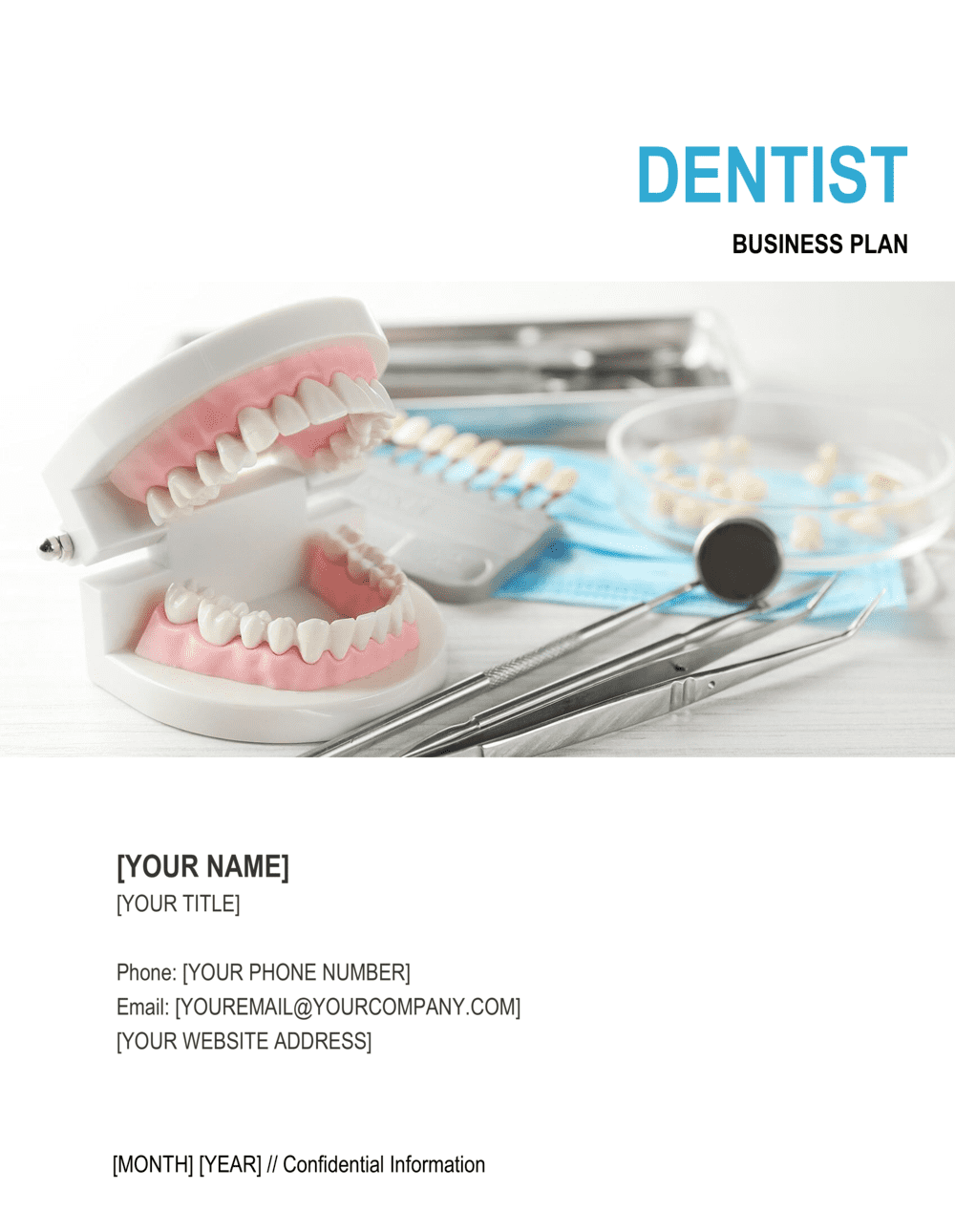
Dentist Business Plan Template

Free Word download β€’ Edit online β€’ Save & share with Drive β€’ Export to PDF

32 pagesβ€’2h 40m – 3h 35m to fillβ€’Difficulty: Expert
Learn more ↓
FreeDentist Business Plan Template

At a glance

What it is
A Dentist Business Plan is a structured document that maps the clinical, operational, and financial strategy for launching or growing a dental practice. This free Word download gives you a section-by-section framework covering market analysis, service offerings, staffing, equipment, insurance, and 3–5 year financial projections β€” ready to edit online and export as PDF for lenders, partners, or internal planning.
When you need it
Use it when opening a new dental practice, buying an existing one, adding a second location, applying for a practice acquisition loan, or pitching a partnership to a dental service organization (DSO).
What's inside
Executive summary, practice overview, market and patient demographic analysis, services and specialty offerings, marketing and patient acquisition strategy, staffing and organizational structure, facility and equipment plan, and 3–5 year financial projections including revenue per chair, overhead ratios, and break-even analysis.

What is a Dentist Business Plan?

A Dentist Business Plan is a structured planning document that defines the clinical focus, market opportunity, operational model, staffing structure, and 3–5 year financial projections for a dental practice β€” whether a startup, acquisition, or multi-location expansion. It translates the unique economics of dental care β€” production per chair, payer mix, hygiene recall revenue, and overhead ratios β€” into a coherent strategy that lenders, partners, and co-owners can evaluate. This free Word download gives dentists a complete, section-by-section framework they can edit online and export as PDF for any professional audience.

Why You Need This Document

Without a written business plan, SBA loan applications stall at the underwriting stage, DSO partnership conversations go nowhere, and practice acquisitions close on assumptions that were never stress-tested. Dental practice lenders require a business plan as a standard part of the application package β€” not optional documentation. Beyond financing, the process of building the plan forces you to validate your market before signing a lease, align your staffing model with realistic patient-volume milestones, and confirm that your projected net collections can cover debt service, overhead, and owner compensation simultaneously. A practice that skips this step routinely discovers in Month 8 that the break-even timeline was 6 months optimistic β€” when the operating reserve is nearly gone and renegotiating the loan is no longer straightforward.

Which variant fits your situation?

If your situation is…Use this template
Opening a brand-new dental practice from scratchDentist Business Plan (Startup)
Acquiring an existing dental practiceDental Practice Acquisition Business Plan
Adding an orthodontics or specialty service lineSpecialty Dental Clinic Business Plan
Quick internal alignment for a solo practitionerOne-Page Business Plan
Joining or pitching to a dental service organizationDSO Partnership Proposal
Opening a pediatric dental clinicPediatric Dental Practice Business Plan
Planning a multi-specialty group practiceMedical Group Practice Business Plan

Common mistakes to avoid

❌ Projecting net collections at 100% of gross production

Why it matters: Insurance write-offs, contractual adjustments, and uncollectible balances consistently reduce net collections to 92–97% of billed production. Overstating revenue accelerates how quickly the practice runs out of cash.

Fix: Apply a collection rate of 94–96% to PPO production and 98–100% to fee-for-service production when building the financial model.

❌ Using statewide dentist-to-population ratios for market sizing

Why it matters: A state average of 1 dentist per 1,500 residents is meaningless if the target zip code has 1 per 600. Opening in a saturated market with a plan built on underserved-market assumptions leads to chronic under-performance.

Fix: Pull dentist density data at the 5-mile radius level from the ADA or a commercial dental demographics report before finalizing the location.

❌ Setting a new-patient target with no channel budget to support it

Why it matters: Financial projections that require 50 new patients per month but allocate only $500 to marketing are internally inconsistent β€” any experienced lender will flag this immediately.

Fix: Back-calculate the required marketing budget from your new-patient target using realistic cost-per-lead estimates for each channel, then include that number in the financial model.

❌ Underestimating the dental office build-out cost

Why it matters: Dental operatory construction runs $50,000–$80,000 per chair. Borrowing based on a generic office estimate creates a funding gap mid-construction that can stall the opening entirely.

Fix: Get at least two itemized quotes from dental-specific contractors before finalizing the loan amount and capital expenditure schedule.

❌ Hiring full-time staff before patient volume justifies it

Why it matters: A fully staffed practice running at 40% capacity in months 2–4 burns cash at a rate that forces the owner to defer compensation or draw down the operating reserve prematurely.

Fix: Staff to the minimum viable team at launch and document specific patient-volume triggers for each subsequent hire in the staffing section.

❌ Omitting debt service from the overhead ratio calculation

Why it matters: A practice showing a 58% overhead ratio looks healthy until you add loan payments β€” which can push the true cash-out ratio above 80% in Year 1, leaving the owner with minimal or negative take-home pay.

Fix: Present two overhead calculations: one excluding debt service (to compare against industry benchmarks) and one including it (to show the owner's true cash position).

The 8 key sections, explained

Executive Summary

Practice Overview

Market and Patient Demographic Analysis

Services and Specialty Offerings

Marketing and Patient Acquisition Strategy

Staffing and Organizational Structure

Facility, Equipment, and Technology Plan

Financial Projections

How to fill it out

  1. 1

    Complete the practice overview and licensure details

    Enter the legal entity name, ownership structure, target location, and the lead dentist's credentials, state license number, and any specialty certifications.

    πŸ’‘ Confirm your DEA registration is active and transferable to the new practice address before submitting any loan application β€” lenders verify this independently.

  2. 2

    Build the local market analysis with zip-code data

    Pull dentist-to-population ratios for the specific zip codes within a 5-mile radius using ADA Health Policy Institute data or a dental demographics report. Map competitor locations and estimate their capacity.

    πŸ’‘ A trade-area map with competitor pins is more persuasive to a bank loan officer than a paragraph of statistics β€” include it as an appendix.

  3. 3

    Define your payer mix and fee schedule assumptions

    Decide what percentage of patients will be fee-for-service versus PPO versus Medicaid. List the PPO networks you intend to join and research their reimbursement rates relative to your intended fees.

    πŸ’‘ In-network PPO reimbursements average 70–85% of your full fee. If more than 60% of your projected patients are PPO, stress-test your revenue model at 75 cents on the dollar.

  4. 4

    Set a specific new-patient-per-month target and map each channel

    Determine the minimum new-patient volume needed to cover fixed overhead by Month 6. For each acquisition channel, estimate the monthly budget, cost per new patient, and expected volume contribution.

    πŸ’‘ Google Ads for dental practices in mid-sized markets typically costs $80–$180 per new patient lead. Use this range to sense-check your channel budget against your patient-volume target.

  5. 5

    Build the staffing plan tied to patient milestones

    Start with the minimum clinical and administrative staff needed to open, then map each additional hire to a specific patient-volume or revenue trigger β€” not a calendar date.

    πŸ’‘ Tying hires to patient milestones (e.g., add a second assistant at 200 active patients) prevents premature labor cost increases that are the leading cause of cash shortfalls in the first year.

  6. 6

    Get a dental-specific contractor quote for the build-out

    Contact at least two dental office contractors and request itemized quotes covering plumbing, electrical, cabinetry, and equipment installation. Use these numbers β€” not estimates β€” in the equipment and facility section.

    πŸ’‘ Ask the contractor to break out tenant improvement allowance (TIA) coverage from your out-of-pocket cost. Many landlords offer $40–$80 per sq ft TIA for medical-dental tenants β€” this directly reduces your loan requirement.

  7. 7

    Build the financial model from production per chair up

    Start with the number of operatories, multiply by realistic production-per-chair benchmarks ($150,000–$250,000 per chair per year for a general practice), apply your payer-mix collection rate, and subtract itemized overhead to reach net income. Build monthly for Year 1, annual for Years 2–5.

    πŸ’‘ Run a downside scenario at 70% of projected new-patient volume. If the practice cannot service its debt at 70%, the loan structure needs to be renegotiated before you sign.

  8. 8

    Write the executive summary last

    Distill the one most compelling data point from each section β€” market gap, projected Year 3 revenue, break-even timeline, and the dentist's credentials β€” into a 1–2 page summary that can stand alone.

    πŸ’‘ SBA lenders read the executive summary and the financial model first. If those two sections are not internally consistent, the application is declined before the body of the plan is reviewed.

Frequently asked questions

What is a dentist business plan?

A dentist business plan is a structured document that outlines the clinical, operational, and financial strategy for a dental practice β€” whether starting from scratch, acquiring an existing practice, or expanding a current one. It covers market analysis, service offerings, staffing, facility requirements, marketing strategy, and 3–5 year financial projections. Banks and SBA lenders require one before approving practice loans; investors and DSO partners use it to evaluate the opportunity.

Do I need a business plan to get an SBA loan for a dental practice?

Yes. SBA 7(a) loans β€” the most common financing vehicle for dental practice acquisitions and startups β€” require a complete business plan as part of the application package. The plan must include a market analysis, management credentials, a detailed use of proceeds, and financial projections with monthly cash flow for at least Year 1. Lenders evaluate the plan to assess whether the practice can generate sufficient net collections to service the loan within the first 24 months.

How much does it cost to open a dental practice?

Startup costs for a new dental practice typically range from $400,000 to $750,000 depending on location, number of operatories, and technology choices. Build-out runs $50,000–$80,000 per chair; equipment (chair, unit, X-ray, CBCT, digital scanner) adds $80,000–$150,000 per operatory; software, signage, marketing, and working capital make up the remainder. SBA loans cover most of these costs with 10% down for qualified applicants.

What financial projections should a dental practice business plan include?

At minimum: monthly P&L for Year 1 with gross production, payer-mix adjustments, and net collections; annual P&L for Years 2–5; a monthly cash flow statement for Year 1 showing the operating reserve drawdown and the month break-even is reached; and a production-per-chair analysis supporting the revenue assumptions. Lenders also want to see debt service coverage ratio β€” net income divided by annual loan payments β€” at 1.25 or higher.

What is a realistic overhead ratio for a dental practice?

Industry benchmarks put healthy dental practice overhead β€” all expenses excluding owner compensation β€” at 55–65% of net collections. Staff costs alone typically run 22–27%, dental supplies 5–7%, lab fees 8–12%, occupancy 5–8%, and marketing 3–5%. New practices often run 70–80% overhead in Year 1 while building patient volume, so projecting a 55% ratio in Month 6 is a credibility red flag for lenders.

Should a dentist join PPO insurance networks?

Whether to participate in PPO networks depends on the market's insurance penetration, the practice's capacity, and the owner's revenue goals. PPO participation drives patient volume faster but reduces net revenue by 15–30% per procedure due to contractual write-offs. Fee-for-service practices retain full fees but require stronger marketing and patient demographics to sustain volume. Most new practices start with selective PPO participation and phase out lower-reimbursing plans as the schedule fills.

How many new patients per month does a dental practice need to break even?

Break-even patient volume depends on the practice's fixed overhead and average production per new patient visit, which typically runs $250–$450 for a comprehensive exam and X-rays plus any same-day treatment. A practice with $35,000 per month in fixed overhead and $350 average production per new patient needs roughly 100 new patients per month to cover costs β€” before accounting for hygiene recall revenue, which grows as the active patient base builds.

How long should a dentist business plan be?

A complete dentist business plan for a bank loan or SBA application typically runs 20–30 pages plus a financial model appendix. An internal planning document for a solo practitioner can be shorter β€” 12–15 pages focused on the market analysis, staffing plan, and financial model. One-page plans are useful for early ideation but are not sufficient for any capital raise or lender submission.

Can I write a dental practice business plan myself?

A structured template handles the majority of the format and section guidance for most dentists. Where professional help adds real value is in the financial modeling β€” specifically building a payer-mix-adjusted revenue model, a month-by-month cash flow, and a debt service coverage analysis. A dental-specific accountant or practice management consultant typically charges $1,500–$4,000 for a financial model review and is worth the cost for any loan application above $300,000.

How this compares to alternatives

vs General Business Plan

A general business plan covers any industry and omits dental-specific metrics such as production per chair, payer mix, CDT fee schedules, operatory count, and dental licensure requirements. The dentist business plan includes these healthcare-specific financial benchmarks and regulatory considerations that a generic template cannot anticipate. Use the dentist-specific version for any practice loan application or DSO pitch.

vs Medical Practice Business Plan

A medical practice business plan shares the same general structure but uses physician-specific metrics β€” RVUs, CPT codes, payer contracting β€” rather than CDT production and dental overhead benchmarks. Dental practices have distinct payer dynamics, equipment cost profiles, and staffing ratios that differ materially from physician offices. Use the dentist-specific version for any dental context.

vs One-Page Business Plan

A one-page plan is an internal alignment tool suitable for early ideation or a sole-practitioner check-in. It lacks the financial depth, market analysis, and payer-mix modeling that SBA lenders require. Use the full dentist business plan for any loan application or investor presentation; use the one-page version only for quick internal planning.

vs Financial Projections Template

A financial projections template covers the numbers β€” P&L, cash flow, balance sheet β€” but provides no market analysis, staffing plan, or strategic narrative. Lenders never evaluate financial projections in isolation; they need the market and operational context to assess whether the assumptions are credible. The dentist business plan integrates the financial model with the full strategic story.

Industry-specific considerations

General Dentistry

Production-per-chair benchmarks, hygiene recall revenue as a base load, and PPO network selection as the primary payer-mix decision.

Orthodontics

Case starts per month as the core revenue driver, financing partner integration for patient treatment plans, and GP referral network development as the main acquisition channel.

Oral Surgery and Specialty Practices

Near-100% referral-based patient acquisition, hospital or surgical center credentialing requirements, and anesthesia staffing costs as a material overhead line.

Pediatric Dentistry

Medicaid and CHIP payer mix considerations, higher chair turnover from shorter appointments, and school and community outreach as the primary marketing channel.

Template vs pro β€” what fits your needs?

PathBest forCostTime
Use the templateDentists preparing an internal operating plan or a first-draft submission for a loan under $400KFree2–4 weeks (40–70 hours)
Template + professional reviewSBA loan applications, practice acquisitions, or any lender submission requiring a detailed payer-mix financial model$1,500–$4,000 for a dental accountant or practice management consultant review3–5 weeks
Custom draftedDSO partnership pitches, multi-location expansions, or acquisitions above $1M requiring institutional-grade financial modeling$4,000–$10,000 for a dental practice consultant or healthcare business plan writer4–8 weeks

Glossary

Production per Chair
Total billable dental services generated by a single operatory chair over a given period β€” a core productivity metric for dental practices.
Overhead Ratio
Total practice expenses (excluding owner compensation) divided by gross production, typically targeting 55–65% for a healthy dental practice.
Case Acceptance Rate
The percentage of recommended treatment plans that patients agree to proceed with β€” a key indicator of patient trust and revenue potential.
Dental Service Organization (DSO)
A management company that provides non-clinical business support β€” billing, HR, marketing β€” to one or more dental practices under an affiliation agreement.
Operatory
A fully equipped dental treatment room; the number of operatories determines a practice's maximum patient capacity and revenue ceiling.
Payer Mix
The breakdown of patient payments by source β€” fee-for-service, PPO insurance, Medicaid/CHIP, or capitation β€” which directly affects net collections and cash flow.
Net Collections
Actual cash received from all sources after insurance adjustments and write-offs, as opposed to gross production billed.
Recall Rate
The percentage of active patients who return for scheduled hygiene appointments β€” a leading indicator of practice retention and recurring revenue.
SBA 7(a) Loan
A Small Business Administration loan program commonly used by dentists to finance practice acquisitions or startups, typically up to $5M with 10-year repayment.
Fee Schedule
The list of CDT procedure codes and corresponding fees a practice charges, negotiated separately for each insurance plan and for fee-for-service patients.

Part of your Business Operating System

This document is one of 3,000+ business & legal templates included in Business in a Box.

  • Fill-in-the-blanks β€” ready in minutes
  • 100% customizable Word document
  • Compatible with all office suites
  • Export to PDF and share electronically

Create your document in 3 simple steps.

From template to signed document β€” all inside one Business Operating System.
1
Download or open template

Access over 3,000+ business and legal templates for any business task, project or initiative.

2
Edit and fill in the blanks with AI

Customize your ready-made business document template and save it in the cloud.

3
Save, Share, Send, Sign

Share your files and folders with your team. Create a space of seamless collaboration.

Save time, save money, and create top-quality documents.

β˜…β˜…β˜…β˜…β˜…

"Fantastic value! I'm not sure how I'd do without it. It's worth its weight in gold and paid back for itself many times."

Managing Director Β· Mall Farm
Robert Whalley
Managing Director, Mall Farm Proprietary Limited
β˜…β˜…β˜…β˜…β˜…

"I have been using Business in a Box for years. It has been the most useful source of templates I have encountered. I recommend it to anyone."

Business Owner Β· 4+ years
Dr Michael John Freestone
Business Owner
β˜…β˜…β˜…β˜…β˜…

"It has been a life saver so many times I have lost count. Business in a Box has saved me so much time and as you know, time is money."

Owner Β· Upstate Web
David G. Moore Jr.
Owner, Upstate Web

Run your business with a system β€” not scattered tools

Stop downloading documents. Start operating with clarity. Business in a Box gives you the Business Operating System used by over 250,000 companies worldwide to structure, run, and grow their business.

Start freeΒ Β·Β No credit card required