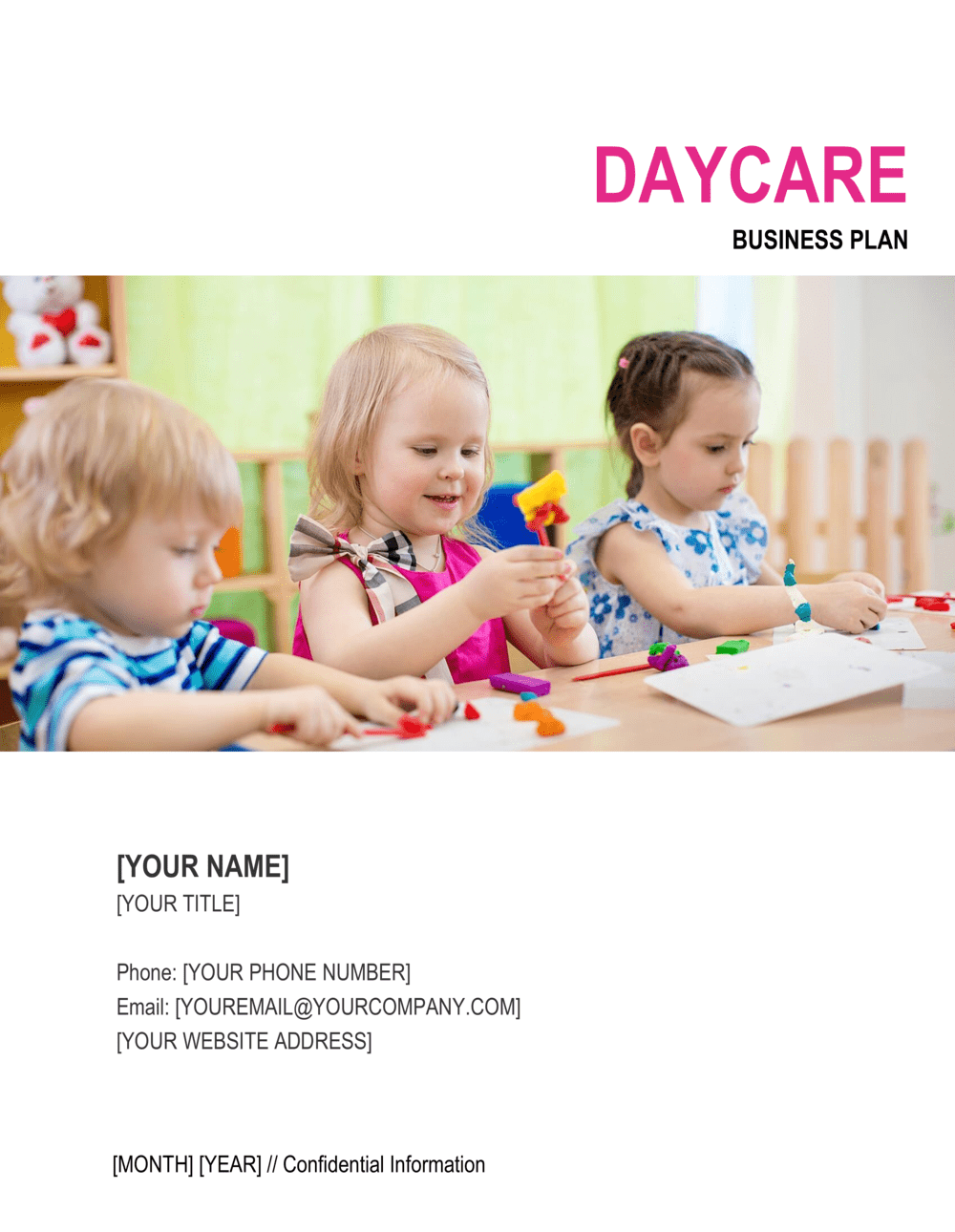
Daycare Business Plan Template

Free Word download β€’ Edit online β€’ Save & share with Drive β€’ Export to PDF

27 pagesβ€’2h 20m – 3h 10m to fillβ€’Difficulty: Expert
Learn more ↓
FreeDaycare Business Plan Template

At a glance

What it is
A Daycare Business Plan is a structured document that maps every operational and financial dimension of launching or expanding a childcare center β€” from licensing requirements and staff-to-child ratios to enrollment projections and break-even analysis. This free Word download gives you a ready-to-edit framework you can customize for a home-based daycare, a licensed childcare center, or a franchise location, then export as PDF for lenders, investors, or licensing boards.
When you need it
Use it when applying for a childcare license, seeking an SBA or small business loan, pitching investors on a new center, or formalizing the strategy for an existing facility that needs a growth roadmap.
What's inside
Executive summary, company overview, market and competitive analysis, services and curriculum, staffing and licensing plan, marketing strategy, operational procedures, and 3-year financial projections including startup costs, monthly P&L, and break-even enrollment thresholds.

What is a Daycare Business Plan?

A Daycare Business Plan is a structured planning document that maps every operational, regulatory, and financial dimension of launching or growing a licensed childcare center. It defines the center's concept and target families, documents the pathway to state licensing, establishes the staffing model required to meet mandatory child-to-staff ratios, and builds out enrollment-driven financial projections β€” including startup costs, monthly tuition revenue, CACFP reimbursements, and break-even enrollment thresholds. Unlike a general business plan, a daycare business plan is built around the specific constraints and revenue drivers of the childcare industry: licensed capacity, regulatory compliance timelines, and a predictable monthly tuition model that ramps over 6–18 months from opening.

Why You Need This Document

Opening a childcare center without a written business plan is one of the most common reasons new operators run out of cash before they reach break-even enrollment. Without a documented enrollment ramp, operators routinely underestimate how long payroll will exceed tuition revenue during the ramp-up period β€” and without a startup cost schedule built from real contractor quotes, they arrive at opening day undercapitalized. Beyond internal planning, a formal daycare business plan is a practical prerequisite: SBA lenders require it for any loan above $150,000, and many state licensing agencies ask for a staffing and operations plan as part of the application package. A well-structured plan also forces you to calculate your break-even enrollment before you sign a lease β€” the single most important number in deciding whether a location is financially viable. This template gives you the framework to work through every section systematically, so you arrive at your licensing board or lender meeting with credible numbers and a clear operating strategy.

Which variant fits your situation?

If your situation is…Use this template
Opening a licensed center with more than 20 enrolled childrenDaycare Business Plan (Full)
Operating a home-based daycare with 6 or fewer childrenHome Daycare Business Plan
Launching a Montessori or specialty curriculum programPrivate School Business Plan
Presenting a quick summary to a single investor or partnerOne-Page Business Plan
Applying for a state childcare subsidy or grantNonprofit Business Plan
Expanding an existing center into an after-school care programBusiness Expansion Plan
Seeking SBA 7(a) financing for a build-out or equipment purchaseBusiness Plan (Bank Loan)

Common mistakes to avoid

❌ Modeling revenue at full enrollment from day one

Why it matters: No childcare center opens at 100% capacity. A model that assumes full enrollment in Month 1 will show profitability that never materializes, causing the operator to run out of cash before break-even.

Fix: Build a realistic 6–12 month enrollment ramp starting at 30–40% of capacity and model monthly cash flow through the ramp to identify the working capital requirement.

❌ Understating the startup cost budget

Why it matters: Facility renovations, commercial kitchen requirements, playground equipment, and licensing fees routinely exceed initial estimates by 20–40%, leaving the operator undercapitalized before opening.

Fix: Get firm contractor quotes for all renovation work before finalizing the plan, and add a 20% contingency line to the startup cost schedule.

❌ Ignoring CACFP reimbursements in the financial model

Why it matters: For centers serving income-eligible families, CACFP reimbursements can cover 30–60% of food costs β€” omitting them understates revenue and makes the business look less viable than it is.

Fix: Estimate CACFP eligibility based on your target enrollment demographics and include projected monthly reimbursements as a separate revenue line.

❌ Treating licensing as a single step with a known completion date

Why it matters: State childcare licensing involves multiple inspections, background checks, and agency reviews that can each introduce multi-week delays β€” pushing the opening date and burning pre-opening reserves.

Fix: Build the licensing process into a milestone timeline with a 30-day buffer at each stage, and ensure working capital covers at least 3 months of pre-opening expenses.

❌ Staffing to projected enrollment rather than required ratios

Why it matters: State ratio requirements apply regardless of how many children are enrolled on a given day. A center licensed for infants must maintain a 1:3 ratio even if only two infants are present, making early-stage payroll costs disproportionately high.

Fix: Calculate minimum staffing cost at the regulatory ratio floor and model it as a fixed cost from day one, not a variable cost that scales with enrollment.

❌ No competitive analysis beyond listing competitor names

Why it matters: Lenders and licensing boards use the competitive section to assess whether there is genuine unmet demand in the area β€” a list of names with no pricing or capacity data provides no evidence of market opportunity.

Fix: For each competitor, document their licensed capacity, tuition rates, age groups served, and any known waitlist β€” this data is often available through your state's childcare registry.

The 9 key sections, explained

Executive Summary

Company Overview

Market Analysis

Services and Curriculum

Licensing and Compliance Plan

Staffing Plan

Marketing and Enrollment Strategy

Operational Procedures

Financial Projections

How to fill it out

  1. 1

    Complete the company overview and owner credentials

    Enter your legal entity name, registered address, ownership structure, and a brief bio highlighting early childhood education credentials and relevant experience.

    πŸ’‘ List every credential, certification, and license the owner holds β€” state licensing boards weigh operator qualifications heavily in the approval decision.

  2. 2

    Research local market supply and demand

    Pull census data on households with children under age 5 within a 3-mile radius. Contact your state childcare resource and referral agency for local licensed-capacity figures and average tuition rates.

    πŸ’‘ A documented waitlist at a nearby competitor is the single strongest piece of demand evidence you can include.

  3. 3

    Define your services, age groups, and tuition schedule

    List every age group served, operating hours, curriculum framework, and meal service plan. Set tuition rates by age group based on your local market benchmarks.

    πŸ’‘ Price infant slots at least 15–20% above preschool slots β€” the 1:3 ratio means each infant requires significantly more staff time per dollar of revenue.

  4. 4

    Map the licensing and compliance timeline

    List every license, permit, and inspection required in your state and municipality. Build a milestone timeline from application submission through anticipated approval and opening day.

    πŸ’‘ Add a 30-day buffer to every licensing milestone β€” delays are the norm, and your financial model must account for pre-opening costs running longer than planned.

  5. 5

    Build the staffing plan by room and ratio

    Assign staff to each age group room and verify that the roster meets your state's minimum ratios at every enrollment level. Calculate monthly payroll at both opening-day enrollment and full capacity.

    πŸ’‘ Model payroll at 30%, 60%, and 100% enrollment β€” the gap between staffing cost and tuition revenue during ramp-up is where most new daycares run out of cash.

  6. 6

    Draft the enrollment ramp and marketing plan

    Set a realistic month-by-month enrollment target from opening through full capacity, typically 12–18 months. Assign a specific marketing tactic and budget to each enrollment milestone.

    πŸ’‘ Start building a waitlist 90 days before your projected opening date β€” families plan childcare months in advance.

  7. 7

    Build the three-year financial model

    Model monthly revenue from tuition, CACFP reimbursements, and any subsidy vouchers. Enter all operating expenses β€” payroll, rent, utilities, food, supplies, insurance β€” and calculate monthly net income and cumulative cash position.

    πŸ’‘ Identify your break-even enrollment number and highlight it in the plan β€” it is the first number every lender will calculate independently to check your model.

  8. 8

    Write the executive summary last

    Pull the center concept, licensed capacity, break-even enrollment, funding ask, and projected profitability timeline into a concise 1–2 page summary once all other sections are complete.

    πŸ’‘ State the break-even enrollment as a percentage of licensed capacity β€” '18 of 24 children, or 75% capacity' is more intuitive to a lender than a raw enrollment number.

Frequently asked questions

What is a daycare business plan?

A daycare business plan is a structured document that defines the concept, target market, licensing roadmap, staffing model, curriculum, and financial projections for a childcare center. It is used to secure state licensing, obtain bank financing or SBA loans, attract investors, and guide the operator through the launch and enrollment ramp-up process.

What sections should a daycare business plan include?

A complete daycare business plan covers nine core sections: executive summary, company overview, market analysis, services and curriculum, licensing and compliance plan, staffing plan, marketing and enrollment strategy, operational procedures, and financial projections. The financial section should include startup costs, a monthly P&L for Year 1, annual projections for Years 2–3, and a break-even enrollment analysis.

How much does it cost to open a daycare?

Startup costs vary significantly by location, facility size, and whether you are building out a new space or converting an existing one. Home-based daycares typically cost $5,000–$25,000 to launch. Licensed centers in commercial space commonly run $75,000–$300,000 in startup costs, including renovation, equipment, licensing, insurance, and working capital. Your business plan's startup cost schedule should be built from firm contractor quotes, not estimates.

Do I need a business plan to get a childcare license?

Most state licensing agencies do not require a formal business plan as part of the license application, but many do require a written policies and procedures manual, a staffing plan showing ratio compliance, and a floor plan showing usable square footage per child. Lenders providing financing for the facility build-out will require a full business plan before approving any loan.

What is the break-even enrollment for a daycare center?

Break-even enrollment is the number of children whose combined weekly tuition exactly covers all monthly operating expenses. For a center with $30,000 in monthly operating costs and a blended weekly tuition of $300 per child, break-even is approximately 25 children. Most new centers plan for break-even at 60–75% of licensed capacity and target reaching that threshold within 12 months of opening.

How long does it take to open a daycare?

From the decision to open through first day of operations, most licensed childcare centers take 6–18 months. The timeline depends on whether a facility needs to be built out or renovated, how quickly the state licensing agency processes applications, and how long background checks and inspections take. Planning for at least 12 months from start to opening is advisable for a first-time operator.

What financial projections should a daycare business plan include?

At minimum: a startup cost schedule, a month-by-month enrollment ramp assumption, monthly tuition revenue by age group, CACFP reimbursement estimates, monthly operating expenses (payroll, rent, utilities, food, supplies, insurance), monthly net income, cumulative cash position, and break-even enrollment. Lenders also expect to see the owner's equity contribution and the total debt service requirement.

Can I write a daycare business plan myself?

Yes β€” a structured template handles the framework, and most of the content requires knowledge of your own center's concept and local market data. The most time-intensive part is building the financial model and gathering local supply-demand data. Engage a small business advisor or SCORE mentor if you are applying for an SBA loan above $150,000 or if your financial model involves complex subsidy payment structures.

What is CACFP and should it be in my business plan?

The Child and Adult Care Food Program is a USDA initiative that reimburses eligible childcare centers for meals and snacks served to enrolled children. For centers serving low- to moderate-income families, CACFP reimbursements can meaningfully reduce net food costs and should be included as a revenue line in your financial projections. Eligibility and reimbursement rates depend on the income profile of enrolled families and are administered through your state agency.

How this compares to alternatives

vs General Business Plan

A general business plan covers universal sections applicable to any industry. A daycare business plan adds childcare-specific elements β€” licensed capacity, staff-to-child ratios, state licensing timelines, CACFP revenue, and enrollment ramp modeling β€” that a generic template does not address. Use this template if your business is a childcare center; use a general plan for any other industry.

vs Nonprofit Business Plan

A nonprofit business plan adds board governance, grant strategy, and restricted-fund accounting that a for-profit daycare does not need. Use a nonprofit plan if your center is structured as a 501(c)(3) and relies on grants or government contracts as a primary revenue source. For-profit daycare operators should use the daycare-specific template.

vs Restaurant Business Plan

Both are location-based service businesses with high fixed costs and regulatory requirements, but the financial drivers are entirely different β€” covers and food cost ratios versus enrollment and staff ratios. A daycare business plan models licensing compliance and enrollment ramp; a restaurant plan models table turns and food cost percentages.

vs One-Page Business Plan

A one-page plan is useful for early-stage concept validation or a quick internal alignment tool, but it lacks the licensing detail, staffing ratios, enrollment projections, and full financial model that banks and licensing boards require. Start with a one-page plan to test the concept, then build the full daycare business plan before any license application or capital raise.

Industry-specific considerations

Early Childhood Education

Curriculum framework selection, CDA credential requirements, NAEYC accreditation pathway, and developmentally appropriate practice standards all shape the services and staffing sections.

Healthcare / Social Services

Centers accepting Child Care and Development Fund vouchers or Head Start partnerships must document subsidy billing procedures, income eligibility verification, and compliance with program-specific reporting requirements.

Franchise / Multi-Unit

Franchise childcare operators must align the business plan with the franchisor's brand standards, territory exclusivity terms, royalty structure, and required curriculum licensing fees.

Nonprofit / Faith-Based

Nonprofit daycare plans require a board governance section, grant funding strategy, IRS 501(c)(3) status description, and financial statements that distinguish restricted from unrestricted revenue.

Template vs pro β€” what fits your needs?

PathBest forCostTime
Use the templateFirst-time operators applying for a state license or a small business loan under $150,000Free2–4 weeks (30–60 hours)
Template + professional reviewSBA loan applications, multi-room centers with complex staffing models, or centers accepting government subsidy vouchers$500–$2,000 for a SCORE mentor session or small business advisor review3–5 weeks
Custom draftedMulti-site operators, franchise territory acquisitions, or centers raising equity capital above $500,000$3,000–$8,000 for a professional business plan writer with childcare sector experience4–8 weeks

Glossary

Staff-to-Child Ratio
The number of licensed caregivers required per enrolled child, set by state regulation and varying by age group β€” typically 1:3 for infants, 1:4 for toddlers, and 1:10 for school-age children.
Licensed Capacity
The maximum number of children a facility is legally permitted to care for at one time, as specified on its state childcare license.
Enrollment Rate
The percentage of licensed capacity that is currently filled with paying families β€” the primary revenue driver in childcare financial models.
Tuition Revenue
The weekly or monthly fees charged to families per enrolled child, which form the core income line in a daycare P&L.
Break-Even Enrollment
The minimum number of enrolled children at which monthly tuition revenue equals total monthly operating expenses.
Child Development Associate (CDA)
A nationally recognized credential for early childhood educators, awarded by the Council for Professional Recognition and often required by state licensing regulations.
CACFP (Child and Adult Care Food Program)
A USDA-funded program that reimburses eligible daycare centers for meals and snacks served to enrolled children, directly reducing food costs.
Capitated Rate
A fixed per-child payment made by a government subsidy program β€” such as Child Care and Development Fund vouchers β€” to a licensed provider on behalf of qualifying families.
Startup Costs
One-time expenses incurred before opening, including facility renovation, furniture and equipment, licensing fees, insurance deposits, and initial marketing.
Operating Ratio
Total operating expenses divided by total revenue β€” a key efficiency metric for childcare centers, where personnel costs typically run 55–70% of revenue.

Part of your Business Operating System

This document is one of 3,000+ business & legal templates included in Business in a Box.

  • Fill-in-the-blanks β€” ready in minutes
  • 100% customizable Word document
  • Compatible with all office suites
  • Export to PDF and share electronically

Create your document in 3 simple steps.

From template to signed document β€” all inside one Business Operating System.
1
Download or open template

Access over 3,000+ business and legal templates for any business task, project or initiative.

2
Edit and fill in the blanks with AI

Customize your ready-made business document template and save it in the cloud.

3
Save, Share, Send, Sign

Share your files and folders with your team. Create a space of seamless collaboration.

Save time, save money, and create top-quality documents.

β˜…β˜…β˜…β˜…β˜…

"Fantastic value! I'm not sure how I'd do without it. It's worth its weight in gold and paid back for itself many times."

Managing Director Β· Mall Farm
Robert Whalley
Managing Director, Mall Farm Proprietary Limited
β˜…β˜…β˜…β˜…β˜…

"I have been using Business in a Box for years. It has been the most useful source of templates I have encountered. I recommend it to anyone."

Business Owner Β· 4+ years
Dr Michael John Freestone
Business Owner
β˜…β˜…β˜…β˜…β˜…

"It has been a life saver so many times I have lost count. Business in a Box has saved me so much time and as you know, time is money."

Owner Β· Upstate Web
David G. Moore Jr.
Owner, Upstate Web

Run your business with a system β€” not scattered tools

Stop downloading documents. Start operating with clarity. Business in a Box gives you the Business Operating System used by over 250,000 companies worldwide to structure, run, and grow their business.

Start freeΒ Β·Β No credit card required