Wholesale Agreement Template

Free Word download β€’ Edit online β€’ Save & share with Drive β€’ Export to PDF

6 pagesβ€’25–35 min to fillβ€’Difficulty: Complexβ€’Signature requiredβ€’Legal review recommended
Learn more ↓
FreeWholesale Agreement Template

At a glance

What it is
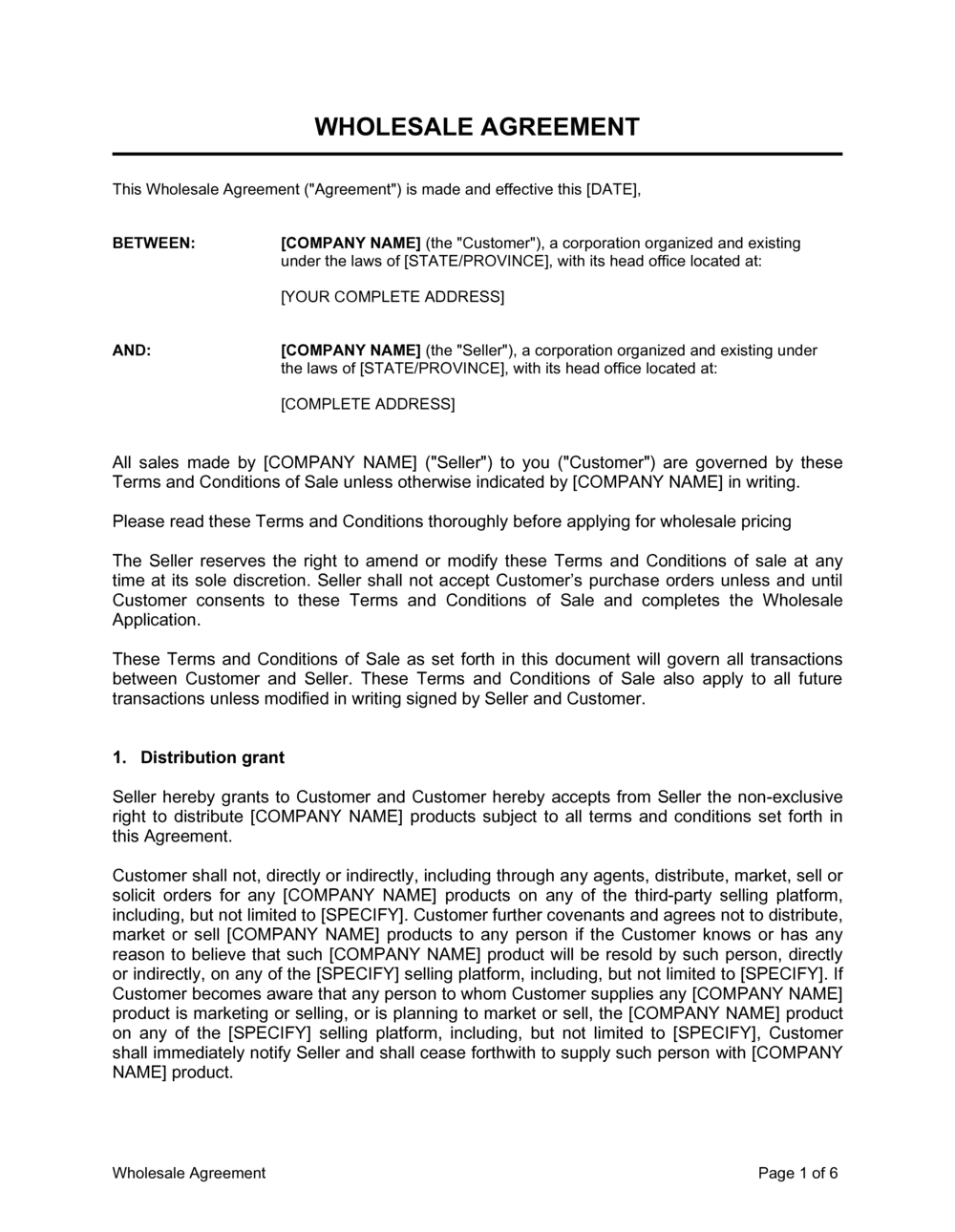
A Wholesale Agreement is a legally binding contract between a wholesaler or manufacturer and a retail or distribution customer that governs the ongoing bulk purchase of goods at wholesale prices. This free Word download covers pricing tiers, minimum order quantities, payment terms, MAP policy, territory restrictions, and returns in a single document you can edit online and export as PDF.
When you need it
Use it whenever you onboard a new retail buyer, distributor, or reseller who will purchase your products in volume at below-retail prices. It replaces informal email arrangements with enforceable obligations on pricing compliance, order minimums, and territory exclusivity.
What's inside
Parties and product scope, pricing tiers and MOQ, payment terms and credit limits, Minimum Advertised Price (MAP) policy, territory and exclusivity, order and delivery procedures, returns and defective goods, term and termination, and governing law.

What is a Wholesale Agreement?

A Wholesale Agreement is a legally binding contract between a manufacturer or wholesaler and a retail or distribution buyer that governs the ongoing bulk purchase of goods at below-retail prices. It establishes the complete commercial framework for the relationship β€” pricing tiers and minimum order quantities, payment terms and credit limits, Minimum Advertised Price (MAP) policy, territory and exclusivity rights, order and shipping procedures, and returns β€” replacing informal email exchanges with enforceable obligations on both sides. Unlike a one-time purchase agreement, a wholesale agreement is designed for repeat ordering over a defined term, creating a stable commercial structure that both parties can rely on across multiple order cycles.

Why You Need This Document

Operating without a written wholesale agreement exposes the wholesaler on every front that matters commercially. Without a MAP policy in the agreement, a single price-cutting retailer can undermine your entire retail pricing structure β€” triggering a race to the bottom across your authorized accounts with no contractual basis to stop it. Without defined territory terms, an exclusive distributor you invested in developing a region can lose that exclusivity to a new account you open next door, destroying the relationship. Without a clear payment terms and credit limit clause, buyers who exceed their effective payment capacity generate bad debt with no agreed remedy. Without a returns and chargeback policy, buyers use returns as inventory management and deduct unauthorized amounts from invoices, creating cash flow unpredictability with no documented basis to dispute. This template closes all of those gaps in under an hour, and delivers a document that protects your pricing, your territory structure, and your receivables from the first shipment forward.

Which variant fits your situation?

If your situation is…Use this template
Appointing an exclusive distributor for a defined territoryExclusive Distribution Agreement
Engaging a sales agent who earns commission rather than buying inventorySales Representative Agreement
Licensing your brand to a manufacturer or retailerLicense Agreement
Supplying goods under a private-label or white-label arrangementPrivate Label Agreement
Authorizing an online marketplace reseller to carry your productsReseller Agreement
Setting terms for a one-time large bulk purchase rather than ongoing supplyPurchase Agreement
Supplying goods internationally with customs and incoterms provisionsInternational Distribution Agreement

Common mistakes to avoid

❌ Granting exclusive territory without a minimum purchase commitment

Why it matters: An exclusive buyer who underperforms blocks the wholesaler from appointing other accounts in that region, stalling revenue with no contractual remedy.

Fix: Tie exclusivity to a specific annual purchase minimum β€” e.g., $50,000 per year β€” with a 90-day cure period before exclusivity reverts to non-exclusive.

❌ MAP policy that controls transaction price rather than advertised price

Why it matters: Fixing the actual sale price β€” not just the advertised price β€” may constitute resale price maintenance, which is a per se antitrust violation in the US and a competition law infringement in the EU and UK.

Fix: Limit MAP language explicitly to advertised prices, listing prices, and display prices. Never instruct a buyer what price to charge customers at the register or checkout.

❌ No notice period for wholesale price changes

Why it matters: An immediate price increase mid-season forces buyers to absorb margin compression on orders already in their sales cycle, damaging the relationship and triggering disputes.

Fix: Require 30 days' written notice for any price change and grandfather orders confirmed before the notice date at the prior price.

❌ Open-ended return policy with no defect or time restriction

Why it matters: Without a defined claim window and a defective-goods-only return scope, buyers return slow-moving inventory months later, creating unpredictable reverse logistics and credit memo exposure.

Fix: Limit returns to defective or non-conforming goods reported within 5 business days of delivery, with photo documentation required before any credit is issued.

❌ No limitation of liability clause

Why it matters: A missing liability cap exposes the wholesaler to consequential damages β€” lost profits, lost customers, lost contracts β€” that can far exceed the value of the goods at issue.

Fix: Cap total liability at the amounts paid by the buyer in the 12 months preceding the claim and explicitly exclude consequential, indirect, and punitive damages.

❌ Using a DBA or brand name instead of the registered legal entity

Why it matters: If the agreement names a trade name rather than the legal entity, enforcement β€” including injunctive relief for MAP violations or territory breaches β€” becomes procedurally complicated and may require an amended filing.

Fix: Confirm each party's exact registered legal name from their corporate registry or secretary of state filing before completing the parties block.

The 10 key clauses, explained

Parties, products, and scope

In plain language: Identifies the wholesaler and the buyer as legal entities, defines the specific product lines covered, and confirms the buyer's status as an authorized reseller.

Sample language
This Wholesale Agreement is entered into as of [DATE] between [WHOLESALER LEGAL NAME], a [STATE] [ENTITY TYPE] ('Wholesaler'), and [BUYER LEGAL NAME], a [STATE] [ENTITY TYPE] ('Buyer'). Wholesaler hereby authorizes Buyer to purchase and resell the products listed in Schedule A ('Products') subject to the terms herein.

Common mistake: Listing a product category rather than specific SKUs in the agreement body. When pricing tiers and MAP policies are SKU-specific, a vague product description creates disputes about which terms apply to new product additions.

Pricing tiers and minimum order quantities

In plain language: Sets out the wholesale price schedule by volume band, states the minimum order quantity per order, and clarifies when pricing changes take effect.

Sample language
Wholesale prices are set forth in Schedule B and are subject to change with [30] days' written notice. Buyer must submit orders of no less than [MINIMUM UNIT COUNT] units or $[MINIMUM DOLLAR AMOUNT] per order to qualify for wholesale pricing. Revised pricing applies to orders placed after the effective date of the notice.

Common mistake: Failing to specify the notice period for price changes. Without it, a mid-season price increase applies immediately and the buyer has no protected window to complete orders at the prior price.

Payment terms and credit

In plain language: States the payment deadline (Net 30, Net 60, etc.), any early-payment discount, the late-fee rate, and the credit limit beyond which prepayment or a deposit is required.

Sample language
Invoices are due [NET 30] days from invoice date. Buyer may deduct [2]% for payment within [10] days of invoice date. Balances unpaid after the due date accrue interest at [1.5]% per month. Wholesaler may require prepayment or a deposit for orders exceeding Buyer's approved credit limit of $[AMOUNT].

Common mistake: Omitting a credit limit and never requiring prepayment. Buyers who exceed their effective payment capacity create bad-debt exposure that a credit ceiling and deposit requirement would prevent.

Minimum Advertised Price (MAP) policy

In plain language: Requires the buyer to advertise and display the product at or above the MAP price set by the wholesaler, with specific remedies β€” warning, suspension, or termination β€” for violations.

Sample language
Buyer agrees not to advertise, list, or display any Product at a price below the MAP set forth in Schedule C. A first violation results in a written warning. A second violation within [12] months entitles Wholesaler to suspend Buyer's account for [30] days. A third violation entitles Wholesaler to terminate this Agreement immediately.

Common mistake: Applying MAP to the sale price rather than the advertised price. MAP policies under US antitrust law govern advertising β€” attempting to control the actual transaction price may constitute resale price maintenance.

Territory and exclusivity

In plain language: Defines the geographic area or sales channel where the buyer is permitted to resell, and states whether the appointment is exclusive or non-exclusive.

Sample language
Wholesaler grants Buyer a [non-exclusive / exclusive] right to resell Products in the territory described in Schedule D ('Territory'). Buyer shall not actively solicit sales or establish distribution points outside the Territory. Exclusivity, if granted, is conditional on Buyer meeting annual purchase commitments of $[AMOUNT].

Common mistake: Granting exclusivity without tying it to a minimum annual purchase commitment. An exclusive territory with no performance threshold blocks the wholesaler from appointing other buyers in the region if the exclusive buyer underperforms.

Orders, shipping, and delivery

In plain language: Covers how orders are placed, the lead time, shipping terms (Incoterms), risk of loss, and what happens if the wholesaler cannot fulfill an order.

Sample language
Buyer shall submit purchase orders via [EMAIL / EDI / PORTAL]. Wholesaler shall acknowledge orders within [3] business days. Delivery lead time is [X] business days from order confirmation. Products ship [FOB WHOLESALER'S WAREHOUSE], and risk of loss passes to Buyer upon tender to the carrier.

Common mistake: Leaving shipping terms undefined and defaulting to vague language like 'standard delivery.' Without an Incoterm or equivalent, disputes over who bears the cost and risk of a lost or damaged shipment have no contractual resolution.

Returns, defective goods, and chargebacks

In plain language: States the conditions under which the buyer may return goods, the process for reporting defective products, the wholesaler's remedy (replace, credit, or refund), and the rules for buyer-initiated chargebacks.

Sample language
Buyer must inspect all shipments within [5] business days of receipt and notify Wholesaler in writing of any defects, shortages, or discrepancies. Wholesaler will, at its election, replace defective goods or issue a credit memo within [15] business days of a validated claim. Unauthorized deductions from invoices are not permitted and will be added back to Buyer's outstanding balance.

Common mistake: Allowing open-ended returns on non-defective stock. Without a clear 'defective goods only' return policy with a defined claim window, buyers use returns as de facto inventory management, creating unpredictable reverse logistics costs for the wholesaler.

Intellectual property and brand guidelines

In plain language: Grants the buyer a limited license to use the wholesaler's trademarks solely to market and sell the authorized products, subject to brand guidelines and approval.

Sample language
Wholesaler grants Buyer a non-exclusive, non-transferable license to use Wholesaler's trademarks, logos, and product images ('Brand Assets') solely to advertise and sell the Products in the Territory during the term. Buyer shall comply with Wholesaler's brand guidelines as updated from time to time and shall submit any new marketing materials for approval before use.

Common mistake: Granting a trademark license without a review-and-approval mechanism. Buyers who modify logos, use outdated imagery, or place products in off-brand contexts cause trademark dilution the wholesaler cannot easily remedy after the fact.

Term, renewal, and termination

In plain language: Sets the initial contract period, the auto-renewal mechanism, and the conditions for termination β€” with or without cause and with or without notice.

Sample language
This Agreement commences on [START DATE] and continues for [1] year, renewing automatically for successive one-year terms unless either party provides [30] days' written notice of non-renewal. Either party may terminate for material breach upon [15] days' written notice if the breach is not cured within that period. Wholesaler may terminate immediately for MAP violations per Section [X] or for Buyer's insolvency.

Common mistake: No cure period for material breach. Immediate termination for a first breach β€” especially a disputed one β€” exposes the wholesaler to a wrongful termination claim and destroys a commercially valuable relationship unnecessarily.

Governing law, dispute resolution, and limitation of liability

In plain language: Specifies the jurisdiction whose law governs, how disputes are resolved, and caps the wholesaler's maximum liability to the amount paid in the prior 12 months.

Sample language
This Agreement is governed by the laws of [STATE / PROVINCE]. Disputes shall first be submitted to good-faith mediation; if unresolved within [30] days, either party may pursue binding arbitration under [AAA / JAMS] rules. In no event shall Wholesaler's liability exceed the total amounts paid by Buyer in the [12] months preceding the claim.

Common mistake: No limitation of liability clause at all. Without a cap, a dispute over a defective shipment worth $5,000 can expose the wholesaler to consequential damages β€” lost profits, lost customers β€” many times the value of the goods.

How to fill it out

  1. 1

    Enter the parties' legal names and confirm authorized reseller status

    Use each party's full registered legal entity name, not a trade name or DBA. Confirm the buyer's resale license or retailer status in the recitals to support authorized-reseller claims.

    πŸ’‘ Request the buyer's resale tax certificate before execution β€” some states require it on file before you can sell tax-exempt to a reseller.

  2. 2

    Complete Schedule A with specific product SKUs and descriptions

    List each product by SKU, product name, and unit of measure. If the agreement covers a full catalog, reference the catalog version and date rather than listing every SKU in the agreement body.

    πŸ’‘ Include a process for adding new SKUs β€” e.g., by mutual written amendment or updated Schedule A signed by both parties β€” so new product launches don't require a new agreement.

  3. 3

    Set pricing tiers, MOQ, and the price-change notice period

    Enter each volume band with the corresponding per-unit price in Schedule B. Set the MOQ at the minimum that keeps the account economically viable. State the notice period for price changes β€” 30 days is the most common standard.

    πŸ’‘ Build in a grandfather clause allowing in-transit orders to ship at the prior price when a price change notice is issued mid-order cycle.

  4. 4

    Define MAP policy and enforcement steps

    Enter MAP prices in Schedule C and spell out the warning-suspension-termination escalation in the MAP clause. Confirm that the policy covers all advertising channels β€” online listings, social media, print, and in-store signage.

    πŸ’‘ State that MAP applies to advertised prices, not transaction prices, to avoid resale price maintenance exposure under US and EU competition law.

  5. 5

    Define territory scope and exclusivity conditions

    Describe the territory precisely β€” by country, state, postal code, or sales channel (e.g., brick-and-mortar only, excluding online). If granting exclusivity, attach the annual minimum purchase commitment as a condition.

    πŸ’‘ For online retailers, specify whether the territory restriction covers the ship-to address or the buyer's registered business location β€” courts have treated these differently.

  6. 6

    Set payment terms, credit limit, and late-fee rate

    Choose Net 30 or Net 60 based on your cash flow needs. Set a credit limit beyond which prepayment or a deposit is required. Add a late-fee rate β€” 1.5% per month is standard β€” and confirm it complies with usury limits in the governing jurisdiction.

    πŸ’‘ For new accounts, start with prepayment or Net 15 for the first two orders, then graduate to standard terms after satisfactory payment history.

  7. 7

    Complete returns, defective goods, and chargeback rules

    State the inspection window (5 business days is standard), the claim submission process, and the wholesaler's elected remedy. Explicitly prohibit unauthorized deductions from invoices and state the consequence β€” adding back to the balance plus an administrative fee.

    πŸ’‘ Require photo evidence of defective goods before issuing any credit. This alone eliminates a large portion of disputed claims.

  8. 8

    Execute before the first order ships

    Both parties must sign before any goods are delivered. Post-delivery signatures create consideration problems in common-law jurisdictions and leave the MAP, territory, and chargeback provisions unenforceable for that initial shipment.

    πŸ’‘ Use a digital signature tool that timestamps execution and stores the fully-executed agreement so both parties can reference specific clause language during disputes.

Frequently asked questions

What is a wholesale agreement?

A wholesale agreement is a legally binding contract between a manufacturer or wholesaler and a retail or distribution buyer that sets the ongoing terms for bulk purchases of goods at below-retail prices. It covers pricing tiers, minimum order quantities, payment terms, MAP policy, territory rights, and returns β€” replacing informal email arrangements with enforceable obligations on both sides.

What should a wholesale agreement include?

At minimum: parties and authorized product scope, pricing tiers and MOQ, payment terms and credit limit, MAP policy with enforcement steps, territory and exclusivity terms, order and shipping procedures, returns and defective goods policy, IP and brand guidelines, term and termination conditions, and governing law with a limitation of liability clause. Missing any of these creates gaps that favor the buyer in a dispute.

Is a wholesale agreement legally required?

No law requires a written wholesale agreement, but operating without one leaves the wholesaler with no enforceable MAP policy, no territory protection, and no defined payment terms β€” meaning disputes are resolved by jurisdiction-specific commercial defaults, which typically favor the party with more negotiating leverage. A signed agreement is the only reliable way to enforce pricing and territory compliance.

What is a MAP policy and how does it work in a wholesale agreement?

A Minimum Advertised Price policy prohibits authorized resellers from advertising your products below a price floor you set, protecting retail margins and brand value across channels. In the agreement, MAP is enforced through a graduated escalation β€” warning, account suspension, termination β€” for violations. Under US antitrust law, MAP applies to advertised prices, not the actual transaction price, so the language must be drafted carefully to avoid resale price maintenance exposure.

What is the difference between a wholesale agreement and a distribution agreement?

A wholesale agreement governs bulk product purchases β€” the buyer acquires inventory at wholesale prices and resells it. A distribution agreement typically grants broader rights: territorial exclusivity, marketing obligations, and sometimes sub-distribution rights. Distribution agreements also tend to include performance minimums and brand-building obligations that a standard wholesale agreement omits. For a network of authorized retailers without exclusive territory, a wholesale agreement is usually sufficient.

Can a wholesale agreement include an exclusive territory clause?

Yes, and many do β€” but exclusivity should always be conditioned on a minimum annual purchase commitment. Without a performance threshold, an exclusive buyer who underperforms locks the wholesaler out of that region with no remedy. In the EU, exclusive territory clauses in supply agreements are subject to the Vertical Block Exemption Regulation and may require review if the parties' combined market share exceeds 30%.

What payment terms are standard in a wholesale agreement?

Net 30 is the most common standard for established wholesale accounts. New accounts often start on prepayment or Net 15 for the first few orders, graduating to Net 30 after satisfactory payment history. Some large retail buyers require Net 60 or Net 90 β€” negotiate a carrying cost into your pricing if you accept extended terms. Always include a late-fee rate (1.5% per month is standard) and a credit limit above which prepayment or a deposit is required.

Who should sign a wholesale agreement?

An authorized signatory for each party β€” typically the owner, CEO, or an officer with signing authority β€” must execute the agreement before the first order ships. Signatures from purchasing managers or sales reps who lack authority to bind the company may render the agreement unenforceable against the entity. Confirm signing authority, especially for corporate buyers, before execution.

Do I need a lawyer to draft a wholesale agreement?

For straightforward domestic wholesale relationships with standard pricing and non-exclusive territory, a high-quality template is typically sufficient. Engage a lawyer when the agreement includes exclusive territory for a major region, cross-border supply with customs or import compliance implications, complex MAP enforcement across multiple channels, or when the buyer is a large retailer whose standard terms you are being asked to accept alongside your own agreement.

How this compares to alternatives

vs Exclusive Distribution Agreement

A distribution agreement grants a distributor exclusive rights to resell within a defined territory, typically with active marketing and minimum performance obligations. A wholesale agreement is a less involved arrangement β€” it sets pricing and ordering terms for authorized buyers without requiring exclusivity or marketing commitments. Use a distribution agreement when you need a partner to actively develop a market; use a wholesale agreement for a retailer who simply buys and resells.

vs Purchase Agreement

A purchase agreement governs a single, one-time transaction for a specific quantity of goods. A wholesale agreement is an ongoing relationship document that covers repeated orders over a defined term. If a buyer places one large order with no expectation of repeat business, a purchase agreement is more appropriate; if the buyer will order regularly, a wholesale agreement provides the operational framework.

vs Reseller Agreement

A reseller agreement typically covers software, digital products, or services, and focuses on license rights, support obligations, and branded resale conditions. A wholesale agreement is designed for physical goods β€” it addresses inventory, shipping terms, MOQ, returns, and MAP compliance. The documents share structural similarities but serve different commercial contexts.

vs Sales Representative Agreement

A sales representative agreement engages an agent who solicits orders on your behalf and earns a commission β€” the agent never takes title to the goods. A wholesale agreement is with a buyer who purchases inventory outright, takes risk of loss, and sets their own resale price (within MAP). The distinction matters for tax, liability, and antitrust purposes.

Industry-specific considerations

Consumer Goods / CPG

SKU-level MAP enforcement across grocery, specialty retail, and online channels, with floor stock adjustment provisions for seasonal pricing resets.

Apparel and Fashion

Seasonal collection ordering windows, markdown and promotional policies, territory restrictions by wholesale channel, and return-to-vendor provisions for end-of-season unsold stock.

Electronics and Technology

Strict MAP enforcement to protect MSRP, authorized reseller programs with compliance auditing, and warranty pass-through conditions tied to authorized seller status.

Food and Beverage

Shelf-life and expiry date requirements on delivery, cold-chain compliance obligations, chargeback rights for short-dated goods, and minimum order quantities tied to full-pallet shipments.

Jurisdictional notes

United States

Wholesale agreements for goods are governed by UCC Article 2 in all US states, which supplies default rules on delivery, risk of loss, and warranties if the contract is silent. MAP policies must be structured as advertised-price restrictions β€” not resale price controls β€” to comply with Sherman Act antitrust standards. California, New York, and Texas each have additional commercial and consumer protection rules that can affect chargeback rights and payment dispute procedures.

Canada

Canadian provinces follow Sale of Goods Acts modeled on the UK statute, which imply conditions of merchantability and fitness for purpose unless expressly excluded. MAP policies must comply with the Competition Act's pricing provisions β€” agreements that fix resale prices are treated as per se anti-competitive. Quebec requires commercial agreements to be available in French for provincially regulated businesses, and consumer protection rules in Quebec are more buyer-favorable than in common-law provinces.

United Kingdom

The Sale of Goods Act 1979 and the Consumer Rights Act 2015 imply statutory terms of satisfactory quality and fitness for purpose into every supply contract. Limitation of liability clauses must satisfy the reasonableness test under the Unfair Contract Terms Act 1977 to be enforceable. Post-Brexit, UK competition law mirrors EU vertical restraints rules but is enforced independently by the CMA β€” MAP and territory restrictions remain subject to Chapter I prohibition under the Competition Act 1998.

European Union

Wholesale supply agreements in the EU are subject to the Vertical Block Exemption Regulation (VBER 2022), which allows exclusive territory and MAP provisions only where neither party's market share exceeds 30%. Binding minimum resale prices are a hardcore restriction under the VBER and are prohibited regardless of market share. GDPR applies to any personal data exchanged as part of buyer onboarding, order processing, or account management β€” include a data processing addendum if the agreement involves EU buyer data.

Template vs lawyer β€” what fits your deal?

PathBest forCostTime
Use the templateManufacturers and brand owners setting up non-exclusive wholesale accounts with standard pricing and domestic buyersFree30–45 minutes
Template + legal reviewExclusive territory grants, high-volume accounts, or buyers requiring custom payment terms or chargeback policies$400–$8002–5 days
Custom draftedInternational distribution, regulated product categories (food, pharma, electronics), or large retail chains with extensive compliance requirements$1,500–$4,000+1–3 weeks

Glossary

Minimum Order Quantity (MOQ)
The smallest number of units or dollar value a buyer must purchase per order to qualify for wholesale pricing.
Minimum Advertised Price (MAP)
The lowest price at which a retailer is permitted to advertise a product, set by the brand or manufacturer to protect price integrity across channels.
Pricing Tier
A volume-based pricing structure where the unit price decreases as the quantity ordered increases β€” e.g., 1–99 units at $10, 100–499 units at $8.50.
Net 30 / Net 60
Payment terms stating the full invoice balance is due 30 or 60 days after the invoice date.
Exclusive Territory
A defined geographic area in which the wholesaler grants the buyer the sole right to resell the products, preventing competing accounts in the same region.
Drop Shipping
A fulfillment arrangement where the wholesaler ships directly to the buyer's end customer, bypassing the retailer's warehouse.
Authorized Reseller
A retailer or distributor formally approved by the brand or manufacturer to sell its products under the terms of the wholesale agreement.
Chargeback
A deduction the buyer takes from an invoice β€” typically for short shipments, damaged goods, or failure to comply with labeling or EDI requirements.
Floor Stock Adjustment
A price reduction credit issued by the wholesaler when it lowers the wholesale price and the buyer holds existing inventory purchased at the higher price.
Incoterms
Standardized international trade terms (e.g., FOB, CIF, DDP) that define when title and risk of loss transfer from seller to buyer during shipment.
EDI (Electronic Data Interchange)
A standardized electronic format for transmitting purchase orders, invoices, and shipping notices between trading partners, commonly required by large retailers.

Part of your Business Operating System

This document is one of 3,000+ business & legal templates included in Business in a Box.

  • Fill-in-the-blanks β€” ready in minutes
  • 100% customizable Word document
  • Compatible with all office suites
  • Export to PDF and share electronically

Create your document in 3 simple steps.

From template to signed document β€” all inside one Business Operating System.
1
Download or open template

Access over 3,000+ business and legal templates for any business task, project or initiative.

2
Edit and fill in the blanks with AI

Customize your ready-made business document template and save it in the cloud.

3
Save, Share, Send, Sign

Share your files and folders with your team. Create a space of seamless collaboration.

Save time, save money, and create top-quality documents.

β˜…β˜…β˜…β˜…β˜…

"Fantastic value! I'm not sure how I'd do without it. It's worth its weight in gold and paid back for itself many times."

Managing Director Β· Mall Farm
Robert Whalley
Managing Director, Mall Farm Proprietary Limited
β˜…β˜…β˜…β˜…β˜…

"I have been using Business in a Box for years. It has been the most useful source of templates I have encountered. I recommend it to anyone."

Business Owner Β· 4+ years
Dr Michael John Freestone
Business Owner
β˜…β˜…β˜…β˜…β˜…

"It has been a life saver so many times I have lost count. Business in a Box has saved me so much time and as you know, time is money."

Owner Β· Upstate Web
David G. Moore Jr.
Owner, Upstate Web

Run your business with a system β€” not scattered tools

Stop downloading documents. Start operating with clarity. Business in a Box gives you the Business Operating System used by over 250,000 companies worldwide to structure, run, and grow their business.

Start freeΒ Β·Β No credit card required