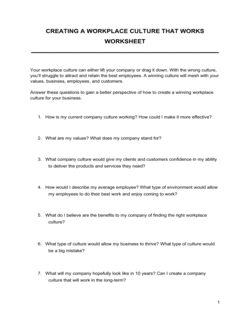
Creating A Workplace Culture That Works Guide

Free to read β€’ Save or share with one click

FreeCreating A Workplace Culture That Works Guide Template

At a glance

What it is
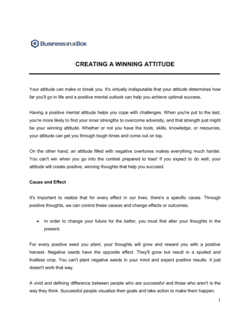
A Workplace Culture Guide is a structured operational document that defines the values, behavioral norms, communication standards, and leadership expectations that shape how people work together inside an organization. This free Word download gives you a ready-to-edit framework you can customize for your team size, industry, and stage, then export as PDF to share with employees, managers, and new hires.
When you need it
Use it when launching a new team or company, after a merger or restructuring that disrupts existing norms, or whenever employee engagement surveys, turnover data, or leadership feedback signal that cultural alignment is breaking down.
What's inside
Culture vision and mission alignment, core values with behavioral definitions, communication and collaboration norms, leadership expectations, recognition and feedback practices, inclusion commitments, and an action plan for embedding culture into daily operations.

What is a Creating a Workplace Culture That Works Guide?

A Workplace Culture Guide is a structured operational document that translates a company's values and behavioral intentions into explicit, actionable norms β€” defining how employees communicate, how managers lead, how recognition works, and how inclusion is practiced day to day. Unlike a mission statement or a set of wall-poster values, a culture guide goes deep enough to be usable in hiring rubrics, onboarding programs, performance conversations, and management training. This free Word template gives you a ready-to-customize framework covering culture vision, core value definitions, communication standards, leadership expectations, recognition mechanisms, and a time-bound implementation roadmap.

Why You Need This Document

Without a documented culture guide, your organization's culture is defined by whoever models behavior most visibly β€” which may have nothing to do with the values leadership intends. The consequences are concrete: voluntary turnover climbs when employees experience a gap between stated values and daily reality; hiring panels make inconsistent culture decisions because there is no shared rubric; new managers default to their previous employer's norms rather than yours. A written culture guide closes these gaps by making behavioral expectations observable, teachable, and measurable. It gives HR a framework for culture-based hiring, gives managers a standard for feedback conversations, and gives employees a clear picture of what working well looks like inside your organization. This template accelerates the process from blank page to published guide β€” so you spend your time on stakeholder input and implementation, not document structure.

Which variant fits your situation?

If your situation is…Use this template
Documenting culture for a brand-new startup or founding teamCompany Culture Statement
Setting behavioral and procedural expectations for all employeesEmployee Handbook
Defining policies specific to a remote or hybrid workforceRemote Work Policy
Formalizing a diversity, equity, and inclusion commitmentDiversity and Inclusion Policy
Outlining expected workplace conduct and disciplinary proceduresCode of Conduct
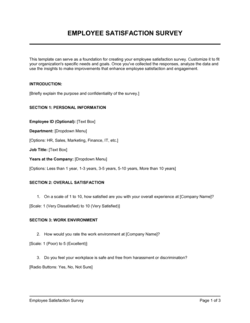
Capturing current culture gaps through structured employee feedbackEmployee Satisfaction Survey
Planning a culture change initiative as part of a broader strategyChange Management Plan

Common mistakes to avoid

❌ Values listed without behavioral definitions

Why it matters: Single-word values like 'integrity' or 'innovation' are interpreted differently by every employee and every manager, making them useless for hiring decisions, feedback conversations, or performance reviews.

Fix: For each value, write two to three observable behaviors and one anti-pattern. Test the definitions by asking three employees independently whether a specific action expresses the value β€” if their answers differ, refine the definition.

❌ No accountability mechanism or measurement plan

Why it matters: A culture guide without a measurement process produces no data, generates no accountability, and gives leadership no way to distinguish cultural improvement from cultural drift.

Fix: Add a culture measurement section that names the survey tool or method, the cadence, the threshold for action, and the person responsible for reviewing results and publishing findings.

❌ Omitting front-line manager behavioral expectations

Why it matters: Research consistently shows that managers account for roughly 70% of variance in employee engagement scores. A culture guide that addresses only executive behavior leaves the most impactful layer of leadership undefined.

Fix: Write explicit, observable behavioral expectations for managers at every level β€” frequency, format, and observable action β€” not competency descriptors that cannot be observed or measured.

❌ Treating the guide as a one-time publication

Why it matters: A culture document published once and never updated becomes a historical artifact within 12–18 months as the company grows, pivots, or absorbs new team members whose norms differ from those documented.

Fix: Schedule a formal annual review aligned to the performance cycle, and assign a named owner responsible for collecting feedback, updating the guide, and publishing the revision to all employees.

The 9 key sections, explained

Culture vision and strategic alignment

Core values with behavioral definitions

Communication and collaboration norms

Leadership expectations and behaviors

Recognition and feedback practices

Inclusion, belonging, and psychological safety

Hiring and onboarding for culture

Accountability and culture measurement

Action plan and implementation roadmap

How to fill it out

  1. 1

    Anchor culture to your mission and business strategy

    Open by stating the company mission in one sentence, then write a direct causal link between the culture you want to build and a specific business outcome β€” retention, product quality, customer satisfaction, or growth rate.

    πŸ’‘ If you cannot complete the sentence 'Our culture drives [OUTCOME] because...', your culture vision is not yet concrete enough to guide behavior.

  2. 2

    Define three to seven core values with behavioral examples

    List each value, then write two to three specific, observable behaviors that express it and one anti-pattern that does not. Review the list with at least three people from different levels of the organization before finalizing.

    πŸ’‘ Run a card-sorting exercise with your team β€” give each person 20 candidate values and ask them to pick the seven most essential. Values that emerge consistently from this process have the strongest cultural legitimacy.

  3. 3

    Document communication and meeting norms explicitly

    List default tools, response-time expectations, meeting structure requirements, and escalation paths for each communication type. Distinguish between synchronous norms for co-located teams and asynchronous norms for remote or hybrid arrangements.

    πŸ’‘ Ask three employees from different departments to describe the current unwritten norms β€” the delta between their answers and your intended norms reveals exactly what to document.

  4. 4

    Write specific behavioral expectations for managers

    For each manager-level expectation, write it as a frequency and observable action: 'conducts weekly one-on-ones,' 'delivers written feedback within 5 business days,' or 'publicly credits team members before self.' Avoid competency language like 'demonstrates empathy.'

    πŸ’‘ Pilot the manager expectations section with two or three current managers before publishing β€” if they find the behaviors unachievable or unclear, employees will too.

  5. 5

    Design the recognition and feedback mechanisms

    Choose a peer recognition channel, a structured feedback format, and a values-based award cadence. Write the process for each in enough detail that a new manager could run it without asking for help.

    πŸ’‘ Link at least one recognition mechanism directly to the core values by name β€” 'nominated for demonstrating [VALUE]' β€” so recognition reinforces culture intentionally.

  6. 6

    Add inclusion practices and a reporting path

    Write two to four active inclusion practices specific to your workplace β€” not generic policy statements β€” and name the person or channel employees should contact if they experience exclusion or psychological safety issues.

    πŸ’‘ If your company has fewer than 20 employees, name a specific role rather than an anonymous channel β€” small teams need visible accountability.

  7. 7

    Build a 90-day implementation roadmap

    Assign an owner, a launch date, and one success metric to each cultural initiative in the action plan section. Prioritize the two or three initiatives with the highest impact on current engagement or turnover data.

    πŸ’‘ Schedule the first culture health measurement before the guide is published, not after β€” this gives you a true baseline to measure improvement against.

  8. 8

    Share the guide and schedule quarterly reviews

    Distribute the finalized guide to all employees with a brief explanation of why it was created and what will change. Schedule a quarterly review cycle to update the guide based on engagement data and leadership feedback.

    πŸ’‘ A culture guide that is never updated signals stagnation β€” schedule the first annual revision date on the day of publication.

Frequently asked questions

What is a workplace culture guide?

A workplace culture guide is a structured operational document that defines the values, behavioral norms, communication expectations, and leadership standards that shape how people work together inside an organization. It translates abstract culture language into concrete, observable behaviors that can be used in hiring, onboarding, performance management, and recognition. Unlike a code of conduct, which focuses on minimum acceptable behavior, a culture guide describes the environment the company actively works to create.

Why does workplace culture need to be documented?

Undocumented culture is not neutral β€” it defaults to whatever informal norms the loudest or most senior people model, which may contradict leadership's intentions. Documenting culture creates a shared reference point for hiring decisions, manager conversations, and performance expectations. Organizations with documented culture frameworks consistently report faster onboarding, lower voluntary turnover, and stronger employee engagement scores than those relying on culture to spread organically.

When should a company create a workplace culture guide?

The most common triggers are: scaling past 10–15 employees when informal norms begin to break down, after a merger or acquisition that brings together teams with different cultural assumptions, when engagement survey scores or voluntary turnover rates deteriorate, or ahead of a strategic pivot that requires new behaviors from the team. Founding teams benefit from creating a lightweight version before hiring β€” it becomes significantly harder to define culture retroactively once norms are already embedded.

What is the difference between a culture guide and an employee handbook?

An employee handbook is a policy document that covers legal obligations, HR procedures, benefits, and conduct rules β€” it answers 'what are the rules?' A culture guide answers 'how do we work together and why?' The handbook is compliance-oriented; the culture guide is aspirational and behavioral. Both are necessary, and they should be consistent β€” a culture guide that promises psychological safety alongside a handbook with punitive disciplinary language creates a credibility gap employees notice immediately.

How many core values should a company have?

Three to seven is the practical range. Fewer than three feels incomplete; more than seven is impossible to remember and use in daily conversations. Five is the most common count among companies recognized for strong cultures. More important than the number is the behavioral specificity attached to each value β€” three well-defined values outperform seven vague ones in every culture-building outcome.

How do you measure whether a workplace culture guide is working?

The most direct indicators are voluntary turnover rate, employee engagement survey scores (measured on a consistent scale like eNPS), offer acceptance rate, and manager effectiveness ratings. A culture health audit β€” combining survey data with focus groups and exit interview analysis β€” provides the richest picture. Establish a baseline measurement before publishing the guide so that subsequent scores reflect real change rather than noise.

Can a small business with fewer than 20 employees benefit from a culture guide?

Yes β€” in fact, the founding stage is the most effective time to document culture because norms are still malleable and the cost of misalignment is low. A single bad cultural fit in a 10-person team has a proportionally larger impact than in a 500-person organization. A lightweight culture guide for a small business can be as short as four to six pages and still deliver the core benefits: clearer hiring criteria, faster onboarding, and explicit expectations for new managers.

How often should a workplace culture guide be updated?

A formal annual review aligned to the performance cycle is the minimum. Trigger an earlier update if the company undergoes a merger, a significant leadership change, or a strategic pivot that changes the required behaviors. The guide should also be reviewed whenever engagement survey results show a score below your threshold on any culture dimension β€” that is a signal that documented norms and lived experience have diverged.

Who should own the workplace culture guide?

Ownership typically sits with the Chief People Officer, HR Director, or the CEO in smaller organizations. What matters more than the title is that the owner has both the authority to hold leadership accountable to the documented standards and the organizational credibility to facilitate the cross-functional input needed to keep it current. Culture guides owned exclusively by HR without executive sponsorship are rarely adopted as management tools.

How this compares to alternatives

vs Employee Handbook

An employee handbook is a policy and compliance document covering HR rules, benefits, and disciplinary procedures. A workplace culture guide is a behavioral and aspirational document that defines values and norms. Both are needed, but they serve different purposes β€” the handbook answers 'what are the rules,' the culture guide answers 'how do we work together.' Use both in onboarding, not one as a substitute for the other.

vs Code of Conduct

A code of conduct sets the floor β€” minimum acceptable behavior and ethical standards that all employees must meet. A workplace culture guide sets the ceiling β€” the aspirational behaviors and norms the company actively cultivates. A code of conduct is largely defensive and compliance-oriented; a culture guide is proactive and engagement-oriented. Companies with strong cultures maintain both documents with consistent messaging.

vs Strategic Plan

A strategic plan defines where the business is going β€” goals, initiatives, KPIs, and resource allocation over a 3–5 year horizon. A workplace culture guide defines how the people inside the business work together to get there. A strategic plan without a culture guide often fails at execution because behavioral alignment is assumed rather than built. The two documents should reference each other explicitly.

vs Employee Satisfaction Survey

An employee satisfaction survey measures how employees currently experience the workplace. A culture guide defines the experience the company intends to create. The survey generates the diagnostic data; the culture guide provides the framework for acting on it. Use the survey to identify gaps between documented culture and lived reality, then update the guide and its implementation plan accordingly.

Industry-specific considerations

Technology / SaaS

Remote and distributed team norms, async communication defaults, psychological safety practices tied to engineering feedback culture, and values-based hiring rubrics for fast-scaling teams.

Professional Services

Client-service behavioral standards, internal knowledge-sharing norms, billing culture expectations, and manager accountability frameworks for high-turnover associate pipelines.

Retail / Hospitality

Front-line employee recognition programs, shift-level communication norms, values-based customer service standards, and culture onboarding adapted for high-volume, short-tenure hiring.

Healthcare

Psychological safety protocols tied to patient safety reporting, interdisciplinary team communication norms, recognition programs that reinforce care quality behaviors, and burnout-reduction culture commitments.

Template vs pro β€” what fits your needs?

PathBest forCostTime
Use the templateHR managers, founders, and people leaders creating or refreshing a culture guide for a team of up to 150 employeesFree1–2 weeks (10–20 hours including stakeholder input)
Template + professional reviewOrganizations undergoing a merger, rapid scaling past 200 employees, or a deliberate culture change initiative$1,000–$5,000 for an HR consultant or organizational development advisor review3–5 weeks
Custom draftedEnterprises with complex multi-site or multinational teams, or organizations commissioning a full culture diagnostic before drafting$10,000–$50,000+ for an OD consulting engagement8–16 weeks

Glossary

Organizational Culture
The shared values, assumptions, and behavioral norms that determine how people inside a company make decisions and interact with each other.
Core Values
A small set of non-negotiable principles β€” typically three to seven β€” that define what a company stands for and expects from every employee's behavior.
Psychological Safety
An environment where employees feel safe to speak up, ask questions, admit mistakes, and offer ideas without fear of ridicule or punishment.
Employee Engagement
The degree to which employees are emotionally invested in their work and motivated to contribute to organizational goals beyond their minimum job requirements.
Culture Fit vs. Culture Add
Culture fit means a candidate mirrors existing norms; culture add means they bring perspectives or skills that strengthen the culture without requiring assimilation.
Voluntary Turnover
Employees who choose to leave the organization β€” as opposed to being laid off or terminated β€” often a direct signal of cultural or management dissatisfaction.
Behavioral Norms
Unwritten or written expectations about how employees should act in specific situations, from how meetings are run to how disagreements are handled.
Recognition Program
A structured system for acknowledging employee contributions β€” through peer shoutouts, manager awards, or company-wide celebrations β€” tied to the organization's stated values.
Employer Brand
The reputation and perception a company projects as a place to work, shaped heavily by its internal culture and communicated through hiring, onboarding, and employee advocacy.
Culture Audit
A structured assessment β€” through surveys, focus groups, and exit interviews β€” that measures the gap between a company's stated culture values and how employees actually experience them.

Part of your Business Operating System

This document is one of 3,000+ business & legal templates included in Business in a Box.

  • Fill-in-the-blanks β€” ready in minutes
  • Compatible with all office suites
  • Export to PDF and share electronically

Create your document in 3 simple steps.

From template to signed document β€” all inside one Business Operating System.
1
Download or open template

Access over 3,000+ business and legal templates for any business task, project or initiative.

2
Edit and fill in the blanks with AI

Customize your ready-made business document template and save it in the cloud.

3
Save, Share, Send, Sign

Share your files and folders with your team. Create a space of seamless collaboration.

Save time, save money, and create top-quality documents.

β˜…β˜…β˜…β˜…β˜…

"Fantastic value! I'm not sure how I'd do without it. It's worth its weight in gold and paid back for itself many times."

Managing Director Β· Mall Farm
Robert Whalley
Managing Director, Mall Farm Proprietary Limited
β˜…β˜…β˜…β˜…β˜…

"I have been using Business in a Box for years. It has been the most useful source of templates I have encountered. I recommend it to anyone."

Business Owner Β· 4+ years
Dr Michael John Freestone
Business Owner
β˜…β˜…β˜…β˜…β˜…

"It has been a life saver so many times I have lost count. Business in a Box has saved me so much time and as you know, time is money."

Owner Β· Upstate Web
David G. Moore Jr.
Owner, Upstate Web

Run your business with a system β€” not scattered tools

Stop downloading documents. Start operating with clarity. Business in a Box gives you the Business Operating System used by over 250,000 companies worldwide to structure, run, and grow their business.

Free Forever PlanΒ Β·Β No credit card required