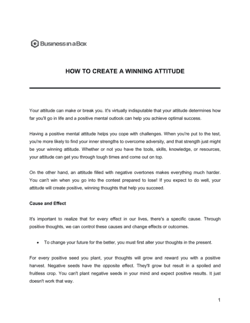
Creating A Winning Attitude Template

Free Word download β€’ Edit online β€’ Save & share with Drive β€’ Export to PDF

2 pagesβ€’20–30 min to fillβ€’Difficulty: Standardβ€’Signature requiredβ€’Legal review recommended
Learn more ↓
FreeCreating A Winning Attitude Template

At a glance

What it is
A Creating A Winning Attitude document is a formal, signed agreement between an organization and its employees or team members that defines the behavioral standards, mindset commitments, and performance expectations required for a high-performance culture. This free Word download gives you a structured template you can edit online and export as PDF, covering accountability principles, positive conduct obligations, and measurable attitude benchmarks.
When you need it
Use it when onboarding new hires, launching a culture initiative, restructuring a team after performance issues, or establishing a documented behavioral baseline before performance-management proceedings begin. It is also used in professional development programs and coaching engagements where a signed commitment from participants strengthens accountability.
What's inside
The document covers organizational values and culture expectations, individual behavioral commitments, performance mindset standards, accountability and self-assessment obligations, communication conduct, team collaboration principles, feedback and growth commitments, consequence and review procedures, and signature and acknowledgment blocks for both parties.

What is a Creating A Winning Attitude Document?

A Creating A Winning Attitude document is a formal, signed agreement between an employer and an employee that translates organizational culture expectations into specific, observable, and enforceable behavioral commitments. Where a standard employment contract defines the economic terms of the relationship β€” salary, duties, IP, and termination β€” this document defines the attitudinal and conduct standards that determine how those duties are performed: how the employee responds to feedback, communicates under pressure, supports colleagues, and holds themselves accountable between performance reviews. When properly drafted with measurable behavioral indicators, a defined review schedule, and a consequence matrix, it functions as a legally supportable supplement to the employment agreement rather than a motivational poster.

Why You Need This Document

Without a signed, specific behavioral commitment on file, enforcing cultural standards through corrective action becomes legally precarious. Managers who take disciplinary steps based on attitude often face grievances, wrongful-termination claims, or tribunal findings of unfair procedure β€” precisely because no documented standard was established and acknowledged before the conduct at issue occurred. The absence of this document means that when a performance improvement plan or termination is needed, the employer must first argue that the behavioral expectations existed at all, rather than simply demonstrating they were not met. A properly executed Creating A Winning Attitude agreement closes that gap: it creates the documented baseline, establishes the employee's informed acknowledgment of the standard, sets a review cadence that generates an evidence trail, and maps consequences to specific failures before any failure occurs. This template gives you a structured starting point you can adapt in under 30 minutes and execute before a new hire's first day or a culture initiative's launch.

Which variant fits your situation?

If your situation is…Use this template
Onboarding a new hire who must acknowledge culture standards on day oneCreating A Winning Attitude (Employee Onboarding Edition)
A performance improvement context where attitude is a documented concernPerformance Improvement Plan
A coaching engagement requiring participant commitment at program startCoaching Agreement
Team-wide culture reset following restructuring or leadership changeTeam Charter
Sales team accountability with quantified attitude and activity metricsSales Performance Agreement
Executive leadership commitment to culture modelingLeadership Commitment Statement
Volunteer or contractor behavioral expectations outside employment lawVolunteer Agreement

Common mistakes to avoid

❌ Using abstract value language without behavioral definitions

Why it matters: A clause requiring employees to 'maintain a positive attitude' cannot be enforced because there is no objective standard against which to measure conduct. In a disciplinary proceeding, the employee can credibly argue they were meeting an undefined obligation.

Fix: Replace every abstract value with at least one observable, measurable behavior β€” for example, 'address feedback without defensive interruption and confirm understanding by restating key points before responding'.

❌ No consequence matrix or escalation path

Why it matters: Without a defined consequence structure, any corrective action taken after signing the document can be challenged as arbitrary, inconsistent, or retaliatory β€” exposing the employer to wrongful-dismissal claims.

Fix: Add a consequence matrix that maps specific numbers of missed commitments in a review period to defined escalating responses, and have employment counsel confirm it meets jurisdictional procedural requirements.

❌ Signing the document after the commitment period has already started

Why it matters: In common-law jurisdictions, a signed commitment requires fresh consideration. An employee already participating in a program under informal expectations may argue the new formal obligations were imposed without anything in return.

Fix: Always execute the document before the first day of the commitment period. If retroactive signing is unavoidable, provide a documented additional benefit β€” a bonus, extra PTO, or training budget β€” as fresh consideration.

❌ Omitting digital communication channels from the conduct standards

Why it matters: Limiting communication standards to in-person or formal written correspondence leaves Slack, email tone, and external social media conduct outside the document's scope β€” precisely where attitude-related conduct issues most commonly arise.

Fix: Name every communication channel used by the team explicitly in the conduct standards clause, including instant messaging platforms, video-call behavior, and any work-related public social media activity.

❌ No time-bound follow-up requirement on feedback

Why it matters: An employee who verbally acknowledges feedback but never acts on it has technically complied with a loosely worded clause, leaving the employer without documented grounds for further corrective action.

Fix: Require written confirmation of agreed action steps within a specific number of business days of each feedback session β€” three to five business days is the standard range.

❌ Treating the document as standalone rather than linking it to the employment contract

Why it matters: Without an integration clause and an explicit reference to the employment agreement, courts may treat this document as aspirational rather than contractually binding, or as creating obligations that conflict with the main contract.

Fix: Include a clause stating that this document supplements and does not replace the employment agreement, and reference the employment agreement's date so the relationship between the two is unambiguous.

The 10 key clauses, explained

Parties and Purpose

In plain language: Identifies the employer and employee as parties, states the document's purpose as establishing behavioral and attitudinal expectations, and clarifies that the document supplements rather than replaces the employment agreement.

Sample language
This Creating A Winning Attitude Agreement ('Agreement') is entered into on [DATE] between [EMPLOYER LEGAL NAME] ('Employer') and [EMPLOYEE FULL NAME] ('Employee'). The purpose of this Agreement is to define the behavioral standards and mindset commitments expected of Employee in their role as [JOB TITLE].

Common mistake: Omitting the relationship between this document and the existing employment contract β€” leaving employees uncertain whether it creates new binding obligations or is merely aspirational.

Organizational Values and Culture Expectations

In plain language: Sets out the core values the organization expects employees to embody daily, giving specific behavioral examples for each value so expectations are concrete and enforceable.

Sample language
Employee commits to upholding the following organizational values in all workplace interactions: (a) Accountability β€” taking ownership of outcomes without deflecting blame; (b) Respect β€” addressing colleagues by name and listening actively before responding; (c) Initiative β€” identifying problems and proposing solutions before being asked.

Common mistake: Listing values as abstract nouns (integrity, excellence, passion) without behavioral definitions β€” making the clause unenforceable in a disciplinary proceeding because there is no objective standard to measure against.

Individual Behavioral Commitments

In plain language: Documents the specific behaviors the employee agrees to demonstrate consistently, including punctuality, communication style, responsiveness, and professional demeanor under pressure.

Sample language
Employee agrees to: (a) arrive prepared for all meetings and respond to internal communications within [X] business hours; (b) address disagreements directly with the relevant colleague before escalating; (c) maintain a constructive tone in written and verbal communication, including during periods of high workload or conflict.

Common mistake: Using subjective language like 'maintain a positive attitude' without defining what a positive attitude looks like in observable, measurable terms β€” creating disputes about whether the standard was met.

Performance Mindset Standards

In plain language: Commits the employee to approaching challenges with a growth orientation β€” treating setbacks as learning events, seeking feedback proactively, and avoiding defeatist language in team settings.

Sample language
Employee acknowledges that [EMPLOYER NAME] expects all team members to approach obstacles with a problem-solving orientation. Employee agrees to (a) seek feedback on performance at least once per [REVIEW PERIOD], (b) refrain from language that attributes failures solely to external factors without identifying personal contributions, and (c) document at least one professional development action per quarter.

Common mistake: Framing mindset standards as aspirational guidelines rather than obligations β€” which means a manager cannot use non-compliance as grounds for corrective action.

Accountability and Self-Assessment Obligations

In plain language: Requires the employee to conduct and document periodic self-assessments against the agreed behavioral standards and share the results honestly with their manager.

Sample language
Employee agrees to complete a written self-assessment using the [EMPLOYER NAME] Attitude and Performance Checklist at the end of each [30/60/90]-day review period and to submit it to [MANAGER NAME / TITLE] no later than [X] business days before the scheduled review meeting.

Common mistake: No self-assessment requirement at all β€” meaning all accountability flows from the manager, which can expose the employer to claims of biased or selective enforcement.

Communication Conduct Standards

In plain language: Sets out expectations for how the employee communicates in meetings, written correspondence, and conflict situations β€” including tone, timing, and escalation paths.

Sample language
Employee agrees to communicate professionally in all workplace channels, including email, instant messaging, and video calls. Disagreements with management decisions shall be raised through [PROCESS] within [TIMEFRAME] and not expressed through passive non-compliance, public dissent, or negative commentary to colleagues.

Common mistake: Covering in-person communication but omitting digital channels β€” leaving Slack messages, email tone, and social media conduct outside the scope of the clause.

Team Collaboration and Support Obligations

In plain language: Commits the employee to contributing constructively to team goals, sharing knowledge, and supporting colleagues β€” not just meeting individual performance targets.

Sample language
Employee agrees to (a) contribute actively to team meetings by preparing at least one agenda item or discussion point per session; (b) share relevant knowledge, tools, or resources with colleagues when it would improve team outcomes; and (c) refrain from conduct that undermines team morale, including public criticism of colleagues' work without private notice first.

Common mistake: Limiting obligations to individual output and ignoring team behavior β€” which means an employee can technically meet individual KPIs while actively damaging team culture, with no documented basis for intervention.

Feedback and Growth Commitments

In plain language: Documents the employee's agreement to receive feedback constructively, act on it within agreed timeframes, and track their own growth against development targets.

Sample language
Employee agrees to receive feedback β€” whether positive or corrective β€” without defensive interruption, to confirm understanding by restating key points, and to document agreed action steps within [X] business days of each feedback session. Employee further agrees to complete [TRAINING / COURSE NAME] by [DATE] as part of their development commitment.

Common mistake: No time-bound follow-up requirement on feedback β€” meaning an employee can acknowledge feedback verbally and never act on it, with no documented basis for further action.

Review Periods, Consequences, and Corrective Action

In plain language: Sets the review schedule, defines what constitutes a failure to meet the commitments in this document, and maps specific failures to escalating corrective actions.

Sample language
This Agreement will be reviewed at [30 / 60 / 90] days from the date of signing. Failure to meet two or more commitments in any single review period may result in: (a) a formal verbal warning; (b) a written warning placed in the employee's file; or (c) commencement of a Performance Improvement Plan, at the Employer's discretion.

Common mistake: No defined consequence structure β€” leaving the employer without a documented escalation path and exposing corrective action to wrongful-termination challenges.

Acknowledgment, Integration, and Signatures

In plain language: Confirms that the employee has read and understood the document, that it supersedes prior informal understandings on the subject, and captures dated signatures from both parties.

Sample language
Employee acknowledges having read and understood this Agreement in its entirety, having had the opportunity to ask questions before signing, and agreeing to the obligations set out above. This Agreement supplements and does not replace the Employee's existing Employment Agreement dated [DATE]. Signed: [EMPLOYEE NAME] [DATE] / [AUTHORIZED REPRESENTATIVE NAME] [TITLE] [DATE].

Common mistake: No integration clause β€” leaving prior verbal promises about culture and behavior admissible as evidence that contradicts or supplements the written document.

How to fill it out

  1. 1

    Enter legal entity names and the employee's role

    Use the employer's full registered corporate name β€” not a brand name β€” and the employee's legal name matching their employment contract. Add their exact job title and department.

    πŸ’‘ Cross-reference the employment contract to confirm entity name consistency β€” a mismatch between documents weakens enforceability.

  2. 2

    Define specific, observable behavioral expectations

    For each value or standard listed, add at least one concrete behavioral example. Replace abstract language like 'be positive' with observable actions like 'arrive prepared for all scheduled meetings with an agenda contribution'.

    πŸ’‘ Ask yourself whether a third-party observer with no context could identify whether the employee met the standard β€” if not, the language is too vague.

  3. 3

    Set the review period and self-assessment schedule

    Choose a 30-, 60-, or 90-day review cadence based on the employee's situation. New hires typically use 30-day checkpoints; experienced employees under a culture initiative may use 60- or 90-day cycles.

    πŸ’‘ Align the review period with any probationary period in the employee's contract to create a unified accountability timeline.

  4. 4

    Complete the communication and conduct standards

    Specify which channels are covered (email, Slack, video calls, in-person), response-time expectations, and the escalation process for disagreements with management decisions.

    πŸ’‘ Include a sentence covering conduct on work-related social media and external professional forums β€” omitting digital channels is the most common gap in communication clauses.

  5. 5

    Add the feedback and development commitments

    Name any specific training courses, certifications, or development activities the employee commits to, with completion dates. Set a time-bound response requirement for feedback received β€” typically 3–5 business days.

    πŸ’‘ Reference specific training by full name and provider so there is no ambiguity about what constitutes completion of the commitment.

  6. 6

    Build the consequence matrix

    Map the number of missed commitments in a review period to escalating responses: verbal warning at two misses, written warning at three, PIP at four. Make the matrix specific enough that either party can read it and predict the outcome.

    πŸ’‘ Have your employment lawyer confirm the consequence matrix aligns with your jurisdiction's disciplinary procedure requirements before the document goes live.

  7. 7

    Execute signatures before the program begins

    Both parties must sign and date the document before the commitment period starts β€” not after. Post-start signatures may require fresh consideration to be enforceable on the restrictive obligations.

    πŸ’‘ Use Business in a Box eSign to timestamp execution and store the fully-executed copy with the employee's personnel file.

  8. 8

    Schedule and document all review meetings in writing

    As each review period ends, document the meeting date, the self-assessment result, the manager's assessment, any agreed corrective actions, and both parties' signatures on the review record.

    πŸ’‘ A review meeting with no written record is almost impossible to use as evidence in a subsequent performance-management or termination proceeding.

Frequently asked questions

What is a Creating A Winning Attitude document?

A Creating A Winning Attitude document is a formal, signed agreement between an employer and an employee that defines the behavioral standards, mindset commitments, and accountability obligations expected in a high-performance culture. It translates abstract organizational values into observable, measurable conduct standards and creates a documented record of the employee's informed agreement to meet them. It is commonly used at onboarding, during culture initiatives, or as a preliminary step before formal performance management.

Is a Creating A Winning Attitude document legally binding?

When properly drafted, signed by both parties before the commitment period begins, and linked to the employment agreement, this document is generally enforceable in most common-law jurisdictions as a supplementary employment obligation. Its enforceability depends on specificity β€” abstract language about 'positive attitudes' is difficult to enforce, while observable, measurable behavioral standards tied to a defined consequence matrix are far more likely to hold in a disciplinary or termination proceeding. Consider having an employment lawyer review it before rollout.

When should I use this document rather than a Performance Improvement Plan?

Use a Creating A Winning Attitude document proactively β€” at onboarding, at the launch of a culture initiative, or at the start of a new team structure β€” before any specific performance issue is documented. A Performance Improvement Plan is the appropriate tool after a documented failure to meet existing standards. The attitude document establishes the standard; the PIP responds to a specific, recorded failure to meet it. Using the attitude document first creates the documented baseline the PIP will later reference.

Do employees have to sign this document?

From a legal standpoint, employees in most jurisdictions cannot be compelled to sign documents that impose new obligations without consideration β€” meaning a new benefit or compensation element. In practice, for new hires the document is typically presented as a condition of employment, making the job offer itself the consideration. For existing employees, presenting the document as part of a culture initiative rather than a disciplinary measure reduces resistance and, where consideration is legally required, a small benefit should accompany the signing request.

How specific should the behavioral commitments be?

Specific enough that a third party with no knowledge of the situation could determine whether the employee met the standard. 'Maintain a positive attitude' is unenforceable. 'Arrive prepared for all scheduled meetings with at least one agenda contribution, and respond to internal messages within four business hours' is specific, observable, and measurable. For each value listed, write at least one concrete behavioral indicator β€” this is the single change that most improves the document's legal utility.

How often should the document be reviewed?

A 30-day review is standard for new hires or employees entering the document in a performance-sensitive context. A 60- or 90-day cadence suits culture-wide rollouts for experienced employees. In every case, review meetings should be documented in writing with both parties signing the meeting record. An undocumented review is legally equivalent to no review at all if the documentation is later needed in a disciplinary or termination proceeding.

What happens if an employee refuses to meet the commitments after signing?

The document's consequence matrix governs the escalation path. Typically, a first failure in a review period triggers a verbal warning, a second failure a written warning placed in the personnel file, and a third or fourth failure the commencement of a formal Performance Improvement Plan. If the PIP is not successfully completed, termination for cause may follow. The signed attitude document creates the documented chain of notice and opportunity that most jurisdictions require before a cause-based termination will withstand challenge.

Can this document be used for contractors or volunteers, not just employees?

Yes, but the language must be adapted carefully. Using employment-style obligation language with an independent contractor can be used as evidence of an employment relationship, triggering tax and benefit liabilities. For contractors, frame the commitments as project-conduct standards within the contractor agreement rather than as a standalone employment document. For volunteers, behavioral expectations are appropriate but consequence clauses should reference program removal rather than employment-style corrective action.

Do I need a lawyer to implement this document?

For straightforward domestic hires where the document supplements an existing employment agreement, a high-quality template is usually sufficient. Engage an employment lawyer when rolling out the document to a unionized workforce, when operating in jurisdictions with strict procedural requirements before discipline (UK, France, Germany, Ontario), or when the document will be used as a precursor to termination proceedings involving senior employees. A 1–2 hour template review typically costs $300–$600 and is worthwhile in any performance-sensitive context.

How this compares to alternatives

vs Performance Improvement Plan

A Performance Improvement Plan responds to a documented failure to meet existing standards β€” it is reactive and typically signals the final stage before termination. A Creating A Winning Attitude document is proactive, setting the behavioral baseline before any failure is recorded. The attitude document creates the standard the PIP will later reference, making the two documents complementary rather than interchangeable.

vs Employee Handbook

An employee handbook covers the full range of company policies β€” attendance, expense reimbursement, leave, code of conduct, and more β€” in a broad reference document that employees acknowledge but do not individually negotiate. A Creating A Winning Attitude document is a signed bilateral commitment to specific behavioral standards tailored to the individual's role and context, making it more enforceable in a disciplinary proceeding than a general handbook acknowledgment.

vs Employment Contract

An employment contract defines the fundamental terms of the working relationship β€” compensation, duties, IP, non-compete, and termination. A Creating A Winning Attitude document supplements that contract by translating organizational culture expectations into specific, signed behavioral obligations. The attitude document should reference the employment contract's date and state explicitly that it supplements rather than replaces it.

vs Team Charter

A team charter is a group-level agreement on shared goals, working norms, and decision-making processes β€” it is typically aspirational and not individually signed. A Creating A Winning Attitude document is an individual bilateral commitment with a defined consequence matrix and review schedule. Use the team charter to set group direction and the attitude document to hold individual members accountable to it.

Industry-specific considerations

Sales and Business Development

Resilience and rejection-recovery standards are quantified by call volume maintained after a losing streak, and positive-mindset commitments are tied to weekly pipeline review participation.

Retail and Hospitality

Customer-facing conduct standards are defined at the interaction level β€” greeting scripts, de-escalation language, and response times to complaints replace generic attitude language.

Healthcare

Conduct standards integrate patient-safety culture obligations, mandatory incident-reporting commitments, and protocols for respectful communication under high-stress clinical conditions.

Technology and SaaS

Growth-mindset and feedback-loop commitments align with agile retrospective culture, and remote-work conduct standards cover asynchronous communication responsiveness and video-call participation norms.

Financial Services

Conduct standards reference regulatory professionalism requirements, client-communication tone obligations, and the specific consequence of attitude-related conduct breaches on licensing status.

Manufacturing and Operations

Team-collaboration commitments cover shift-handover communication quality, safety-reporting culture, and the behavioral obligations that underpin near-miss reporting programs.

Jurisdictional notes

United States

In at-will states, behavioral commitment documents supplement the employment relationship but do not typically alter the at-will nature of employment unless explicitly stated. Ensure the document includes a disclaimer confirming at-will status is preserved. In California, conduct standards that could be interpreted as restricting off-duty activities must be drafted narrowly to avoid conflicts with Labor Code protections. State-specific anti-retaliation laws may limit how quickly corrective action can follow a signed commitment.

Canada

Canadian employment law requires that new obligations imposed on existing employees be supported by fresh consideration β€” a benefit beyond continued employment. Rolling out a Creating A Winning Attitude document to existing employees without a corresponding benefit risks making the new obligations unenforceable. In Quebec, the document must be provided in French for provincially regulated employers. Ontario's Employment Standards Act sets procedural floors for discipline that the consequence matrix must not undercut.

United Kingdom

UK employment law requires that disciplinary procedures follow the ACAS Code of Practice on Disciplinary and Grievance Procedures to be defensible at an Employment Tribunal. A consequence matrix that bypasses the Code's requirements β€” for example, by skipping the right to be accompanied at disciplinary meetings β€” can result in an uplift of up to 25% on any unfair dismissal award. The document should reference the employer's existing disciplinary policy and confirm the attitude commitments operate within it.

European Union

EU member states impose some of the strictest procedural requirements before disciplinary action, with France, Germany, and Spain requiring works council consultation before implementing new performance-related documentation for existing employees. GDPR applies to the collection and storage of self-assessment records and review meeting notes β€” ensure data minimization principles are followed and employees are informed of the legal basis for processing. Post-signing obligations that monitor conduct in digital channels must comply with applicable employee-monitoring laws, which vary significantly by member state.

Template vs lawyer β€” what fits your deal?

PathBest forCostTime
Use the templateStandard domestic hires and culture-initiative rollouts for non-unionized teams in a single jurisdictionFree20–30 minutes per employee
Template + legal reviewDocuments used as a precursor to performance management or termination, or for employees in jurisdictions with strict disciplinary procedural requirements$300–$6001–3 days
Custom draftedUnionized workforces, multi-jurisdiction rollouts, senior employees with complex employment agreements, or regulated industries where conduct breaches affect licensing$1,000–$3,500+1–2 weeks

Glossary

Behavioral Commitment
A signed, documented pledge by an individual to maintain specific conduct standards within the organization.
Performance Culture
An organizational environment where shared values, attitudes, and accountability norms are defined, communicated, and enforced consistently.
Accountability Framework
A structured set of obligations and review mechanisms that hold individuals responsible for meeting defined behavioral and performance standards.
Acknowledgment Clause
A section of a document in which the signatory confirms they have read, understood, and agreed to the terms set out β€” creating a record of informed consent.
Corrective Action
A formal employer response to a documented failure to meet behavioral or performance standards, ranging from a verbal warning to termination.
Growth Mindset
A documented organizational principle that employees are expected to treat setbacks as learning opportunities and actively seek improvement rather than deflecting blame.
Conduct Standard
A defined, measurable expectation of how an employee must behave toward colleagues, customers, or the organization in a given situation.
Self-Assessment Obligation
A requirement that the employee periodically evaluate their own attitude and conduct against agreed standards and report honestly to their manager.
Feedback Protocol
The agreed process and frequency by which the employee will receive and respond to feedback on their attitude, behavior, and performance.
Integration Clause
A provision stating that the signed document supersedes all prior verbal or written understandings about the subject matter, making it the definitive record of agreed expectations.
Review Period
The defined interval β€” typically 30, 60, or 90 days β€” at which the parties formally assess whether the employee is meeting the commitments in the document.
Consequence Matrix
A structured table within the document that maps specific behavioral failures to defined organizational responses, removing ambiguity from the disciplinary process.

Part of your Business Operating System

This document is one of 3,000+ business & legal templates included in Business in a Box.

  • Fill-in-the-blanks β€” ready in minutes
  • 100% customizable Word document
  • Compatible with all office suites
  • Export to PDF and share electronically

Create your document in 3 simple steps.

From template to signed document β€” all inside one Business Operating System.
1
Download or open template

Access over 3,000+ business and legal templates for any business task, project or initiative.

2
Edit and fill in the blanks with AI

Customize your ready-made business document template and save it in the cloud.

3
Save, Share, Send, Sign

Share your files and folders with your team. Create a space of seamless collaboration.

Save time, save money, and create top-quality documents.

β˜…β˜…β˜…β˜…β˜…

"Fantastic value! I'm not sure how I'd do without it. It's worth its weight in gold and paid back for itself many times."

Managing Director Β· Mall Farm
Robert Whalley
Managing Director, Mall Farm Proprietary Limited
β˜…β˜…β˜…β˜…β˜…

"I have been using Business in a Box for years. It has been the most useful source of templates I have encountered. I recommend it to anyone."

Business Owner Β· 4+ years
Dr Michael John Freestone
Business Owner
β˜…β˜…β˜…β˜…β˜…

"It has been a life saver so many times I have lost count. Business in a Box has saved me so much time and as you know, time is money."

Owner Β· Upstate Web
David G. Moore Jr.
Owner, Upstate Web

Run your business with a system β€” not scattered tools

Stop downloading documents. Start operating with clarity. Business in a Box gives you the Business Operating System used by over 250,000 companies worldwide to structure, run, and grow their business.

Start freeΒ Β·Β No credit card required