Workplace Violence Prevention Policy Template

Free Word download β€’ Edit online β€’ Save & share with Drive β€’ Export to PDF

3 pagesβ€’20–30 min to fillβ€’Difficulty: Standard
Learn more ↓
FreeWorkplace Violence Prevention Policy Template

At a glance

What it is
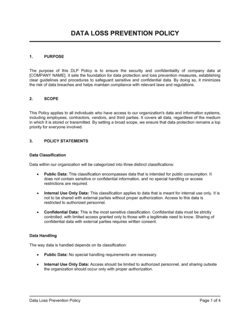
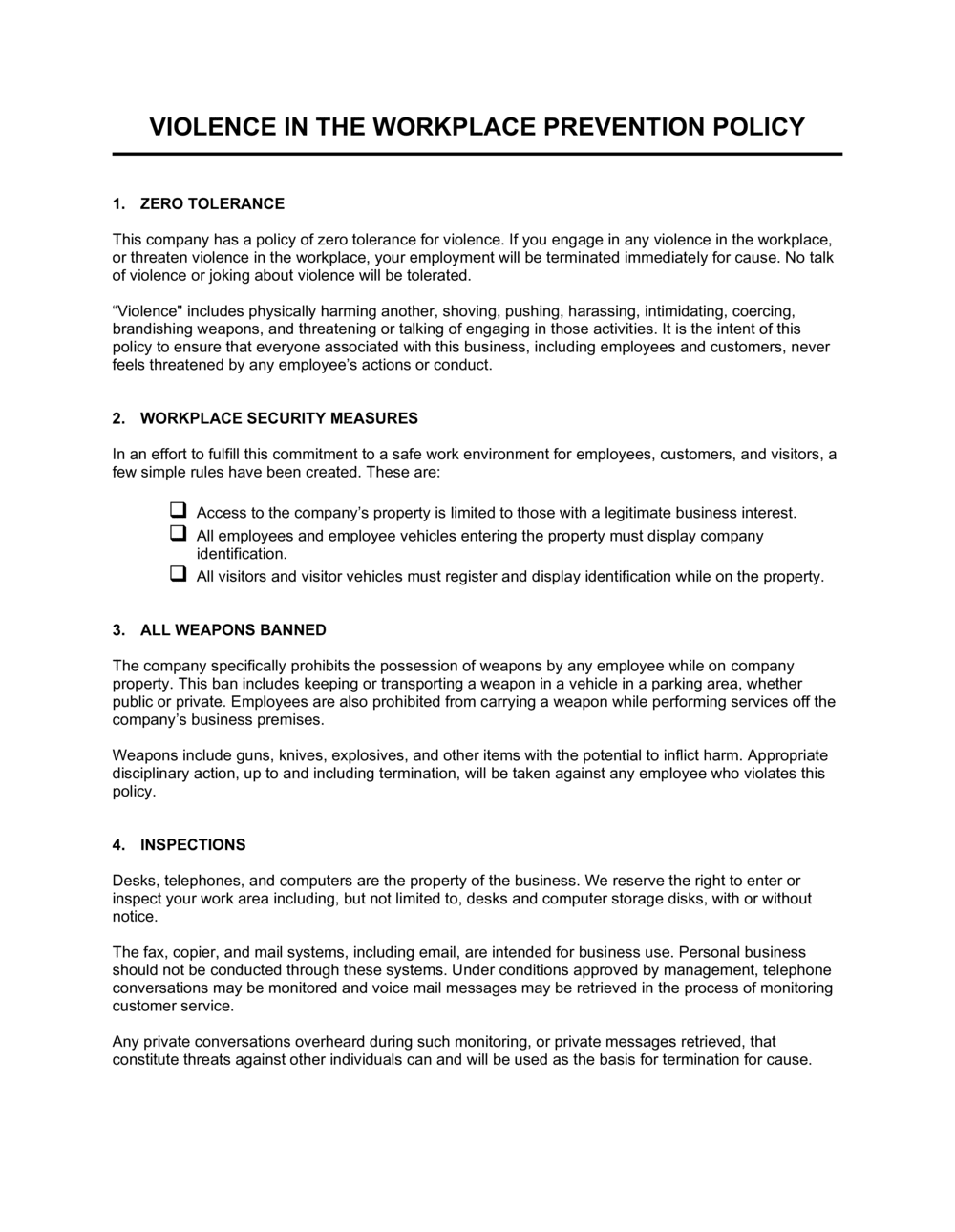
A Workplace Violence Prevention Policy is a formal written policy that defines prohibited violent behaviors, establishes reporting and investigation procedures, and outlines the employer's response to threats and incidents. This free Word download gives you a structured, ready-to-edit template you can customize for your organization's size, industry, and risk profile, then export as PDF for distribution to staff.
When you need it
Use it when onboarding new employees, updating your employee handbook, responding to a workplace incident, or meeting OSHA general duty clause obligations. Many industries β€” healthcare, retail, education, and financial services β€” face elevated violence risk that makes a written policy a practical necessity.
What's inside
Purpose statement and scope, definitions of prohibited conduct, reporting and investigation procedures, threat assessment protocols, response and corrective action steps, employee training requirements, and confidentiality and non-retaliation protections.

What is a Workplace Violence Prevention Policy?

A Workplace Violence Prevention Policy is a formal organizational document that defines prohibited violent and threatening behaviors, establishes how employees should report incidents and concerns, and outlines the employer's procedures for investigating threats and taking corrective action. It covers all four recognized categories of workplace violence β€” criminal acts by external parties, violence from customers or patients, co-worker-initiated threats, and domestic violence that enters the work setting β€” and applies to every employee, contractor, and visitor on company premises or engaged in work-related activities. The policy functions as both a preventive tool and an operational framework, giving managers and HR professionals a documented, consistent process to follow when a situation escalates.

Why You Need This Document

Without a written workplace violence prevention policy, organizations face three converging risks simultaneously. First, OSHA's General Duty Clause requires employers to address recognized hazards β€” and courts have found that a failure to implement a written violence prevention program constitutes a recognized hazard in industries with documented risk. Second, without defined reporting channels and a named investigation process, employees who witness or experience threatening behavior have no clear path forward, and incidents escalate or go unreported entirely. Third, when termination or disciplinary action follows a violent or threatening incident, the absence of a prior written policy makes wrongful termination claims significantly harder to defend. This template gives you a structured, customizable starting point that addresses scope, definitions, reporting, threat assessment, response, training, and non-retaliation in a single document β€” reducing both safety risk and legal exposure from the day it is distributed to staff.

Which variant fits your situation?

If your situation is…Use this template
Healthcare facility with patient-facing staff at elevated riskHealthcare Workplace Violence Prevention Policy
Retail or hospitality business with frequent public-facing interactionsCustomer-Facing Workplace Violence Prevention Policy
Remote or hybrid workforce with limited physical premisesRemote Workforce Safety Policy
School, college, or university campus environmentCampus Violence Prevention Policy
Construction or field operations with isolated worksitesField Operations Safety Policy
Organization needing a full written emergency response programEmergency Action Plan
Post-incident documentation and corrective action trackingIncident Report Form

Common mistakes to avoid

❌ Scope limited to physical premises only

Why it matters: Remote workers, field staff, and employees at off-site events are left unprotected, creating both safety gaps and potential OSHA liability when an incident occurs outside the office.

Fix: Explicitly extend policy scope to all work-related activities β€” remote work, off-site meetings, company events, and travel conducted on behalf of the organization.

❌ Promising absolute confidentiality to reporters

Why it matters: Investigation steps β€” interviewing the subject of a complaint, notifying security, or adjusting work assignments β€” inevitably reveal some information about who filed the report, making an absolute promise impossible to keep.

Fix: Use the phrase 'confidentiality to the extent reasonably possible consistent with a thorough investigation' and explain this standard to employees during training.

❌ No named owner for policy review

Why it matters: Policies without a named accountable owner are routinely skipped at review time, leaving organizations operating under outdated procedures and out of compliance with new state requirements.

Fix: Assign the annual review to a specific HR title (not an individual's name), add it to that role's annual calendar, and confirm ownership transfers when the role changes hands.

❌ Single-consequence discipline language

Why it matters: Committing to automatic termination for all violations removes the flexibility needed to respond proportionately and can expose employers to wrongful termination claims when the facts call for a lesser response.

Fix: Replace fixed-consequence language with a range β€” 'up to and including termination' β€” and tie the response level to the TAT's assessed risk classification.

The 10 key sections, explained

Purpose and scope

Definitions of prohibited conduct

Reporting procedures

Investigation process

Threat assessment protocol

Response and corrective action

Employee training requirements

Confidentiality and non-retaliation

Support and employee assistance

Policy review and accountability

How to fill it out

  1. 1

    Define your scope and risk profile

    Identify all locations, work arrangements, and employee categories the policy covers. Note any elevated-risk factors β€” patient-facing roles, public-contact positions, late-night shifts, or isolated worksites β€” that require specific procedural callouts.

    πŸ’‘ Include remote workers and off-site work activities explicitly. Courts and regulators interpret scope narrowly when it is ambiguous.

  2. 2

    Complete the definitions of prohibited conduct

    Replace the placeholder conduct list with language calibrated to your industry. A healthcare facility should address patient-initiated violence; a retail business should address customer threats. Ensure definitions cover verbal, written, and digital threats.

    πŸ’‘ Include a reference to domestic violence that enters the workplace β€” Type IV incidents are underaddressed in most template policies but account for a significant share of workplace homicides.

  3. 3

    Set up multiple reporting channels

    Enter at least three reporting options: a named HR contact with phone and email, an anonymous reporting hotline or web form, and a direct 911 instruction for emergencies. Confirm each channel is operational before distributing the policy.

    πŸ’‘ Test the anonymous reporting channel yourself before launch β€” broken links or unanswered hotlines undermine trust in the entire policy.

  4. 4

    Name the Threat Assessment Team and define risk levels

    List the specific individuals (by title) who sit on the TAT. Define what Low, Moderate, and High risk mean in observable, behavioral terms so the team can apply them consistently without subjective judgment calls.

    πŸ’‘ Avoid naming individuals by name rather than title β€” when roles change, the policy requires an update. Use titles and update the named roster in a separate internal document.

  5. 5

    Align corrective action with your disciplinary framework

    Cross-reference the corrective action section against your existing progressive discipline policy to ensure the two are consistent. The violence policy should note that serious violations may bypass the normal progressive steps.

    πŸ’‘ Include an EAP referral option even for policy violators β€” it demonstrates proportionate response and reduces claims that termination was the only option considered.

  6. 6

    Assign training owners and set delivery dates

    Enter the name or role responsible for delivering each training module, the format (in-person, e-learning, video), and the completion deadline. Add training completion to your new-hire onboarding checklist.

    πŸ’‘ Record completion in your HRIS. In an OSHA inspection or litigation, training records are the primary evidence that your prevention program was actually implemented.

  7. 7

    Have employees acknowledge receipt

    Attach a one-page acknowledgment form to the policy and collect a signed copy from every employee. Store signed acknowledgments in each employee's personnel file.

    πŸ’‘ A digital acknowledgment through your HRIS is legally equivalent to a paper signature in most jurisdictions and is easier to retrieve during an audit or litigation.

  8. 8

    Schedule the first annual review before distributing the policy

    Set a calendar reminder for the policy review date β€” 12 months from the effective date β€” and assign it to a named HR owner. Note any state law changes you expect to monitor (California, New York, and New Jersey have specific workplace violence prevention statutes).

    πŸ’‘ California SB 553, effective July 2024, requires most employers to have a written Workplace Violence Prevention Plan with specific mandatory elements β€” review compliance before finalizing.

Frequently asked questions

What is a workplace violence prevention policy?

A workplace violence prevention policy is a formal organizational document that defines what constitutes workplace violence, prohibits specific behaviors, establishes how employees should report threats or incidents, and outlines the employer's investigation and response process. It applies to all employees and typically covers four types of violence: criminal, customer/client-initiated, co-worker-initiated, and domestic violence that enters the workplace.

Is a workplace violence prevention policy legally required?

At the federal level in the US, OSHA does not have a specific workplace violence standard, but the General Duty Clause requires employers to address recognized hazards β€” and OSHA has cited employers under this clause for failing to address violence risk. Several states go further: California's SB 553 (effective July 2024) mandates a written Workplace Violence Prevention Plan for most employers. New York and New Jersey have similar requirements for healthcare employers. Check your state's current requirements before adopting a policy.

Who should be covered by the policy?

The policy should cover all employees regardless of classification β€” full-time, part-time, temporary, and contract staff β€” as well as vendors, visitors, and volunteers on company premises. It should also extend to remote workers and employees performing work-related activities off-site, including client visits, company events, and business travel.

What is a Threat Assessment Team and does every company need one?

A Threat Assessment Team (TAT) is a cross-functional group responsible for evaluating reported threats, assigning risk levels, and coordinating the organizational response. Organizations with 50 or more employees benefit significantly from a standing TAT. Smaller organizations can designate two to three individuals β€” typically an HR lead, a manager, and a safety officer β€” to fulfill the same function on a case-by-case basis without forming a permanent committee.

How does this policy differ from a harassment policy?

A harassment policy addresses discriminatory conduct, hostile work environment, and inappropriate behavior based on protected characteristics. A workplace violence prevention policy addresses physical threats, intimidation, assault, and other conduct that creates a risk of physical harm β€” regardless of whether the conduct is discrimination-based. The two policies complement each other but address distinct legal frameworks and should not be merged into a single document.

What training is required under a workplace violence prevention policy?

At minimum, all employees should receive training on recognizing warning signs of escalating behavior, how to report a concern, and what to do during an active threat. Supervisors require additional training on de-escalation techniques and their specific reporting and investigation obligations. California SB 553 requires annual training with specific content elements for covered employers. Training records should be maintained in each employee's HR file.

Can an employee be disciplined for reporting a false threat?

An employee who files a report in good faith β€” meaning they genuinely believed there was cause for concern β€” should not face adverse action even if the investigation concludes no credible threat existed. The non-retaliation provision covers good-faith reports, not malicious or knowingly false ones. If an employee fabricates a threat to harm a colleague, that conduct is itself a policy violation subject to discipline.

How often should the policy be reviewed and updated?

Annual review is the standard practice, aligned to the end of your fiscal or calendar year. Trigger an immediate out-of-cycle review after any serious workplace incident, after a significant change in the organization (merger, major layoff, new high-risk service line), or when a new state law affecting your jurisdiction takes effect. Outdated policies can be used against employers in litigation to show that safety practices were inadequate.

Should employees sign an acknowledgment of this policy?

Yes. A signed acknowledgment confirms the employee received, read, and understood the policy. It is one of the first documents requested in OSHA inspections and employment litigation involving a workplace incident. Collect acknowledgments at hire, after any material policy update, and annually during performance review cycles. Digital signatures through an HRIS are sufficient and easier to retrieve than paper records.

How this compares to alternatives

vs Employee Code of Conduct

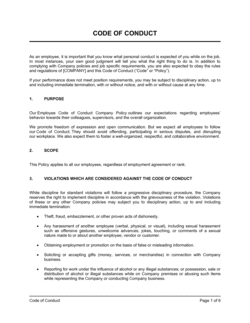
A code of conduct covers the full range of professional behavior expectations β€” ethics, conflicts of interest, dress, and communication standards. A workplace violence prevention policy focuses specifically on physical threats, intimidation, and safety response. The code of conduct may reference the violence policy, but the two should remain separate documents because they trigger different investigation and response procedures.

vs Anti-Harassment Policy

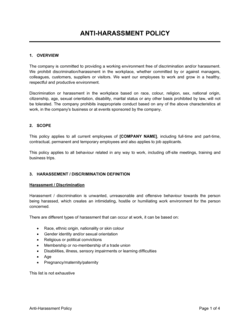
An anti-harassment policy addresses discriminatory conduct and hostile work environment based on protected characteristics β€” sex, race, religion, disability, and similar grounds. A workplace violence prevention policy addresses conduct that creates risk of physical harm, regardless of whether discrimination is a factor. Both policies are necessary; using one in place of the other leaves significant legal and safety gaps.

vs Emergency Action Plan

An emergency action plan covers the full spectrum of workplace emergencies β€” fire, natural disaster, chemical spill, and active threat. A workplace violence prevention policy focuses on prevention, reporting, and investigation of violence-related threats and incidents. The emergency action plan should reference the violence policy for active-threat scenarios, but operates as a separate operational document with its own OSHA compliance requirements.

vs Disciplinary Action Policy

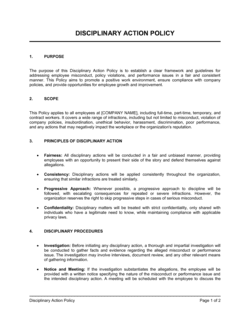
A disciplinary action policy defines the progressive steps β€” verbal warning, written warning, suspension, termination β€” applied to performance and conduct violations generally. A workplace violence prevention policy specifies that serious threats and violent acts may bypass progressive steps and result in immediate termination or law enforcement referral. Cross-reference the two policies to ensure consistency, but keep them separate for clarity.

Industry-specific considerations

Healthcare

Patient-initiated violence (Type II) is the leading category; policies must address restraint protocols, security staffing ratios, and staff debriefing procedures after violent patient encounters.

Retail and Hospitality

High-volume public contact creates elevated robbery and customer aggression risk; policies should address cash-handling security, lone-worker protocols, and after-hours closing procedures.

Education

Campus policies must coordinate with local law enforcement, address student threat assessment alongside employee conduct, and align with state-specific school safety mandates.

Financial Services

Branch robbery prevention, access control for secure areas, and domestic violence awareness training are the most operationally relevant elements for banks and credit unions.

Template vs pro β€” what fits your needs?

PathBest forCostTime
Use the templateSmall to mid-size employers in standard industries without elevated violence risk or state-specific mandatesFree2–4 hours to customize and distribute
Template + professional reviewHealthcare employers, organizations in California, New York, or New Jersey, or businesses that have experienced a recent incident$300–$800 for an HR consultant or employment attorney review3–5 business days
Custom draftedLarge employers, high-risk industries (corrections, emergency services, psychiatric care), or organizations subject to union agreements and collective bargaining$1,500–$5,000+2–4 weeks

Glossary

Workplace Violence
Any act or threat of physical violence, harassment, intimidation, or other threatening disruptive behavior occurring at the worksite or in connection with work duties.
Type I Violence
Violence committed by an external perpetrator β€” typically a robbery or criminal act β€” with no legitimate relationship to the workplace.
Type II Violence
Violence directed at employees by customers, clients, patients, or members of the public they serve in the course of their work.
Type III Violence
Violence between current or former co-workers, including supervisors and subordinates β€” the most common category in office and service environments.
Type IV Violence
Violence in the workplace connected to a personal relationship, such as domestic violence that extends into the work setting.
Threat Assessment Team
A cross-functional group β€” typically including HR, security, legal, and management β€” responsible for evaluating reported threats and determining the appropriate response level.
Zero-Tolerance Policy
An organizational standard that treats any act of workplace violence or credible threat as a policy violation subject to disciplinary action up to and including termination, regardless of severity.
Non-Retaliation Protection
A policy provision that prohibits adverse action against any employee who reports a threat, incident, or concern in good faith.
OSHA General Duty Clause
Section 5(a)(1) of the US Occupational Safety and Health Act, which requires employers to provide a workplace free from recognized hazards likely to cause death or serious physical harm.
Behavioral Threat Assessment
A structured process for evaluating whether an individual's observable behavior, statements, or actions indicate a credible risk of violence.

Part of your Business Operating System

This document is one of 3,000+ business & legal templates included in Business in a Box.

  • Fill-in-the-blanks β€” ready in minutes
  • 100% customizable Word document
  • Compatible with all office suites
  • Export to PDF and share electronically

Create your document in 3 simple steps.

From template to signed document β€” all inside one Business Operating System.
1
Download or open template

Access over 3,000+ business and legal templates for any business task, project or initiative.

2
Edit and fill in the blanks with AI

Customize your ready-made business document template and save it in the cloud.

3
Save, Share, Send, Sign

Share your files and folders with your team. Create a space of seamless collaboration.

Save time, save money, and create top-quality documents.

β˜…β˜…β˜…β˜…β˜…

"Fantastic value! I'm not sure how I'd do without it. It's worth its weight in gold and paid back for itself many times."

Managing Director Β· Mall Farm
Robert Whalley
Managing Director, Mall Farm Proprietary Limited
β˜…β˜…β˜…β˜…β˜…

"I have been using Business in a Box for years. It has been the most useful source of templates I have encountered. I recommend it to anyone."

Business Owner Β· 4+ years
Dr Michael John Freestone
Business Owner
β˜…β˜…β˜…β˜…β˜…

"It has been a life saver so many times I have lost count. Business in a Box has saved me so much time and as you know, time is money."

Owner Β· Upstate Web
David G. Moore Jr.
Owner, Upstate Web

Run your business with a system β€” not scattered tools

Stop downloading documents. Start operating with clarity. Business in a Box gives you the Business Operating System used by over 250,000 companies worldwide to structure, run, and grow their business.

Start freeΒ Β·Β No credit card required