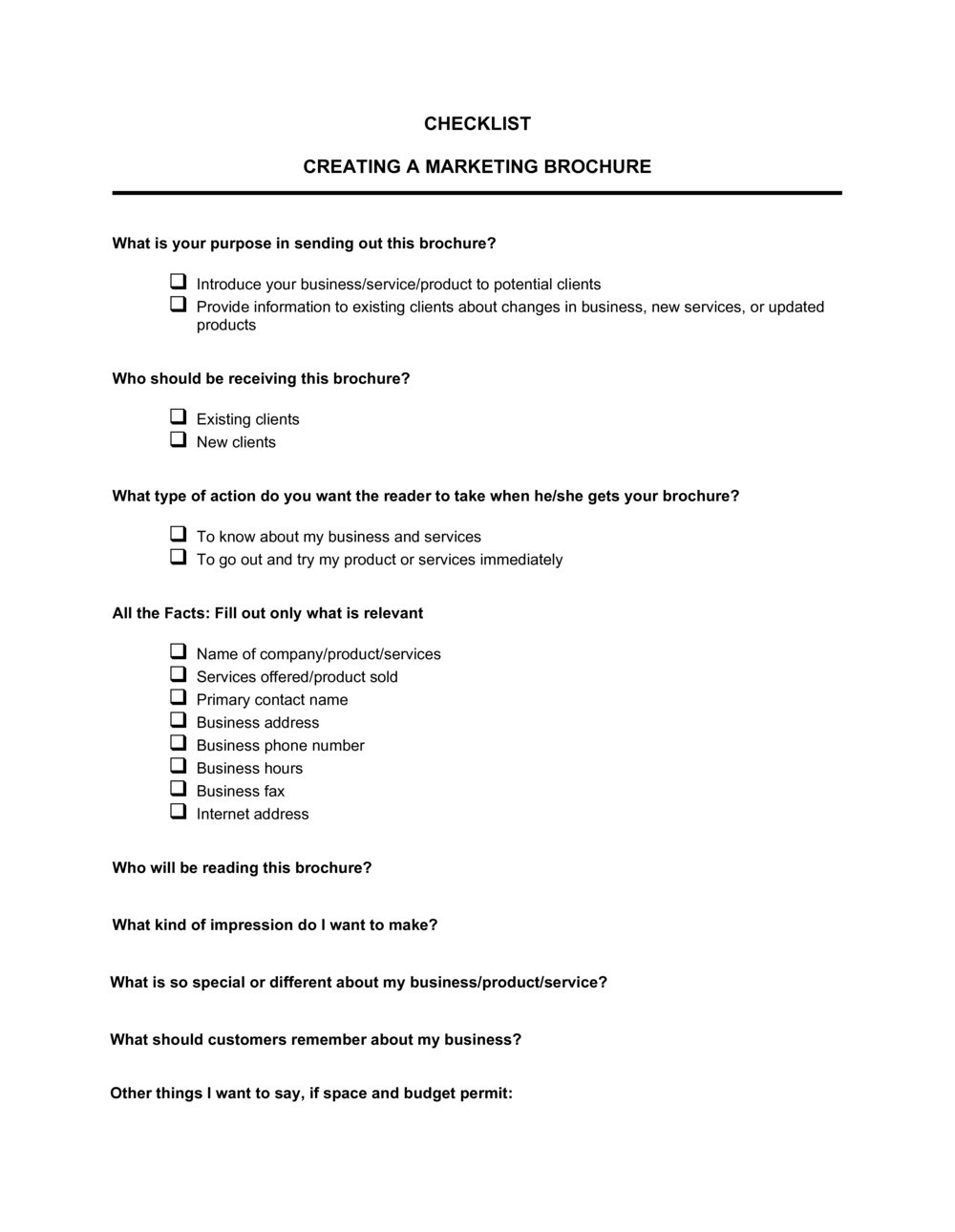
Creating a Marketing Brochure Template

Free to read β€’ Save or share with one click

FreeCreating a Marketing Brochure Template

At a glance

What it is
A Marketing Brochure is a structured promotional document that presents a company's products, services, or brand to a target audience in a concise, visually organized format. This free Word download gives you a ready-to-edit framework covering headline messaging, product or service descriptions, benefits, proof points, and a call to action β€” exportable as PDF for print or digital distribution.
When you need it
Use it when launching a new product or service, attending a trade show or sales meeting, equipping a sales team with leave-behind materials, or updating your company's promotional collateral for a new campaign or market.
What's inside
A headline and tagline block, company or product overview, key benefits and features, supporting proof points such as testimonials or statistics, a clear call to action, and contact and social media details β€” organized into a print-ready or digital-ready layout you can adapt to any fold format.

What is a Marketing Brochure?

A Marketing Brochure is a structured promotional document that presents a company's products, services, or brand story to a defined target audience in a format designed to be read in under two minutes. Unlike a full proposal or report, a brochure distills the most persuasive elements of an offer β€” the core customer benefit, supporting proof points, and a direct call to action β€” into a compact, visually organized layout suitable for print distribution, digital download, or email attachment. The format follows a deliberate narrative sequence: capture attention with the headline, build credibility with benefits and proof, and convert with a single clear next step.

Why You Need This Document

Without a professionally structured brochure, sales conversations rely entirely on verbal explanations that prospects forget, inconsistent elevator pitches that vary by rep, and follow-up emails that get lost in crowded inboxes. A well-crafted brochure gives every prospect the same high-quality first impression regardless of who handed it to them. Trade show leads who receive a brochure are significantly more likely to follow up than those who receive only a business card. For regulated industries such as healthcare and financial services, a documented, reviewed brochure also reduces the risk of inadvertent compliance violations from off-the-cuff verbal claims. This template gives you the structure to build a brochure that communicates your value proposition clearly, withstands a compliance review, and works as a standalone sales tool from the moment it leaves your hands.

Which variant fits your situation?

If your situation is…Use this template
Promoting a single product with technical specificationsProduct Data Sheet
Introducing the company and its full service rangeCompany Profile Brochure
Presenting a proposal to a specific prospective clientBusiness Proposal
Summarizing a nonprofit's programs for donor outreachNonprofit Brochure
Creating a one-page overview for trade show distributionOne-Page Company Overview
Providing a visual product catalog for wholesale buyersProduct Catalog Template
Outlining a consulting or professional services offeringServices Brochure

Common mistakes to avoid

❌ Leading with company history instead of customer benefit

Why it matters: Readers decide within three seconds whether to keep reading. An opening paragraph about founding year and office locations gives them no reason to continue.

Fix: Open with the problem the customer faces or the outcome they want, then introduce the company as the solution in the second paragraph.

❌ Using unattributed or vague testimonials

Why it matters: A quote from 'a satisfied customer' or 'John D.' carries no credibility. Skeptical readers assume the testimonial is fabricated.

Fix: Obtain written permission to use each testimonial with the person's full name, job title, and company name. Specific results in the quote β€” '30% faster,' '$12,000 saved' β€” dramatically increase trust.

❌ Including multiple competing calls to action

Why it matters: When readers are asked to call, email, visit a website, and follow on social media simultaneously, they typically do none of the above.

Fix: Choose one primary CTA aligned to where the prospect is in the buying journey. A trade show brochure should drive a demo booking; a direct-mail piece should drive a URL visit.

❌ Ignoring print production requirements

Why it matters: A brochure designed entirely on screen without accounting for bleed, trim marks, and CMYK color conversion often prints with white borders, color shifts, or clipped content.

Fix: Set up the document at print dimensions with 3mm bleed on all sides, convert colors to CMYK before export, and request a printer proof before approving the full run.

❌ Overloading the brochure with text

Why it matters: Dense paragraphs signal effort to read, which most prospects will not invest at a first-contact touchpoint. Key messages get buried and the reader disengages.

Fix: Target a maximum of 250–350 words of body copy for a standard tri-fold. Use bullet points, subheadings, and white space to make the document scannable in under 30 seconds.

❌ Using low-resolution or unlicensed images

Why it matters: Pixelated images at print size undermine the professional impression the brochure is supposed to create. Using unlicensed stock photography exposes the business to copyright claims.

Fix: Source images at a minimum of 300 DPI at print size from a licensed stock library such as Shutterstock or Adobe Stock, and retain the license receipt for each image used.

The 10 key clauses, explained

Headline and tagline block

In plain language: The opening panel's primary text β€” a benefit-driven headline that states the core offer and a supporting tagline that reinforces brand identity.

Sample language
Headline: 'Cut Your [PROCESS] Time in Half.' Tagline: '[COMPANY NAME] β€” [BRAND PROMISE].'

Common mistake: Writing a headline that names the company rather than the customer benefit. Readers scan for what is in it for them, not who made it.

Company or product overview

In plain language: A 40–80 word description of what the company or product is, who it serves, and what problem it solves β€” written for a reader who has never heard of the brand.

Sample language
[COMPANY NAME] helps [TARGET CUSTOMER] to [ACHIEVE OUTCOME] by providing [PRODUCT/SERVICE DESCRIPTION]. Founded in [YEAR], we serve [NUMBER] clients across [GEOGRAPHY/INDUSTRY].

Common mistake: Opening with founding history or company size instead of the customer problem. Readers abandon the brochure if the first paragraph is about the seller, not the buyer.

Key benefits section

In plain language: A structured list of three to five specific outcomes or advantages the customer gains β€” written as benefits, not features.

Sample language
Benefit 1: [SPECIFIC OUTCOME β€” e.g., 'Reduce invoice processing time by 40%']. Benefit 2: [OUTCOME]. Benefit 3: [OUTCOME].

Common mistake: Listing technical features instead of customer outcomes. 'AI-powered processing' is a feature; 'invoices approved in under 2 hours' is a benefit.

Features or specifications block

In plain language: For product brochures, a concise table or bulleted list of technical specifications, included after benefits have been established.

Sample language
[PRODUCT NAME] Specifications: [SPEC 1] | [SPEC 2] | [SPEC 3]. Compatible with [PLATFORM/SYSTEM]. Available in [OPTIONS/CONFIGURATIONS].

Common mistake: Leading with specifications before benefits. Technical buyers still need to know why the specs matter to them before they will read the detail.

Proof points and social proof

In plain language: Testimonials, case study results, client logos, awards, or statistics that give a skeptical reader independent evidence the claims are true.

Sample language
'[COMPANY NAME] saved us $[X] in the first 90 days.' β€” [CLIENT NAME], [TITLE], [CLIENT COMPANY]. Rated [X]/5 by [NUMBER] customers on [PLATFORM].

Common mistake: Using unattributed quotes such as 'Our clients love us.' An unnamed testimonial has zero credibility β€” always include the person's name, title, and company.

Offer or pricing summary

In plain language: An optional section stating the pricing structure, package tiers, or a limited-time offer β€” enough to anchor expectations without replacing a full sales conversation.

Sample language
Starting at $[PRICE]/month. [PACKAGE NAME]: $[PRICE] β€” includes [FEATURES]. [PACKAGE NAME]: $[PRICE] β€” includes [FEATURES]. All plans include [GUARANTEE/FEATURE].

Common mistake: Including a price with no context for the value delivered alongside it. An unanchored price looks expensive; a price next to a specific outcome looks reasonable.

Call to action

In plain language: A single, direct instruction telling the reader exactly what to do next β€” visit a URL, call a number, scan a QR code, or book a meeting.

Sample language
Ready to [ACHIEVE OUTCOME]? Visit [URL] or call [PHONE NUMBER] to schedule a free [DEMO/CONSULTATION/ASSESSMENT] today.

Common mistake: Including three or four CTAs β€” 'Call us, email us, visit our website, or find us on LinkedIn.' Multiple competing actions dilute response rates. Choose one primary CTA.

Contact and social media details

In plain language: The company's website, phone number, email address, and relevant social handles β€” grouped in a consistent format so the reader can act immediately.

Sample language
[COMPANY NAME] | [WEBSITE URL] | [PHONE NUMBER] | [EMAIL ADDRESS] | [LINKEDIN / INSTAGRAM / TWITTER HANDLE]

Common mistake: Listing a general company email such as info@ instead of a named contact or dedicated response address. Generic inboxes have lower response rates and create accountability gaps.

Logo and visual identity elements

In plain language: Placement instructions for the company logo, brand colors, and approved imagery β€” ensuring the finished brochure is consistent with all other brand materials.

Sample language
Logo placement: top-left of front panel. Primary brand color: [HEX CODE]. Secondary color: [HEX CODE]. Body font: [FONT NAME] at [SIZE]pt.

Common mistake: Stretching or recoloring the logo to fit the layout. A distorted or off-brand logo signals unprofessionalism to prospects who have never encountered the brand before.

Legal and compliance notices

In plain language: Any required disclaimers, trademark symbols, copyright notices, or regulatory statements β€” particularly relevant for financial services, healthcare, and food and beverage companies.

Sample language
Β© [YEAR] [COMPANY NAME]. All rights reserved. [TRADEMARK SYMBOL][PRODUCT NAME] is a registered trademark of [COMPANY NAME]. [REGULATORY DISCLAIMER IF APPLICABLE].

Common mistake: Omitting a copyright notice on a brochure containing proprietary content or imagery. Without it, enforcing IP rights against unauthorized reproduction is more difficult.

How to fill it out

  1. 1

    Define your audience and single key message

    Before writing any copy, name the specific audience segment this brochure targets and write one sentence summarizing the single most important thing they should take away. Every section should support that sentence.

    πŸ’‘ If the brochure is trying to speak to everyone, it will resonate with no one. A brochure aimed at 'mid-size law firms with 10–50 attorneys' outperforms one aimed at 'businesses.'

  2. 2

    Write the headline last, not first

    Draft the overview, benefits, and proof points first. Once the full message is clear, compress the strongest benefit into a headline of ten words or fewer.

    πŸ’‘ Test your headline by reading it aloud to someone unfamiliar with the product. If they cannot tell you what the product does after hearing it, rewrite it.

  3. 3

    Fill in the company or product overview

    Write 40–80 words covering who the product is for, what problem it solves, and what makes it different. Use plain language β€” avoid internal jargon or industry acronyms your target audience may not know.

    πŸ’‘ Read the overview to a potential customer before finalizing it. If they ask 'but what does it actually do?', you need to be more specific.

  4. 4

    List three to five benefits in outcome language

    For each feature or capability, ask 'so what does this mean for the customer?' and write the answer. Each benefit should describe a measurable or tangible result.

    πŸ’‘ Quantify wherever possible β€” 'reduces onboarding time by 3 days' is more persuasive than 'speeds up onboarding.'

  5. 5

    Add at least two proof points with full attribution

    Include one or two testimonials with the speaker's name, title, and company; or a case study result with a specific metric. If you have an industry award or certification, include it here.

    πŸ’‘ A single well-attributed testimonial with a specific dollar or time result outweighs five generic positive quotes.

  6. 6

    Set one clear call to action

    Choose the single most important action you want the reader to take and make it prominent. Include the URL, phone number, or QR code directly in the CTA block β€” do not make the reader search for contact details.

    πŸ’‘ Add a time-bound incentive to the CTA if appropriate β€” 'Book by [DATE] and receive a free [ITEM]' consistently improves response rates.

  7. 7

    Insert brand assets and check visual consistency

    Place the logo in its approved position, apply the correct brand colors using HEX codes, and confirm all imagery is licensed for commercial use. Export a proof PDF and review it at actual print size before distributing.

    πŸ’‘ Print one physical copy before finalizing the print run. Color accuracy on screen differs from printed output, and text that reads clearly on a monitor can become too small to read at 10pt in print.

  8. 8

    Add legal notices and export

    Insert the copyright line, any required trademark symbols, and industry-specific disclaimers in the footer. Save the final version as a press-quality PDF at 300 DPI for print or a compressed PDF for digital distribution.

    πŸ’‘ Create two separate export profiles β€” one high-resolution PDF for the printer and one compressed PDF (under 5 MB) for email and web. Sending a 25 MB file by email is a common and avoidable error.

Frequently asked questions

What is a marketing brochure?

A marketing brochure is a printed or digital promotional document that presents a company's products, services, or brand to a target audience in a structured, visually organized format. It typically covers a headline message, key benefits, proof points, and a call to action β€” condensed into a format designed to be read in under two minutes. Brochures are used as trade show handouts, direct-mail pieces, sales leave-behinds, and digital downloads.

What should a marketing brochure include?

A complete marketing brochure includes a benefit-driven headline and tagline, a concise company or product overview, three to five specific customer benefits, supporting proof points such as testimonials or statistics, a pricing summary if applicable, one clear call to action, and full contact details. Legal notices such as copyright lines and trademarks belong in the footer.

What is the best format for a marketing brochure?

The tri-fold (six-panel) format is the most common for print because it fits a standard #10 mailing envelope, presents well at trade shows, and provides enough space for a structured narrative. Bi-fold formats suit product catalogs or data-heavy content. For digital distribution, a single-page PDF or a multi-page digital brochure with clickable links is more practical than a folded print layout.

How long should a marketing brochure be?

A tri-fold brochure should contain 250–350 words of body copy β€” enough to communicate the offer clearly without overwhelming a reader who is scanning, not studying. A multi-page product or company brochure can run 4–12 pages but should still lead with benefits and proof before expanding into detail. Every additional page must earn its place by answering a question the reader is likely to have.

What is the difference between a marketing brochure and a flyer?

A flyer is typically a single-sided, single-page sheet designed for quick, high-volume distribution β€” event announcements, promotions, and awareness campaigns. A brochure is a folded, multi-panel document that tells a more complete story about a product, service, or company. Flyers drive immediate action around a specific event or offer; brochures build understanding and support a longer consideration process.

Can I use a Word template to create a print-ready brochure?

Yes. A Word template is a practical starting point for most small business brochures. For professional print runs, export the final document as a PDF at the highest available quality setting. If your printer requires specific bleed, trim, or color profile settings, ask them for their file specifications before exporting. For high-volume or premium print jobs, a graphic designer using Adobe InDesign will produce a more precise result.

How do I make a marketing brochure stand out?

Focus on three things: one specific, clearly stated customer benefit in the headline, at least one attributed testimonial with a measurable result, and a single prominent call to action. Visually, consistent use of brand colors, ample white space, and high-resolution imagery does more for professional appearance than complex design elements. Brochures that try to communicate everything rarely communicate anything clearly.

What resolution should images be in a printed brochure?

Images in a printed brochure must be at least 300 DPI (dots per inch) at the final print size. An image that looks sharp on screen at 72–96 DPI will appear pixelated when printed at the same physical dimensions. Always request high-resolution files from your photographer or download the largest available size from your stock image library before placing images in the template.

How this compares to alternatives

vs Company Profile

A company profile is a comprehensive document covering the organization's history, leadership, financials, and full service range β€” typically 8–20 pages. A marketing brochure is a focused, short-form sales tool targeting a specific audience with a specific offer. Use the company profile for formal introductions to investors, partners, or enterprise clients; use the brochure for prospect-facing sales situations.

vs Business Proposal

A business proposal is addressed to a specific prospect and outlines a tailored solution, scope, timeline, and pricing in response to an identified need. A marketing brochure is a generic, audience-targeted document distributed broadly. The brochure generates interest; the proposal converts it. Use the brochure at awareness and consideration stages; send the proposal when the prospect has expressed buying intent.

vs Product Data Sheet

A product data sheet is a single-page technical reference listing specifications, compatibility, regulatory certifications, and performance data. It is written for a technical evaluator, not a general buyer. A marketing brochure leads with benefits and proof points for a broader audience. Use the data sheet in procurement and engineering conversations; use the brochure for initial sales outreach and awareness campaigns.

vs Sales Presentation

A sales presentation is a slide-based document delivered verbally in a meeting, designed to walk a prospect through a structured pitch with the presenter present to answer questions. A marketing brochure is a standalone document that must communicate without a presenter. Use the presentation for scheduled discovery or demo calls; use the brochure as a pre-meeting primer or post-meeting leave-behind.

Industry-specific considerations

Professional Services

Law firms, consultancies, and accountancies use brochures to explain service lines and credentials to prospective clients at referral meetings and networking events.

Healthcare and Wellness

Medical practices, clinics, and wellness brands use brochures in waiting rooms and health fairs to explain procedures, treatments, or programs β€” with required regulatory disclaimers in the footer.

Real Estate

Agents and developers use property brochures as leave-behinds at open houses and listings presentations, featuring floor plans, pricing tiers, and neighborhood highlights.

Retail and E-commerce

Retailers include product brochures with orders or at point of sale to drive cross-sells, communicate brand values, and provide care or usage instructions.

Education and Training

Schools, training providers, and online course platforms use brochures at enrollment fairs and in direct-mail campaigns to present program benefits, outcomes, and enrollment steps.

Manufacturing and Industrial

Manufacturers use product brochures at trade shows and with distributor networks to present specifications, certifications, and application use cases for technical buyers.

Jurisdictional notes

United States

The FTC regulates advertising claims under Section 5 of the FTC Act β€” all claims must be truthful, non-deceptive, and substantiated. Health and wellness claims are subject to FDA oversight; financial product marketing must comply with SEC or FINRA rules. State consumer protection laws such as California's CLRA add additional requirements for comparative advertising.

Canada

The Competition Act prohibits misleading advertising and requires that promotional claims be accurate and verifiable. In Quebec, all marketing materials distributed to consumers must be available in French under the Charter of the French Language. Health products marketed in Canada are regulated by Health Canada and require pre-approved claims for natural health products and pharmaceuticals.

United Kingdom

The Advertising Standards Authority (ASA) enforces the UK Code of Non-broadcast Advertising (CAP Code), which requires that all marketing claims be legal, decent, honest, and truthful. Comparative advertising is permitted but must not mislead or discredit competitors. Financial promotions must be approved by an FCA-authorized person before distribution.

European Union

The EU Unfair Commercial Practices Directive prohibits misleading and aggressive marketing across all member states. GDPR applies to digital brochures that collect personal data via embedded forms or tracking links. The EU Green Claims Directive, expected to take effect in 2026, will require substantiation for any environmental or sustainability claims made in marketing materials.

Template vs lawyer β€” what fits your deal?

PathBest forCostTime
Use the templateSmall businesses and solo marketers creating brochures for general product or service promotionFree2–4 hours
Template + legal reviewCompanies in regulated industries or those making specific performance or comparative claims$200–$800 for a marketing compliance or legal review1–3 days
Custom draftedEnterprise brands, highly regulated sectors such as financial services or healthcare, or campaigns with significant print budgets where errors are costly$1,000–$5,000+ for a copywriter, designer, and compliance review1–3 weeks

Glossary

Value Proposition
A concise statement of the specific benefit a product or service delivers to a defined customer, and why it is preferable to alternatives.
Call to Action (CTA)
A direct instruction to the reader specifying the next step β€” call, visit a URL, scan a QR code, or book a meeting.
Headline
The single most prominent piece of text on the brochure, designed to capture attention and communicate the core offer in under ten words.
Tagline
A short, memorable phrase that reinforces brand identity and is typically displayed beneath the company name or logo.
Proof Point
A specific, verifiable claim β€” a statistic, client testimonial, case study result, or award β€” that supports the brochure's core message.
Fold Format
The physical layout of a printed brochure, such as bi-fold (4 panels), tri-fold (6 panels), or Z-fold, which determines how content is sequenced.
Bleed
In print design, the extension of background color or images beyond the trim edge to ensure no white border appears after cutting.
White Space
Intentional empty space around text and images that improves readability, reduces visual clutter, and makes key messages stand out.
Brand Consistency
The practice of using the same logo, color palette, typography, and tone of voice across all marketing materials so audiences recognize the brand instantly.
Digital Brochure
A PDF or interactive version of a brochure distributed by email or download link rather than in print, often including clickable links and embedded video.

Part of your Business Operating System

This document is one of 3,000+ business & legal templates included in Business in a Box.

  • Fill-in-the-blanks β€” ready in minutes
  • Compatible with all office suites
  • Export to PDF and share electronically

Create your document in 3 simple steps.

From template to signed document β€” all inside one Business Operating System.
1
Download or open template

Access over 3,000+ business and legal templates for any business task, project or initiative.

2
Edit and fill in the blanks with AI

Customize your ready-made business document template and save it in the cloud.

3
Save, Share, Send, Sign

Share your files and folders with your team. Create a space of seamless collaboration.

Save time, save money, and create top-quality documents.

β˜…β˜…β˜…β˜…β˜…

"Fantastic value! I'm not sure how I'd do without it. It's worth its weight in gold and paid back for itself many times."

Managing Director Β· Mall Farm
Robert Whalley
Managing Director, Mall Farm Proprietary Limited
β˜…β˜…β˜…β˜…β˜…

"I have been using Business in a Box for years. It has been the most useful source of templates I have encountered. I recommend it to anyone."

Business Owner Β· 4+ years
Dr Michael John Freestone
Business Owner
β˜…β˜…β˜…β˜…β˜…

"It has been a life saver so many times I have lost count. Business in a Box has saved me so much time and as you know, time is money."

Owner Β· Upstate Web
David G. Moore Jr.
Owner, Upstate Web

Run your business with a system β€” not scattered tools

Stop downloading documents. Start operating with clarity. Business in a Box gives you the Business Operating System used by over 250,000 companies worldwide to structure, run, and grow their business.

Free Forever PlanΒ Β·Β No credit card required