Diversity Equity and Inclusion Policy Template

Free Word download β€’ Edit online β€’ Save & share with Drive β€’ Export to PDF

5 pagesβ€’25–35 min to fillβ€’Difficulty: Complex
Learn more ↓
FreeDiversity Equity and Inclusion Policy Template

At a glance

What it is
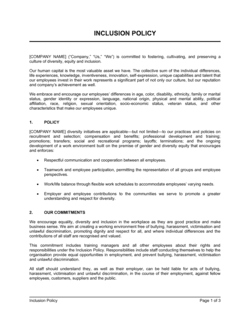
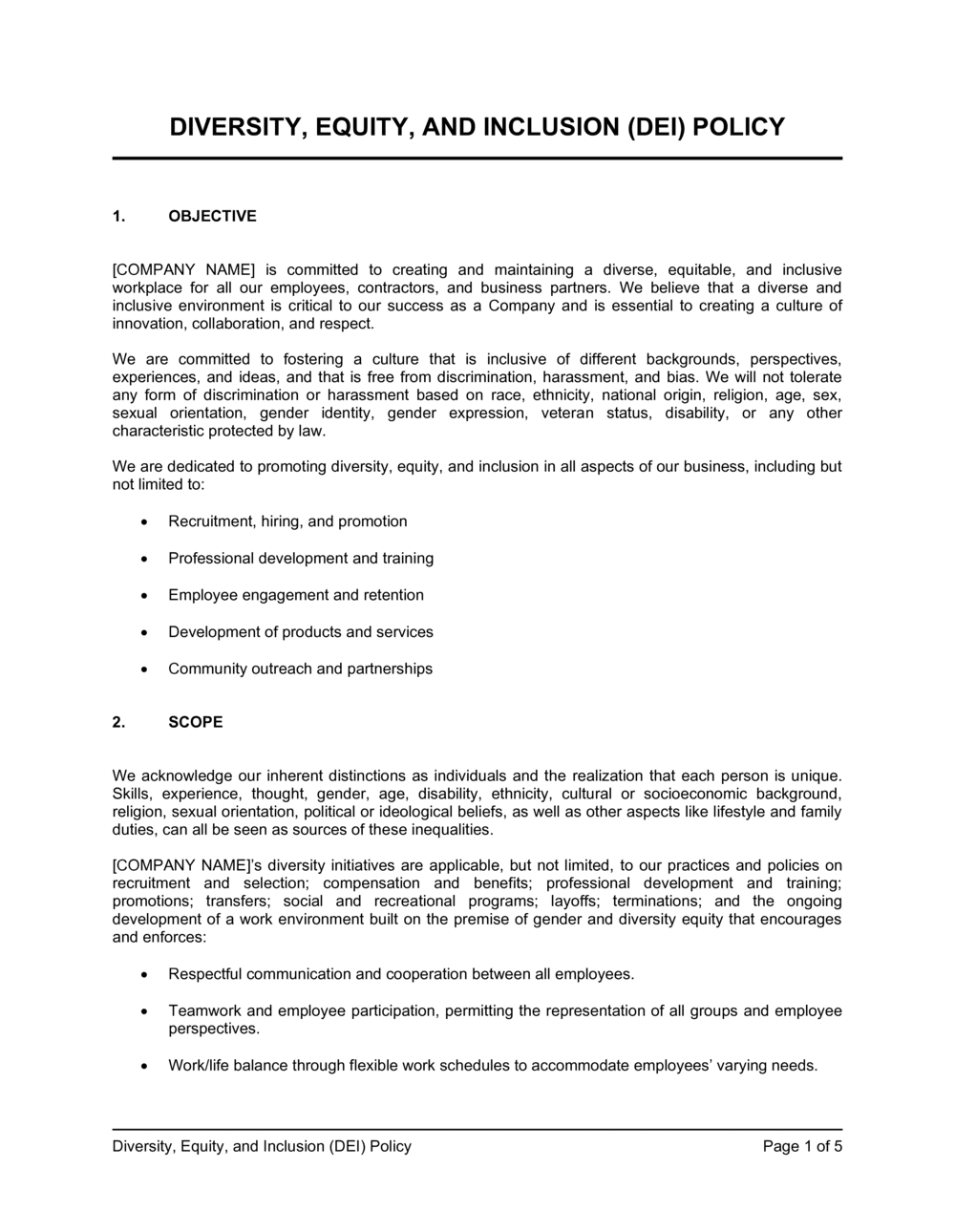
A Diversity, Equity, and Inclusion (DEI) Policy is a formal written document that defines an organization's commitments, expectations, and procedures for creating a workplace where every employee is treated fairly and can contribute fully regardless of background. This free Word download gives you a structured, ready-to-edit template you can tailor to your organization's size, industry, and goals, then export as PDF for distribution to employees and stakeholders.
When you need it
Use it when onboarding new employees, updating your employee handbook, responding to regulatory or investor inquiries about workplace practices, or after a workforce assessment reveals gaps in representation or inclusion. It is also commonly required by enterprise clients, government contractors, and grant-making bodies as a condition of doing business.
What's inside
The template covers a policy statement and scope, definitions of diversity, equity, and inclusion, equal opportunity commitments, anti-harassment and anti-discrimination provisions, accommodation procedures, recruitment and hiring practices, employee training requirements, reporting and accountability mechanisms, and a review schedule.

What is a Diversity Equity and Inclusion Policy?

A Diversity, Equity, and Inclusion (DEI) Policy is a formal organizational document that defines a company's commitments, standards, and procedures for building a workplace where every employee β€” regardless of race, gender, age, disability, religion, sexual orientation, or other protected characteristic β€” is treated fairly and has a genuine opportunity to contribute and advance. It goes beyond a general equal-opportunity statement by specifying the processes the organization uses to uphold those commitments: how accommodation requests are handled, how complaints are investigated, what training is required, and how progress is measured and reported.

Why You Need This Document

Without a written DEI policy, your organization has no documented standard against which employment decisions can be evaluated β€” leaving you exposed when a discrimination or harassment complaint is filed and a regulator or court asks what procedures were in place. Enterprise clients, government contracting officers, and institutional investors increasingly require documented DEI policies as a condition of doing business, and the absence of one can disqualify you from contracts and funding rounds before a conversation begins. Internally, employees in organizations with no written inclusion standard report lower psychological safety and higher turnover β€” two costs that are immediately measurable on your P&L. This template gives you a complete, structured starting point that you can customize to your jurisdiction and workforce in a few hours, establishing a credible foundation before your next hire, audit, or client RFP.

Which variant fits your situation?

If your situation is…Use this template
Standalone policy distributed to all employeesDiversity Equity and Inclusion Policy
Embedding DEI commitments inside a broader employee handbookEmployee Handbook
Documenting a multi-year DEI action plan with measurable targetsDiversity and Inclusion Plan
Addressing workplace harassment and discrimination specificallyAnti-Harassment Policy
Meeting government contractor equal-opportunity obligationsAffirmative Action Plan
Communicating DEI values to external stakeholders and clientsCorporate Social Responsibility Report
Training new employees on workplace inclusion expectationsDEI Training Acknowledgment Form

Common mistakes to avoid

❌ Using aspirational language with no enforceable commitments

Why it matters: A policy that says 'we value diversity' without specifying processes, timelines, or consequences provides no legal protection and no operational guidance β€” employees and regulators treat it as decoration.

Fix: Replace every value statement with a concrete procedure: who is responsible, what the timeline is, and what happens if the standard is not met.

❌ Omitting state and local protected characteristics

Why it matters: Federal law covers a baseline set of protected classes, but many states and municipalities protect additional categories β€” sexual orientation, gender identity, marital status, or source of income β€” and employees can file complaints under those laws regardless of what your policy says.

Fix: Review the protected-class lists for every jurisdiction where you have employees before finalizing the policy, and update it whenever you expand to a new location.

❌ Routing all complaints through the direct manager

Why it matters: When the manager is the subject of a complaint β€” which is common β€” a single-channel process effectively has no route for the employee to use, leaving the organization exposed to retaliation claims.

Fix: Provide at least two independent reporting channels β€” a named HR contact and an anonymous option β€” and state explicitly that employees may bypass their manager when reporting concerns about that manager.

❌ Publishing the policy without a named review owner or schedule

Why it matters: Policies without an assigned owner and calendar review date become stale within 12–18 months. An outdated policy that references superseded laws or lacks recent statutory protections can actively increase legal risk.

Fix: Name a specific individual as policy owner and schedule the annual review in the HR calendar on the same day the policy is published.

The 10 key sections, explained

Policy statement and scope

Definitions

Equal opportunity commitment

Anti-harassment and anti-discrimination provisions

Accommodation procedures

Recruitment and hiring practices

Training and awareness

Reporting and investigation procedures

Accountability and metrics

Policy review and ownership

How to fill it out

  1. 1

    Define the scope and insert your legal entity name

    Replace all [COMPANY NAME] placeholders with your registered legal entity name. Specify in the scope section which worker categories and locations the policy covers.

    πŸ’‘ If you have operations in multiple jurisdictions with different protected-class lists, name each location explicitly in the scope rather than using a generic 'all locations' phrase.

  2. 2

    Review and expand the protected characteristics list

    Start with the federally protected classes in your primary jurisdiction, then add any additional characteristics protected under applicable state, provincial, or local law β€” such as sexual orientation, gender identity, or marital status.

    πŸ’‘ Cross-reference your jurisdiction's employment standards against the template list before distributing β€” a 15-minute check prevents significant legal exposure.

  3. 3

    Customize the accommodation request process

    Name the specific HR contact or role to whom accommodation requests should be directed, and set a concrete response timeline β€” typically 5–10 business days for an initial response.

    πŸ’‘ If your organization uses an HR information system (HRIS), link the accommodation request form directly in this section so employees know exactly where to start.

  4. 4

    Add concrete inclusive hiring commitments

    Replace the generic hiring-practice language with the specific process changes your organization will implement β€” structured interview rubrics, diverse panel requirements, or job-board distribution targets.

    πŸ’‘ Commitments that name a specific process (e.g., 'at least one interviewer from an underrepresented group on every panel') are significantly more likely to be followed than vague intent statements.

  5. 5

    Set mandatory training requirements and deadlines

    Specify which training modules are required, which are optional, the completion window for new hires, and the annual renewal cadence. Name the system used to track completion.

    πŸ’‘ Coordinate with your LMS or HR platform to automate enrollment so training compliance doesn't rely on manual follow-up.

  6. 6

    Configure the reporting channel and anti-retaliation language

    Insert the specific email address, hotline number, or HR portal link employees should use to report concerns. Confirm the investigation timeline and retaliation prohibition are clearly stated.

    πŸ’‘ If you don't yet have an anonymous reporting channel, a dedicated HR email address is sufficient for most small and mid-size organizations β€” add it before publishing the policy.

  7. 7

    Identify your DEI metrics and reporting cadence

    Select two to four measurable indicators β€” representation by level, promotion rate by demographic group, pay equity gap, inclusion survey score β€” and specify when and to whom results will be reported.

    πŸ’‘ Start with metrics you can actually pull from existing HR data today; aspirational metrics you cannot yet measure undermine credibility rather than demonstrating commitment.

  8. 8

    Name the policy owner and set the review date

    Assign the policy to a named individual (not a committee), enter the first review date β€” typically 12 months from publication β€” and add the intranet or handbook location where the current version will live.

    πŸ’‘ Calendar the review date immediately after publishing so it doesn't slip. An outdated DEI policy can create more legal exposure than no policy at all if it references laws that have since changed.

Frequently asked questions

What is a diversity equity and inclusion policy?

A diversity, equity, and inclusion (DEI) policy is a formal organizational document that defines commitments, standards, and procedures for creating a workplace free from discrimination and harassment where employees of all backgrounds can participate and advance. It typically covers equal opportunity hiring, anti-harassment provisions, accommodation procedures, training requirements, and accountability mechanisms. It is distinct from an affirmative action plan, which involves numerical goals and is required only for certain government contractors.

Is a DEI policy legally required?

In most jurisdictions, a standalone DEI policy is not legally mandated for private employers. However, anti-discrimination and anti-harassment policies are effectively required in practice β€” courts and regulatory bodies typically view the absence of a written policy as evidence of organizational negligence when a complaint is filed. US federal contractors above certain contract thresholds must maintain affirmative action programs. Some state and local laws require written harassment prevention policies for employers above a minimum employee count.

What is the difference between diversity, equity, and inclusion?

Diversity refers to the presence of differences β€” in race, gender, age, ability, religion, and other characteristics. Equity means tailoring resources and opportunities to individual needs so outcomes are fair, rather than treating everyone identically regardless of circumstance. Inclusion describes an environment where employees feel genuinely welcomed and able to contribute, not merely represented in headcount. All three are necessary: organizations can be diverse without being inclusive, and inclusive without achieving equitable outcomes.

Who should the DEI policy apply to?

The policy should cover all workers β€” full-time employees, part-time staff, temporary workers, contractors, interns, and volunteers β€” as well as applicants during the hiring process. Limiting the scope to full-time employees leaves significant gaps, since harassment and discrimination claims regularly involve contractors and temporary workers who interact daily with the permanent workforce.

How often should a DEI policy be reviewed?

Annual review is the standard, with an additional review triggered by any significant change in applicable law, a material expansion into a new jurisdiction, a workforce restructuring, or a formal DEI audit finding. Employment law in this area changes frequently β€” protected classes are added by statute and court interpretation regularly β€” so a policy that is more than 18 months old without review should be treated as potentially out of date.

What metrics should we track to measure DEI progress?

Start with metrics your HR system can produce today: representation by gender and race or ethnicity at each level, promotion rates broken down by demographic group, voluntary and involuntary turnover by group, and the results of an annual inclusion survey. Pay equity analysis β€” comparing compensation for equivalent roles across demographic groups β€” is increasingly expected by investors and enterprise clients and should be added as soon as you have sufficient headcount to produce statistically meaningful results.

Can a small business use this DEI policy template?

Yes. The template is designed to scale from organizations with 10 employees to those with several hundred. For very small teams, simplify the reporting channel section to a named HR contact rather than a hotline, and set the training requirement to an annual 1-hour session rather than a multi-module program. The core commitments β€” equal opportunity, anti-harassment, accommodation, and accountability β€” are equally important regardless of company size.

Does a DEI policy need to be signed by employees?

The policy itself does not typically require individual signatures, but having employees acknowledge receipt and understanding β€” via a signed acknowledgment form or an electronic confirmation in your HRIS β€” creates a documentation record that protects the organization if a complaint later arises. Include an acknowledgment step in your onboarding process and again when the policy is materially updated.

What is the difference between a DEI policy and an affirmative action plan?

A DEI policy sets organizational values, prohibitions, and procedures that apply to all employees. An affirmative action plan (AAP) is a formal document required of US federal contractors that includes workforce utilization analysis, numerical placement goals for underrepresented groups, and action-oriented programs. AAPs are regulatory compliance documents with specific format requirements; DEI policies are internal governance documents. Companies subject to AAP requirements typically maintain both.

How this compares to alternatives

vs Employee Handbook

An employee handbook is a comprehensive reference document covering all workplace policies β€” compensation, leave, conduct, and benefits β€” in a single document. A DEI policy is a focused standalone document dedicated to inclusion, equity, and anti-discrimination commitments. Many organizations maintain both: the handbook references the DEI policy and incorporates it by link or appendix.

vs Anti-Harassment Policy

An anti-harassment policy addresses a specific subset of DEI β€” prohibited conduct, reporting procedures, and investigation processes for harassment and hostile work environment claims. A DEI policy is broader, also covering recruitment practices, accommodation, training, pay equity, and accountability metrics. Organizations in high-risk industries or jurisdictions that mandate written harassment policies often maintain both documents.

vs Code of Conduct

A code of conduct governs employee behavior broadly β€” integrity, conflicts of interest, confidentiality, and professionalism β€” across all workplace interactions. A DEI policy focuses specifically on equitable treatment and inclusion across protected characteristics. The code of conduct sets behavioral standards; the DEI policy sets equity and inclusion standards. Both are typically referenced in onboarding and the employee handbook.

vs Affirmative Action Plan

An affirmative action plan is a formal regulatory compliance document required of US federal contractors, containing workforce utilization analysis, numerical placement goals, and structured remediation programs. A DEI policy is an internal governance document with no mandatory format. Companies subject to AAP requirements need both: the AAP satisfies regulatory obligations; the DEI policy communicates organizational values and procedures to all employees.

Industry-specific considerations

Technology / SaaS

Tech companies face intense public scrutiny on gender and racial representation data; DEI policies are frequently reviewed by investors during due diligence and by enterprise clients in vendor qualification.

Professional Services

Law firms, consulting firms, and accounting practices tie DEI commitments to partner-track processes and client RFP requirements that increasingly mandate documented inclusion policies.

Healthcare

Healthcare organizations address both workforce inclusion and patient-facing equity, with DEI policies often required by hospital accreditation bodies and government payer contracts.

Manufacturing

Manufacturing employers focus on physical accessibility accommodations, multilingual communication of policy terms, and shift-schedule equity across demographic groups.

Retail / Hospitality

High-turnover environments require DEI training that can be delivered quickly to frontline staff; policies must address both back-of-house and customer-facing harassment scenarios.

Nonprofit

Grant-making foundations and government funders routinely require documented DEI policies as a condition of funding, and nonprofit boards increasingly treat inclusion metrics as a governance matter.

Template vs pro β€” what fits your needs?

PathBest forCostTime
Use the templateSmall to mid-size businesses establishing a written DEI commitment for the first timeFree2–4 hours to customize and publish
Template + professional reviewOrganizations expanding into new jurisdictions, undergoing investor due diligence, or responding to a formal DEI audit$300–$800 (HR consultant or employment attorney review)3–5 business days
Custom draftedUS federal contractors with AAP obligations, publicly traded companies, or organizations with 500+ employees across multiple jurisdictions$2,000–$8,000 (specialist DEI consultant or employment law firm)3–6 weeks

Glossary

Diversity
The presence of differences within a group β€” including race, gender, age, disability, religion, sexual orientation, national origin, and socioeconomic background.
Equity
The practice of tailoring support and resources to individual needs so every person has a fair opportunity to succeed, as distinct from treating everyone identically.
Inclusion
An environment where every employee feels welcomed, respected, and able to contribute fully β€” not just represented in headcount.
Protected Characteristic
A personal attribute β€” such as race, sex, age, disability, or religion β€” that employment law in most jurisdictions prohibits employers from using as a basis for employment decisions.
Reasonable Accommodation
A modification to a job, work environment, or the way work is performed that allows an employee with a disability or religious requirement to perform the essential functions of the role.
Affirmative Action
Proactive steps an employer takes to increase representation of underrepresented groups in hiring, promotion, and retention β€” required for US federal contractors above certain thresholds.
Unconscious Bias
Automatic, unintentional attitudes or stereotypes that influence decisions without the decision-maker's awareness β€” addressed through structured processes and awareness training.
Psychological Safety
The degree to which employees believe they can speak up, ask questions, or raise concerns without fear of ridicule, retaliation, or punishment.
Reporting Channel
A formal mechanism β€” such as a dedicated email address, hotline, or HR portal β€” through which employees can report DEI policy violations or concerns confidentially.
DEI Metrics
Quantitative measures used to track progress on diversity and inclusion goals β€” including representation rates by level, pay equity gaps, promotion rates, and inclusion survey scores.

Part of your Business Operating System

This document is one of 3,000+ business & legal templates included in Business in a Box.

  • Fill-in-the-blanks β€” ready in minutes
  • 100% customizable Word document
  • Compatible with all office suites
  • Export to PDF and share electronically

Create your document in 3 simple steps.

From template to signed document β€” all inside one Business Operating System.
1
Download or open template

Access over 3,000+ business and legal templates for any business task, project or initiative.

2
Edit and fill in the blanks with AI

Customize your ready-made business document template and save it in the cloud.

3
Save, Share, Send, Sign

Share your files and folders with your team. Create a space of seamless collaboration.

Save time, save money, and create top-quality documents.

β˜…β˜…β˜…β˜…β˜…

"Fantastic value! I'm not sure how I'd do without it. It's worth its weight in gold and paid back for itself many times."

Managing Director Β· Mall Farm
Robert Whalley
Managing Director, Mall Farm Proprietary Limited
β˜…β˜…β˜…β˜…β˜…

"I have been using Business in a Box for years. It has been the most useful source of templates I have encountered. I recommend it to anyone."

Business Owner Β· 4+ years
Dr Michael John Freestone
Business Owner
β˜…β˜…β˜…β˜…β˜…

"It has been a life saver so many times I have lost count. Business in a Box has saved me so much time and as you know, time is money."

Owner Β· Upstate Web
David G. Moore Jr.
Owner, Upstate Web

Run your business with a system β€” not scattered tools

Stop downloading documents. Start operating with clarity. Business in a Box gives you the Business Operating System used by over 250,000 companies worldwide to structure, run, and grow their business.

Start freeΒ Β·Β No credit card required