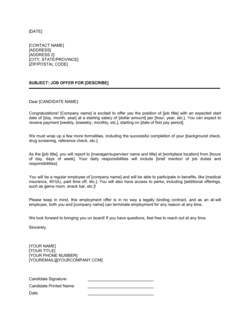
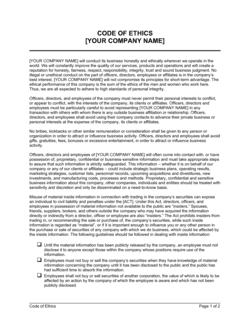
Employee Handbook Template

Free Word download β€’ Edit online β€’ Save & share with Drive β€’ Export to PDF

34 pagesβ€’35–45 min to fillβ€’Difficulty: Complex
Learn more ↓
FreeEmployee Handbook Template

At a glance

What it is
An Employee Handbook is a written policy document that communicates a company's rules, expectations, benefits, and culture to every employee from day one. This free Word download gives you a structured, editable starting point covering everything from attendance and conduct to PTO, disciplinary procedures, and workplace safety β€” ready to customize with your logo and policies and export as PDF.
When you need it
Use it when hiring your first employees, scaling past 10 staff where verbal policies break down, or when updating an outdated manual to reflect current law, remote-work norms, or changes to your benefits program.
What's inside
Welcome message and company mission, employment classification and at-will statement, compensation and benefits overview, code of conduct and anti-harassment policy, attendance and leave policies, performance and disciplinary procedures, technology and data use guidelines, and acknowledgment signature page.

What is an Employee Handbook?

An Employee Handbook is a written policy document that communicates a company's rules, expectations, benefits, and behavioral standards to every employee from the moment they are hired. It covers the full range of the employment relationship β€” classification and compensation, PTO and leave, conduct and anti-harassment standards, disciplinary procedures, technology use, and workplace safety β€” in a single reference document. Unlike an employment contract, which governs one individual's specific terms, a handbook applies equally to all employees and gives management a documented basis for consistent, defensible policy enforcement.

Why You Need This Document

Without a written handbook, every policy question becomes a conversation, every disciplinary action becomes a dispute, and every termination becomes a potential lawsuit. Managers at different locations or on different shifts apply rules inconsistently β€” and inconsistency in discipline is one of the most common triggers for discrimination and wrongful-termination claims. Many states require written notice of specific policies β€” paid sick leave, harassment reporting procedures, and safe-workplace rights among them β€” and a handbook is the most efficient way to satisfy all of those obligations at once. Beyond compliance, a well-written handbook accelerates onboarding by giving new hires a clear picture of how the company operates on day one. This template gives you a professionally structured, fully customizable starting point that covers every core section β€” so you spend your time tailoring policy to your business, not building the framework from scratch.

Which variant fits your situation?

If your situation is…Use this template
Small business with fewer than 15 employees needing a lean policy documentSmall Business Employee Handbook
Remote-first or hybrid team needing explicit work-from-home policiesRemote Work Policy Handbook
Company with hourly or shift-based workers requiring scheduling policiesHourly Employee Handbook
Technology company needing detailed acceptable-use and data-security policiesIT and Data Security Policy Manual
Healthcare or regulated-industry employer with compliance obligationsCompliance Policy Manual
Organization refreshing only the code of conduct sectionCode of Conduct Policy
Employer needing a standalone anti-harassment and discrimination policyAnti-Harassment Policy

Common mistakes to avoid

❌ Omitting the 'not a contract' disclaimer

Why it matters: Courts in several US states have ruled that handbook promises β€” including progressive discipline steps and termination procedures β€” constitute implied contracts, exposing employers to wrongful-termination claims.

Fix: Add a clear disclaimer on the first page and the acknowledgment page: 'This handbook is not an employment contract and does not create any contractual rights.'

❌ Copying benefit plan details into the handbook body

Why it matters: When benefit plans change β€” and they change annually β€” the handbook instantly becomes inaccurate, creating employee expectations the company no longer meets and potential ERISA exposure.

Fix: Reference benefit categories and eligibility dates only; direct employees to the current Summary Plan Description for all coverage details.

❌ Writing disciplinary steps as a guaranteed sequence

Why it matters: Language like 'the company will always proceed through four steps before termination' removes the employer's ability to terminate immediately for serious misconduct and has been used to support wrongful-termination suits.

Fix: Use permissive language: 'The company may use progressive discipline at its discretion. Serious misconduct may result in immediate termination at any stage.'

❌ Publishing without collecting signed acknowledgments

Why it matters: Without a signed acknowledgment, an employee can credibly claim they never received or agreed to the policies β€” making enforcement of conduct rules, confidentiality obligations, or termination procedures significantly harder.

Fix: Require every employee to sign and date the acknowledgment page before or on their first day, and re-collect signatures after each substantive handbook update.

❌ Using a generic protected-characteristics list without checking state law

Why it matters: Federal law protects nine categories; many states and cities protect additional characteristics such as source of income, sexual orientation, gender identity, or hairstyle. An incomplete list can leave the employer exposed to state-law discrimination claims.

Fix: Review the protected-characteristics list against the employment non-discrimination laws of every state and city where you have employees, and update the list accordingly.

❌ Never updating the handbook after the initial rollout

Why it matters: Employment law changes frequently β€” new leave mandates, updated FLSA thresholds, and state-specific requirements can make a two-year-old handbook non-compliant without any action on the employer's part.

Fix: Schedule an annual handbook review, assign ownership to an HR lead, and flag every section tied to a statutory requirement for a compliance check before each new fiscal year.

The 10 key sections, explained

Welcome and company overview

Employment classification and at-will statement

Compensation and payroll

Benefits overview

Code of conduct and workplace behavior

Attendance, hours, and leave policies

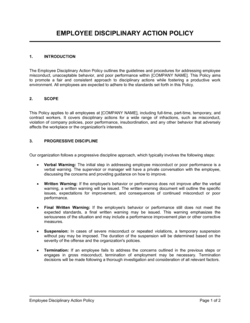
Performance management and disciplinary procedures

Technology, data, and social media use

Health, safety, and workplace security

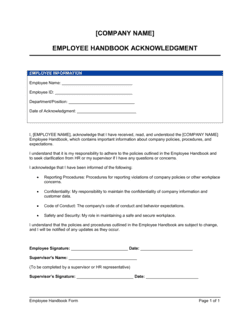
Acknowledgment and receipt

How to fill it out

  1. 1

    Add your company name, logo, and mission statement

    Replace all [COMPANY NAME] placeholders throughout the template. Insert your logo in the header, and write a one- to two-sentence mission statement that reflects your actual values β€” not a generic placeholder.

    πŸ’‘ The welcome section is the first thing a new hire reads β€” a specific, authentic message from the CEO lands better than corporate boilerplate.

  2. 2

    Confirm your employment classification categories

    Review the employment-type definitions (full-time, part-time, exempt, non-exempt, temporary) and ensure they match the actual categories on your payroll. Verify your exempt/non-exempt classifications against current FLSA salary thresholds.

    πŸ’‘ The FLSA salary threshold for exempt status is updated periodically β€” check the current DOL figure before finalizing this section.

  3. 3

    Customize compensation and payroll details

    Enter your pay periods, timekeeping system, overtime approval process, and expense reimbursement procedure. Remove or note as 'see plan document' any reference to specific dollar amounts that change frequently.

    πŸ’‘ Link to a separate compensation philosophy document rather than embedding rates β€” it keeps the handbook stable between annual updates.

  4. 4

    Reference β€” do not duplicate β€” your benefits plan documents

    Summarize benefit categories and eligibility dates, then direct employees to the Summary Plan Description for coverage details. Never copy coverage amounts or premium shares into the handbook body.

    πŸ’‘ Include a one-line statement: 'In the event of a conflict between this handbook and the plan documents, the plan documents govern.'

  5. 5

    Tailor the code of conduct to your jurisdiction and industry

    Add any protected characteristics required by your state or local law beyond the federal list. If you operate in a regulated industry (healthcare, finance, childcare), add sector-specific conduct requirements.

    πŸ’‘ Run your final protected-characteristics list against SHRM's state-law summary or have an HR consultant review it β€” the list varies significantly by state.

  6. 6

    Set specific PTO accrual and leave rules

    Enter your accrual rate, carryover cap, payout-on-termination policy, and any front-loaded amounts. Cross-reference your state's paid sick leave law β€” the handbook policy must meet or exceed the statutory minimum.

    πŸ’‘ States with mandatory paid sick leave (CA, NY, WA, CO, and others) require specific accrual rates and permitted uses β€” verify compliance before publishing.

  7. 7

    Review disciplinary language for managerial flexibility

    Remove any language that guarantees every step of progressive discipline will be followed in every case. Add a clause reserving the company's right to skip steps or proceed directly to termination for serious misconduct.

    πŸ’‘ Have a manager or HR advisor read the disciplinary section with the question: 'Could I be sued for breach of this procedure?' If yes, revise the language.

  8. 8

    Distribute, collect, and file the acknowledgment page

    Send the final handbook to all employees, collect signed acknowledgment pages, and store them in each employee's personnel file. If using eSignature, ensure the platform timestamps the signing event and identifies the handbook version.

    πŸ’‘ Re-collect acknowledgments every time you publish a substantive update β€” not just annually. Version-date the handbook header so the signed copy is traceable.

Frequently asked questions

What is an employee handbook?

An employee handbook is a written document that communicates a company's policies, expectations, benefits, and culture to all employees. It covers topics ranging from attendance and conduct to compensation, leave, and disciplinary procedures. It serves as the single authoritative reference for how the company operates day-to-day and what employees can expect from their employer.

Is an employee handbook legally required?

No federal law in the United States requires employers to maintain an employee handbook. However, many state and local laws require employers to provide written notice of specific policies β€” paid sick leave, sexual harassment, and safe workplace procedures among them. A handbook is the most efficient way to satisfy all of these notice requirements in one document while also reducing policy disputes.

Can an employee handbook be used as evidence in a lawsuit?

Yes. Courts frequently treat handbook language as evidence of employer obligations β€” particularly when the handbook describes a multi-step disciplinary process or makes specific promises about termination. This is why a clear 'not a contract' disclaimer and permissive (rather than mandatory) disciplinary language are critical. The acknowledgment page also becomes evidence that the employee was informed of the policies.

What should an employee handbook not include?

Avoid embedding specific salary figures, exact benefit coverage levels, or annual premium amounts β€” these change frequently and instantly outdating the handbook creates disputes. Also avoid guaranteeing a specific disciplinary sequence, making promises about job security, or including language that implies a fixed term of employment unless that is your actual intent.

How often should an employee handbook be updated?

At minimum, review the handbook annually before the start of each fiscal or calendar year. Trigger an immediate review whenever employment law changes in a jurisdiction where you have employees, when you add a new benefit or significantly change an existing one, or when a policy failure or workplace incident reveals a gap. Re-collect employee acknowledgments after every substantive update.

Do remote employees need a separate handbook?

Most employers extend the same core handbook to remote employees and add a remote-work addendum covering home-office requirements, equipment policies, data security expectations, and core-hours expectations. If remote employees are located in states with materially different employment laws β€” California and New York are the most common examples β€” state-specific supplements are advisable.

What is the difference between an employee handbook and an employment contract?

An employment contract is a binding agreement between the employer and a specific individual that governs their individual terms β€” salary, non-compete, IP assignment, and severance. An employee handbook applies to all employees equally, communicates general policies, and is typically not a binding contract. A handbook disclaimer explicitly states this distinction. Both documents can coexist β€” the contract governs the individual relationship; the handbook governs workplace conduct and policy.

Should employees sign the employee handbook?

Yes. Every employee should sign and date an acknowledgment page confirming they received, read, and agree to comply with the handbook. This creates a documented record that is invaluable in any subsequent policy dispute, disciplinary action, or termination proceeding. Collect a fresh acknowledgment each time the handbook is meaningfully revised.

How long should an employee handbook be?

For a small business with 10–50 employees, 20–40 pages is typically sufficient to cover all essential policies without overwhelming new hires. Larger organizations with complex benefits, multiple locations, or regulated operations often run 60–80 pages. Avoid padding β€” a handbook employees can actually read and understand is more effective than a comprehensive document that no one opens.

How this compares to alternatives

vs Employment Contract

An employment contract is a binding agreement with a specific individual covering salary, IP assignment, non-compete, and severance. An employee handbook applies equally to all staff and communicates company-wide policy. A handbook disclaimer explicitly states it is not a contract. Both documents serve different functions and most employers use both.

vs Code of Conduct

A code of conduct is a focused document covering professional behavior, ethics, and conflicts of interest β€” often 3–6 pages. An employee handbook is the comprehensive policy reference that includes the code of conduct as one of many sections. Standalone codes of conduct are common in organizations that need a separate ethics document for board adoption or regulatory filing.

vs HR Policy Manual

An HR policy manual is an internal operational reference for HR and management β€” detailed, procedural, and not distributed to all employees. An employee handbook is written for employees, communicates expectations in plain language, and is distributed at onboarding. Both may cover similar topics, but the audience, tone, and level of procedural detail differ significantly.

vs Remote Work Agreement

A remote work agreement is a bilateral document between employer and a specific remote employee confirming home-office requirements, equipment terms, data security obligations, and scheduling expectations. An employee handbook sets general policy for all workers. Remote employers typically use both β€” the handbook for policy, and the agreement for employee-specific terms and acknowledgments.

Industry-specific considerations

Technology / SaaS

Remote-work policy, acceptable-use and data-security guidelines, IP assignment notice, and equity or stock-option plan references are often the most contested sections.

Healthcare

HIPAA confidentiality obligations, drug and background-check policies, credentialing requirements, and mandatory reporter obligations require dedicated handbook sections.

Retail / Hospitality

Attendance and tardiness policies, tip and gratuity handling, dress code, customer interaction standards, and shift-swap procedures are the highest-traffic sections for hourly workforces.

Professional Services

Client confidentiality, billing conduct, conflicts of interest, and professional licensing maintenance obligations are typically more detailed than in general-industry handbooks.

Template vs pro β€” what fits your needs?

PathBest forCostTime
Use the templateSmall businesses and startups with under 50 employees in a single stateFree4–8 hours to customize and distribute
Template + professional reviewEmployers in California, New York, or any state with complex paid-leave and anti-discrimination laws$500–$2,000 for an HR consultant or employment attorney review1–2 weeks
Custom draftedEmployers with 100+ employees, multi-state workforces, regulated industries, or union considerations$2,500–$8,000+ for a full custom handbook drafted by employment counsel3–6 weeks

Glossary

At-Will Employment
An employment arrangement in which either the employer or employee may end the relationship at any time for any lawful reason, without advance notice.
Employment Classification
The category assigned to each worker β€” full-time, part-time, exempt, non-exempt, or contractor β€” which determines their pay, benefits, and legal protections.
FLSA Exempt vs. Non-Exempt
Under the US Fair Labor Standards Act, exempt employees are not entitled to overtime pay; non-exempt employees must receive 1.5Γ— their regular rate for hours over 40 per week.
PTO (Paid Time Off)
A unified leave bank combining vacation, sick, and personal days into a single balance employees draw from for any absence.
Progressive Discipline
A structured corrective process that escalates consequences β€” verbal warning, written warning, suspension, termination β€” giving employees the opportunity to improve before the most severe action.
Acknowledgment Page
A signed page at the end of the handbook confirming the employee has received, read, and agrees to comply with the policies β€” creating a documented record for the employer.
Reasonable Accommodation
A modification to a job, work environment, or practice that enables a qualified employee with a disability or religious need to perform their role without creating undue hardship for the employer.
Whistleblower Protection
A policy or legal provision protecting employees who report illegal activity, safety violations, or ethical breaches from retaliation by the employer.
Severance
Compensation paid to an employee upon termination, typically expressed as a number of weeks' pay per year of service, and often conditioned on signing a release of claims.
Confidential Information
Non-public business data β€” including customer lists, financials, trade secrets, and product roadmaps β€” that employees are obligated not to disclose during or after employment.

Part of your Business Operating System

This document is one of 3,000+ business & legal templates included in Business in a Box.

  • Fill-in-the-blanks β€” ready in minutes
  • 100% customizable Word document
  • Compatible with all office suites
  • Export to PDF and share electronically

Create your document in 3 simple steps.

From template to signed document β€” all inside one Business Operating System.
1
Download or open template

Access over 3,000+ business and legal templates for any business task, project or initiative.

2
Edit and fill in the blanks with AI

Customize your ready-made business document template and save it in the cloud.

3
Save, Share, Send, Sign

Share your files and folders with your team. Create a space of seamless collaboration.

Save time, save money, and create top-quality documents.

β˜…β˜…β˜…β˜…β˜…

"Fantastic value! I'm not sure how I'd do without it. It's worth its weight in gold and paid back for itself many times."

Managing Director Β· Mall Farm
Robert Whalley
Managing Director, Mall Farm Proprietary Limited
β˜…β˜…β˜…β˜…β˜…

"I have been using Business in a Box for years. It has been the most useful source of templates I have encountered. I recommend it to anyone."

Business Owner Β· 4+ years
Dr Michael John Freestone
Business Owner
β˜…β˜…β˜…β˜…β˜…

"It has been a life saver so many times I have lost count. Business in a Box has saved me so much time and as you know, time is money."

Owner Β· Upstate Web
David G. Moore Jr.
Owner, Upstate Web

Run your business with a system β€” not scattered tools

Stop downloading documents. Start operating with clarity. Business in a Box gives you the Business Operating System used by over 250,000 companies worldwide to structure, run, and grow their business.

Free Forever PlanΒ Β·Β No credit card required