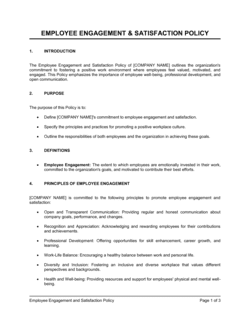
- Employee Engagement
- The degree to which employees feel emotionally committed to their work and organization — distinct from mere job satisfaction, which measures contentment rather than active investment.
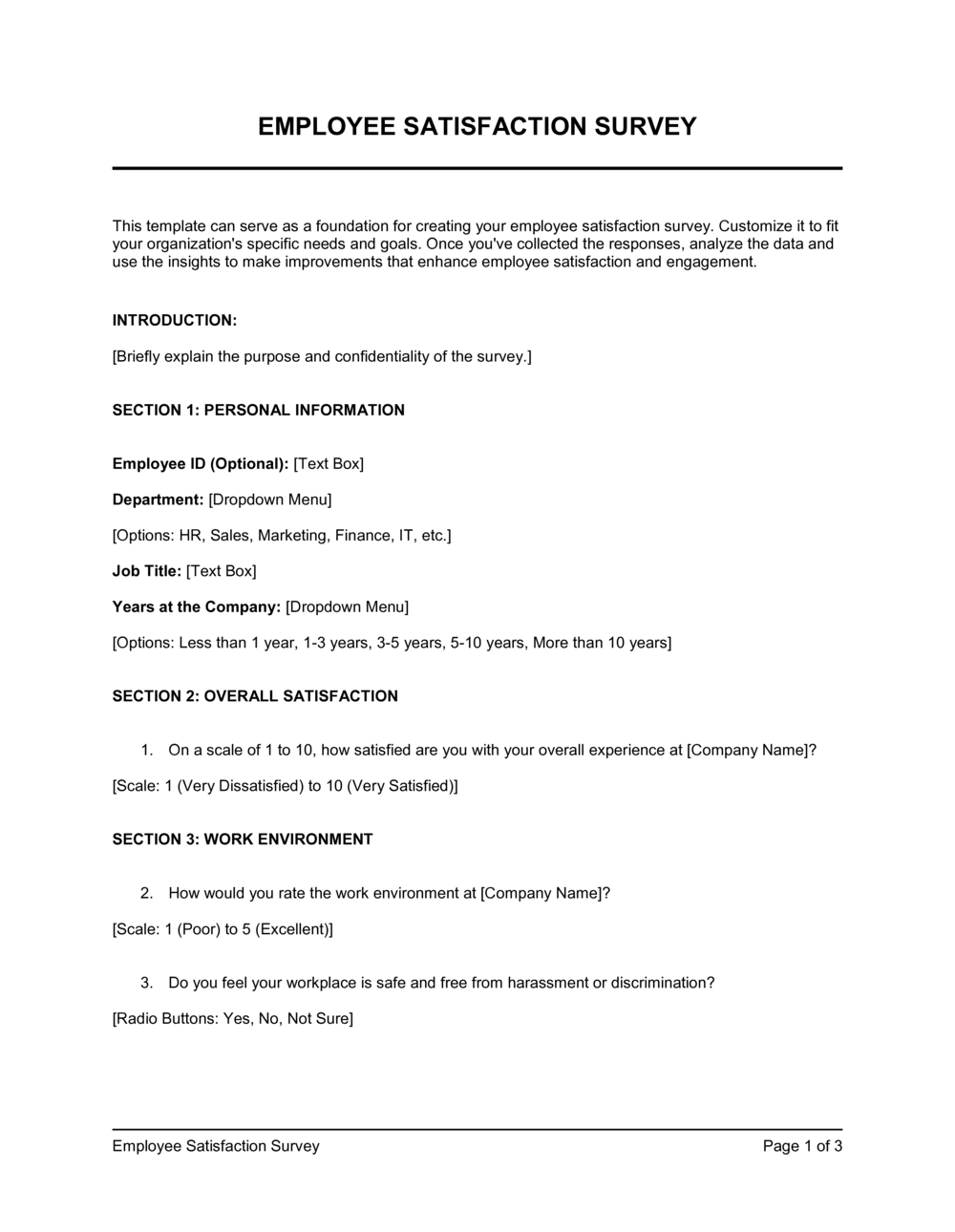
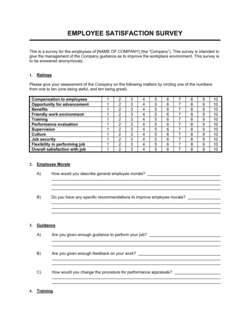
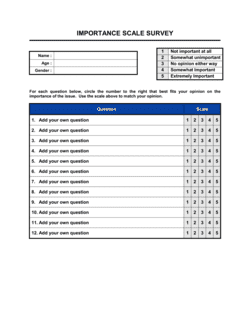
- Likert Scale
- A rating scale — typically 1 to 5 or 1 to 7 — used in surveys to measure the intensity of agreement, satisfaction, or frequency of a response.
- Confidentiality Notice
- A written statement at the start of the survey explaining how responses will be stored, who can access them, and how individual answers will be anonymized before reporting.
- Informed Consent
- Voluntary, documented agreement by an employee to participate in the survey after being told how their data will be used, stored, and protected.
- Anonymization
- The process of removing or aggregating identifying information from survey responses so that no individual's answers can be traced back to them.
- Net Promoter Score (eNPS)
- An adapted version of the Net Promoter Score applied internally — asking employees how likely they are to recommend the company as a place to work on a 0–10 scale.
- Response Rate
- The percentage of eligible employees who complete and return the survey — rates below 60% are generally considered too low to draw statistically meaningful conclusions.
- Data Controller
- The legal entity — typically the employer — that determines the purposes and means of processing personal data collected through the survey, as defined under GDPR and similar data protection laws.
- Psychological Safety
- An employee's belief that they can speak up, ask questions, or report concerns without fear of retaliation or negative consequences.
- Benchmarking
- Comparing survey results against industry norms, prior survey cycles, or peer organizations to give raw scores meaningful context.
- Action Plan
- A documented set of specific commitments the employer makes in response to survey findings — including owners, timelines, and success metrics.