Workplace Food and Drink Policy Template

Free Word download β€’ Edit online β€’ Save & share with Drive β€’ Export to PDF

2 pagesβ€’20–25 min to fillβ€’Difficulty: Standard
Learn more ↓
FreeWorkplace Food and Drink Policy Template

At a glance

What it is
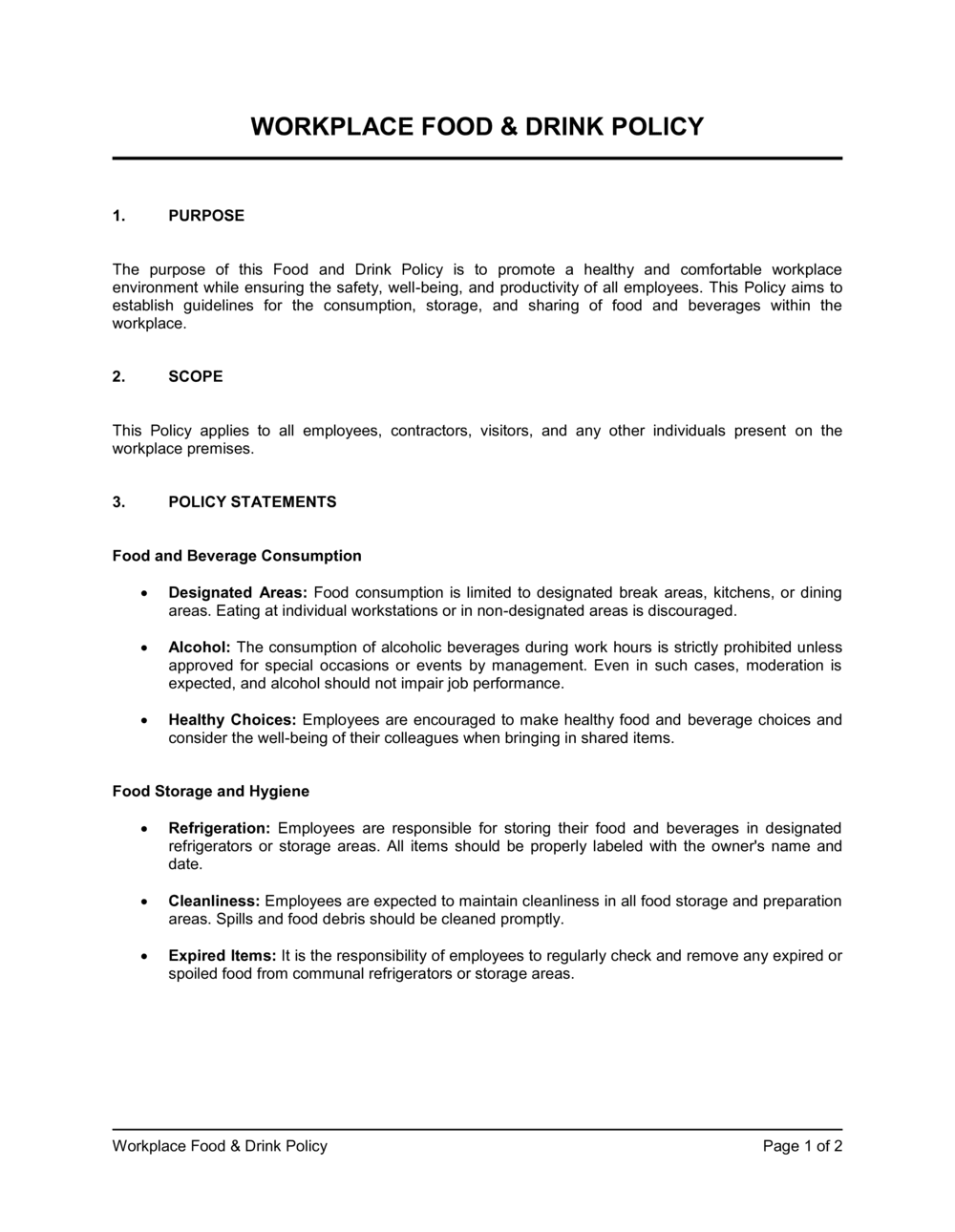
A Workplace Food and Drink Policy is an operational document that sets clear rules for how employees may store, prepare, consume, and dispose of food and beverages on company premises. This free Word download gives you a structured, ready-to-customize starting point you can edit online and export as PDF to distribute to all staff during onboarding or policy updates.
When you need it
Use it when formalizing office conduct standards, responding to recurring hygiene complaints, accommodating employees with food allergies, or establishing expectations before expanding to a new office location.
What's inside
Purpose and scope, permitted eating areas, kitchen and shared space etiquette, food storage rules, allergy and dietary accommodation guidelines, alcohol and substance rules, desk dining conditions, enforcement and consequences, and a policy acknowledgment section for employee sign-off.

What is a Workplace Food and Drink Policy?

A Workplace Food and Drink Policy is an operational document that establishes clear, enforceable rules for how employees store, prepare, consume, and dispose of food and beverages on company premises. It defines which areas are designated for eating, what standards apply to shared kitchen and break-room use, how food allergies are accommodated, when (if ever) alcohol may be present on-site, and the consequences for non-compliance. Unlike informal verbal guidelines, a written policy gives both employees and managers a consistent reference point that removes ambiguity and creates a documented basis for enforcement.

Why You Need This Document

Without a written food and drink policy, hygiene complaints accumulate with no standard to enforce, allergen incidents occur with no documented protocol to reference, and shared kitchen spaces become a recurring source of workplace friction. The absence of formal guidance also exposes employers to duty-of-care liability when a preventable food-related incident β€” a serious allergic reaction, a pest problem traced to improper food storage, or an alcohol-related incident at a company event β€” leads to a legal or HR dispute. A clear, distributed policy closes those gaps: it sets expectations before conflicts arise, gives managers a documented escalation path, and demonstrates that the organization took reasonable steps to maintain a safe and respectful workplace. This template gives you a structured starting point that covers every core scenario, ready to customize for your premises and team in under an hour.

Which variant fits your situation?

If your situation is…Use this template
Office-based team with a shared kitchen and break roomWorkplace Food and Drink Policy
Manufacturing or warehouse environment with strict hygiene zonesFood Safety and Hygiene Policy
Hospitality or food-service business with customer-facing staffEmployee Conduct and Appearance Policy
Company event or team function involving alcoholWorkplace Alcohol and Drug Policy
Remote-first team with no shared office kitchenRemote Work Policy
Business with a formal employee dining benefit or subsidized canteenEmployee Benefits Policy
Organization managing employee food allergies and dietary needs formallyWorkplace Health and Safety Policy

Common mistakes to avoid

❌ Vague area descriptions

Why it matters: Writing 'appropriate areas' instead of naming specific rooms means employees apply their own judgment, and enforcement conversations become subjective disagreements rather than policy references.

Fix: List every permitted and prohibited room by its actual name in the designated eating areas section, and post a printed reminder in the kitchen.

❌ No refrigerator clearout schedule

Why it matters: Without a defined schedule, shared refrigerators fill with unlabeled, expired food β€” creating hygiene complaints and disputes about who threw away whose lunch.

Fix: Set a named day and time for weekly clearouts, assign responsibility to a facilities or office management role, and communicate the schedule visibly in the kitchen.

❌ Placing all allergen responsibility on the allergic employee

Why it matters: If a preventable allergic reaction occurs and the policy contained no shared-space allergen guidance, the employer may face negligence or duty-of-care claims.

Fix: Include a shared responsibility clause requiring employees to flag medically severe allergies to HR, and establish a process for notifying team members who share a kitchen.

❌ No version date on the document

Why it matters: An undated policy is effectively unenforceable β€” employees can claim they followed an earlier verbal version, and HR cannot confirm which iteration was in effect at the time of a complaint.

Fix: Always include a version date and review date in the policy footer and in the acknowledgment block. Update the date with every substantive revision.

❌ Failing to address company-sponsored events explicitly

Why it matters: Employees assume off-site or after-hours company events fall outside workplace policy. Without explicit language, alcohol-related incidents at work events create employer liability with no documented policy basis for action.

Fix: Add a clause stating that the alcohol and conduct standards in this policy apply at all company-sponsored events, on-site or off-site, during or outside normal working hours.

❌ Using individual names instead of role titles in enforcement sections

Why it matters: Naming a specific person as the policy owner means the document becomes stale every time that person changes roles or leaves the company.

Fix: Always reference role titles β€” 'HR Manager,' 'Operations Director,' 'Facilities Lead' β€” so the policy remains valid through staff changes without requiring a full re-issue.

The 9 key sections, explained

Purpose and scope

Designated eating areas

Kitchen and shared-space etiquette

Food storage rules

Allergy and dietary accommodation

Desk dining conditions

Alcohol and substance rules

Enforcement and consequences

Policy review and acknowledgment

How to fill it out

  1. 1

    Define the scope and premises

    Insert your company's legal name and the specific addresses or office locations where the policy applies. Confirm whether it covers remote workers' home offices or only company premises.

    πŸ’‘ For multi-location businesses, create a single policy with a location-specific appendix rather than separate documents per site β€” this reduces version-control headaches.

  2. 2

    List designated eating areas by name

    Replace all generic placeholders with the actual room names used in your office β€” 'Canteen,' 'Floor 3 Break Room,' or 'Rooftop Terrace.' Walk the space before filling this in.

    πŸ’‘ Post a laminated one-page summary of permitted and restricted areas in the kitchen β€” this cuts repeat enforcement conversations significantly.

  3. 3

    Set the refrigerator clearout schedule

    Choose a specific day and time for weekly refrigerator clearouts and enter it in the food storage section. Assign a named role (not a specific person's name) as responsible.

    πŸ’‘ Friday afternoon clearouts work best β€” they prevent odor buildup over the weekend and give employees a natural prompt to retrieve their food before it is discarded.

  4. 4

    Customize the allergy accommodation process

    Decide whether employees with severe allergies notify HR, their line manager, or both, and name the role (not an individual) in the policy. Confirm how company-provided food at meetings will be labeled.

    πŸ’‘ If your organization has more than 50 employees, consider a short allergy declaration form as a separate companion document rather than embedding declarations in the policy itself.

  5. 5

    Define your desk-dining rules specifically

    Choose one of three positions β€” permitted with conditions, restricted to specific food types, or prohibited β€” and describe the exact conditions that apply. Consider role-based exceptions for employees who cannot leave their station.

    πŸ’‘ Listing specific food categories that are prohibited (e.g., reheated fish, strong curries) rather than relying on 'odorous foods' removes ambiguity and is easier to enforce.

  6. 6

    Tailor the alcohol and substance rules to your culture

    Determine whether any on-site alcohol consumption is ever permitted (e.g., a Friday drinks trolley or end-of-quarter celebration), under what conditions written approval is required, and reference your broader disciplinary policy.

    πŸ’‘ Cross-reference your existing alcohol and drug policy rather than duplicating it here β€” duplicate language creates contradiction risk when one document is updated and the other is not.

  7. 7

    State the enforcement escalation path

    Fill in the three-stage escalation (verbal, written warning, formal action) and reference the document name of your company's disciplinary policy. Assign enforcement responsibility to a named role.

    πŸ’‘ Giving line managers β€” not HR alone β€” first-stage enforcement authority makes day-to-day compliance faster and less bureaucratic.

  8. 8

    Set a review date and distribute for acknowledgment

    Enter today's date as the policy version date, set a calendar reminder for the annual review, and distribute the acknowledgment block to all in-scope employees. Retain signed copies in each employee's HR file.

    πŸ’‘ For remote or hybrid teams, use an e-signature or HRIS acknowledgment workflow so you have a timestamped record without chasing paper copies.

Frequently asked questions

What is a workplace food and drink policy?

A workplace food and drink policy is an operational document that defines the rules for consuming, storing, and disposing of food and beverages on company premises. It covers designated eating areas, shared kitchen etiquette, food labeling and storage, allergy accommodations, desk dining conditions, and alcohol use β€” giving both employees and managers a clear, consistent reference for expected behavior.

Is a workplace food and drink policy legally required?

In most jurisdictions, no specific law mandates a standalone food and drink policy. However, employers have a general duty of care under occupational health and safety legislation to maintain a safe and hygienic workplace. A formal written policy supports that duty, provides a documented basis for disciplinary action, and demonstrates reasonable steps were taken if a hygiene or allergen incident is ever disputed.

How should we handle employees with severe food allergies?

The policy should include a process for employees to notify HR or their line manager of a medically documented severe allergy in writing. For life-threatening allergies, consider whether shared kitchen restrictions are warranted and how company-provided food at meetings and events will be labeled. Placing the entire burden on the allergic employee alone, with no shared-space guidance, can expose the employer to duty-of-care liability if a preventable incident occurs.

Can we prohibit eating at desks?

Yes β€” a desk dining prohibition is a legitimate workplace rule in most jurisdictions, particularly in client-facing, food-production, or hygiene-sensitive environments. However, consider role-based exceptions for employees who cannot reasonably leave their station, such as reception staff or lone workers. A blanket ban applied inconsistently across roles undermines the policy's enforceability.

How do we manage alcohol at company events under this policy?

The policy should explicitly state that workplace conduct standards, including any restrictions on alcohol consumption, apply at all company-sponsored events β€” on-site or off-site. Require written approval from management or HR before alcohol is made available at any company function, and cross-reference your broader alcohol and substance policy for the full disciplinary framework.

How often should a workplace food and drink policy be reviewed?

An annual review is standard for most operational workplace policies. Additionally, review the policy following any significant hygiene incident, a workplace health and safety audit, a change in office layout that creates or removes eating areas, or when the company expands to a new location. Always update the version date when any substantive change is made.

Do employees need to sign the food and drink policy?

A signed acknowledgment is not legally required in most jurisdictions, but it is strongly recommended. A signed or electronically confirmed acknowledgment creates a documented record that the employee received, read, and agreed to the policy β€” which is essential if disciplinary action for a policy breach is ever challenged. Retain signed acknowledgments in each employee's HR file.

What consequences are appropriate for policy breaches?

A three-stage escalation is standard practice: a verbal reminder for a first minor breach, a written warning for a repeated or more serious breach, and formal disciplinary action β€” up to and including termination for persistent or egregious violations β€” for continued non-compliance. The enforcement section should reference your company's disciplinary policy rather than restating the full procedure.

Should the policy cover strong-smelling foods specifically?

Yes β€” listing specific examples of restricted food types (reheated fish, strong curries, fermented foods) is more effective than a general reference to 'odorous foods,' which employees interpret differently. Specific examples reduce ambiguity, make enforcement conversations easier, and reduce the likelihood of repeated complaints about the same foods.

How this compares to alternatives

vs Workplace Health and Safety Policy

A workplace health and safety policy covers the full scope of occupational hazards, risk assessments, and emergency procedures. A food and drink policy addresses a narrow slice of that β€” hygiene, shared spaces, and allergen management. The two are complementary: the food and drink policy should cross-reference the health and safety policy for incident reporting and duty-of-care obligations.

vs Workplace Alcohol and Drug Policy

An alcohol and drug policy focuses exclusively on substance use, impairment at work, and testing procedures. A food and drink policy covers alcohol only at the surface level β€” typically a short section on on-premises or event use. Organizations with a zero-tolerance stance or regulated-industry requirements need both documents, with the food and drink policy cross-referencing the alcohol policy for the full disciplinary framework.

vs Employee Handbook

An employee handbook is an omnibus document covering all workplace conduct policies in a single reference. A standalone food and drink policy is appropriate when the topic requires detailed treatment β€” allergy management, multi-site kitchen rules, or enforcement escalation β€” that would be too granular for a handbook section. The handbook typically references the standalone policy by name rather than reproducing it in full.

vs Remote Work Policy

A remote work policy governs home-office conduct, equipment use, and availability expectations for remote employees. A food and drink policy applies primarily to company premises. For fully remote teams with no shared office space, a remote work policy is sufficient; for hybrid teams, both documents are needed to cover conduct in each setting.

Industry-specific considerations

Professional Services

Client-facing offices often restrict desk dining and strong food smells to maintain a professional environment during client visits.

Technology / SaaS

Open-plan offices with hot-desking require clear desk-dining rules and equipment hygiene standards to prevent damage and odor complaints across shared workstations.

Healthcare

Strict cross-contamination and hygiene controls are required; food consumption is typically prohibited in clinical areas and the policy must align with infection-control protocols.

Manufacturing

Food is commonly banned from production floors entirely; designated canteen areas must be physically separated from work zones, and hygiene rules must comply with food safety regulations where applicable.

Template vs pro β€” what fits your needs?

PathBest forCostTime
Use the templateHR managers and office managers at small to mid-size businesses establishing or updating food and kitchen rulesFree30–60 minutes
Template + professional reviewOrganizations with documented severe allergy cases, unionized workforces, or locations in jurisdictions with specific food hygiene regulations$100–$300 for an HR consultant review1–2 days
Custom draftedFood-production or healthcare employers where kitchen and consumption rules intersect with regulatory compliance or collective bargaining agreements$500–$1,5003–7 days

Glossary

Designated Eating Area
A specific room, zone, or space formally approved by the employer for employees to consume food and beverages during work hours.
Communal Kitchen
A shared workspace equipped with appliances such as a refrigerator, microwave, and kettle for employees to store and prepare food.
Food Allergen
A substance in food β€” such as nuts, gluten, dairy, or shellfish β€” that can trigger an allergic reaction, ranging from mild discomfort to a life-threatening anaphylactic response.
Cross-Contamination
The unintended transfer of allergens or harmful bacteria from one food item, surface, or utensil to another.
Desk Dining
The practice of eating food at one's workstation rather than in a designated eating area β€” permitted, restricted, or prohibited depending on the policy.
Labeling Requirement
A rule requiring employees to mark personal food stored in shared refrigerators with their name and the date stored, to prevent confusion and food waste.
Alcohol Policy
The section of a workplace policy that governs whether, when, and under what conditions alcoholic beverages may be consumed on company premises or at company-sponsored events.
Policy Acknowledgment
A signed or countersigned statement from an employee confirming they have read, understood, and agreed to comply with the policy.
Food Waste Disposal
The process and rules governing how employees must dispose of uneaten food and packaging β€” including refrigerator cleanout schedules and bin responsibilities.
Break Room
An informal term for a designated space where employees may rest and consume food or beverages, distinct from production or client-facing areas.

Part of your Business Operating System

This document is one of 3,000+ business & legal templates included in Business in a Box.

  • Fill-in-the-blanks β€” ready in minutes
  • 100% customizable Word document
  • Compatible with all office suites
  • Export to PDF and share electronically

Create your document in 3 simple steps.

From template to signed document β€” all inside one Business Operating System.
1
Download or open template

Access over 3,000+ business and legal templates for any business task, project or initiative.

2
Edit and fill in the blanks with AI

Customize your ready-made business document template and save it in the cloud.

3
Save, Share, Send, Sign

Share your files and folders with your team. Create a space of seamless collaboration.

Save time, save money, and create top-quality documents.

β˜…β˜…β˜…β˜…β˜…

"Fantastic value! I'm not sure how I'd do without it. It's worth its weight in gold and paid back for itself many times."

Managing Director Β· Mall Farm
Robert Whalley
Managing Director, Mall Farm Proprietary Limited
β˜…β˜…β˜…β˜…β˜…

"I have been using Business in a Box for years. It has been the most useful source of templates I have encountered. I recommend it to anyone."

Business Owner Β· 4+ years
Dr Michael John Freestone
Business Owner
β˜…β˜…β˜…β˜…β˜…

"It has been a life saver so many times I have lost count. Business in a Box has saved me so much time and as you know, time is money."

Owner Β· Upstate Web
David G. Moore Jr.
Owner, Upstate Web

Run your business with a system β€” not scattered tools

Stop downloading documents. Start operating with clarity. Business in a Box gives you the Business Operating System used by over 250,000 companies worldwide to structure, run, and grow their business.

Start freeΒ Β·Β No credit card required