Corporate Governance Policy Template

Free Word download β€’ Edit online β€’ Save & share with Drive β€’ Export to PDF

5 pagesβ€’20–30 min to fillβ€’Difficulty: Standard
Learn more ↓
FreeCorporate Governance Policy Template

At a glance

What it is
A Corporate Governance Policy is a high-level framework document that defines how a company is directed, controlled, and held accountable to its stakeholders. This free Word download covers board composition, committee mandates, director independence standards, conflict-of-interest procedures, executive compensation principles, and shareholder rights in a single structured policy you can edit online and export as PDF.
When you need it
Use it when preparing for a public listing, satisfying ESG reporting requirements, responding to an institutional investor's due diligence questionnaire, or formalizing governance practices for a growing private company with an active board.
What's inside
Board structure and composition, director independence criteria, committee charters for audit and compensation, conflict-of-interest disclosure procedures, executive compensation philosophy, shareholder rights and engagement protocols, and a compliance and review schedule.

What is a Corporate Governance Policy?

A Corporate Governance Policy is a high-level framework document that defines how a company is directed, controlled, and held accountable to its shareholders and other stakeholders. It establishes the rules of the road for the board of directors β€” covering composition, independence standards, committee mandates, conflict-of-interest procedures, executive compensation principles, and shareholder rights β€” in a single authoritative document that sits above individual committee charters and operational policies. Unlike bylaws, which govern the legal mechanics of the corporation, a governance policy articulates the behavioral and structural standards the board holds itself to, providing the accountability architecture that investors, regulators, and ESG frameworks look for.

Why You Need This Document

Without a written governance policy, board decisions on executive pay, related-party transactions, and director independence rely on informal norms that are impossible to verify, enforce, or disclose. Institutional investors conducting pre-investment due diligence, proxy advisors scoring your annual meeting, and ESG raters evaluating your governance pillar all look for a documented framework β€” its absence is scored as a deficiency regardless of how well the board actually functions. For companies approaching a public listing, the absence of a governance policy delays the offering timeline and triggers additional regulatory questions. For private companies with PE sponsors or significant debt facilities, lenders and investors routinely require adoption of a formal policy as a closing condition. This template gives you a complete, board-ready starting point that covers every core governance component β€” structured so individual sections can be updated as the company grows without rewriting the entire framework.

Which variant fits your situation?

If your situation is…Use this template
Publicly listed company meeting exchange rulesCorporate Governance Policy (Listed Company)
Early-stage startup formalizing its first boardBoard of Directors Charter
Defining the mandate of the audit committee specificallyAudit Committee Charter
Documenting how executive pay decisions are madeExecutive Compensation Policy
Managing related-party transactions and conflicts of interestConflict of Interest Policy
Setting out how the board is structured and how it operatesBoard of Directors Meeting Minutes
Communicating governance standards to shareholdersShareholder Rights Agreement

Common mistakes to avoid

❌ Copying exchange rules verbatim without adaptation

Why it matters: Stock exchange governance rules set a minimum β€” institutional investors and proxy advisors apply stricter tests. A policy that merely restates the listing standard looks compliant on paper but fails in shareholder engagements and ESG ratings.

Fix: Review the current ISS and Glass Lewis policy guidelines for your market and calibrate independence criteria, committee composition, and pay practices to the higher standard where feasible.

❌ Assigning policy ownership to the CEO

Why it matters: A governance policy that management can amend without board approval undermines the entire accountability framework it is supposed to create.

Fix: Assign ownership to the Nominating and Governance Committee and require full board approval for any amendment, regardless of how minor it appears.

❌ Omitting a specific peer group for executive compensation benchmarking

Why it matters: Vague pay philosophy language β€” 'competitive with the market' β€” gives the Compensation Committee unlimited discretion and provides no basis for defending pay decisions to shareholders or a court.

Fix: Name the peer group or the methodology for selecting it, set a target percentile, and update the peer list annually in a schedule rather than in the policy body.

❌ No in-camera session requirement for independent directors

Why it matters: Without a standing requirement, independent directors rarely convene without management present, and issues of management performance or conduct go unaddressed until a crisis forces the discussion.

Fix: Add a standing agenda item requiring an in-camera session of independent directors at every regularly scheduled board meeting, with minutes confirming the session occurred.

❌ Conflict-of-interest threshold set too high for the company's scale

Why it matters: A $500,000 pre-approval threshold at a $5M-revenue company means the vast majority of related-party transactions never receive oversight, exposing minority shareholders to undisclosed self-dealing.

Fix: Calibrate the threshold to approximately 1% of annual revenues, with a lower disclosure-only threshold at 0.25%, and revisit both thresholds annually as revenue changes.

❌ Making shareholder engagement provisions aspirational

Why it matters: Governance policies that say the board 'may engage' with shareholders rather than specifying when and how give ESG raters nothing to verify and give shareholders no rights to enforce.

Fix: Define a specific ownership threshold, a response timeline (e.g., within 30 business days), and the designated contact β€” Lead Independent Director or Chair β€” so the commitment is measurable.

The 10 key sections, explained

Purpose and scope

Board composition and size

Director independence standards

Committee structure and mandates

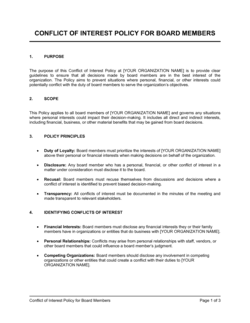
Conflicts of interest and related-party transactions

Executive compensation philosophy

Shareholder rights and engagement

Board and committee meeting conduct

Ethics, conduct, and whistleblower protection

Policy review and compliance

How to fill it out

  1. 1

    Confirm the legal entities and persons covered

    Enter the company's full legal name and list all subsidiaries or affiliates subject to the policy. Decide whether the policy also governs officers and senior management in addition to directors.

    πŸ’‘ Check your corporate registry for the precise registered name β€” discrepancies between the policy and filing documents create ambiguity in enforcement.

  2. 2

    Set board size, composition targets, and independence thresholds

    Enter the minimum and maximum board size, the independence percentage you are targeting, and the key skills the board needs to maintain. Base independence criteria on the highest standard applicable β€” exchange rules, investor guidelines, or proxy advisor standards.

    πŸ’‘ Institutional Shareholder Services (ISS) and Glass Lewis publish annual policy updates. If institutional investors hold more than 20% of your company, align your independence criteria to their current standards before filing.

  3. 3

    Define standing committees and attach Schedule A charters

    Identify each standing committee, set its minimum seat count and independence requirements, and draft a separate one-page charter for each as Schedule A. The main policy should only summarize β€” not repeat β€” the full charter language.

    πŸ’‘ Keep committee charters in a separate schedule so they can be updated independently without requiring a full policy amendment.

  4. 4

    Set conflict-of-interest disclosure thresholds

    Enter the dollar threshold above which related-party transactions require Audit Committee pre-approval. Set a separate, lower threshold for disclosure-only obligations. Calibrate both to your revenue scale.

    πŸ’‘ A threshold equal to 1% of average annual revenues is a common starting point for private companies; public companies should align to their proxy statement materiality standard.

  5. 5

    Articulate the executive compensation philosophy

    Define the peer group for benchmarking, the target pay percentile, the ratio of fixed to variable compensation, and any specific performance metrics that govern annual bonus and long-term incentive payouts.

    πŸ’‘ Name the peer companies in a schedule rather than in the policy body β€” peers change as the company grows, and a schedule update is faster than a full policy amendment.

  6. 6

    Establish shareholder engagement procedures

    Set the ownership threshold that triggers direct board engagement, the timeline for responding to engagement requests, and the contact mechanism. Confirm whether the policy applies to all shareholders or only those on the share register.

    πŸ’‘ A 3–5% ownership threshold for board-level engagement matches current institutional investor expectations for most mid-cap and large-cap companies.

  7. 7

    Link the whistleblower channel and code of conduct

    Insert the URL or telephone number for the confidential reporting channel and reference the current version of the company's code of conduct by title and date.

    πŸ’‘ Test the reporting channel before publishing the policy β€” a broken link on a governance document signals operational carelessness to auditors and ESG raters.

  8. 8

    Schedule the annual review and board approval

    Enter the Nominating and Governance Committee as the policy owner, set the annual review timeline (typically Q1, aligned to the proxy season), and confirm the board approval process for amendments.

    πŸ’‘ Calendar the annual review in the board's work plan for the year so it doesn't get deferred. Governance policies that haven't been reviewed in two or more years are routinely flagged by proxy advisors.

Frequently asked questions

What is a corporate governance policy?

A corporate governance policy is a framework document that defines how a company is directed, controlled, and held accountable to its shareholders and other stakeholders. It covers board composition, director independence, committee structures, executive compensation principles, conflict-of-interest procedures, and shareholder rights. It sits above individual committee charters and operational policies, providing the overarching governance architecture the entire organization operates within.

Who needs a corporate governance policy?

Public companies listed on major exchanges are typically required to adopt and disclose a governance policy as a condition of listing. Pre-IPO companies, private equity-backed businesses, and nonprofits increasingly adopt formal governance policies to satisfy investor due diligence, ESG reporting frameworks, and lender covenants. Any organization with an active board of directors and external accountability obligations benefits from having one.

What should a corporate governance policy include?

A complete policy covers board composition and size, director independence standards, committee structures and mandates, conflict-of-interest disclosure procedures, executive compensation philosophy, shareholder rights and engagement procedures, meeting conduct and quorum rules, ethics and whistleblower protection, and a review and amendment process. Each component addresses a different accountability risk; omitting any one creates a gap that regulators, investors, or proxy advisors will flag.

Is a corporate governance policy legally required?

For companies listed on the NYSE, NASDAQ, TSX, or London Stock Exchange, governance disclosure requirements effectively mandate a written policy as a condition of listing. For private companies, there is no universal legal requirement β€” but institutional investors, PE sponsors, and major lenders routinely require one as a condition of investment or financing. Regulatory frameworks like the SEC's Regulation S-K and the UK Corporate Governance Code set disclosure standards that a formal policy helps satisfy.

How does a corporate governance policy support ESG reporting?

The governance pillar of every major ESG framework β€” GRI, SASB, TCFD, and ISS ESG β€” evaluates board independence, committee structure, executive pay alignment, whistleblower protections, and shareholder rights. A formal governance policy provides the written evidence base that ESG raters and investors look for when scoring the G dimension. Companies without a documented policy typically receive lower governance scores regardless of actual practice.

How is a corporate governance policy different from a code of conduct?

A code of conduct governs individual behavior β€” ethics, conflicts, gifts, and anti-corruption standards β€” for all employees. A corporate governance policy governs the structure and decision-making processes of the board and senior management as a collective body. The two documents complement each other: the governance policy references the code of conduct and establishes enforcement accountability, but they serve distinct purposes and should be maintained separately.

How often should a corporate governance policy be reviewed?

Annual review is standard, typically by the Nominating and Governance Committee before the proxy season. Off-cycle reviews should be triggered by a change in listing status, a material regulatory update (such as new SEC rules or exchange listing standard amendments), a significant governance incident, or a major ownership change. A policy that has not been reviewed in more than 18 months is routinely flagged by proxy advisors as stale.

Can a private company use this template?

Yes. Private companies with active boards, institutional investors, or external debt facilities benefit from the same governance structure as public companies β€” the formality simply matches the audience's expectations rather than a regulatory mandate. The template's independence criteria, committee structure, and shareholder engagement sections can be scaled down for a smaller board or simplified ownership structure without losing the core accountability framework.

What is the difference between a governance policy and board bylaws?

Bylaws are a legally constituted document governing the internal mechanics of the corporation β€” how meetings are called, how votes are counted, how officers are appointed β€” and are filed with the state or provincial registry. A governance policy is an internal framework document that sits on top of the bylaws to articulate best-practice standards for board behavior, independence, and stakeholder accountability. The governance policy should explicitly state that it supplements β€” and does not supersede β€” the bylaws and articles of incorporation.

How this compares to alternatives

vs Code of Business Conduct and Ethics

A code of conduct governs individual employee and officer behavior β€” gifts, conflicts, anti-bribery, and insider trading. A corporate governance policy governs the structure and collective decision-making of the board. Both are needed: the governance policy establishes the oversight architecture; the code of conduct sets the behavioral standards enforced within it.

vs Conflict of Interest Policy

A standalone conflict-of-interest policy provides detailed procedures for disclosing, reviewing, and resolving conflicts β€” including forms, approval workflows, and recusal protocols. A corporate governance policy addresses conflicts at a high level and cross-references the standalone policy for operational detail. Larger organizations maintain both; smaller ones may embed conflict procedures directly in the governance policy.

vs Board of Directors Charter

A board charter defines the board's specific authorities, responsibilities, and operating procedures as a governance body. A corporate governance policy is the broader framework within which the board charter sits β€” covering compensation, shareholder rights, and ethics alongside board mechanics. Companies typically adopt the governance policy first, then develop committee and board charters as sub-documents.

vs Shareholder Rights Agreement

A shareholder rights agreement is a binding contract between the company and its shareholders governing transfer restrictions, pre-emption rights, drag-along and tag-along provisions. A corporate governance policy addresses shareholder engagement and voting rights at the policy level but does not create contractual rights. Both documents are needed for a complete governance framework in a company with multiple shareholders.

Industry-specific considerations

Financial Services

Regulatory capital requirements, audit committee financial expert mandates, and enhanced independence standards for directors serving on risk committees.

Technology / SaaS

Equity compensation governance, dual-class share structure disclosures, and data security oversight added to audit committee mandates.

Healthcare and Life Sciences

Compliance committee mandates, FDA and HIPAA risk oversight, and clinical trial conflict-of-interest disclosures for physician directors.

Manufacturing and Energy

Environmental oversight delegation to the board, safety incident reporting to the audit committee, and supply-chain ethics compliance standards.

Template vs pro β€” what fits your needs?

PathBest forCostTime
Use the templatePrivate companies formalizing board governance for the first time, nonprofits, and pre-IPO companies building an initial governance frameworkFree3–5 hours
Template + professional reviewPE-backed companies, companies approaching a public listing, or organizations with institutional investors requiring governance certification$500–$2,000 for a governance consultant or legal review1–2 weeks
Custom draftedListed companies with complex ownership structures, dual-class shares, regulated industries, or active proxy advisory engagement$3,000–$10,000+ for securities counsel or a governance advisory firm3–6 weeks

Glossary

Board Composition
The mix of director profiles on a board β€” skills, independence status, tenure, diversity, and total seat count β€” that determines its ability to provide effective oversight.
Director Independence
A standard that a board member has no material relationship with the company β€” financial, familial, or professional β€” that could compromise objective judgment.
Committee Mandate
The written terms of reference for a board committee (audit, compensation, nominating) that define its authority, responsibilities, and reporting obligations.
Fiduciary Duty
The legal obligation of directors to act in the best interests of the company and its shareholders, encompassing duties of care and loyalty.
Quorum
The minimum number of directors or committee members who must be present for a meeting to be valid and its resolutions binding.
Say-on-Pay
A shareholder advisory vote on executive compensation packages, required for US public companies under the Dodd-Frank Act and similar rules in other markets.
Related-Party Transaction
Any transaction between the company and a director, officer, major shareholder, or their affiliates, which requires disclosure and often board or shareholder approval.
ESG (Environmental, Social, Governance)
A framework used by investors and raters to evaluate a company's non-financial performance, with governance covering board structure, accountability, and ethics.
Proxy Statement
A document filed with regulators and distributed to shareholders before an annual meeting, disclosing governance practices, director nominees, and executive compensation.
Clawback Provision
A policy requiring executives to repay incentive compensation that was based on financial results later found to be misstated or fraudulently reported.
Staggered Board
A board structure in which directors serve overlapping multi-year terms so that only a fraction of seats come up for election in any given year, providing continuity and takeover defense.
Whistleblower Protection
Policy provisions that protect employees who report governance violations, fraud, or ethics breaches from retaliation by the company or its managers.

Part of your Business Operating System

This document is one of 3,000+ business & legal templates included in Business in a Box.

  • Fill-in-the-blanks β€” ready in minutes
  • 100% customizable Word document
  • Compatible with all office suites
  • Export to PDF and share electronically

Create your document in 3 simple steps.

From template to signed document β€” all inside one Business Operating System.
1
Download or open template

Access over 3,000+ business and legal templates for any business task, project or initiative.

2
Edit and fill in the blanks with AI

Customize your ready-made business document template and save it in the cloud.

3
Save, Share, Send, Sign

Share your files and folders with your team. Create a space of seamless collaboration.

Save time, save money, and create top-quality documents.

β˜…β˜…β˜…β˜…β˜…

"Fantastic value! I'm not sure how I'd do without it. It's worth its weight in gold and paid back for itself many times."

Managing Director Β· Mall Farm
Robert Whalley
Managing Director, Mall Farm Proprietary Limited
β˜…β˜…β˜…β˜…β˜…

"I have been using Business in a Box for years. It has been the most useful source of templates I have encountered. I recommend it to anyone."

Business Owner Β· 4+ years
Dr Michael John Freestone
Business Owner
β˜…β˜…β˜…β˜…β˜…

"It has been a life saver so many times I have lost count. Business in a Box has saved me so much time and as you know, time is money."

Owner Β· Upstate Web
David G. Moore Jr.
Owner, Upstate Web

Run your business with a system β€” not scattered tools

Stop downloading documents. Start operating with clarity. Business in a Box gives you the Business Operating System used by over 250,000 companies worldwide to structure, run, and grow their business.

Free Forever PlanΒ Β·Β No credit card required