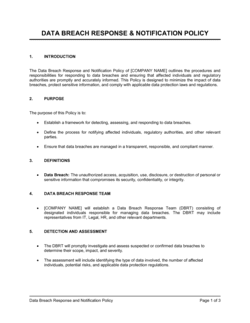
Data Governance Policy Template

Free Word download β€’ Edit online β€’ Save & share with Drive β€’ Export to PDF

3 pagesβ€’20–25 min to fillβ€’Difficulty: Standard
Learn more ↓
FreeData Governance Policy Template

At a glance

What it is
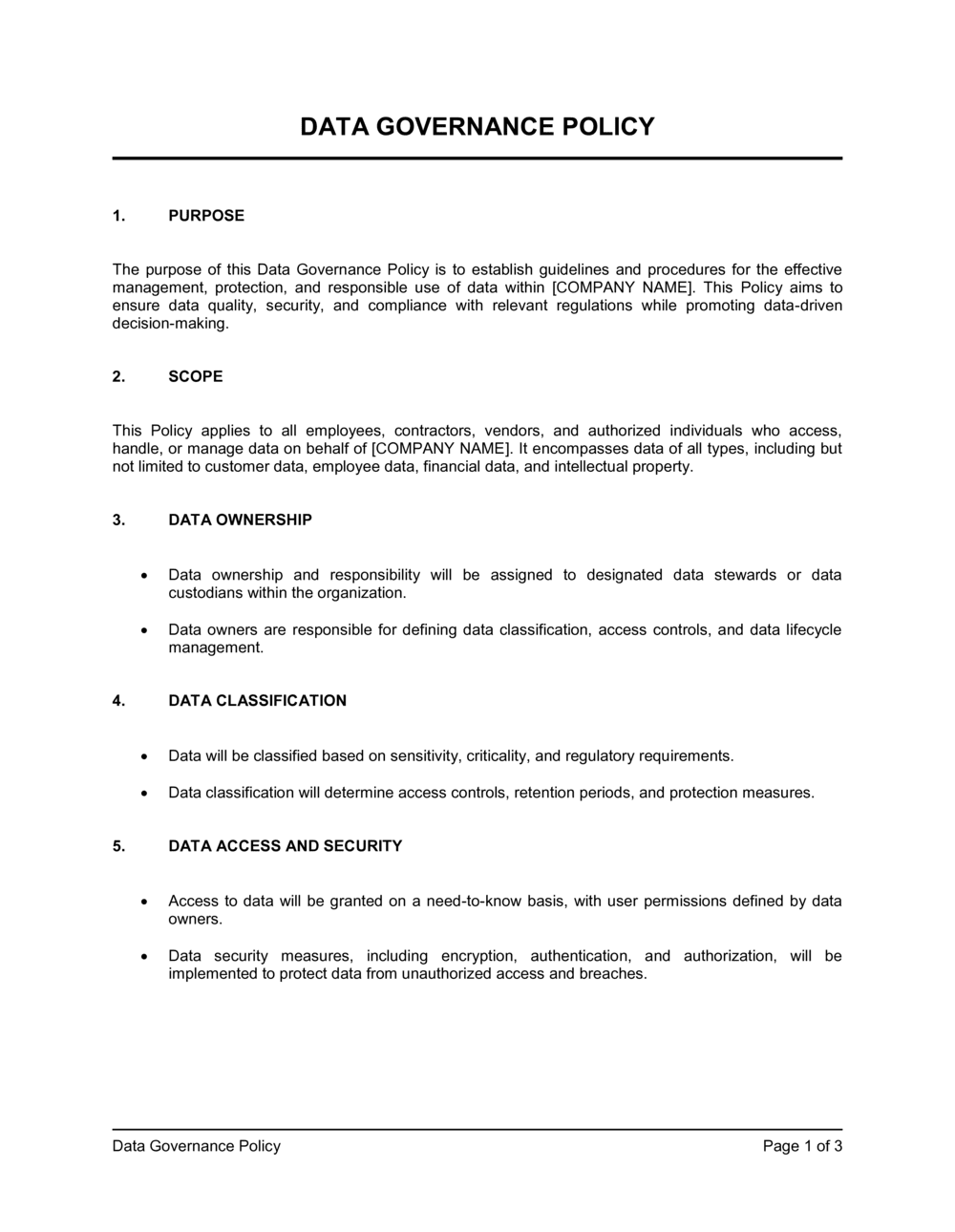
A Data Governance Policy is a formal operational document that establishes how an organization collects, stores, manages, and uses its data assets. This free Word download gives you a structured, editable template covering data ownership, quality standards, access controls, retention schedules, and compliance obligations β€” ready to export as PDF and distribute to staff, auditors, or regulators.
When you need it
Use it when implementing or formalizing a data management program, preparing for a compliance audit (SOC 2, ISO 27001, HIPAA, or GDPR), onboarding a data team, or responding to an incident that exposed gaps in data handling practices. It is also required by many enterprise vendor contracts and regulatory frameworks before data can be shared or processed.
What's inside
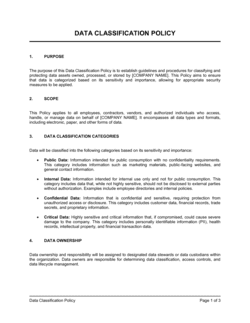
Purpose and scope, data classification tiers, roles and responsibilities (data owners, stewards, and custodians), data quality standards, access control rules, retention and disposal schedules, compliance and audit requirements, and a policy review cycle. Each section includes placeholder language you replace with your organization's specific rules and thresholds.

What is a Data Governance Policy?

A Data Governance Policy is a formal internal document that defines how an organization collects, classifies, stores, accesses, and retains its data assets β€” and who is accountable for each of those activities. It establishes a three-tier ownership model (data owners, stewards, and custodians), sets measurable quality standards, specifies access control rules by data classification tier, and maps the organization's data practices to applicable regulatory requirements such as GDPR, HIPAA, CCPA, and SOC 2. Unlike a privacy policy, which communicates data practices to the public, a data governance policy is an operational document for employees, auditors, and technology teams that translates data management principles into enforceable, day-to-day rules.

Why You Need This Document

Without a data governance policy, data ownership disputes between departments create quality problems that compound over time β€” customer records become duplicated, financial data becomes inconsistent across systems, and no single team is accountable for fixing any of it. When a regulatory audit or enterprise customer security review arrives, the absence of documented controls is itself a finding. GDPR and HIPAA do not require a document called a "data governance policy" by name, but they require the accountability structures, access controls, and retention rules that such a policy implements β€” and auditors expect to see them in writing. Data incidents and breaches that occur in organizations without governance frameworks cost significantly more to remediate because the scope of exposure is unknown until forensic work is complete. This template gives you a structured, professionally formatted starting point that covers every material governance control, so your first audit or enterprise sales review does not expose gaps you had no framework to even identify.

Which variant fits your situation?

If your situation is…Use this template
Establishing data governance for a regulated industry (healthcare, finance)Data Governance Policy (Regulated Industry)
Documenting how personal data is handled under GDPR or CCPAPrivacy Policy
Defining rules for sharing data with third-party vendorsData Processing Agreement
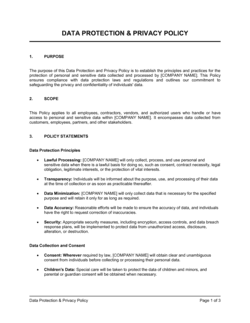
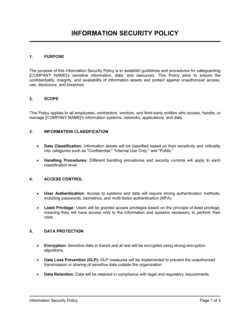
Securing sensitive data with encryption and access standardsInformation Security Policy
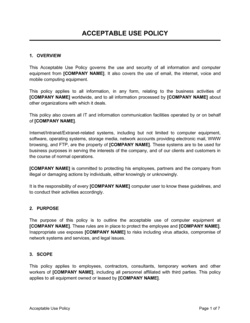
Setting employee-level rules for handling company dataAcceptable Use Policy
Responding formally to a data breach or incidentData Breach Response Plan
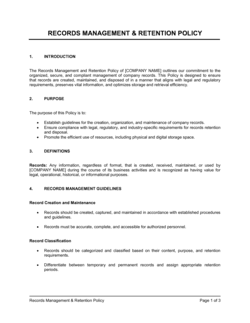
Managing records lifecycle from creation to destructionRecords Retention Policy

Common mistakes to avoid

❌ Assigning data ownership to IT by default

Why it matters: IT cannot be accountable for the accuracy and appropriate use of data they did not create and do not consume. Misassigned ownership leaves quality issues with no business-side accountability.

Fix: Assign data ownership to the department head of the business unit that generates and uses the data. IT retains the custodian role for storage and security.

❌ Qualitative quality standards with no numeric targets

Why it matters: A standard that says 'data must be accurate' gives teams nothing to measure against and no clear trigger for corrective action.

Fix: Set specific thresholds β€” for example, 'customer records must be at least 95% complete at entry' β€” so quality can be monitored and reported objectively.

❌ No stated policy review date

Why it matters: Regulations change, technology stacks evolve, and new data sources emerge. A policy without a mandatory review date drifts out of compliance silently.

Fix: Schedule an annual review by the Data Stewardship Council with a named executive approver, and build the review date into the policy header so it is visible on every copy.

❌ Treating breach notification as solely an IT decision

Why it matters: GDPR's 72-hour supervisory authority notification and HIPAA's breach notification rules require legal and executive judgment β€” IT alone does not have the authority or expertise to make those determinations.

Fix: Define a multi-role escalation path in the incident response section: IT detects and contains, legal assesses notification obligations, and the executive team approves any public or regulatory disclosure.

❌ Single retention period applied to all data types

Why it matters: Financial records, HR files, health data, and marketing data each carry different statutory retention minimums. A blanket rule either over-retains some data (creating privacy liability) or under-retains other data (creating compliance risk).

Fix: Build a retention schedule table with one row per data category, each with its own retention period and cited regulatory basis.

❌ No employee acknowledgment process

Why it matters: A policy that employees have never confirmed reading cannot be enforced in a disciplinary or legal proceeding β€” the organization cannot demonstrate the employee was aware of the rules.

Fix: Require a dated signature or digital acknowledgment from every in-scope employee at rollout and again after each material update. Store acknowledgment records in your HR or compliance system.

The 9 key sections, explained

Purpose and scope

Data classification tiers

Roles and responsibilities

Data quality standards

Data access controls

Data retention and disposal

Compliance and regulatory obligations

Data breach and incident response

Policy review and update cycle

How to fill it out

  1. 1

    Define scope and identify all data assets

    List every system, database, and data stream your organization operates before writing a single policy rule. The scope section can only be accurate once you know what you are governing.

    πŸ’‘ Run a data inventory workshop with IT, finance, HR, and operations before filling in this section β€” most organizations discover data assets they did not know existed.

  2. 2

    Set your data classification tiers

    Choose three or four tiers (e.g., Public, Internal, Confidential, Restricted) and write two to three concrete examples for each tier from your own data environment.

    πŸ’‘ Fewer tiers are better β€” three is workable, four is the practical maximum. More than four and employees start skipping the classification step entirely.

  3. 3

    Assign data owners by domain

    For each major data domain (customer, financial, HR, product), identify the senior business leader who will serve as Data Owner. Document their name and title in the roles section.

    πŸ’‘ Data owners must have budget and authority to enforce quality and access decisions β€” do not assign the role to someone without organizational standing to act on it.

  4. 4

    Set measurable data quality thresholds

    Replace qualitative statements with specific metrics: completeness percentage, acceptable duplicate rate, and maximum time-to-resolution for quality issues.

    πŸ’‘ Pull one month of current data quality metrics before setting thresholds β€” setting targets you are already missing by 50% demoralizes teams on day one.

  5. 5

    Document access control rules by tier

    For each classification tier, specify who can approve access, how long provisioning takes, how often access is reviewed, and what happens when an employee changes roles or leaves.

    πŸ’‘ Include an off-boarding trigger: access to Confidential and Restricted data must be revoked within 24 hours of an employee's last working day, not at the next quarterly review.

  6. 6

    Build the retention schedule table

    Create a table mapping each data category to its retention period, the regulatory or business justification, and the approved disposal method. Reference specific law or regulation names, not generic phrases like 'applicable law.'

    πŸ’‘ Cross-reference your retention periods against your jurisdiction's statutory minimums β€” for US federal contractors, NARA requirements may exceed your current defaults.

  7. 7

    Map policy sections to compliance frameworks

    If your organization is pursuing SOC 2, ISO 27001, HIPAA, or GDPR compliance, add a mapping table in the appendix that references each policy section alongside the relevant control or article it satisfies.

    πŸ’‘ Auditors spend roughly 60% of their time on mapping evidence β€” a pre-built cross-reference table can cut your audit preparation time by several days.

  8. 8

    Establish the review cycle and get executive sign-off

    Set the annual review date, name the approving executive, and record the version number and effective date. Distribute the signed policy to all in-scope employees and store it in a centrally accessible repository.

    πŸ’‘ Require employees to acknowledge receipt with a dated signature or digital confirmation β€” acknowledgment records are frequently requested during audits and litigation.

Frequently asked questions

What is a data governance policy?

A data governance policy is a formal document that defines how an organization manages its data assets β€” covering ownership, classification, quality standards, access controls, retention schedules, and compliance obligations. It creates a consistent framework that all employees and systems must follow, replacing ad hoc data handling with documented, enforceable rules.

Who is responsible for data governance in an organization?

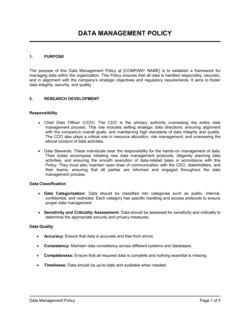
Data governance is a shared responsibility across three roles. Data owners β€” typically department heads β€” are accountable for the accuracy and appropriate use of data within their domain. Data stewards handle day-to-day quality monitoring and metadata management. Data custodians, usually in IT, manage physical storage and security. A Data Stewardship Council with cross-functional membership typically oversees the program at the organizational level.

Is a data governance policy required by law?

No single law universally mandates a data governance policy by name, but several regulations require the controls that a governance policy implements. GDPR requires documented data processing activities and accountability measures. HIPAA requires policies covering PHI access and handling. SOC 2 and ISO 27001 audits expect evidence of governance controls. In practice, any organization subject to data privacy or security regulation needs a governance policy to demonstrate compliance.

What is the difference between a data governance policy and a privacy policy?

A privacy policy is an external-facing document that informs customers and users how their personal data is collected and used β€” it is a legal disclosure requirement under GDPR, CCPA, and similar laws. A data governance policy is an internal operational document that defines how employees manage all data assets, including but not limited to personal data. The two documents work together but serve different audiences and purposes.

How often should a data governance policy be reviewed?

Annual review is the standard minimum, aligned to the organization's fiscal or calendar year. Additional out-of-cycle reviews are triggered by material regulatory changes (a new data privacy law, a change in HIPAA guidance), a significant data incident, a major technology migration, or a merger or acquisition that brings new data assets and obligations. The policy's effective date and version number should be updated after every review, even when no changes are made.

What data classification tiers should we use?

Three to four tiers cover the needs of most organizations: Public, Internal, Confidential, and Restricted. Public data has no access restrictions. Internal data is available to all employees but not shared externally. Confidential data requires role-based access and encryption in transit. Restricted data β€” typically regulated personal data, financial records, or trade secrets β€” requires the highest controls including encryption at rest, audit logging, and least-privilege access. More than four tiers are difficult to apply consistently in practice.

How does a data governance policy relate to an information security policy?

A data governance policy defines what data exists, who owns it, and the rules for its quality, access, and retention. An information security policy defines the technical and organizational controls that protect data from unauthorized access, loss, or breach. Governance determines the classification and ownership of data; security implements the controls that enforce those classifications. Both documents are needed, and they should cross-reference each other.

Do small businesses need a data governance policy?

Any organization that stores customer data, employee records, or financial information β€” regardless of size β€” benefits from documented data governance. Small businesses that handle personal data are subject to GDPR or CCPA if they serve customers in covered jurisdictions. Enterprise customers and SaaS buyers increasingly require vendors to provide evidence of a data governance program before signing contracts. A simple, well-implemented policy provides both compliance coverage and a competitive advantage.

How this compares to alternatives

vs Information security policy

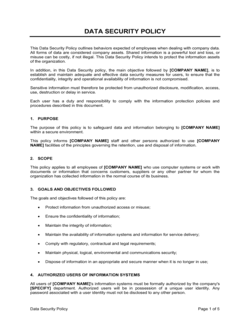
An information security policy defines the technical and organizational controls that protect data from breaches and unauthorized access. A data governance policy defines who owns data, how it is classified, and what quality and retention standards apply. Security implements the controls; governance defines what is being protected and by what rules. Both are needed and should reference each other.

vs Privacy policy

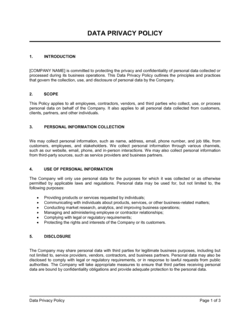
A privacy policy is an external legal disclosure β€” published on your website β€” that tells users how you collect and use their personal data. A data governance policy is an internal operational document for employees and auditors. The privacy policy communicates commitments to the public; the governance policy defines the internal rules that fulfill those commitments.

vs Acceptable use policy

An acceptable use policy governs how employees may use company IT systems and data in their day-to-day work β€” covering permitted and prohibited behaviors at the individual level. A data governance policy operates at the organizational level, defining data ownership, quality standards, and retention frameworks. The acceptable use policy enforces governance rules at the employee level.

vs Records retention policy

A records retention policy is a narrow document focused specifically on how long different record types must be kept and how they must be disposed of. A data governance policy is broader, covering ownership, quality, access, compliance, and incident response in addition to retention. For organizations that need both, the governance policy typically incorporates or references the retention policy.

Industry-specific considerations

Financial services

Regulatory data lineage requirements under Basel III and BCBS 239 demand traceable data from source systems to regulatory reports, making formal ownership and quality standards essential.

Healthcare

PHI classification, minimum necessary access controls, and documented retention schedules are direct HIPAA compliance requirements that a data governance policy operationalizes.

SaaS / Technology

Enterprise customer contracts and SOC 2 Type II audits require documented data governance controls β€” without them, sales cycles stall at the security review stage.

Retail / E-commerce

Customer PII collected across web, mobile, and in-store channels requires consistent classification and retention rules to comply with CCPA and international privacy laws.

Template vs pro β€” what fits your needs?

PathBest forCostTime
Use the templateSmall and mid-size businesses establishing baseline data governance for the first timeFree4–8 hours to customize and distribute
Template + professional reviewOrganizations preparing for SOC 2, ISO 27001, HIPAA, or GDPR audits who need controls mapped to specific framework requirements$500–$2,000 for a compliance consultant or privacy attorney review1–2 weeks
Custom draftedRegulated enterprises in financial services, healthcare, or critical infrastructure with multi-jurisdiction data obligations$3,000–$15,000 for a specialized data governance consultant or law firm4–12 weeks

Glossary

Data Governance
The set of policies, processes, roles, and standards that define how an organization manages its data assets to ensure quality, security, and compliance.
Data Owner
A senior individual β€” typically a department head or executive β€” accountable for the accuracy, access, and appropriate use of a defined data domain.
Data Steward
An operational role responsible for day-to-day data quality, metadata management, and compliance with governance rules within a specific domain.
Data Custodian
The technical role β€” typically IT or a database administrator β€” responsible for the physical storage, security, and backup of data systems.
Data Classification
A tiered labeling system that categorizes data by sensitivity level β€” such as Public, Internal, Confidential, and Restricted β€” to determine handling and access requirements.
Metadata
Data that describes other data β€” including its origin, format, owner, date created, and update history β€” used to make datasets discoverable and understandable.
Data Lineage
A documented map of where data originates, how it moves through systems, how it is transformed, and where it is consumed.
Data Quality
The degree to which data is accurate, complete, consistent, timely, and fit for its intended use.
Retention Schedule
A policy table specifying how long each category of data must be kept and the approved method for disposing of it after the retention period expires.
Data Stewardship Council
A cross-functional committee of data owners and stewards that meets regularly to oversee governance implementation, resolve disputes, and approve policy changes.
Master Data Management (MDM)
A discipline for creating a single, authoritative source of record for core business entities β€” such as customers, products, or employees β€” across all systems.

Part of your Business Operating System

This document is one of 3,000+ business & legal templates included in Business in a Box.

  • Fill-in-the-blanks β€” ready in minutes
  • 100% customizable Word document
  • Compatible with all office suites
  • Export to PDF and share electronically

Create your document in 3 simple steps.

From template to signed document β€” all inside one Business Operating System.
1
Download or open template

Access over 3,000+ business and legal templates for any business task, project or initiative.

2
Edit and fill in the blanks with AI

Customize your ready-made business document template and save it in the cloud.

3
Save, Share, Send, Sign

Share your files and folders with your team. Create a space of seamless collaboration.

Save time, save money, and create top-quality documents.

β˜…β˜…β˜…β˜…β˜…

"Fantastic value! I'm not sure how I'd do without it. It's worth its weight in gold and paid back for itself many times."

Managing Director Β· Mall Farm
Robert Whalley
Managing Director, Mall Farm Proprietary Limited
β˜…β˜…β˜…β˜…β˜…

"I have been using Business in a Box for years. It has been the most useful source of templates I have encountered. I recommend it to anyone."

Business Owner Β· 4+ years
Dr Michael John Freestone
Business Owner
β˜…β˜…β˜…β˜…β˜…

"It has been a life saver so many times I have lost count. Business in a Box has saved me so much time and as you know, time is money."

Owner Β· Upstate Web
David G. Moore Jr.
Owner, Upstate Web

Run your business with a system β€” not scattered tools

Stop downloading documents. Start operating with clarity. Business in a Box gives you the Business Operating System used by over 250,000 companies worldwide to structure, run, and grow their business.

Start freeΒ Β·Β No credit card required